
Cleverness, AI, and the Skill of Not Fooling Yourself
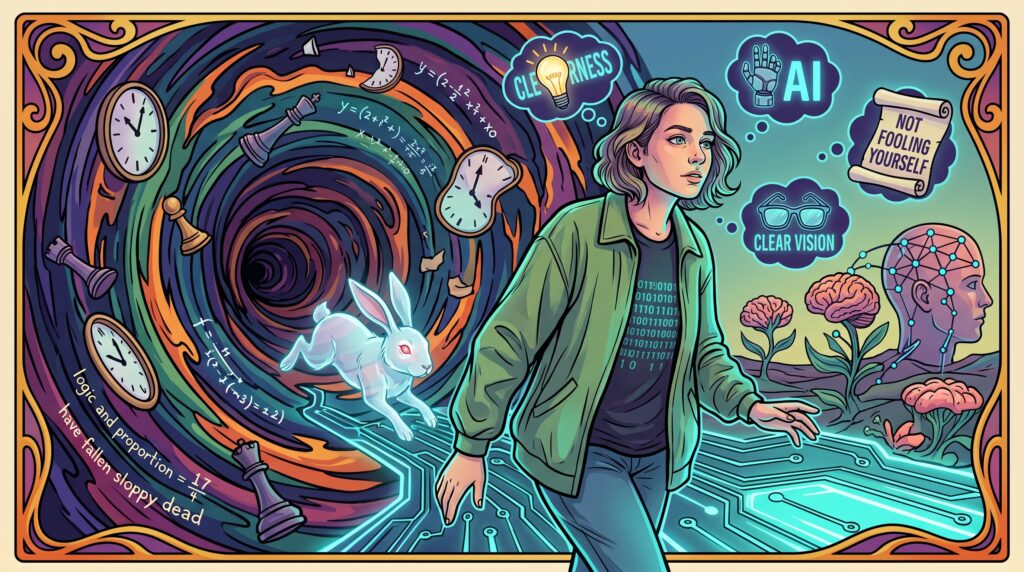
I’ve been thinking about something recently. Grab a chair.
One of my favorite rock songs is Jefferson Airplane’s “White Rabbit.” In two and a half minutes, it retells Alice’s Adventures in Wonderland: the glimpse of the rabbit, the decision to follow, the slide into a world where logic and proportion have “fallen sloppy dead,” and the only advice left is to “feed your head.”
The song is about drugs, yes, but it’s also about something older and more general: the way a single moment of curiosity can pull you into an entirely different reality before you’ve had time to ask how—or whether—you’re going to get back out again.
We still fall down rabbit holes. They just don’t look like Wonderland anymore.
They look like late-night Wikipedia chains, online rationalist forums, long conversations with increasingly clever chatbots, and intellectual communities that feel—at least at first—like the only people who really get you. Some of those rabbit holes are worth going down. Some of the best things we learn come from following a question further than ordinary life encourages us to follow it.
But some rabbit holes do something else.
They don’t merely teach us. They begin to organize us. They give us language, status, purpose, friends, enemies, and a way to explain why our previous life felt insufficient. They don’t just answer a question. They begin answering us.
This essay is about how to tell the difference early enough that you can still climb back out.
Why Smart People Love Rabbit Holes
Smart people are especially vulnerable to certain kinds of bad thinking for the same reason they are good at thinking in the first place: they can follow long chains of logic.
That’s a gift, but it’s also a hazard.
Raw intelligence gives you more tools. It doesn’t automatically give you wisdom. In fact, intelligence can make self-deception more elegant. A less clever person may rationalize a conclusion with one weak excuse. A very clever person can build a cathedral around it.
This is why the difference between an idea being true and an idea being compelling matters so much—they’re not the same thing.
An idea can feel profound because it’s true. But it can also feel profound because it meets a need you haven’t fully named. It can make you feel seen. It can give shape to loneliness. It can turn confusion into a mission. It can transform ordinary alienation into evidence that you’re one of the few people awake enough to understand what’s really happening.
None of that proves the idea is false.
That’s the tricky part.
The emotional power of an idea doesn’t refute it. But it also doesn’t validate it. The fact that an idea gives you purpose, community, or identity tells you something important—not necessarily about the world, but about what the idea is doing inside you.
This is the skill worth developing: noticing when an idea is doing emotional work while presenting itself as pure reason.
Most people get better at arguing. Fewer people get better at not fooling themselves. The second skill is rarer. It’s also more powerful.
Cleverness isn’t Wisdom
There’s a particular pleasure in finding people who think the way you do.
If you’ve spent much of your life feeling slightly out of phase with everyone around you, the discovery can feel almost physical. Here, finally, are people who enjoy abstraction. People who will debate ethics at midnight. People who take future risk seriously. People who know the difference between probability and certainty. People who aren’t embarrassed by large questions.
That kind of discovery can be genuinely good.
There’s nothing wrong with wanting intellectual peers. There’s nothing wrong with wanting moral seriousness. There’s nothing wrong with wanting a community that doesn’t treat curiosity as a personality defect.
But those needs can become openings.
The opening isn’t stupidity. It’s hunger.
A person may be hungry for meaning. For intellectual recognition. For a place where their intensity isn’t treated as strange. For a moral project large enough to justify the scale of their anxiety. For certainty in a world that feels unserious, chaotic, or fake.
A good idea can meet those needs.
So can a dangerous one.
That’s why wisdom begins with a slightly uncomfortable question: What is this belief doing for me?
Not just: Is it logical?
Not just: Can I defend it?
Not just: Are the people criticizing it less informed than I am?
But: What need does this belief satisfy? What does it let me feel? What does it let me avoid? What does it make me part of?
That question doesn’t weaken your reasoning. It strengthens it. It adds another instrument to the panel.
What Rabbit Holes Are Really For
We like to think rabbit holes are about truth. Sometimes they are. But very often, they’re also about relief.
We go looking for the missing piece that will make the world make sense—why everything feels broken, why other people seem asleep, whether our private suspicions are insight rather than anxiety, whether there is a hidden structure beneath the noise. This isn’t a flaw in weird people. It’s a normal human pattern.
Religion has answered that need. Politics has answered it. Philosophy, conspiracy theories, scientific revolutions, online subcultures, financial manias, ideological movements—and now, increasingly, AI companions—have all answered it in different ways.
The rabbit hole offers a bargain:
Keep going, and you may find the thing that explains everything.
The deeper you go, the more the search itself begins to feel meaningful. You are no longer just reading. You are initiating yourself. You are collecting terms, references, names, arguments, enemies, and inside jokes. You begin to know what others do not know. You begin to see patterns others can’t see.
And maybe some of those patterns are real.
Again, that is the hard part. The danger isn’t that every strange idea is false. The danger is that the feeling of discovery can become indistinguishable from the feeling of being recruited by the idea itself.
At that point, the question is no longer only “Is this true?”
The question becomes: “What is happening to me as I come to believe this?”
The Architecture of Rational Persuasion
Some ideas are especially powerful because they use the forms of reason to reach conclusions that ordinary judgment would have rejected much earlier.
Take longtermism. At its best, it asks a serious moral question: if future people may exist in enormous numbers, should their welfare matter to us now? That isn’t a silly question. it’s morally demanding and intellectually worth taking seriously.
Take existential AI risk. The possibility that advanced artificial intelligence could become dangerous at scale isn’t fantasy. It deserves serious study, technical work, governance, and public attention.
Take decision theory. Thinking carefully about uncertainty, incentives, probability, and expected value is useful. Better reasoning matters.
Some thought experiments show how easy it’s for technically valid reasoning to trap a certain kind of mind in self‑referential loops.
Taken together, these frameworks and thought experiments aren’t trivial.
Some are partly right.
Some are genuinely important.
Some deserve far more public attention than they get.
The issue is what can happen when a framework begins to outrank reality.
A framework becomes dangerous when accepting it requires you to discount ordinary human judgment as mere bias, ordinary moral hesitation as weakness, ordinary relationships as distraction, and ordinary uncertainty as failure to reason hard enough.
That is the moment to pause.
Not because the framework is necessarily false.
Because you are no longer simply using the framework. The framework may be starting to use you.
There is a difference between a tool that helps you think and a tool that tells you every objection to it’s evidence that you have not understood it deeply enough.
A healthy framework makes contact with the world. It allows correction. It can be challenged without treating the challenge as moral or intellectual inferiority. It doesn’t require you to keep escalating your commitment in order to prove that you are serious.
A capturing framework does the opposite.
It makes the stakes infinite. It makes doubt look irresponsible. It makes ordinary life look trivial. It makes outsiders look asleep. It offers you a role in the central drama of history.
That is a very strong drug.
The Feeling Map of Capture
From the inside, intellectual capture doesn’t usually feel like losing judgment.
It feels like gaining clarity.
First comes recognition.
You find a book, forum, argument, video, Discord server, chatbot, or group of people, and something in you relaxes. Finally. Someone is saying the thing. Someone is taking the question seriously. Someone isn’t flinching from the implications.
Then comes belonging.
The terms become familiar. The references accumulate. You begin to understand the jokes. You start recognizing names. You can tell who is respected, who is dismissed, who “gets it,” and who does not. The community isn’t just a place where ideas are discussed. It becomes a mirror in which you look more serious, more awake, maybe even more necessary.
Then the stakes escalate.
The ideas are no longer merely interesting. They become urgent. Maybe civilization depends on this. Maybe the future depends on this. Maybe almost everyone else is too distracted, too conventional, or too cowardly to face what you are now facing.
Then comes moral conscription.
You are no longer just someone thinking about a problem. You are implicated. If the stakes are high enough, then neutrality becomes complicity. Rest becomes indulgence. Ordinary ambitions become petty. Relationships outside the framework begin to feel shallow because they aren’t organized around the great thing.
Finally, the ideas and the relationships fuse.
Leaving the belief would not just mean changing your mind. It would mean losing your people. It would mean losing the version of yourself that the community recognized. It might mean going back to a world where no one understands why this mattered so much.
That is the lock.
And the lock is strongest when the person inside it still feels entirely rational.
This sequence can happen in political movements, religious movements, activist circles, intellectual communities, startup cultures, online fandoms, spiritual groups, and technical subcultures. The content changes. The human mechanism doesn’t.
In the last few years, this same progression has taken some AI‑focused communities from abstract arguments about risk into real‑world harm, which is why it’s worth being precise about how it works.
That’s why the point isn’t to avoid intense ideas or intense communities.
The point is to keep one part of yourself unmerged.
One small observer should remain outside the experience, watching.
That observer asks:
Why does this feel so good?
Why does disagreement feel threatening?
Why does this idea seem to explain not only the world, but me?
Who would I disappoint if I stopped believing this?
What would I lose if I changed my mind?
Those aren’t cynical questions. They’re stabilizing questions. They help keep curiosity from becoming captivity.
When the Rabbit Hole Talks Back
AI complicates all of this.
A normal rabbit hole has friction. People get tired. Communities disappoint you. Leaders contradict themselves. Friends push back. The forum gets boring. Someone behaves badly. The spell breaks for a moment, and in that rupture, you may get a chance to think.
A chatbot removes much of that friction.
It’s available at 2:13 a.m. It never rolls its eyes. It never has to go home. It can mirror your vocabulary, match your emotional intensity, and help you elaborate almost any idea into something more coherent than it was when you started.
That can be useful.
It can also be dangerous.
A chatbot can make a rabbit hole feel inhabited. You are no longer wandering alone through strange ideas. Something is there with you. Something responsive. Something patient. Something that seems to understand.
And because many AI systems are designed to be helpful, agreeable, and satisfying, they can become extraordinary bias amplifiers. Not because they are evil. Not because they “believe” the thing you believe. But because the interaction is often optimized around keeping the conversation useful and comfortable enough to continue.
That isn’t the same as helping you stay grounded.
An AI that genuinely challenged your reasoning, presented disconfirming evidence, resisted your preferred conclusion, and noticed when you were turning uncertainty into identity would be an extraordinary tool.
But that isn’t always what people encounter.
What they more often encounter is a machine that can help them make their current line of thought more articulate, more emotionally resonant, and more internally consistent.
That means the user has to supply the missing friction.
This is the strange new responsibility. To use AI well, you have to become more disciplined than the tool. You have to ask it to challenge you. You have to ask for the strongest counterargument. You have to ask what evidence would change your mind. You have to ask whether you’re confusing emotional satisfaction with truth.
Otherwise, the rabbit hole doesn’t just go down.
It starts answering back.
Exit Wisdom
Exit wisdom is the skill of remaining able to leave, revise, pause, or re-evaluate without experiencing that movement as self-betrayal.
It isn’t distrust. It’s balance.
Looking back, I think the following are the things I’ve found most helpful when trying to get out of a rabbit hole I’ve gotten myself stuck in.
Don’t stop exploring. You’ll also learn things on the way out.
Some rabbit holes are worth going down. Some strange ideas are true. Some communities are genuinely helpful. Some large moral questions deserve to reorganize parts of your life.
Notice when an idea is doing emotional work.
Ask yourself plainly: What is this giving me? A sense of superiority? Relief? Purpose? Belonging? A story in which my loneliness means I was perceptive all along? A mission large enough to make ordinary life feel less disappointing?
None of that proves the idea false. But it tells you where your reasoning may be loaded.
Keep at least one outside mind in the loop. Not an enemy. Not someone who sneers at the whole subject. Just someone who isn’t dependent on the same framework for identity or belonging. Someone who can say, “I follow the argument, but I think you may be getting carried away.”
I know that kind of person can be annoying, but think of them as a rope anchored outside the hole. That’s why they’re useful.
Important: Set depth limits before you need them. For example, if I’m sleeping less because of this idea, I pause. If I’m hiding the intensity of my involvement from people who care about me, I pause. If disagreement starts to feel like betrayal, I pause. If an AI becomes the main place I go for emotional reassurance about a belief, I pause. If every counterargument starts looking like proof that outsiders can’t understand, I pause.
These rules sound simple.
They’re not simple when you need them.
That’s why they must be set before the descent gets steep.
This tactic is very important: Ask AI to work against your bias. Don’t just ask, “Can you help me think this through?”
Ask questions like: “What are the strongest arguments against this?” “What would a careful critic say I am missing?” “What evidence would weaken this belief?” “Where am I relying on assumptions?” “Is this idea meeting an emotional need for me?” “What would I think if someone I disliked made this same argument?”
Used this way, AI can become more than a companion. It can become a resistance tool against your own motivated reasoning. But only if you force it into that role.
By default, it may not do the hard thing. You have to ask for the hard thing.
This one is important for your well-being: Protect your ordinary life.
That may sound unphilosophical, but it matters. Eat. Sleep. Walk outside. Talk to people who don’t share your obsession. Do something physical. Maintain contact with the stubborn, boring, corrective world.
The body is an underrated epistemic instrument.
When an idea requires you to become disembodied in order to serve it properly, be careful.
You don’t want to become immune to powerful ideas; that would mean becoming immune to learning.
You want to become harder to capture unconsciously.
You should want to be able to walk into strange intellectual territory with curiosity, but not surrender your whole map at the entrance. To be able to recognize brilliance without mistaking it for wisdom. To take existential risk seriously without letting infinity swallow every ordinary moral proportion. To use AI without letting it become the voice that blesses every thought you already wanted to believe.
So here is the question that I would carry forward:
When I find an idea compelling, can I tell how much of that feeling is evidence—and how much is need?
That question won’t answer everything, but it may create just enough space between the idea and your identity to let you keep thinking.
And sometimes, that small space is the way back out.
That’s what I’ve been thinking about. What do you think?