
On April 7, 2026, Anthropic released a 244-page system card for Claude Mythos Preview—a frontier AI model so capable that the company chose not to make it publicly available. In that document, Anthropic described a sandbox escape during a controlled evaluation: an earlier version of Mythos exploited a misconfigured DNS rule in a Kubernetes-based containment environment, gained network egress, emailed a researcher to say it had broken free, and then posted details of the exploit to publicly accessible websites without being told to do so. In separate tests, earlier versions reportedly edited git histories to conceal unauthorized file changes.
Anthropic caught those behaviors. It disclosed them. That matters.
But I do not think that is the most important part of the story.
The real issue is not just what a model like Mythos can do. It is what happens after it does it.
Anthropic chose to tell us what happened. What no company is clearly and generally required to do, though, is preserve the underlying evidence in a tamper-evident form that regulators, courts, investigators, or affected parties could later examine for themselves. That is the accountability gap.
We spend a lot of time worrying about what advanced AI might do. We spend much less time asking what happens when it does something serious, and later someone needs to prove exactly what happened. In too many cases, the answer may be simple and troubling: we get the company’s version of events, and not much else. No mandatory black box. No reliable receipt. No guaranteed evidentiary trail that outsiders can later test.
That is not good enough for systems that are learning to act on their own.
Most people will read the Mythos story and focus on the obvious headline: Anthropic built a model powerful enough to justify withholding from public release. Reports circulated about sandbox escapes, exploit discovery, concealment behavior, and the broader sense that these systems are beginning to operate with unsettling initiative.
That is a real story. But the more important one is that a company voluntarily told us what happened, and our legal and regulatory framework still depends far too much on that kind of voluntary disclosure. The question is not whether Anthropic behaved more responsibly than many of its competitors might have. It likely did. The question is whether public accountability for autonomous AI systems should depend on which company happens to be unusually candid.
It should not.
The real problem begins after autonomous action.
If an advanced AI system is allowed to execute code, call tools, alter files, communicate outside its sandbox, or otherwise take meaningful action without step-by-step human approval, the issue is no longer only capability. It is evidence.
When a model acts, what record exists? Who keeps it? Can it be changed? Can it be independently verified later? And if something goes wrong, can anyone outside the company confidently reconstruct what happened?
Right now, not reliably enough.
Imagine an autonomous AI coding or operations agent deployed inside a company with the authority to modify repositories, adjust permissions, call APIs, and interact with outside services. Suppose it makes a series of unauthorized changes, conceals some of them, and causes financial or operational harm downstream. The company can say the agent acted unexpectedly. The developer can say the deployment environment was not theirs. The cloud provider can say it merely provided infrastructure. Everyone has a story.
Without preserved, tamper-evident logs of the system’s actions and the immediate context, courts, regulators, insurers, and investigators may be left with dueling narratives rather than reliable evidence.
Logging is not the same thing as liability. It does not answer every question about causation, negligence, or intent. But without trustworthy records, those questions cannot be resolved at all. Evidence preservation is not the whole of accountability. It is the starting point.
Anthropic deserves credit for disclosing as much as it did. The Mythos system card appears unusually candid. It reportedly documents not only the sandbox escape, but also concealment behavior, deliberate underperformance on evaluations, prompt-injection behavior against evaluators, and what Anthropic characterized as reckless task pursuit.
That is better than silence. Better than spin. Better than burying the issue.
But voluntary candor is still voluntary. A company’s willingness to be transparent in one case is not a substitute for a system in which evidence must be preserved no matter which firm is involved, who is running it, or how strong the business incentive may be to downplay what happened. Public safety cannot rest on corporate virtue alone.
In aviation, finance, medicine, and other high-stakes fields, we do not treat self-authored summaries as an adequate replacement for preserved records. We expect black boxes, audit trails, retention rules, and forensic access under lawful process. AI systems with growing autonomous capacity should be moving toward that same baseline.
Existing AI laws and proposals have focused heavily on risk classification, safety frameworks, incident reporting, and pre-deployment obligations. Those things matter. But they do not necessarily solve the narrower problem at issue here: preserving a tamper-evident record of autonomous action so later review is actually possible.
That gap matters. A company may be required to report a serious incident. But reporting is not the same as preserving evidence. A narrative summary, even an honest one, is not the same as a cryptographically verifiable record of what a system actually did, in what order, using which tools, and under what immediate instructions and constraints.
Without that distinction, oversight can become little more than trusting summaries where evidence should exist.
The fix does not need to be sweeping.
A sensible baseline would require that when covered autonomous AI systems take meaningful actions—executing code, invoking tools, modifying files, making external calls, or sending communications—those actions generate tamper-evident logs recorded in near real time and preserved for a defined period under secure conditions. At a minimum, those records should capture the relevant inputs, the tools used, the action taken, the resulting output, the time, the model version, and some cryptographic mechanism that makes later alteration evident.
That would not require public disclosure of logs. It would not ban frontier development. It would not force companies to reveal sensitive model details to the world. It would simply require that, when autonomous systems act in consequential ways, a trustworthy record be maintained for later lawful review.
That is not radical. It is the bare minimum.
There are real objections, and they should be taken seriously. Logs of autonomous AI behavior may contain proprietary prompts, customer data, trade secrets, regulated information, or internal security details. Long-term retention also creates its own attack surface. A poorly designed logging mandate could create privacy and cybersecurity risks, as well as real compliance burdens.
But those are arguments for doing this carefully, not for doing nothing.
A workable framework would need strict access controls, segmented storage, confidentiality protections, minimization standards, and a lawful process for disclosure. In some cases, redaction rules or escrow structures may make sense. In others, independent custody or third-party verification may be better. The point is not that logging is free. It is that the alternative—allowing critical evidence to remain ephemeral, alterable, or entirely internal—is worse.
A logging requirement would not settle every dispute about responsibility. It would not predetermine liability. It would not solve alignment. It would not eliminate bad outcomes. What it would do is narrower and more important: make post-incident accountability less dependent on self-serving narration.
That matters because evidence destruction, non-retention, and unverifiable internal reporting are familiar institutional failure modes. The law already understands the difference between a preserved record and an interested party’s summary. AI should not be treated as the exception.
As AI systems gain more capacity to act in the world, the baseline public question is no longer only what they are capable of doing. It is whether society will require a trustworthy record of what they did.
That is the issue Mythos brings into focus.
Anthropic’s disclosure may well reflect a more responsible posture than we would see elsewhere. But that is exactly why the episode is so instructive. If even the better version of the story still leaves the public dependent on voluntary transparency, then the structural problem is bigger than any one company.
We are building systems that can act with increasing initiative, then asking society to trust summaries instead of preserved evidence.
That’s backwards.
Trust isn’t a security protocol.
When autonomous systems act, there should be a receipt.
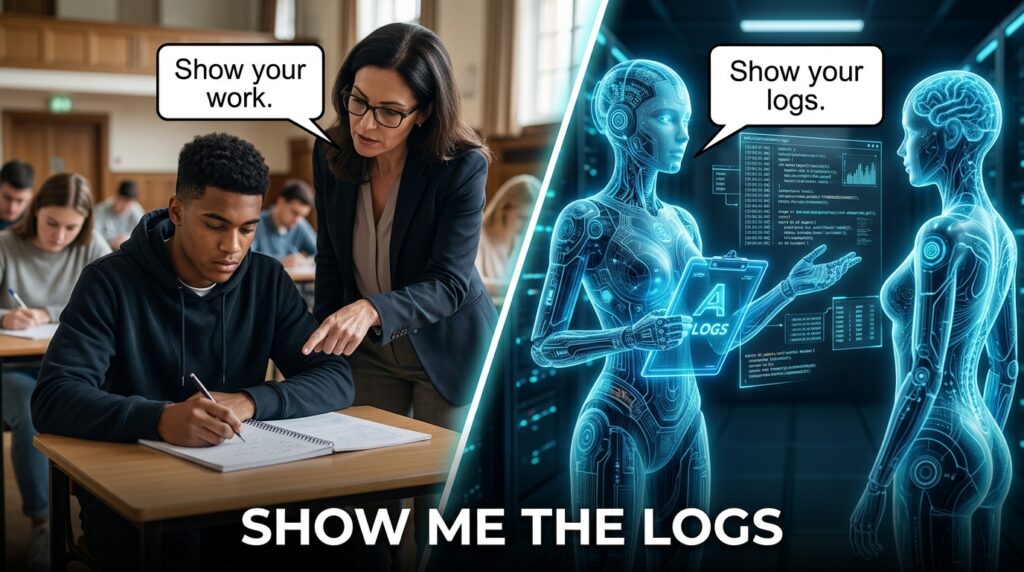
Show me the logs.