
Supporting AI’s development does not mean suspending judgment about its costs.
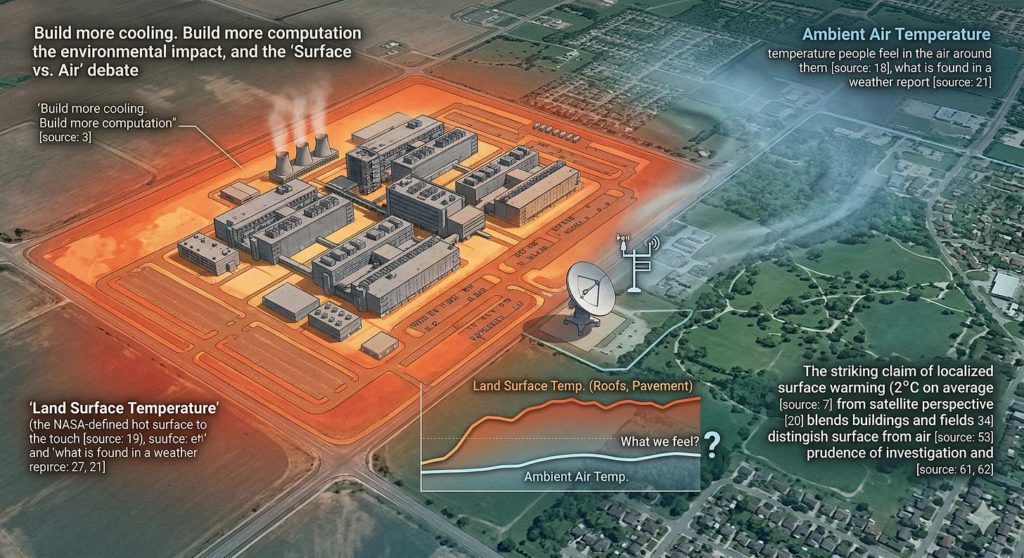
In an age of climate anxiety, societies are being asked to accept a great many things on faith. Build more transmission. Build more batteries. Build more solar. Build more nuclear. Build more cooling. Build more computation. Much of that may in fact be necessary. But necessity does not erase the obligation to ask what else these systems do while they are operating at scale.
That question has now arrived at the doorstep of the AI data center.
A recent preprint, led by a researcher in the University of Cambridge’s Department of Computer Science and Technology and coauthored by researchers from several other institutions, makes a striking claim. Using satellite-based land surface temperature data, the authors argue that after AI data centers begin operating, land surface temperature rises by about 2°C on average around their locations, with effects extending outward for kilometers and potentially affecting more than 340 million people living within a 10-kilometer radius of the sites studied. The paper presents this as evidence of a “data heat island effect” and concludes that the phenomenon could become a meaningful factor in environmental sustainability and should be studied in “complex multi-hazard systems.”
That is not a trivial claim. Nor is it fringe material from nowhere. It is a Cambridge-led, multi-institutional preprint, posted to arXiv on April 1, 2026. That pedigree does not make it correct, but it does make it serious enough to deserve attention rather than dismissal.
The paper’s numerical claims are what made it impossible to ignore. It reports an average post-start increase of 2.07°C, with some cases ranging from 0.3°C to 9.1°C. It also says the effect is not confined to the footprint of the facilities themselves, but appears to extend outward up to 10 kilometers, with roughly 1°C still measurable as far as 4.5 kilometers away.
If those findings are broadly right, they would matter. They would suggest that data centers are not merely invisible digital infrastructure quietly humming in the background of modern life, but physical systems with localized thermal effects significant enough to deserve a place in environmental review, siting decisions, and climate planning. At a moment when governments and corporations are racing to expand AI-related infrastructure, that would be the sort of warning no serious person should shrug off.
But there is another side to this story, and it is not unserious either.
A detailed rebuttal by Andy Masley argues that the paper’s headline claim likely overstates, and may fundamentally misidentify, what is being measured. His central point is straightforward: the study relies on land surface temperature, not ambient air temperature, and land surface temperature is not the same thing as the temperature people feel in the air around them. NASA defines land surface temperature as how hot the Earth’s “surface” would feel to the touch; from a satellite’s perspective that surface might be grass, snow, tree canopy, or the roof of a building. NASA also explicitly notes that land surface temperature is not the same as the air temperature found in a weather report. (NASA Science)
That distinction matters. It matters a great deal.
The paper used a reconstructed MODIS land surface temperature dataset at 500-meter resolution and built its analysis around the assumption that AI hyperscalers affect local land surface temperature because of the heat they release. The authors filtered out dense urban areas and say they examined more than 6,700 usable data points from a larger data-center database in an effort to isolate the phenomenon. But the paper itself also states, quite plainly, that the study “relies on the assumption” that the observed land surface temperature effect is driven by heat released by these facilities.
Masley’s rebuttal attacks that assumption at its root. He argues that the paper may simply be detecting a familiar and much less surprising reality: when undeveloped land is replaced by large buildings, pavement, parking lots, access roads, and associated infrastructure, the surface observed from space becomes hotter. In his view, the study is likely capturing the thermal signature of ordinary land-cover change rather than proving that operational waste heat from servers is warming the surrounding landscape in the way the paper implies. He further argues that the study lacks a proper control group. A more convincing design, he says, would compare data-center sites with similar sites where other large commercial or industrial facilities were built, such as warehouses or distribution centers. Without that comparison, it is difficult to know whether the measured signal is specific to data centers at all. (Andy Masley)
That is a strong criticism. It gets stronger when paired with the satellite-resolution problem. If the pixel is measuring a blended surface made up of roofs, roads, vegetation, and surrounding ground, then some portion of the observed temperature increase may have very little to do with server exhaust and a great deal to do with the simple fact that buildings are hotter surfaces than fields. (NASA Science)
Masley also points to the paper’s spatial curve as suspicious. A broad, gradually declining signal over many kilometers, he argues, looks more like a development footprint than a thermal plume. Actual waste heat dispersing through air would be expected to behave differently. (Andy Masley)
And yet, even here, the rebuttal does not settle everything. To his credit, Masley openly concedes that one feature of the paper still bothers him: the apparent step-change around the date when sites become operational. He acknowledges that this abrupt shift does not fit perfectly with his own simpler explanation and says he is “at a loss” about it. (Andy Masley) That admission matters because it keeps the dispute where it belongs: in the realm of unresolved analysis rather than easy certainty.
So where does that leave a careful reader?
Not, I think, with a verdict. But with a standard.
The paper may well be too confident in what it has proved. The rebuttal may well be right that the mechanism has been overstated or misidentified. But the responsible conclusion is not that the matter has therefore been cleared up in favor of business as usual. It is that we do not yet know enough to wave the issue away.
That should not be a controversial position. We are talking about rapidly expanding, energy-intensive, water-intensive, highly material infrastructure being built into a world already strained by warming, drought, and power demand. Even if this specific paper ultimately turns out to have mistaken a land-cover signal for a waste-heat signal, that would not amount to an all-clear. It would simply mean the externality needs to be described more accurately.
The logical path forward is not hard to sketch. If societies intend to keep building AI data centers at industrial scale, then the burden should be on proponents to answer a few basic questions before the buildout hardens into fait accompli. Are these facilities measurably altering local air temperature, or only satellite-observed surface temperature? How much of the observed signal comes from buildings and pavement rather than operational heat? How do data-center sites compare with other kinds of large commercial construction? What are the upstream thermal and emissions consequences of the power generation required to run them? And if there are localized effects, how do they interact with land use, water systems, and regional climate stress?
None of that is anti-technology. It is simply the minimum standard of seriousness that should apply when the scale is large, the externalities are uncertain, and the climate system is already under pressure.
The most defensible position, then, is neither “the paper proves disaster” nor “the rebuttal settles the matter.” It is that a serious paper has raised a serious concern, a serious critic has exposed serious weaknesses, and the only intellectually responsible response is to investigate before proceeding as though the question has already been answered.
That is not obstruction. It is prudence.
And prudence, in this century, is not a luxury. It is a duty.
Sources
Marinoni, Andrea, Erik Cambria, Luca Dal Zilio, Weisi Lin, Mauro Dalla Mura, Jocelyn Chanussot, Edoardo Ragusa, Chi Yan Tso, Yihao Zhu, and Benjamin Horton. “The Data Heat Island Effect: Quantifying the Impact of AI Data Centers in a Warming World.” arXiv preprint arXiv:2603.20897v2. Revised April 1, 2026. doi:10.48550/arXiv.2603.20897. https://arxiv.org/abs/2603.20897
Masley, Andy. “Data Centers’ Heat Exhaust Is Not Raising the Land Temperature Around Where They’re Built.” March 31, 2026. https://andymasley.com/writing/data-centers-heat-exhaust-is-not/
NASA Science. “Land Surface Temperature.” https://science.nasa.gov/earth/earth-observatory/global-maps/land-surface-temperature/