Those who cannot remember the past, George Santayana warned, are condemned to repeat it—and in 2026, Washington appears bent on relearning an old lesson the hard way. The United States is trying to throttle China the way empires once strangled their rivals, by cutting off lifelines of cheap oil from Iran and Venezuela, seizing fields, bombing infrastructure, and betting that energy scarcity will slow China’s pursuit of AI dominance. But just as blockades in the last century drove adversaries into synthetic fuels, autarky, and total war, today’s “Active Resource Denial” is already catalyzing something else: an accelerated transition from barrels to electrons to gradient updates, where AI‑driven militaries and pharmaceutical labs adapt faster to constraint than the strategists who imposed it.
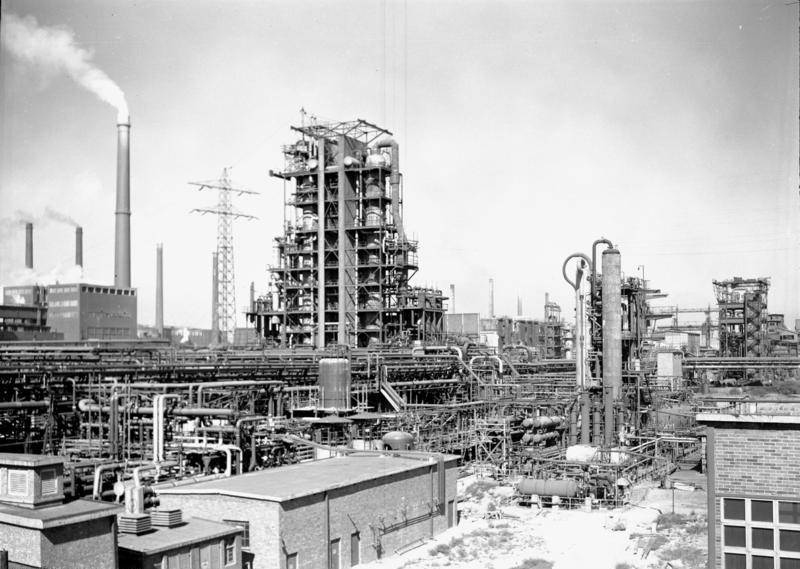
Britain’s naval blockade of Germany in both world wars was among the most comprehensive in history, designed to strangle an industrial economy by cutting off its access to overseas oil and nitrates. It worked, in the narrow sense that Germany was denied those resources. What it could not prevent was what Germany built in their absence. Forced into self-sufficiency, Berlin poured capital into coal-to-liquids technology and the Haber–Bosch process for synthesizing ammonia—the latter solving simultaneously the problem of explosives and agricultural fertilizer. By the late 1930s, Germany was producing roughly 72 percent of its aviation fuel synthetically. The blockade had not grounded the Luftwaffe. It had, in a real sense, funded it. The lesson Britain failed to absorb was that resource denial, applied to a determined industrial rival, does not produce collapse. It produces a crash course in self-sufficiency—at enormous human and environmental cost, but a crash course nonetheless.
That was not an isolated miscalculation. The pattern has repeated itself whenever a dominant power has reached for the lever of resource denial against a determined rival. The mechanism is consistent: deprivation triggers investment, investment produces capability, and the capability that emerges is often more resilient than the one the denial was meant to prevent.
In the 1980s, the United States pressured Japan to restrain its semiconductor industry, which had grown competitive enough to threaten American dominance in memory chips. Japan complied, or appeared to. What actually happened was that the investment didn’t disappear—it migrated. South Korea and Taiwan absorbed the capital, the expertise, and the ambition that Japan was pressured to abandon. The result was TSMC and Samsung, two companies that now sit at the absolute center of global semiconductor supply chains, neither of them American, neither of them easily controlled by Washington. The United States had set out to protect its technological edge. Instead it redistributed and ultimately concentrated the industry’s most critical capabilities in places it cannot fully influence. The strategic own-goal was decades in the making and is still being reckoned with today.
Washington has not missed the connection between cheap oil and Chinese ambition. The logic of Active Resource Denial is straightforward: cut off Beijing’s discounted energy lifelines and you slow the industrial and computational expansion that underwrites its rise. In January 2026, Operation Absolute Resolve removed Nicolás Maduro from power, seized Venezuelan oil reserves, re-anchored them to the dollar, and liquidated roughly $50 billion in Chinese investments in a single stroke. Parallel strikes on Iranian energy infrastructure closed the other tap. China had purchased more than 80 percent of Iranian oil exports by 2025, underpinned by a 25-year, roughly $400 billion cooperation agreement signed in 2021. Venezuela had been sending approximately three-quarters of its oil to China, largely to service loans. These were not incidental trading relationships. They were Beijing’s shadow-barrel lifelines, carefully constructed over years to reduce dependence on dollar-denominated markets. Washington has now dismantled both of them simultaneously.
The short-term pain is real. China must now compete on open markets for oil it was previously buying at a discount, and the disruption to its energy planning is genuine. But analysts watching Beijing’s response are noting something familiar. Rather than absorbing the blow passively, China is repositioning—contrasting itself internationally as a stable and peaceful power, redirecting investment into less vulnerable supply chains, and accelerating the domestic energy infrastructure it had already begun building precisely because it anticipated this kind of pressure. The denial has not stopped the adaptation. It has, once again, funded it.
The irony writes itself, though Washington does not appear to have noticed it. The United States is deploying artificial intelligence—for targeting, logistics, surveillance, coordination—to execute a strategy of resource denial against a rival whose primary response to that denial is to accelerate its own development of artificial intelligence. Every sanction on advanced chips forces a crash program in domestic semiconductor design. Every disrupted oil shipment redirects Chinese capital toward renewable energy, grid infrastructure, and the domestic compute capacity that runs on it. The instrument of American power and the target of American strategy are, in this sense, the same thing.
Santayana’s warning was not about the past as trivia. It was about the past as mechanism—the repeating logic of how nations respond when their backs are against the wall. Germany built synthetic fuel. Japan’s displaced semiconductor investment built TSMC. China is building the energy and compute infrastructure that resource denial was supposed to prevent. The pattern is not subtle. It has now repeated itself across a century, in different domains, with different actors, and with the same result.
Those who cannot remember the past are condemned to repeat it. In 2026, Washington is not merely repeating it. It is funding it.