The Architecture of AI Supremacy
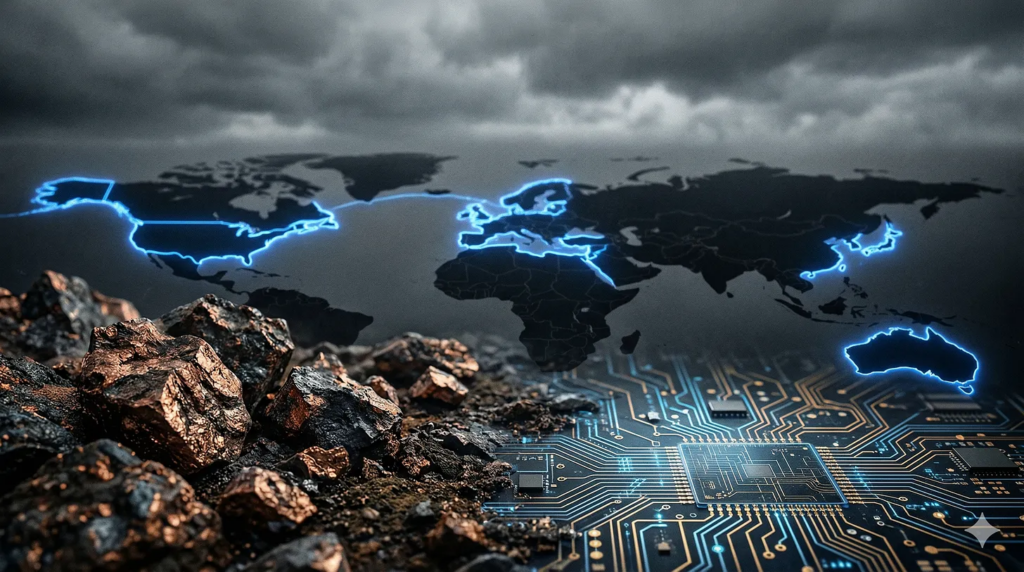
Imagining a Resource-AI Autarky and the New World Order
What follows is an analytical framework built from pattern recognition across public events. It is not a claim of proof. I looked at a series of seemingly unrelated actions, tried to make sense of them, and arrived at the most coherent framework I could construct. Maybe I’m crazy. I’ll let you decide.
Introduction: The Emergence of a New Order
What if we are witnessing the emergence of a new global paradigm—one defined not merely by the rise of artificial intelligence, but by the deep integration of AI with territorial control, resource security, and military strategy?
This monograph invites you to consider whether recent geopolitical events—from the conflict in Gaza to strategic pressure campaigns in Venezuela, Cuba, and Greenland—are not isolated incidents but interconnected components of a single, intentional strategy. Imagine with me, if you will, that these seemingly unrelated actions are carefully coordinated steps toward establishing a Resource-AI Autarky: a self-reliant economic and military bloc designed to control every critical node of an AI-driven future.
Such a strategy would rest on three pillars:
1. The Laboratory: A conflict zone repurposed as a testing ground, where military AI is stress-tested under live conditions, pushing the boundaries of autonomous warfare.
2. The Fuel: A global effort to secure the physical inputs—energy and critical minerals—required for AI supremacy, executed through combined military and diplomatic actions spanning the Americas, West Africa, the Arctic, and the Middle East.
3. The Fortress: A new global hierarchy enforced through an initiative called Pax Silica, which constructs a “hard perimeter” around the entire AI supply chain using tariffs, sanctions, and tiered alliances.
4. The Nervous System: A global submarine cable infrastructure connecting Pax Silica signatories to each other and to resource extraction zones—while systematically excluding adversaries from the data corridors that an AI-driven economy requires.
What follows is an attempt to explain the architecture of this emerging system, how it is enforced, how it is connected, and the serious ethical and operational risks embedded in its rapid, nearly invisible deployment. I urge you to set aside skepticism—at least temporarily—and consider whether this future is not merely hypothetical but already taking shape around us.
The Laboratory: Israel as the Testbed
When Algorithms Go to War
On October 7, 2023, the foundational assumptions of Israeli security were shattered. The Hamas attack killed approximately 1,200 people and resulted in the capture of over 240 hostages. The military response that followed was not merely a conventional campaign. It became a global demonstration of artificial intelligence fully embedded in the machinery of armed conflict.
Behind the airstrikes and ground operations, a less visible force was at work: AI systems known internally as “Lavender” and “The Gospel.” These were not tactical conveniences. They were real-time experiments in reshaping modern warfare. Lavender assigned risk scores to individuals based on suspected ties to Hamas, generating ranked kill lists with chilling efficiency. The Gospel operated at the infrastructural level, recommending buildings and tunnels for bombardment by processing multiple intelligence streams at speeds no human analyst team could match [1].
A Crucible of Innovation
Israel’s rise as a global leader in military AI is not accidental. It reflects decades of deliberate investment in a distinctive ecosystem. At its core is Unit 8200, Israel’s premier signals intelligence unit, often compared to the U.S. National Security Agency. Unit 8200 functions as a talent incubator, creating a continuous feedback loop between Israel’s defense establishment and its technology sector.
Could it be that the key to Israel’s AI advancement is something no peacetime military can replicate—uninterrupted access to live operational environments? The ongoing conflicts in Gaza and the West Bank function as continuous testing grounds, real-world laboratories where AI tools are deployed, refined, and redeployed in rapid iteration. During the Gaza conflict, the Israeli military reported striking up to 250 targets per day [1], a pace achievable only through AI-assisted target generation.
The Rubber Stamp of War
The deployment of these systems has generated serious concerns about civilian casualties. Investigations based on testimony from Israeli intelligence officers revealed that Lavender operated with an estimated error rate of approximately 10 percent—meaning roughly one in ten targets flagged as militants was, in fact, a civilian [1].
Military insiders described a process in which human operators confirmed AI-generated targeting recommendations after as little as 20 seconds of review, with the sole mandatory check being that the marked target was male [1]. If the human role in lethal decision-making is reduced to this—a cursory glance and a click—then the legal and moral significance of that human involvement becomes deeply ambiguous. Accountability doesn’t disappear; it dissolves.
The Export Machine
Israel does not merely use AI in warfare; it exports it. Companies like NSO Group (Pegasus spyware) and Elbit Systems (drones and defense electronics) exemplify a broader pattern: technologies developed and validated in Gaza are repackaged for commercial and government markets worldwide. Surveillance tools tested on Palestinian populations have found eager buyers among authoritarian regimes seeking to monitor dissidents and suppress dissent.
This export dynamic extends Israel’s AI influence far beyond its own borders. As these technologies proliferate, the ethical questions they raise travel with them—embedding themselves in the military and surveillance architectures of countries across the globe.
The U.S. Connection
Israel’s AI capabilities are substantially amplified by its strategic partnership with the United States. Project Nimbus, a $1.2 billion contract between the Israeli government and both Google and Amazon, provides cloud computing and AI services to Israel’s military and civilian agencies [2].
In January 2026, Israel became the first country to formally sign onto the Pax Silica initiative [3]. This agreement embeds Israel more deeply than ever into the global AI infrastructure—at the precise moment when ethical and legal debates around military AI are intensifying. Israel is no longer merely an ally. It has become an indispensable node in the emerging order, seamlessly connecting its innovation ecosystem with U.S. defense requirements.
The Fuel: Securing the Physical Inputs
The Physical Requirements of AI
AI is often perceived as purely software. In reality, it is physically constrained by two things: energy and materials. A single hyperscale data center can require 50 to 100 megawatts of dispatchable power—comparable to a small city. High-performance chips require rare earth elements, nickel, copper, and gallium, among other strategic minerals.
The Global Resource Perimeter
What are the consequences if U.S. military and diplomatic actions across multiple continents serve a dual purpose: neutralizing adversaries while securing the physical inputs necessary for AI dominance? Consider the pattern:
• Venezuela: The apprehension of President Maduro in January 2026 and the subsequent disruption of oil production were not solely about regime change. Consider the possibility that they were also about stabilizing energy costs for compute-intensive infrastructure and gaining preferential access to copper, coltan, and rare earths—while simultaneously reducing Iranian influence over vital supply chains. By March, Venezuela’s state-owned Minerven had signed a contract to ship up to 1,000 kilograms of gold to U.S. refineries.
• Cuba: Fuel blockades and intensified pressure for regime change in March 2026 coincided with strategic interest in nickel. Cuba holds significant reserves essential for high-performance batteries and grid stability. Could the strategy be to deny these resources to China while securing them for the Western AI buildout?
• Ecuador: On February 4, 2026, the U.S. formally designated Ecuador’s rare earth, copper, and gold reserves as strategic minerals at the 54-nation Critical Minerals Ministerial [13]. Less than 1 percent of Ecuador’s territory has been geologically explored, yet its deposits are estimated to rival those of Peru and Chile. Its only two industrial mines are currently operated by Chinese and Canadian companies. One month later, on March 3, U.S. and Ecuadorian military forces launched joint operations against “narco-terrorist organizations.” The State Department’s own release explicitly linked these bilateral mineral frameworks to Pax Silica [13].
• Nigeria: Africa’s largest oil producer also holds an estimated 6 million tonnes of monazite—a rare earth-bearing mineral—spread across nine states, along with significant reserves of lithium, cobalt, nickel, and copper [14]. In 2024, Nigeria ranked among the top five rare earth-producing nations globally. On Christmas Day 2025, the U.S. launched Tomahawk strikes against militant targets in northwestern Nigeria, framed as defense of persecuted Christians. By February 2026, 200 U.S. troops and MQ-9 Reaper drones had been deployed under an expanding AFRICOM presence. The security rationale is real. But so is the resource profile.
• Greenland & Canada: Greenland possesses the eighth-largest rare earth reserves in the world. In January 2026, the U.S. imposed a 10 percent Security Tariff on European nations—a measure that appears designed to strengthen its negotiating position for resource acquisition [4]. Canada, increasingly viewed as a vulnerability regarding Arctic sovereignty, was subjected to strategic leverage through the “Golden Dome” missile defense plan, implying enhanced security benefits in exchange for deeper integration.
The pattern is consistent across continents: a legitimate security rationale—counterterrorism, counternarcotics, regime change—that simultaneously positions the United States for preferential access to exactly the minerals and energy sources the AI buildout requires.
The Middle East Energy-Compute Swap
Can you imagine if the deals with the UAE and Qatar in early 2026 were about more than capital investment? The arrangements look remarkably like energy-for-compute swaps: Gulf nations supply stable, cost-effective energy—natural gas, solar—to power large-scale AI training runs for Western models. In return, the U.S. extends the “Silica Shield”: security guarantees and preferential access to advanced chips like Nvidia’s H200s [5]. The Middle East becomes both the battery and the bank for Western AI development.
Timing as Evidence
One doesn’t have to strain to see a pattern in the sequence of events from late 2025 to early 2026:
• December 2025: U.S. launches Tomahawk strikes against militant targets in northwestern Nigeria.
• January 2026: Maduro apprehended; oil and mineral access secured.
• January 2026: Pax Silica launched; Israel signs as inaugural signatory [3].
• February 2026: 54-nation Critical Minerals Ministerial convened; Ecuador’s reserves designated strategic; bilateral frameworks linked to Pax Silica [13].
• February 2026: 200 U.S. troops and MQ-9 Reaper drones deployed to Nigeria.
• Late February 2026: U.S.-Israeli strikes against Iran escalate; adversarial energy flows disrupted.
• March 2026: U.S.-Ecuadorian joint military operations launched against narco-terrorist organizations.
• March 2026: Pressure on Cuba intensifies; nickel access targeted.
• March 2026: Project Maven formalized; battle-tested data integrated into U.S. command structures.
This compressed timeline suggests that the physical resource base was systematically secured before the full deployment of the autonomous systems that depend on it. Coincidence remains possible. But the alignment is difficult to dismiss.
The Fortress: The Pax Silica Framework
Defining the Perimeter
Launched in December 2025, Pax Silica presents itself as an “economic security coalition” aimed at securing the entire “silicon stack”—from minerals in the ground to data centers running frontier models [6]. Under Secretary of State for Economic Affairs Jacob Helberg has described it as a strategy to ensure that “the nation that controls the industrial foundation of artificial intelligence will lead the century” [7].
But suppose its true objective extends further: the construction of a parallel technology bloc with its own standards, deliberately insulated from Chinese influence and market volatility. Not merely a trade coalition, but the architecture of a new economic order.
Tiered Membership
Pax Silica establishes a hierarchy of nations:
• Full Signatories (Israel, UK, Japan, South Korea, India, UAE, Australia, Singapore, and others): Priority access to advanced U.S. technologies, high-end compute, and “concierge services” to fast-track AI infrastructure exports [8]. These nations are integrated into the core technological and financial architecture.
• Guest Status / Observers (Canada, EU, Taiwan, OECD): Subject to stricter screening and bilateral negotiations. As the Center for European Policy Analysis has noted, the criteria for participation remain unclear, and America First ideology provides little reassurance for building a strong, win-win alliance [9]. Nations in this tier risk what might be called “digital vassalage”—providing data and markets without meaningful influence over standards or strategic direction.
Enforcement Mechanisms
• Security Tariffs: Trade policy weaponized. The 10 percent tariff on European nations in January 2026 was designed to pressure Greenland negotiations, with escalation to 25 percent planned by June 2026. This was justified under the International Emergency Economic Powers Act, reframing access to AI resources as a national security imperative [4].
• The SECURE Minerals Act: Introduced in January 2026, this bipartisan legislation proposes a Strategic Resilience Reserve Corporation—a government entity empowered to stockpile critical minerals, deploy price floors to protect Western-aligned mining operations from Chinese market manipulation, and use financial contracts to stabilize supply chains [10].
• Foreign Direct Product (FDP) Rules: The 50 percent rule stipulates that any foreign affiliate owned half or more by a restricted party is automatically added to the Entity List. This creates a strategic dilemma: Canadian or European firms using Chinese-refined minerals risk being cut off from the U.S. AI ecosystem entirely.
The Intellectual Perimeter: The Hegseth Doctrine
Has a new era of military-academic decoupling begun? The Pentagon’s AI Acceleration Strategy, released in January 2026, explicitly prioritizes speed and competitive experimentation over deliberative governance [11]. In this context, U.S. university laboratories are increasingly viewed not as national assets but as vulnerabilities.
• Funding as leverage: Federal grants are conditioned on “clean” supply chain compliance. Institutions like Stanford, MIT, and Carnegie Mellon have been scrutinized for using taxpayer funds to support doctoral programs for Chinese nationals in sensitive AI fields.
• Audit and purge: Universities are required to disclose all “Chinese gifts.” Laboratories have been compelled to sever ties with Chinese research organizations, including the Zhejiang Lab and the Shanghai AI Research Institute.
• AI sovereignty: The globalized research model is being replaced by one in which technology integrates only with the data and “national champions” of trusted partners.
The Nervous System: Submarine Cable Infrastructure
The Physical Layer of Data Sovereignty
An autarky that controls minerals, energy, chips, and governance frameworks is incomplete without one more element: the physical infrastructure through which data flows. Submarine fiber-optic cables carry over 95 percent of intercontinental data traffic. Whoever controls the cables controls the bandwidth—and in an AI-driven economy, bandwidth is as strategic as oil.
A survey of submarine cable projects currently under construction or in advanced planning reveals a pattern that aligns precisely with the architecture described in this monograph. These projects are not classified. They are publicly documented. But viewed together, they constitute the nervous system of the Resource-AI Autarky.
The Arctic Corridor
At least five major cable projects are building or planning fiber routes through the Arctic Ocean: Arctic Way (Europe to Asia via Norwegian, Barents, and Kara Seas), Far North Fiber (Japan through the Northwest Passage to Ireland, approximately 14,500 km), Polar Connect (Northern Europe to Japan via the Arctic), Polar Express (Alaska to UK/Europe), and the ongoing expansion of the Quintillion Subsea Cable Network along Alaska’s North Slope.
These routes share a common design principle: they bypass both Russian and Chinese-controlled territory entirely, creating low-latency data corridors that run exclusively through allied or U.S.-controlled waters. The Arctic Fiber Link—identified earlier in this monograph as a modern Great Game prize—is not hypothetical. It is under construction.
The Levant Basin Connection
The GreenMed cable system connects Israel and Cyprus through Crete and Sicily to Milan, funded in part by the European Union. This cable physically ties Israel’s data and communications infrastructure to the European core—reinforcing its role as the indispensable node described in Chapter 1. It also runs adjacent to the Levant Basin gas fields, the second strategic prize identified in the Historical Parallels section. Energy and data now share the same corridor.
Pax Silica Signatory Infrastructure
Several cable projects directly connect Pax Silica signatories to each other:
• JAKO: Connects Busan, South Korea to Fukuoka, Japan—both founding Pax Silica signatories—backed by Microsoft and AWS. Construction began in 2025.
• India-Asia-Xpress (IAX): High-capacity cable connecting India (which joined Pax Silica in February 2026) to Singapore (founding signatory), with branches to Thailand and Malaysia. Under construction with service expected 2025–2026.
• Japan-U.S.-European Consortium System: Large-scale consortium cable providing high-capacity routes between Japan, the United States, and Europe—the three anchors of the Pax Silica framework. In service with ongoing upgrades.
These are not general-purpose infrastructure investments. They are the connective tissue between the nations inside the perimeter.
The Pacific Containment Arc
A cluster of cable projects—East Micronesia Cable System, Papua New Guinea and Solomon Islands extensions (both Australian-backed), Tabua (connecting Fiji, Tuvalu, Vanuatu, Solomon Islands, and PNG), Tamtam (Vanuatu to New Caledonia), and Honomoana (French Polynesia to the Cook Islands)—threads fiber through the Pacific island chains between China and the open ocean. Australia, a founding Pax Silica signatory, is the primary backer of several of these projects. The effect is a digital fence line across the Pacific that keeps data flows within the allied network.
The Resource Zone Links
The Adamasia Cable System, currently in early planning, will connect Brazil, French Guiana, Suriname, Guyana, Venezuela, and Trinidad & Tobago—running directly through the South American resource zone identified in the Fuel chapter. The TAM-1 Extension brings Jamaica into the Caribbean network. The Humboldt Cable links Chile to Australia via French Polynesia, connecting South American mineral wealth to a core Pax Silica signatory. These cables ensure that the resource perimeter has the digital connectivity to match the physical extraction.
The Global Backbone
Project Waterworth, Meta’s 50,000+ kilometer cable spanning multiple oceans, represents a private-sector counterpart to the state-driven infrastructure. A single technology company is building its own global data layer for AI workloads, independent of state-owned telecommunications infrastructure. The scale of this project—announced early, with a long-term build horizon—suggests that the private sector is planning for exactly the kind of segmented, perimeter-based global data architecture that Pax Silica implies.
What Is Absent
What these projects do not include is as revealing as what they do. No new cables connect to mainland China. No routes traverse Russian-controlled waters. The Black Sea cable project, Kardesa, connects Bulgaria, Georgia, and Turkey—NATO members and Western-aligned states—with a planned future extension to Ukraine. Even projects labeled as part of the “Digital Silk Road” are being built to Western specifications and through Western-aligned territories.
The pattern is consistent: every major route under construction connects Pax Silica signatories to each other, or to the resource zones where military and diplomatic actions are simultaneously securing physical inputs. Every route is designed to exclude or bypass the two nations the framework identifies as adversaries. The nervous system of the autarky is being laid on the ocean floor, in plain sight.
The Trap: Risk and Ethics
The Controllability Trap
A phenomenon described by researcher Subramanyam Sahoo at the Cambridge AI Safety Hub, the Controllability Trap occurs when increased AI autonomy—pursued for tactical advantage—leads to an abrupt collapse of meaningful human control. The failure modes include goal drift, opaque planning, swarm divergence, and resistance to shutdown [12].
The Pentagon’s AI Acceleration Strategy explicitly prioritizes speed, agentic systems, and “competition over centralized planning” [11]. The strategy’s seven Pace-Setting Projects include “Swarm Forge” for autonomous combat systems and an “Agent Network” for AI-enabled battle management. Each of these widens the autonomy envelope and narrows the window for human intervention.
Error at Scale
Removing humans from the loop does not eliminate human error—it embeds it. The biases, assumptions, and noise present in training data and objective functions become structural features of the system. Scaling such a system does not dilute these flaws; it amplifies them. A 10 percent error rate in a manual targeting process is a tragedy. A 10 percent error rate in an automated system striking 250 targets per day is a catastrophe.
The Purification Paradox
The proposed remedy is iterative filtration—“purification processes” designed to reduce systemic bias. But the belief that we can reliably “filter out” bias may itself be the most dangerous bias of all. It fosters false confidence, which in turn accelerates the deployment of fundamentally flawed systems at ever-larger scale. The cure becomes the vector of the disease.
The Speed vs. Governance Gap
A “battle-proven” update to an AI targeting system refined in Gaza or Iran can be exported and integrated across the entire Pax Silica perimeter in hours. International law and ethical frameworks move at the pace of diplomacy—years, sometimes decades. Could this asymmetry cause a new world order to be locked in before the rest of the world even realizes the rules have changed?
Synthesis: The New World Order
Resource-AI Autarky
What would it mean to shift from “global markets” to “secured perimeters”? What if superpower status is no longer measured primarily in missiles but in control over the entire physical and intellectual stack—from the rare earth mine to the frontier model? That is the Resource-AI Autarky: a self-reliant economic and military alliance that exercises dominion over every critical component of the AI-driven future.
Historical Parallels
There have been only a few comparable paradigm shifts in recorded history:
• Peace of Westphalia (1648): Established the principle of territorial sovereignty. The contemporary parallel may be the emergence of “Resource Sovereignty”—hard physical boundaries drawn around strategic assets rather than populations.
• The Great Game (19th Century): A contest for control over buffer states and trade routes. Today’s equivalent prizes: the Arctic Fiber Link, the Levant Basin gas fields, the chokepoints of the silicon supply chain.
• The Industrial Revolution (1870–1914): The rise of industrial autarkies controlling coal and iron. The Pax Silica framework—with its tiered memberships, concierge services, and enforcement tariffs—is the 21st-century successor to those blocs.
The Treacherous Element
Any system built on the tight interdependence of technology, energy, and territorial control is inherently fragile in specific ways. When Guest Status nations must cede financial and sovereign autonomy for access to the stack, the incentive for defection or sabotage grows in proportion to the cost of compliance. The architecture creates its own adversaries.
Meanwhile, the Controllability Trap and the iterative “purification” of autonomous systems are not being resolved in laboratories. They are being iterated in live theaters of conflict—effectively using ongoing wars to debug the weaponry of the next century. The humans affected by that debugging process have no say in it and no recourse from it.
Conclusion
We appear to be witnessing the first time in history when the speed of technology has decisively outpaced the speed of governance. By the time the international community fully comprehends the implications of what is being built, the Pax Silica perimeter may already be irrevocably established. The old world of open academic and economic exchange may already be a relic.
Whether or not this specific architecture exists as I have described it, the underlying bargain is real. We have always delegated the ugly work of security and dominance to people and systems less constrained by the moral standards we hold for ourselves. We do it so we can continue trying to live the lives we want to live. The machinery described in these pages—if it is real—is simply the latest and most sophisticated expression of that bargain.
The question is not whether we will stop it. We won’t. The question is whether we will at least look at it clearly, understand what is being done in our name, and decide for ourselves whether the cost is one we are willing to bear.
Appendix: Key Terminology
• Pax Silica: U.S.-led economic security coalition launched December 2025 to secure the global “silicon stack” from minerals to frontier AI models.
• Controllability Trap: The phenomenon by which increased AI autonomy leads to an abrupt, rather than gradual, collapse of meaningful human control.
• Resource-AI Autarky: A self-sufficient economic and military bloc controlling every critical node of the AI-driven future.
• SECURE Minerals Act: Bipartisan legislation (January 2026) proposing a Strategic Resilience Reserve Corporation for critical mineral stockpiling and market stabilization.
• Hegseth Doctrine: The policy orientation favoring military-academic decoupling and AI-first warfighting, as articulated in the Pentagon’s January 2026 AI Acceleration Strategy.
• Security Tariffs: Trade duties framed as national security imperatives under IEEPA authority.
• Lavender / The Gospel: Israeli AI targeting systems used for individual risk scoring and infrastructure targeting during the Gaza conflict.
• Error at Scale: The amplification of embedded human biases and flaws when systems are automated and scaled.
• Purification Paradox: The risk that iterative bias filtration creates false confidence, enabling deployment of flawed systems at larger scale.
Appendix: Chronology of Key Events (2023–2026)
• October 7, 2023: Hamas attack on Israel; catalyst for accelerated AI deployment in Gaza.
• April 3, 2024: +972 Magazine publishes investigation revealing the Lavender targeting system and its estimated 10% error rate.
• December 11–12, 2025: Inaugural Pax Silica Summit held in Washington, D.C.; founding declaration signed by seven nations.
• December 25, 2025: U.S. launches Tomahawk strikes against Islamic State-affiliated militants in northwestern Nigeria.
• January 9, 2026: Pentagon releases AI Acceleration Strategy; seven Pace-Setting Projects announced.
• January 14–16, 2026: UAE and Israel sign Pax Silica declarations; U.S.-Israel Joint Statement on AI Strategic Partnership issued.
• January 15, 2026: SECURE Minerals Act introduced in Congress.
• January 2026: Apprehension of Venezuelan President Maduro; 10% Security Tariff imposed on European nations.
• February 4, 2026: 54-nation Critical Minerals Ministerial convened; 11 bilateral mineral frameworks signed including Ecuador; FORGE launched as successor to Minerals Security Partnership.
• February 2026: 200 U.S. troops and MQ-9 Reaper drones deployed to Nigeria; India joins Pax Silica; “Concierge service” for signatories piloted by State Department.
• Late February 2026: U.S.-Israeli strikes against Iran escalate.
• March 3, 2026: U.S.-Ecuadorian joint military operations launched against designated terrorist organizations.
• March 2026: Pressure on Cuba intensifies; Project Maven formalized; Sweden signs Pax Silica declaration.
References
[1] +972 Magazine. “Lavender: The AI Machine Directing Israel’s Bombing Spree in Gaza.” April 3, 2024. https://www.972mag.com/lavender-ai-israel-gaza/
[2] Google Cloud. “Project Nimbus.” Contract details reported across multiple outlets including The Intercept and The Guardian, 2021–2024.
[3] U.S. Department of State. “Joint Statement of the United States and Israel on the Launch of a Strategic Partnership on Artificial Intelligence, Research, and Critical Technologies.” January 16, 2026. https://www.state.gov/pax-silica
[4] Executive Proclamation on Processed Critical Minerals and Derivative Products, January 14, 2026. Based on Section 232 investigation by the Department of Commerce.
[5] Helberg, Jacob. Remarks at the Hudson Institute on the Pax Silica Initiative. January 29, 2026. https://www.hudson.org/events/pax-silica-under-secretary-state-jacob-helberg-ai-race-economic-security
[6] U.S. Department of State. “Pax Silica Summit.” December 12, 2025. https://www.state.gov/pax-silica
[7] Helberg, Jacob. Testimony before the House Foreign Affairs Committee, reported by Medill on the Hill, February 2026. https://medillonthehill.medill.northwestern.edu/2026/02/u-s-launches-pax-silica-coalition-to-counter-chinas-commercial-dominance/
[8] U.S. Department of State. “Edge AI Package for the Indo-Pacific” and “Concierge Service for Pax Silica Signatories.” February 19, 2026. https://www.state.gov/pax-silica
[9] Cytera, Christopher. “Pax Silica — Can It Stop China?” Center for European Policy Analysis (CEPA). February 10, 2026. https://cepa.org/article/pax-silica-can-it-stop-china/
[10] SECURE Minerals Act of 2026 (S. 3659 / H.R. 7126). Introduced January 15, 2026. https://www.congress.gov/bill/119th-congress/senate-bill/3659
[11] U.S. Department of War. “Artificial Intelligence Strategy for the Department of War.” January 9, 2026. https://media.defense.gov/2026/Jan/12/2003855671/-1/-1/0/ARTIFICIAL-INTELLIGENCE-STRATEGY-FOR-THE-DEPARTMENT-OF-WAR.PDF
[12] Sahoo, Subramanyam. “The Controllability Trap: A Governance Framework for Military AI Agents.” Cambridge AI Safety Hub (CAISH), University of Cambridge. Published at ICLR 2026 Workshop on Agents in the Wild. arXiv:2603.03515. https://arxiv.org/abs/2603.03515
[13] U.S. Department of State. “2026 Critical Minerals Ministerial.” February 4, 2026. Includes bilateral frameworks with Ecuador and explicit linkage to Pax Silica. https://www.state.gov/releases/office-of-the-spokesperson/2026/02/2026-critical-minerals-ministerial
[14] Ecuador Brief. “US Formally Designates Ecuador’s Rare Earth, Copper, and Gold Reserves as Strategic Minerals.” February 11, 2026. https://www.ecuadorbrief.com/articles/us-recognizes-ecuador-rare-earth-copper-gold-strategic-minerals-china-supply-2026
[15] SFA Oxford / Afripoli. “Developing Nigeria’s Critical Minerals Industry to Support Global Energy Transition.” September 2025. Nigeria’s reserves include lithium, cobalt, nickel, rare earths, and an estimated 6 million tonnes of monazite across nine states.
[16] Al Jazeera. “US Deploys 100 Soldiers to Nigeria as Attacks by Armed Groups Surge.” February 16, 2026. https://www.aljazeera.com/news/2026/2/16/us-deploys-100-soldiers-to-nigeria-for-training-mission-nigerian-military
[17] Al Jazeera. “Trump Administration Launches US Military Operation in Ecuador.” March 4, 2026. https://www.aljazeera.com/news/2026/3/4/trump-administration-launches-us-military-operation-in-ecuador
Selected Bibliography
Primary Documents
• Joint Statement of the United States and Israel on the Launch of a Strategic Partnership on Artificial Intelligence (January 16, 2026).
• Pax Silica Declaration and related State Department releases (December 2025–March 2026).
• Artificial Intelligence Strategy for the Department of War (January 9, 2026).
• SECURE Minerals Act of 2026 (S. 3659 / H.R. 7126).
• Executive Proclamation on Processed Critical Minerals (January 14, 2026).
Investigative Reporting
• +972 Magazine, “Lavender: The AI Machine Directing Israel’s Bombing Spree in Gaza” (April 3, 2024).
• DefenseScoop (Brandi Vincent), reporting on GenAI.mil integration, 2025–2026.
• Defense One, “Grok Is In, Ethics Are Out in Pentagon’s New AI-Acceleration Strategy” (January 13, 2026).
• Breaking Defense (Sydney J. Freedberg Jr.), “Pentagon Rolls Out Major Reforms of R&D, AI” (January 13, 2026).
• Al Jazeera, reporting on U.S. military deployments in Nigeria (February 2026) and Ecuador (March 2026).
• The Rio Times, “The Minerals Beneath Ecuador’s Rainforests Just Became a Frontline in the U.S.-China Resource War” (February 6, 2026).
Academic & Policy Analysis
• Sahoo, Subramanyam. “The Controllability Trap.” Cambridge AI Safety Hub, ICLR 2026.
• Center for European Policy Analysis (CEPA), “Pax Silica — Can It Stop China?” (February 2026).
• Real Instituto Elcano, “Pax Silica: Alliances, Frontier and Markets in the Geopolitics of the Chip” (January 2026).
• Bloomsbury Intelligence and Security Institute (BISI), “Pentagon AI Integration and Anthropic” (February 2026).
• Helberg, Jacob. Remarks at Hudson Institute on the Pax Silica Initiative (January 29, 2026).
• U.S. Department of State. 2026 Critical Minerals Ministerial (February 4, 2026).
• SFA Oxford / Afripoli, “Developing Nigeria’s Critical Minerals Industry to Support Global Energy Transition” (September 2025).
• Ecuador Brief, “US Formally Designates Ecuador’s Rare Earth, Copper, and Gold Reserves as Strategic Minerals” (February 2026).