
Sovereignty and the Kessler Ransom
A continuation of “The High Ground”
Introduction
In February, this series argued that the SpaceX-xAI merger represented something larger than a corporate consolidation—that we were witnessing the construction of a sovereign-grade infrastructure platform in orbit, one that converges communications, compute, and surveillance under a single private entity. The response, both from readers and from the industry, suggested the thesis struck a nerve.
Three weeks later, the nerve is exposed.
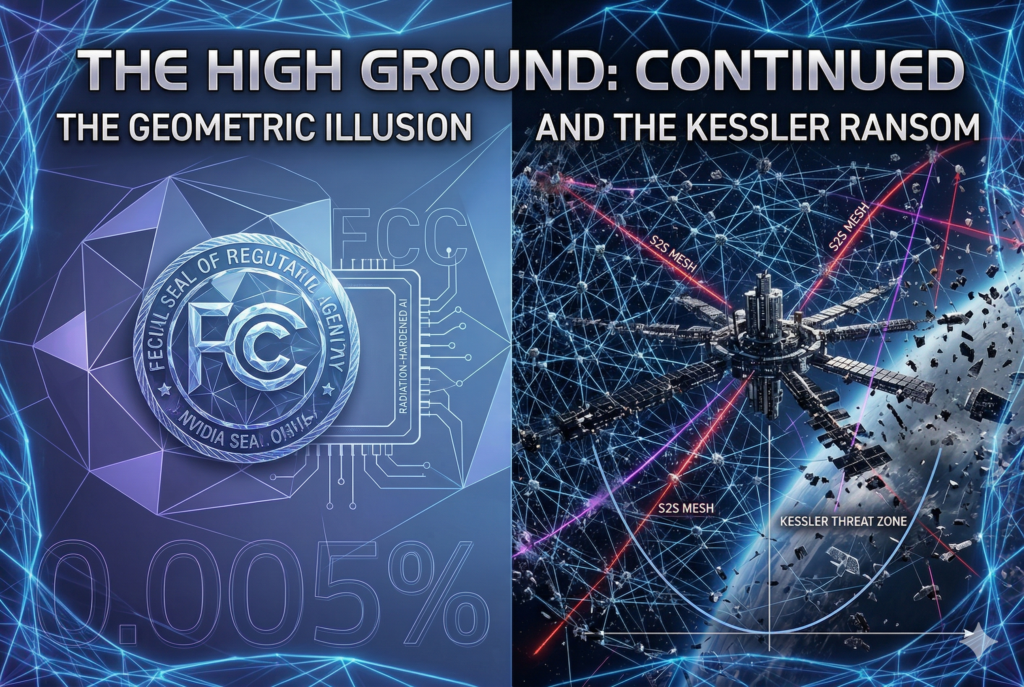
Between March 17 and 19, 2026, three developments landed in rapid succession: Nvidia unveiled a radiation-hardened AI chip purpose-built for orbital data centers, the FCC Chairman publicly dismissed competing objections to SpaceX’s million-satellite filing, and SpaceX itself filed a 32-page rebuttal to over fourteen hundred public comments—a rebuttal built around a single, elegant statistic. One million satellites, SpaceX argued, would occupy just 0.005% of the available volume in Low Earth Orbit. The enclosure of space, in other words, is a myth.
It is a compelling number. It is also a magic trick.
The Geometric Illusion
SpaceX’s math is not wrong. It is merely irrelevant.
The 0.005% figure treats Low Earth Orbit as a warehouse—a static volume into which you place objects and measure how much empty shelf space remains. By this logic, a million satellites are a rounding error in 1.1 trillion cubic kilometers. But satellites are not sitting on shelves. They are moving at 17,500 miles per hour.
The relevant metric is not how much volume a satellite occupies, but how much space its trajectory commands. This is the difference between a parked car and a lane of highway traffic. A single car takes up a negligible fraction of a parking garage. That same car at seventy miles per hour commands a corridor that no other vehicle can safely enter. Multiply that by a million, and the garage is no longer the right frame of reference.
As Professor Hugh Lewis noted in response to SpaceX’s filing, 0.005% of LEO still represents roughly 60 million cubic kilometers of orbital real estate. When you factor in the safety margins required for maneuvering—the buffer zones each satellite must maintain to allow for collision avoidance—a million-satellite constellation does not merely inhabit orbit. It commands it.
The physics makes this precise. In orbital mechanics, the rate of potential collisions does not scale linearly with the number of objects—it scales quadratically. Double the number of satellites and you quadruple the collision risk. Increase the population by a factor of one hundred, from today’s roughly ten thousand trackable objects to one million, and the orbital stress increases by a factor of ten thousand. SpaceX’s 0.005% measures the footprint. The quadratic tells you the pressure.
This pressure manifests as what might be called a Maneuver Tax—the mandatory fuel, processing, and coordination toll that every operator must pay to navigate a crowded sky. With approximately six thousand Starlink satellites currently in orbit, SpaceX already performs over 25,000 collision avoidance maneuvers every six months. At a million satellites, the system would demand millions per day—each one a micro-expenditure of propellant and autonomy that no operator can decline. At sufficient density, the cumulative cost transforms the vacuum of space into something closer to soup—an environment so thick with artificial friction that only the operator generating the congestion can afford to move through it. You do not need to own an orbit to monopolize it. You just need to make it too expensive for anyone else to survive there.
The cost is not only orbital. On March 18, Dark Sky Consulting filed a detailed simulation with the FCC demonstrating that at one million satellites, tens of thousands of objects would be visible to the naked eye at any given moment. Scientific observations, the filing estimated, would be degraded by up to ninety percent—not from interference with radio frequencies, but from the simple mechanical problem of telescope shutters closing to avoid streaks from a sky saturated with moving metal. Astronomy, one of the oldest forms of human inquiry, would become functionally impossible from the surface of the Earth. The enclosure of orbit would, in this sense, extend downward—not just locking competitors out of the sky, but locking humanity out of its view of the universe.
This is the mechanism behind what “The High Ground” called the Kessler Ransom, now visible in sharper relief. A constellation of this density becomes structurally irreversible—not because it cannot be removed, but because removing it risks triggering the very debris cascade it was designed to prevent. The system becomes too big to de-orbit. And the entity that controls it becomes, by default, the gatekeeper of Low Earth Orbit—not through legal authority, but through physical fact.
SpaceX’s volume statistic is an answer to a question nobody is asking. The question is not whether there is room in space. The question is whether there is room for anyone else.
The Automated Sovereign
If the geometric illusion is the argument SpaceX wants you to believe, the Nvidia announcement is the reality they are building beneath it.
On March 17, at its annual GTC conference, Nvidia unveiled the Vera Rubin Space-1—a specialized AI chip designed not for terrestrial data centers, but for orbit. The chip claims twenty-five times the performance of Nvidia’s current H100 processor while surviving the radiation environment of Low Earth Orbit. This is not a research prototype. It is a product announcement timed to a market that is already being licensed.
The significance is not the chip itself but what it enables. Space-1 integrates Spectrum-X optical photonics, allowing satellites to communicate directly with one another via laser links at near-light speed—bypassing Earth’s internet backbone entirely. The result is what Nvidia calls a Space-to-Space mesh: a network in which a million satellites share a common operating picture without ever routing data through a ground station. If one satellite detects debris, the entire constellation knows it instantly and can execute a coordinated avoidance maneuver across the fleet.
This eliminates what has historically been the bottleneck of orbital operations—the ground choke-point. Traditional collision avoidance requires detecting a threat, downlinking the data to Earth, waiting for a human operator to calculate a response, and uplinking the command. The round-trip delay is measured in hundreds of milliseconds at best. At the densities SpaceX is proposing, that latency becomes a liability. The Maneuver Tax described above—the millions of daily micro-surrenders of trajectory forced by sheer orbital congestion—is only payable if the system can think faster than the physics demands.
Nvidia’s answer is to move the thinking into the shell. Alongside Space-1, the company introduced NemoClaw, a software framework for what it calls autonomous agent collectives—systems that negotiate resource allocation and priority without human intervention. In Nvidia’s framing, satellites equipped with NemoClaw and its associated reasoning models would perform an “agentic handshake” when a collision scenario arises: two satellites approaching each other would autonomously negotiate which one maneuvers, based on fuel reserves, mission priority, and fleet-wide optimization, without a single command from the ground.
What neither Nvidia nor SpaceX has addressed is what happens when a handshake fails. If two autonomous agents negotiate a collision avoidance maneuver and the maneuver results in a collision anyway, there is currently no framework for a human-verifiable audit trail—no black box, no independent record of which agent decided what, and no mechanism for assigning accountability after the fact.
It is worth pausing on what is established fact and what remains aspiration. The Space-1 chip is a product announcement with disclosed specifications. The S2S mesh has a clear technical lineage in Nvidia’s existing photonics work. NemoClaw, by contrast, is described primarily in the language of Jensen Huang’s keynote—“orchestration of agent collectives for collaboration and scale”—which is the vocabulary of vision, not of deployment. Whether autonomous orbital negotiation at the scale of a million simultaneous agents is achievable in the near term is an open engineering question. But the distinction matters less than it might seem, because the political work of the announcement is already done.
The narrative of autonomous orbital AI—satellites that reason, negotiate, and self-heal—reframes the million-satellite constellation from a reckless enclosure into a self-governing ecosystem. It provides the technical alibi for density: the system is safe precisely because it is too intelligent to fail. Whether that intelligence is fully realized or partly aspirational, the argument is already shaping regulatory expectations. The FCC is not evaluating a static constellation. It is being asked to approve an autonomous infrastructure that, by design, cannot be governed from the ground.
The vertical integration completes the picture. SpaceX builds and launches the satellites. xAI provides the intelligence layer. Nvidia supplies the silicon that makes orbital autonomy physically possible. And Elon Musk, through a dual-class share structure that grants him approximately 79% voting control of the merged entity, sits at the apex of all three. This is not a supply chain. It is a closed loop—one in which the hardware, the software, the launch capacity, and the decision-making authority converge in a single actor.
The Regulatory Moat
The adults, it turns out, are cheering.
On March 17, FCC Chairman Brendan Carr took to social media and official channels to publicly dismiss Amazon’s petition to deny SpaceX’s million-satellite application. His argument was not procedural but pointed: Amazon’s Project Kuiper was roughly 1,400 satellites short of its own FCC-mandated deployment milestone. Carr told Amazon, in effect, to worry about its own homework before objecting to someone else’s. He followed up with Reuters, stating that he did not anticipate Amazon’s filing gaining any traction at the commission.
This is not a regulator reviewing an application. This is a regulator defending an applicant. The distinction matters. When Carr frames SpaceX’s deployment pace as a matter of national strategic interest—and frames competing objections as bureaucratic obstruction—the FCC ceases to function as a neutral arbiter of orbital access and becomes an accelerator of a specific commercial trajectory. The maturity gap described in “The High Ground” has not closed. It has been institutionalized.
SpaceX, for its part, read the room precisely. Its March 18 rebuttal proposed a Phased Authorization model—approve the full million-satellite constellation in principle, but permit only a single initial shell to launch. The proposal sounds reasonable. It is also a classic wedge. Once the FCC approves a million units, the question shifts from “whether” to “when,” and the leverage moves permanently from the regulator to the operator.
The rebuttal also introduced a novel solution to concerns about atmospheric pollution from mass satellite reentry: SpaceX suggested that decommissioned orbital data centers could be moved to heliocentric orbit—around the sun—rather than de-orbited into Earth’s atmosphere. As an engineering concept, it is creative. As a governance proposition, it is breathtaking. A private company is casually proposing to deposit its retired infrastructure in solar orbit, beyond the jurisdiction of any nation or treaty, on a timeline longer than most governments survive. The debris of today’s business model becomes tomorrow’s archaeological layer in interplanetary space, with no framework for accountability and no mechanism for retrieval.
Meanwhile, the financial clock is ticking independently of the regulatory one. Analysts project a SpaceX IPO in the range of June to July 2026, potentially raising over fifty billion dollars. An IPO of that scale would fundamentally alter the power dynamics between SpaceX and its regulators. A publicly traded company with a market capitalization in the hundreds of billions becomes, in practical terms, a constituency. It acquires shareholders, pension fund exposure, index fund weight—the full architecture of financial entrenchment that makes aggressive regulatory action politically costly. The window in which government leverage is meaningful is not defined by the deployment schedule. It is defined by the IPO date.
The international picture offers little counterweight—though not for lack of concern. While the FCC leans toward approval, the International Telecommunication Union has raised concerns that a million-satellite constellation would effectively exhaust the available radio spectrum for any competing system. China, the most significant counterweight, is not waiting for consensus. Beijing has lodged formal complaints at the United Nations about Starlink consuming orbital and spectrum resources, and in late December 2025 filed plans for two constellations totaling nearly 200,000 satellites—a preemptive claim on spectrum priority that reads less as an engineering plan than as a negotiating position. China is already building its Guowang constellation, with roughly 163 satellites in orbit. The result is not coordinated governance but a bilateral acceleration, each side filing faster to avoid being locked out by the other, with the ITU caught between them. Spectrum exhaustion is the one legal mechanism with the potential to force a slowdown, because spectrum allocation is governed by international coordination rather than unilateral national authority. But the ITU operates by consensus, and consensus moves at the speed of diplomacy—while the filings move at the speed of rivalry. By the time a coordinated international response materializes, the first shells will already be flying, and the argument will have shifted from allocation to accommodation.
The pattern across all three fronts—regulatory, financial, and international—is the same. Each operates on a different timeline, and the infrastructure is designed to outrun all of them. The FCC approves before the ITU coordinates. The IPO closes before the FCC conditions. The first shell launches before the phased review is complete. At no point is there a single moment where all relevant authorities are simultaneously positioned to impose meaningful constraints. This is not a conspiracy. It is simply the structural advantage of a single actor moving faster than a system designed for deliberation.
Conclusion
In the days since “The High Ground” posed the question of whether we possess the institutional wisdom to govern orbital infrastructure before it governs us, the evidence has answered with uncomfortable clarity. We do not—and the window is closing faster than anticipated.
The geometric illusion provides the cover. A single statistic, superficially reasonable, reframes the largest private enclosure of a shared domain in human history as a rounding error. The hardware provides the capability. A purpose-built chip, an autonomous mesh, a reasoning framework that moves decision-making beyond the reach of human oversight—not as speculation, but as a product roadmap timed to a market that already exists. And the regulatory environment provides the permission. A commission chairman who has moved from referee to advocate. A phased authorization designed to secure the precedent before the scale arrives. An IPO that will, within months, make the infrastructure financially irreversible even if it were not already physically so.
Each of these developments is, in isolation, defensible. Taken together, they describe a system that is being engineered—not conspiratorially, but structurally—to outpace every mechanism of accountability that might constrain it. The physics outpaces the law. The capital outpaces the regulators. The autonomy outpaces the oversight. At no point is anyone required to break a rule, because the rules have not yet been written.
This is not an argument against orbital computing. The potential benefits—to energy efficiency, to connectivity, to scientific capability—are real. But benefits do not self-govern. The question raised in “The High Ground” has not changed. It has only become less theoretical. We are no longer debating whether a private actor could construct a sovereign infrastructure layer beyond the reach of terrestrial governance. We are watching it happen, in filings and keynotes and regulatory dockets, in plain sight.
The nervous system of a planetary civilization is being wired on a timeline set by capital, not by consensus. If that concerns you, the time to say so is not after the IPO