How the veto turns international law into theater
The promise that emerged from the ruins of World War II was simple: the law would mean something even when the powerful were the ones doing the killing. The United Nations Charter, the Genocide Convention, the Geneva framework — all of it rested on that idea.
But there was a compromise built into that promise from the very beginning.
The Security Council veto was not a loophole discovered later. It was part of the original design. The great powers were never going to sign onto a system that could be meaningfully used against what they considered their core interests, so the escape hatch was written in at the start. The postwar order was built not just on moral principle, but on a bargain with power.[1][2]
That matters, because it changes how we should think about failure.
It is comforting to imagine that international law was sound in principle and only later undermined by hypocrisy. There is some truth in that. But the deeper truth is harder to look at. The system was always divided against itself. It was supposed to restrain atrocity while also preserving the consent of the states most capable of committing it. Those two goals were never fully compatible. Under Article 27 of the Charter, substantive Security Council decisions require the concurring votes of the permanent members. In plain English, one permanent member can stop binding action cold.[1]
That is why Gaza matters beyond Gaza.
The legal machinery was not absent. It was activated. South Africa brought its case before the International Court of Justice, and the Court issued provisional measures in January, March, and May of 2024.[3] The International Criminal Court moved forward as well. The point is not that the world lacked legal language, institutions, or procedures. The point is that all of them ran into the same wall when the moment for consequence arrived.
This is the part that gets blurred when people use the word impunity too loosely. The veto is not just another example of impunity. It is the means by which impunity is assured at the precise moment international law might otherwise begin to matter.
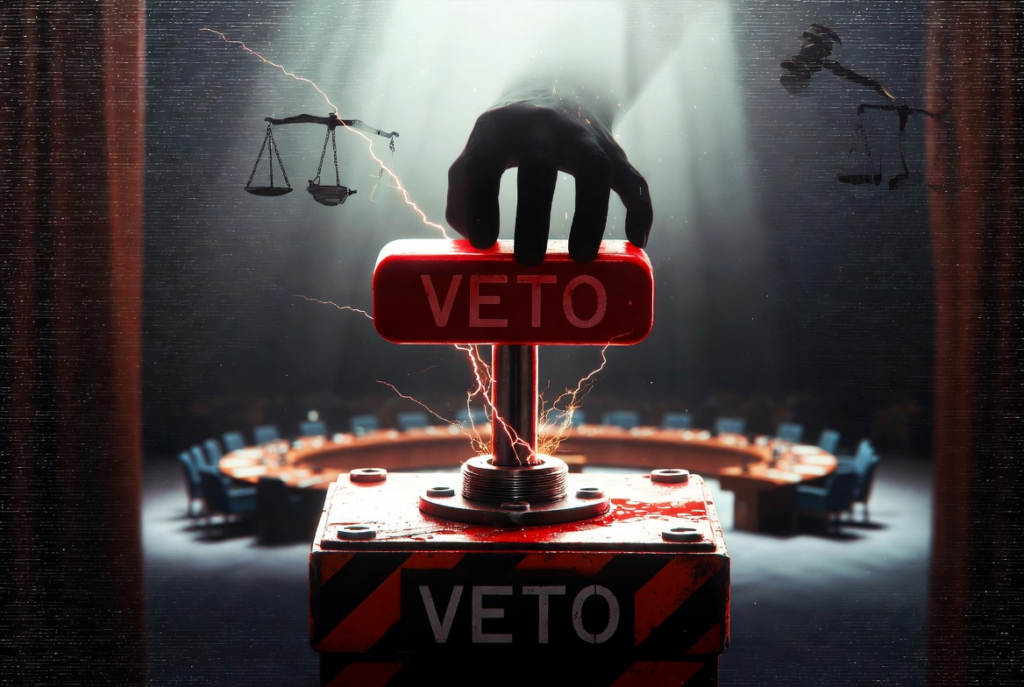
That is why I keep coming back to the phrase kill switch. It is not dramatic for the sake of being dramatic. It is a structural description. The Security Council can meet. Delegates can speak. Draft resolutions can circulate. Courts can issue findings. Investigators can document what happened. But when the time comes for binding collective action, one permanent member can shut the circuit down. The United States did exactly that on Gaza more than once, including vetoes on 18 October 2023, 20 February 2024, and 20 November 2024.[4]
Once you see that clearly, a lot of the surrounding talk starts to sound different.
People say the courts have no power. That is not quite right. The courts have language. They have records. They can issue rulings. They can narrow the space for denial. But power is another matter. The ICC says openly that it has no police force of its own and depends on state cooperation.[5] The ICJ is often described as the highest court on the planet, but even its path to enforcement points back toward politics. Article 94 of the UN Charter says that if a party fails to comply with an ICJ judgment, the other party may go to the Security Council, which may then decide what measures to take.[6] In other words, even the world court’s road to enforcement can run straight back into the veto.
So when people ask why international law seems powerless in the face of obvious mass atrocity, the answer is not that no one thought to write the rules. The answer is that the rules were tied to an enforcement mechanism containing a built-in override.
And the contradiction gets even harder to ignore when the same country that blocks enforcement also moves against the institutions trying to act without it. In February 2025, the White House imposed sanctions on the ICC, calling its actions “illegitimate and baseless” and explicitly referencing investigations involving “America and our close ally Israel.” In June 2025, Treasury added four ICC judges to the sanctions list.[7][8] That is not just criticism of an international court. It is the use of state power to protect a favored ally from legal consequence while the Security Council veto protects that ally from binding collective action.
This is why I no longer think the usual reform language is enough on its own. Gaza has exposed something older and deeper than an AI governance problem. The postwar order never really solved the question of how to enforce law against the protected. It deferred that question. It managed it. It buried it under procedure, diplomacy, and the hope that the great powers would act with restraint. Military AI makes all of this worse — compressing judgment, obscuring responsibility, accelerating violence faster than the law can adapt. But the rot is in the foundation, not the wiring.
That is the problem I think is being missed. The failure was not that international law forgot how to name injustice. The failure was that it was built in such a way that one of the most powerful states on earth could decide when injustice would remain a matter of speeches, filings, and headlines rather than consequence.
The veto is not the whole story. It does not explain every injustice, and it does not facilitate every war crime. But it does something even more important than that: it guarantees that certain crimes can survive the point at which the law begins to close in. That is what makes it the kill switch — and why any serious discussion of war, accountability, and the future of military AI has to begin there.
Endnotes
1. UN Charter, Article 27. Substantive Security Council decisions require the concurring votes of the permanent members.
2. U.S. Department of State, Office of the Historian. The Yalta voting formula and San Francisco discussions show that great-power unanimity was treated as essential to the system’s creation.
3. International Court of Justice, South Africa v. Israel. Orders on provisional measures issued January 26, 2024, March 28, 2024, and May 24, 2024.
4. UN meetings coverage and press releases. U.S. vetoes on Gaza-related Security Council resolutions on October 18, 2023, February 20, 2024, and November 20, 2024.
5. International Criminal Court, “How the Court Works.” The ICC states that it has no police force or enforcement body and relies on state cooperation.
6. UN Charter, Article 94. If a party fails to comply with an ICJ judgment, the other party may have recourse to the Security Council.
7. White House, February 6, 2025. Executive order imposing sanctions on the ICC, describing its actions as targeting “America and our close ally Israel.”
8. U.S. Treasury OFAC, June 5, 2025. ICC-related designations added four judges to the sanctions list.