
Compute is the new oil, and the Gulf is learning how to pump it.
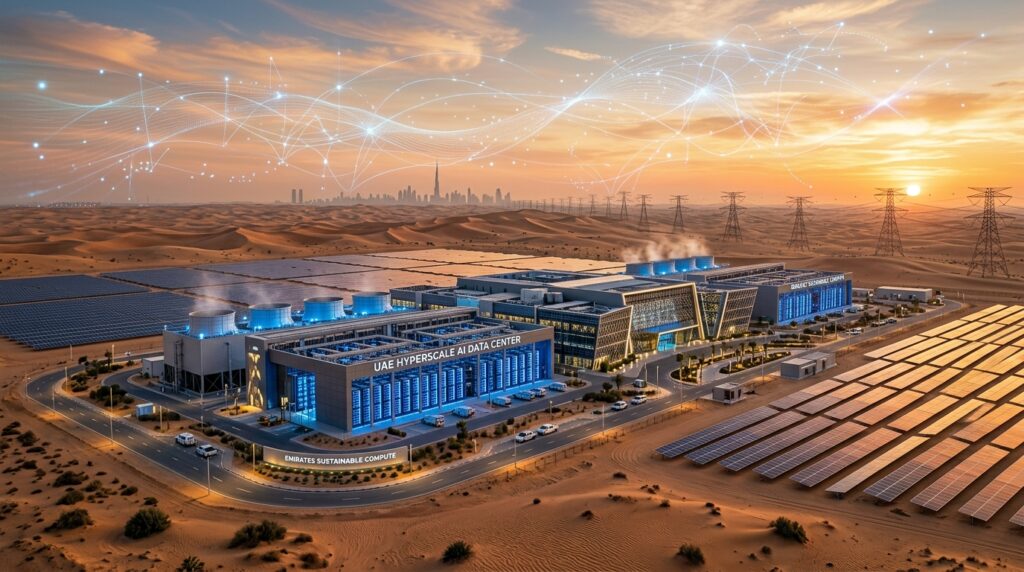
The emerging U.S.–Gulf AI relationship is not just a story about sovereign wealth diversifying into tech. It is a bargain in which Washington trades access to frontier compute for something it increasingly lacks at home: vast, controllable power, land for hyperscale campuses, and sovereign capital that can build fast. Export licenses, security conditions, and grid capacity are now part of the same deal. Chips make Gulf corridors technically possible; Gulf energy and siting are what make those corridors strategically irresistible.
The constraint on AI expansion is no longer only silicon. It is electricity, transmission, cooling, and the political ability to stitch them together at scale. Seen through that lens, the new datacenter belt running through Abu Dhabi and Riyadh looks less like a distant investment play and more like an offshore extension of an American-aligned compute system.
Core linkage: why the Gulf matters
The Gulf’s AI proposition is simple: cheap, scalable energy; abundant land; and sovereign wealth able to bankroll multi-gigawatt campuses. That combination is rare in the United States and Europe, and it is why hyperscale operators are suddenly treating the region as prime real estate for model training and serving.
The relationship is genuinely interdependent. Gulf states need access to U.S. chips, clouds, and model ecosystems. The United States, in turn, needs politically reliable places where that compute can actually be powered, cooled, and expanded without hitting domestic grid and permitting walls. Washington has the stack; the Gulf has the chassis.
Once power bottlenecks come into focus, the picture sharpens. Energy abundance is not a footnote to Gulf AI plans; it is the center of gravity. Policy and industry analysis now talk about Gulf AI less in terms of “innovation hubs” and more in the language of megawatts, substation upgrades, cooling loads, and 10-to-20-year siting bets. This shifts the geography of AI. The assumption that frontier compute must sit on U.S. soil is quietly being abandoned in favor of a distributed but tightly aligned network of nodes.
In that network, selected Gulf sites function as trusted extensions of a broader American stack. The region’s comparative advantage is not just turning hydrocarbons into tech branding; it is turning energy abundance into secure infrastructure that can host and scale compute precisely when Western power systems are under strain.
Why conditions tighten
Frontier chips are scarce, sensitive, and must be refreshed every few years. The United States is therefore not simply exporting hardware. It is exporting compute under conditions.
Recent approvals for advanced American accelerators to Saudi Arabia’s HUMAIN and the UAE’s G42 make this explicit. Licenses came wrapped in strict security and reporting requirements, and U.S. officials have been unusually open about the fact that future approvals depend on ongoing compliance. The real leverage lies in that renewal cycle: Washington can shape, slow, or cut off access as clusters grow and need fresh silicon.
Grid and siting are pulled directly into this logic. A Gulf state that can point to large, power-rich campuses with hard physical security, controlled tenancy, runtime auditing, and clear red lines against diversion becomes a more attractive destination for scarce chips than a friendly partner whose grid is already at the edge. In this model, the host country stops being just a customer. It becomes part of the enforcement mechanism.
Export control is bleeding into alliance management. U.S. strategy papers increasingly describe a deliberate use of compute access to lock in broader alignment. In the Gulf, that means AI export decisions are inseparable from questions like: Who runs the grid? Who has audit rights? How far are Chinese firms kept from the fiber, the cooling, and the management stack?
One way to frame it: Washington is no longer only licensing semiconductors. It is licensing entry into a governed compute system. The more Gulf campuses matter to U.S. clouds and models, the stronger the incentives to keep chips flowing—but also the stronger the justification for demanding intrusive audits, reporting, and institutional separation from Chinese-linked entities. The fine print on an export license becomes the instrument that folds concrete, cables, and cooling towers in Abu Dhabi and Riyadh into a larger architecture of American technological power.
Corridor logic: from map to metal
From Washington’s vantage point, a “compute corridor” is a chain of trusted, power-dense, American-stack infrastructure that runs through selected Gulf sites. Geography matters: the corridor is a route not only for chips, electricity, cloud services, and data, but also for standards, oversight, and leverage. It is a literal circulatory system of life-sustaining support for Frontier-level AI.
This helps explain why flagship projects are doing so much narrative work. The planned Stargate UAE complex in Abu Dhabi and Saudi Arabia’s HUMAIN-anchored buildouts are not just vanity campuses. They are designed as anchor nodes in a wider geography of allied compute, places where export deals, energy policy, and cloud partnerships reinforce one another. Their real strategic weight comes less from how many racks they hold and more from how tightly they can be wired into U.S. technical and regulatory systems.
Grid capacity: the hard limit
None of this becomes real without the grid. That is why Gulf AI strategy is steadily collapsing into power-sector planning. The decisive questions now sound like: Where will the dedicated generation sit? How much spare capacity can be rerouted in a crisis? What happens if another megaproject plugs into the same line?
The GCC Interconnection Authority is the quiet fulcrum. It was built as an insurance policy—a way to shove power across borders in emergencies. In current policy debates, it reappears as the skeleton of something bolder: an integrated electricity architecture that could support cross-border AI loads. A system designed to prevent blackouts becomes, with investment and political will, the spine of a distributed AI back end.
Hyperscale AI campuses are not normal loads: they demand continuous, high-quality supply in some of the hottest climates on earth, where cooling can rival compute as a power draw. Recent work on Gulf AI infrastructure warns of very concrete limits around electricity and water as datacenter capacity surges. Analysis of UAE datacenter demand, for instance, projects a sharp increase by 2030, turning “AI strategy” into a live grid-management problem.
Once grid expansion is read this way, its political meaning changes. Routing a new line, beefing up an interconnector, or ring-fencing generation for a campus becomes a decision about where strategic compute lives—and who can reach the off switch. A Gulf government that can offer land, capital, and resilient interconnection is offering Washington not just a site, but a governable electrical environment for U.S.-origin compute.
The risks of building one big brain
That same interconnected architecture, however, carries real geopolitical risk.
Cross-border electricity systems create interdependence, and interdependence can slide into leverage. Work on the geopolitics of power grids shows that when states share critical infrastructure, whoever controls key nodes can threaten or manipulate flows—openly or through “technical” measures—to extract concessions.
Overlay AI on top of that, and the stakes jump. If model-serving clusters and data centers are concentrated along a few transborder corridors, hitting those corridors—physically or digitally—can do far more than shut down factories. Attacks on substations, HVDC links, or control centers can ripple across multiple states, dragging down cloud availability, communications, and potentially military-relevant compute in one move. Efficiency comes bundled with concentrated points of failure.
Cyber risk amplifies this. Interconnected grids depend on complex operational-technology systems and supervisory networks that are already high-value targets. Reporting on the GCC documents a steady rise in cyber pressure on infrastructure; interconnection means a compromise in one jurisdiction can propagate through shared systems. For AI campuses that sell themselves on uptime guarantees, that blurring of infrastructure and cyber conflict is not theoretical.
Offshoring the compute also offshores the oversight. Congressional inquiry, federal courts, state-level environmental review, and public records law all stop at the water’s edge; the governance regime that replaces them is bilateral, conditional, and largely opaque.
For Washington, the trade-off is stark. Offshoring part of the compute stack to trusted Gulf partners helps solve domestic constraints and anchor U.S. ecosystems abroad, but it also exposes that stack to regional crises, sabotage, and political gambits over cross-border flows. For Gulf states, the bargain is equally double-edged: they gain privileged access to the U.S. AI stack, but tie big pieces of their digital future to grid architectures and compliance regimes shaped by external security priorities.
Strategic implications
The upshot is that power systems are becoming tools of alignment. If Gulf campuses run on American chips, American cloud partnerships, and U.S.-monitored security terms, then every new substation outside Abu Dhabi or Riyadh is not just an industrial upgrade. It is an extension of American technological influence into the Middle East, Africa, and South Asia.
That changes how chip access will be allocated. The question is no longer just “Who is on our side?” but “Who can credibly host and secure megawatt-scale compute under dependable power, audited governance, and clear separation from rival ecosystems?” Energy systems, cloud partnerships, export controls, and security vetting are fusing into a single strategic field.
The Gulf is not getting chips simply because it has energy. It is getting chips because it can turn that energy into governable, allied compute at a moment when grid scarcity is becoming one of the hidden limits on AI power projection.
The same architecture that lets Washington scale compute faster abroad, also lets it scale compute with less accountability. That’s not an incidental property of the corridor. It’s one of the reasons it exists.
Bibliography
ABI Research. “From Petro Capital to Data Capital: The Gulf States’ Strategic Pivot Toward AI and Next-Generation Data Centers.” March 31, 2025. Accessed April 20, 2026.
AI Policy Bulletin. “Leveraging Gulf AI Ambitions for US Strategic Objectives.” February 8, 2026. Accessed April 20, 2026.
Al-Kandari, A., et al. “The Operation of the GCCIA HVDC Project and Its Potential Impacts on the Electric Power Systems of the Region.” Presentation and technical paper. Accessed April 20, 2026.
Al-Monitor. “Oil-Rich UAE Turns to AI to Grease Economy.” December 8, 2025. Accessed April 20, 2026.
American Security Project. “The United States’ Precarious AI Strategy in the Middle East.” February 19, 2026. Accessed April 20, 2026.
Arab Gulf States Institute (AGSI). “AI and the U.S.-Gulf Tech Axis.” July 27, 2025. Accessed April 20, 2026.
Carnegie Endowment for International Peace. “The AI Export Dilemma: Three Competing Visions for U.S. Strategy.” December 12, 2024. Accessed April 20, 2026.
Carnegie Endowment for International Peace. “With Its Latest Rule, the U.S. Tries to Govern AI’s Global Spread.” January 12, 2025. Accessed April 20, 2026.
CBS / CNBC. “U.S. Approves AI Chip Exports to Gulf after Saudi Crown Prince Visit.” November 20, 2025. Accessed April 20, 2026.
Cyble. “Inside the GCC’s Cyber Threats: Ransomware & Dark Web.” September 8, 2025. Accessed April 20, 2026.
Debuglies Intel. “AI Statecraft: U.S. Influence Through Gulf AI Infrastructure in 2025.” October 5, 2025. Accessed April 20, 2026.
ElecWatts GCC. “Smart Grid Cybersecurity Protocols for GCC Utilities (2026).” January 29, 2026. Accessed April 20, 2026.
Escribano, Gonzalo, et al. “Geopolitics of Electricity: Grids, Space and (Political) Power.” SWP Research Paper, March 5, 2022.
GCC Interconnection Authority (GCCIA). “GCCIA Organized a Workshop on the Applications of Generative AI in GCC Power Systems.” 2025. Accessed April 20, 2026.
GE Vernova and GCCIA. “GCCIA Phase 1 Interconnection Brochure.” Technical brochure. Accessed April 20, 2026.
Gulf International Forum. “Gulf AI Infrastructure: Examining the Business and Economic Case.” March 31, 2026. Accessed April 20, 2026.
Gulf News. “G42 Gets US Approval for Advanced AI Chip Exports.” November 19, 2025. Accessed April 20, 2026.
Hinrich Foundation. “Data Centers and Undersea Cables Tangle in Geopolitics and Climate.” November 25, 2024. Accessed April 20, 2026.
IndexBox. “US Approves Advanced AI Chip Sales to UAE and Saudi Arabia Firms.” November 19, 2025. Accessed April 20, 2026.
Introl. “AI Export Controls: Navigating Chip Restrictions Globally.” January 18, 2026. Accessed April 20, 2026.
International Centre for Defence and Security (ICDS). “The Geopolitics of Power Grids.” March 2018. Accessed April 20, 2026.
Istituto Analisi Relazioni Internazionali (IARI). “Energy, Artificial Intelligence, and Digital Power in the Gulf.” January 26, 2026. Accessed April 20, 2026.
Middle East Institute. “AI, the Gulf, and the US: A Primer.” Accessed April 20, 2026.
Middle East Institute. “From Crude to Compute: Building the GCC AI Stack.” February 5, 2026. Accessed April 20, 2026.
Middle East Institute. “Why Gulf AI Ambitions Must Align with Energy and Water Realities.” April 12, 2026. Accessed April 20, 2026.
Morgan Lewis. “Department of Commerce Issues Export Controls on Advanced Computing Chips and Artificial Intelligence Models.” Client Alert, January 29, 2025. Accessed April 20, 2026.
New York Times. “Big Tech’s Uncertain Future in the Persian Gulf.” March 7, 2026. Accessed April 20, 2026.
ORF Middle East. “The GCC Data Centre Industry: Conflict and Policy.” March 25, 2026. Accessed April 20, 2026.
Red Line. “US Compute Diplomacy: AI Diffusion via UAE Infrastructure.” November 5, 2025. Accessed April 20, 2026.
Reuters. “US Authorizes Export of Advanced American Semiconductors to Companies in Saudi Arabia and UAE.” November 19, 2025. Accessed April 20, 2026.
S&P Global Commodity Insights. “Powering the Future with EU–MENA Interconnections.” 2024. Accessed April 20, 2026.
ScienceDirect. “The Geopolitics of Cross-Border Electricity Grids: The Israeli-Arab Case.” Accessed April 20, 2026.
Wood Mackenzie. “UAE Data Centre Power Demand to Double by 2030 as Regulatory Gaps Constrain Clean Energy.” March 25, 2026. Accessed April 20, 2026.
World Economic Forum. “New GCC Partnerships and Investments Are Powering Global Data and AI.” February 23, 2026. Accessed April 20, 2026.
Yahoo Finance. “US Approves Sale of 35,000 AI Chips to UAE’s G42, Saudis’ Humain.” November 19, 2025. Accessed April 20, 2026.
World Resources Institute / social media repost. “As Factors like New Data Centers, Political Conflicts and Extreme Weather Strain Power Grids…” February 25, 2025. Accessed April 20, 2026.