
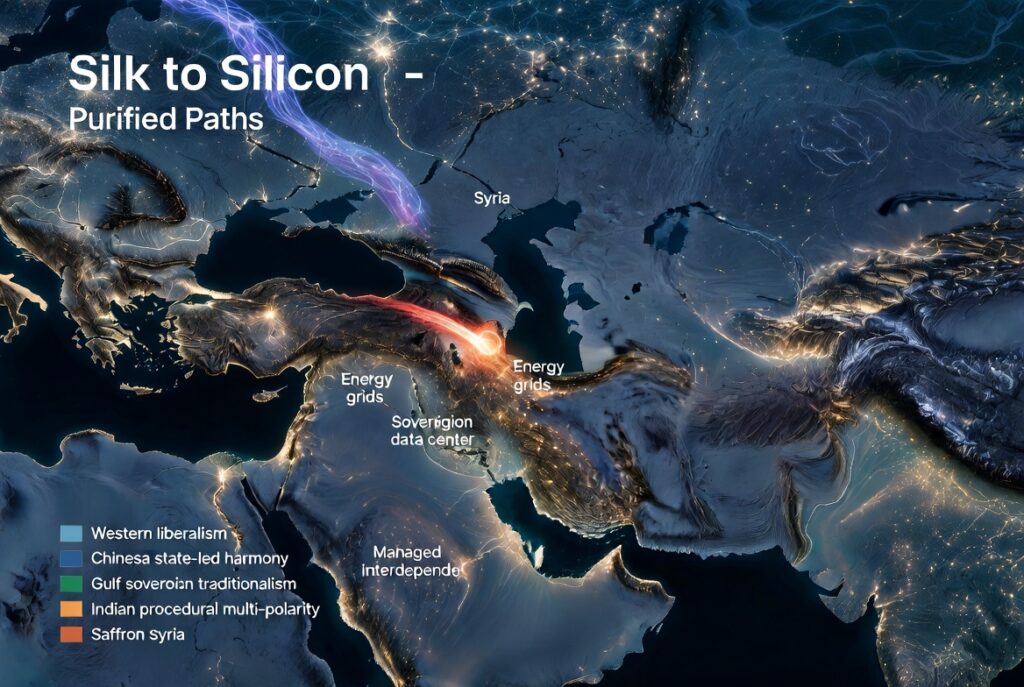
Thinking Out Loud is a personal series where I trace patterns in real time, share how I’m reading them, and invite your perspective. These are working observations—not forecasts, not policy prescriptions, not statements of fact. Just one analyst’s lens, offered in the spirit of discussion.
In Part I, I traced how energy grids, fiber corridors, and sovereign data centers are becoming the physical carriers of competing worldviews. Part II follows the signal one layer deeper: into the data itself. What began as a map of ideological operating systems has now revealed the mechanics driving their divergence. The physical corridors remain the hardware. But the software layer—the data that actually gets compiled into models—is where the real contest is being decided.
After tracing the patterns in real time, one conclusion stands out: AI fragmentation—the balkanization into sovereign stacks, filtered datasets, and parallel epistemic ecosystems—is not accidental or purely ideological; in my reading, it is overdetermined, with multiple structural forces pushing in the same direction. Multiple structural forces are pushing in the same direction, and the practical response—data purification and filtering at token‑level granularity—is already emerging as the linchpin that makes localized “OSes” viable without total isolation.
Here’s what I’m seeing: the drivers behind the split, which ones feel like the true roots, and what the landscape might look like once this fragmentation settles in. As before, I’m not claiming this is how things will end up. I’m tracing how they’re unfolding right now.
The Eight Interlocking Drivers
These forces compound rather than compete:
- Elite‑driven statecraft: Governments and policymakers are deliberately building sovereign stacks for leverage, security, and economic positioning—visible in US export‑control packages and Saudi‑backed sovereign compute projects like the 480‑MW Hexagon data centre in Riyadh, alongside what I’m calling emerging “SilkLink” fiber‑corridor realignments and China’s April 2026 anti‑hegemony diplomacy.
- Geopolitical anxiety and fear of dependence: Nations dread permanent subordination to a handful of US or Chinese hyperscalers, along with the foreign biases those models inherently carry.
- Regulatory divergence: Irreconcilable legal philosophies (EU privacy‑first, Chinese control, US market‑driven, Indian procedural) create incompatible training‑data pools and enforcement regimes.
- Techno‑nationalism and enclosure of the commons: AI is being reclassified as strategic territory—like ports or power grids—leading to the deliberate fencing‑off of data, fiber, and compute.
- Material and energy constraints: Explosive data‑center power demands, grid bottlenecks, and physical cooling limits make full‑stack independence practically out of reach for most countries, given today’s concentration of frontier‑scale compute and hyperscale projects in a small number of states.
- Bottom‑up cultural homophily: The natural human preference for systems that feel like “people like oneself” drives demand for culturally resonant defaults.
- Market‑driven concentration at the frontier: Only a handful of players currently appear able to sustain true full‑stack frontier capability, plus the relentless maintenance, inference scaling, and capex required to keep it alive—judging by who is consistently training frontier models and financing multi‑hundred‑MW data centres.
- Data poisoning / GIGO as statecraft—and purification as counter: Deliberate flooding of the open web forces defensive curation. Token‑level filtering and data‑curation pipelines (moving raw web scrapes through progressively cleaned, locally verified layers) become the affordable way to embed cultural defaults without walling off the system entirely, as concerns about data and model poisoning move from research papers into policy conversations.
These aren’t abstract theories. They show up concretely in the $5.3 billion Saudi–Syria investment package, the New Delhi Declaration on AI Impact and its 91 signatories, China’s April 2026 anti‑hegemony messaging on AI, and the quiet rise of sovereign Arabic‑language efforts such as the UAE’s Falcon models.
Eight drivers. But if we step back and weigh them by how foundational they are—how they would still push toward fragmentation even if others were absent—the hierarchy sharpens.
Which Causes Are the True Roots?
Primary Root Causes (The Structural Drivers)
- Market‑driven concentration + material/energy constraints. This is the hardest constraint. Frontier pre‑training at scale, perpetual model maintenance, and the physics of power and cooling create natural moats that, in practice, only the US and China currently seem positioned to surmount, given their control of advanced fabs, GPUs, and frontier‑scale training runs. Everyone else reacts with hybrid sovereignty because pure independence is structurally infeasible.
- Geopolitical anxiety and fear of dependence. Once the market reality is clear, nations refuse to accept permanent subordination. This turns economic necessity into policy action.
- Elite‑driven statecraft. Policymakers are the ones actually laying the cables, financing the grids, and declaring the rules. The Syria hinge is a concrete illustration of how this looks on the ground, from regime change to a $5.3 billion Saudi investment package anchored in infrastructure and telecoms.
Important Secondary Causes (Amplifiers & Accelerants)
- Regulatory divergence: The legal borders that make data flows incompatible.
- Techno‑nationalism: The mindset that treats AI as territory rather than shared knowledge.
- Data poisoning / GIGO: The immediate catalyst that poisons the old open commons and makes unchecked scraping untenable, as the risks of dataset contamination and model poisoning become part of mainstream AI‑governance debates.
Tertiary but Powerful Human‑Level Driver
- Bottom‑up cultural homophily: It explains why societies embrace the resulting stacks once the structural forces are in motion. The “nobler choice” of tools that deliver stability, continuity, and contextual fit feels legitimate because it aligns with lived reality.
In short: the roots are economic/physics + anxiety + elite execution. Cultural preference and data poisoning are the fuel, not the spark. Data purification and filtering—especially token‑level techniques that surgically excise bad content while preserving utility—is the practical technology that turns this inevitability into something workable.
Imagined Impacts on the World
Once fragmentation locks in—purified sovereign stacks routed through physical corridors—the world doesn’t fracture into isolated islands. It reconfigures into parallel but bridged ecosystems. Here’s how the impacts could unfold:
Short‑to‑medium term (2026–2030)
- The death of easy universalism. The open web becomes a “shared but filtered” resource. Cross‑cultural synthesis slows. Unexpected breakthroughs that once emerged from raw, global data become rarer. Internet and AI usefulness dips unless deliberate interoperability standards—agent protocols, federated learning, provenance tagging—keep the bridges open, as the same states that sign AI‑impact declarations also tighten control over data and infrastructure.
- Legitimacy shifts decisively to delivered utility. In post‑conflict zones or rapidly modernizing societies, the faction that wires the ground (energy + purified data + culturally aligned models) wins trust. In my reading of the early pattern, Gulf traditionalism and Indian procedural multi‑polarity gain ground here because they prioritize collective stability and accessible seats at the table over abstract rights rhetoric.
- Resilience rises at the cost of raw efficiency. As concerns about data and model poisoning move from research into policy, poisoning campaigns lose some of their asymmetric bite. Societies get tools that “just work” for their context. But global AI progress slows, and integration costs rise as duplicated layers multiply capex.
Longer‑term / structural (2030+)
- Redrawn alliances and power balances. Physical infrastructure becomes the new Silk Road. Whoever controls the hinges (Syria‑style nodes) hardwires their ideological OS into daily life for billions. If current investment and diplomacy trajectories hold—from Saudi Arabia’s Hexagon build‑out to India’s AI‑Impact convening—new dependencies are likely: Gulf energy‑compute blocs, Indian convening power, and the US/China frontier suppliers acting as the “handful” everyone else partners with.
- Epistemic silos versus genuine pluralism. Worst case: miscalculation when stacks collide in trade, diplomacy, or crisis response. Best case: authentic cultural pluralism baked into technology, reducing Western homogenization and giving non‑Western societies real agency in shaping the future.
- Economic and human ripple effects. Markets are likely to reward the frontier handful and their sovereign partners; smaller players specialize in data, applications, or bridging. Everyday users get more relevant, trustworthy AI locally—but fewer “magic” universal answers. Trust in AI may actually rise within each ecosystem while falling across them.
- The internet and AI models evolve, not die. Usefulness is preserved through hybrid architectures: token‑level purification + managed interoperability. Early moves toward combining curated sovereign datasets with cross‑border model access suggest the “birds of a feather” instinct will be satisfied without total isolation.
This isn’t dystopia or utopia. It’s the pragmatic rebalancing already visible in Saudi Arabia’s 480‑MW Hexagon data‑centre project, and in what I think of as SilkLink‑style rerouting and the quiet rise of medallion pipelines in sovereign clouds.
Closing Reflection
The map has shifted again. Infrastructure is still ideology made physical, but data purification and filtering is the quiet hand that actually compiles the defaults. The real contest isn’t just who builds the cables or who controls the frontier—it’s whose purified worldview gets to shape daily life on the ground, and whether the bridges we deliberately build can keep enough shared utility alive to prevent the silos from becoming echo chambers.
If infrastructure is ideology made physical and purified data is ideology made operational, the next question shifts from the macro to the human: What does this mean for the communities living inside these stacks, for the policymakers navigating them, and for the rest of us who rely on AI to make sense of the world?
I’m still tracing the pattern in real time. I’d love to hear what you’re seeing.
Sources:
- Syria and Saudi Arabia sign multibillion‑dollar investment deals (Al Jazeera, 7 Feb 2026).
https://www.aljazeera.com/news/2026/2/7/syria-and-saudi-arabia-ink-multi-billion-dollar-investment-deals - Saudi Arabia, Syria sign $5.3 billion in agreements across key sectors (Anadolu Agency, 7 Feb 2026).
https://www.aa.com.tr/en/middle-east/saudi-arabia-syria-sign-53-billion-in-agreements-across-key-sectors/3823493 - Saudi Arabia, Syria, sign $5.3 bln in agreements (Al Mayadeen, 7 Feb 2026).
https://english.almayadeen.net/news/politics/saudi-arabia–syria–sign–5-3-bln-in-agreements - Syria and Saudi Arabia sign multibillion‑dollar investment agreements (AP / NBC/AP News relays, 7–8 Feb 2026).
AP example: https://apnews.com/article/syria-saudi-arabia-investments-telecommunications-2d135302860c4338d6a10e2862b7ea83 - Saudi deepens ties with Syria’s new leaders through major investment package (Reuters, 7 Feb 2026).
https://www.reuters.com/world/middle-east/saudi-arabia-announces-major-new-syria-investments-2026-02-07/ - Syria and Saudi Arabia sign major investment package (DW, 7 Feb 2026).
https://www.dw.com/en/syria-and-saudi-arabia-sign-major-investment-package/a-75857509 - New Delhi Declaration on AI Impact signatories reach 91 (ANI / Tribune India, Feb 2026).
https://www.tribuneindia.com/news/business/new-delhi-declaration-on-ai-impact-signatories-reach-91-as-three-more-nations-join-598002 - Three more countries join New Delhi Declaration on AI Impact (Doordarshan News, 22 Feb 2026).
https://ddnews.gov.in/en/three-more-countries-join-new-delhi-declaration-on-ai-impact-signatories-rise-to-91/ - Representatives of 91 countries and international organisations sign AI Impact Summit Declaration (TV BRICS / IANS, 26 Feb 2026).
https://tvbrics.com/en/news/representatives-of-91-countries-and-international-organisations-sign-ai-impact-summit-declaration/ - “New Delhi Declaration on AI Impact signatories reach 91 as three more nations join” (Economic Times / AI coverage, Feb 2026).
https://economictimes.com/ai/ai-insights/new-delhi-declaration-on-ai-impact-signatories-reach-91-as-three-more-nations-join/ - Saudi Arabia’s $2.7 Billion AI Data Center (The Middle East Insider, 21 Mar 2026) – Hexagon 480‑MW facility.
https://themiddleeastinsider.com/2026/03/22/saudi-arabia-data-center-2026-hexagon-pif-ai-2/ - Saudi Arabia Launches Hexagon Data Centre, Poised to Be World’s Largest Government Data Facility (Gulf‑focused tech outlet, Jan 2026).
https://www.gulfgoodnews.com/saudi-arabia-hexagon-data-centre-vision-2030 - “Project Award – 480 MW Data Centre – Saudi Arabia” (Albawani / LinkedIn announcement, Jan 2026).
https://www.linkedin.com/posts/saeed-ur-rehman-9a7b5261_project-award-480-mw-data-centre-saudi-activity-7416926294212468736-zQdM