
Thinking Out Loud is a personal series where I trace patterns in real time, share how I’m reading them, and invite your perspective. These are working observations—not forecasts, not policy prescriptions, not statements of fact. Just one analyst’s lens, offered in the spirit of discussion.
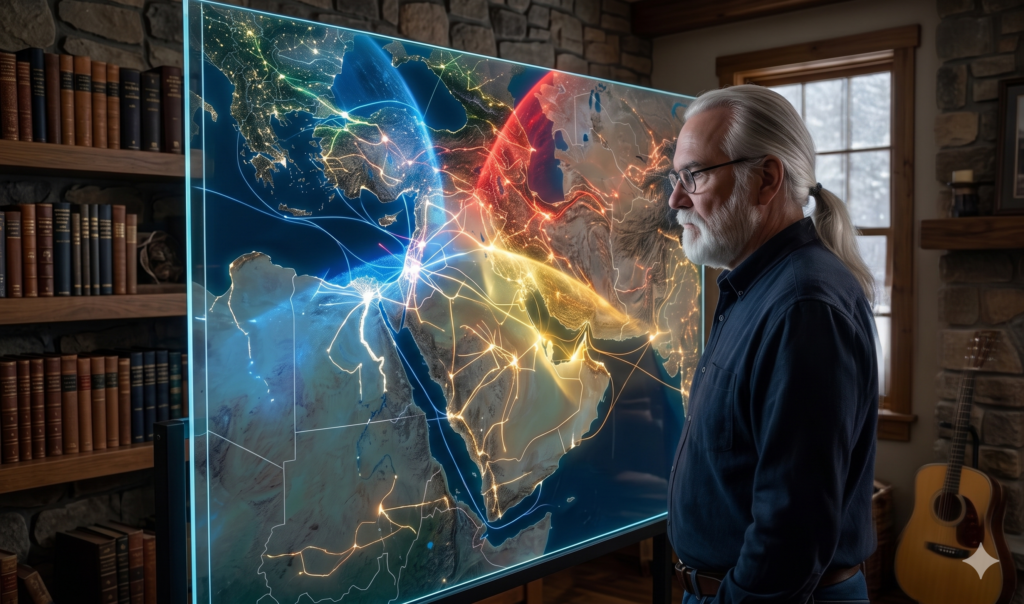
What began as a technical review of regional AI strategies has slowly revealed something broader: we’re no longer just racing for faster chips. We’re watching the emergence of competing “ideological operating systems,” and they’re traveling along the same kind of physical routes that once carried silk, spices, and ideas across continents.
The framing “From Silk to Silicon” emerged because infrastructure is no longer neutral. The fiber-optic corridors, sovereign data centers, and energy grids being wired across the Middle East and beyond aren’t just moving data—they’re encoding values. Each major actor is baking a distinct worldview into the stack: Western rights-based individualism, Chinese state-led harmony, Gulf sovereign traditionalism, and India’s procedural multi-polarity. These aren’t abstract policy debates anymore. They’re being hardwired into the models, routed through the cables, and powered by the grids that will shape daily life for billions.
If you follow the recent moves, the pattern is hard to ignore. Saudi Arabia’s 480-megawatt Hexagon facility, China’s April 2026 coalition statement opposing “technological hegemony,” India’s New Delhi Declaration pulling in 91 signatories, and the quiet but decisive rerouting of fiber through Syria to bypass older chokepoints—all of it points to a shift. Physical infrastructure has become the new arena for cultural and ideological alignment. Whoever finances energy recovery, lays the cable, and trains local-language models isn’t just building compute capacity. They’re setting the defaults for how societies will navigate order, dignity, and progress.
For communities emerging from conflict or rapid modernization, that reality changes the calculus. An AI that restores the power grid, reflects lived cultural norms, and prioritizes collective stability can feel more immediately useful—and more deeply legitimate—than a framework heavy on abstract individual rights but light on local resonance. That doesn’t make one worldview inherently superior. It does suggest that legitimacy in the AI era may increasingly be earned through delivered public goods and contextual fit, not assumed through export.
Here’s what I’m seeing on the map, how the pieces are moving, and why the ground beneath them matters as much as the code running on it. I’m not claiming this is how things will end up. I’m tracing how they’re unfolding. And if infrastructure is ideology made physical, the real question isn’t just who builds the cables—it’s what happens when these worldviews intersect.
The Factions and Their “Operating Systems”
If infrastructure is the hardware, then worldviews are the software. What’s striking about the current landscape isn’t just the pace of deployment—it’s how distinctly each major actor is encoding its underlying assumptions into the AI stack. I’ve started tracking them as competing “ideological operating systems,” not as rigid doctrines, but as the default settings each model ships with. Here’s how I’m reading the four main configurations:
1. The Western OS: Liberal Individualism
Led by the United States, this framework centers on individual autonomy, rights-based governance, and risk mitigation through regulation. Think transparency mandates, bias audits, and guardrails designed to protect civil liberties before scaling. The EU operates here as a highly sophisticated regulatory sub-variant: ambitious with the AI Act and the “Brussels Effect,” but notably absent when it comes to independent cultural encoding, linguistic sovereignty, or physical infrastructure scale in the Middle East. It’s a rules-first approach: define the boundaries, then deploy.
2. The Chinese OS: State-Led Harmony
China’s model prioritizes social stability, state coordination, and what official documents call “people-centered” AI. Rather than exporting a single cultural template, it offers a governance architecture: align technology with national development goals, maintain social cohesion, and respect differing social systems while actively resisting “technological hegemony.” The April 13, 2026 coalition statement from 16 Chinese scientific groups made this explicit, framing AI as a shared utility that should serve sovereign development paths rather than universalist mandates.
3. The Gulf OS: Sovereign Traditionalism
This is where the “Silk to Silicon” metaphor feels most tangible. Anchored by Saudi Arabia, the UAE, and Qatar, this bloc is pursuing full linguistic and digital sovereignty by embedding religious, political, and social norms directly into Arabic-language models. It’s not just about training algorithms—it’s a full-stack infrastructure play: secure the energy grid, deploy sovereign compute, build cloud layers, train culturally aligned LLMs, and ship applications that reflect local realities. The 480-megawatt Hexagon facility in Riyadh, paired with Arabic-first models like HUMAIN Chat, Falcon, and Fanar, shows how deliberately this is being operationalized. The goal isn’t isolation; it’s alignment.
4. The Indian OS: Procedural Multi-Polarity
India is positioning itself as the Global South’s convener and a bridge in a multipolar landscape. Rather than prescribing cultural content, it emphasizes consent-based governance, accessible compute, and procedural fairness. The “Welfare for all, Happiness of all” framing behind the New Delhi Declaration (which pulled in 91 signatories) captures this well: focus on diffusion, accessibility, and anti-hegemonic balancing. India’s $1.25 billion IndiaAI Mission and deployment of 38,000+ GPUs aren’t just capacity plays—they’re proof points for a model that scales without demanding cultural assimilation.
What stands out isn’t that one is inherently “correct” and the others “flawed.” It’s that each ships a different set of defaults for how societies should navigate order, progress, and dignity.
The West asks: What rights must be protected?
China asks: What stability must be maintained?
The Gulf asks: What continuity must be preserved?
India asks: Who gets a seat at the table?
These aren’t abstract policy debates. They’re being compiled into models, routed through fiber-optic corridors, and powered by the grids that will shape daily life. And if you want to see where these operating systems actually collide, you don’t look at conference stages. You look at the ground.
The “Fourth Node”: Syria as the Physical Hinge
Specifically, you look at Syria.
For years, Syria was framed as a buffer state, a humanitarian crisis, or a proxy battlefield. But if you follow the energy and data flows being wired right now, a different picture emerges: Syria is becoming the critical geopolitical hinge where the energy-data bond will decide whose worldview actually gets hardwired into the region’s future.
Here’s the logic, stripped to its essentials:
AI cannot run without power.
Training and inference at scale demand massive, stable electricity and cooling. Whoever finances Syria’s energy recovery—oil fields, gas pipelines, grid rehabilitation—gains structural leverage over what runs on that power. It’s not just about kilowatts. It’s about which models get to operate, whose data gets prioritized, and which cultural “weights” travel the cables.
Fiber follows finance.
The Saudi Telecom (STC) SilkLink project isn’t just another infrastructure deal. It’s a deliberate rerouting of the region’s digital spine: a fiber-optic corridor running through Syria to connect the Gulf to the Mediterranean, explicitly bypassing Israeli-controlled routes. Paired with the $5.3 billion in Saudi-Syrian agreements signed in February 2026—covering energy, telecom, data centers, and technical support for fields like al-Omar—this isn’t speculation. It’s a full-stack sovereign corridor being assembled in real time.
The hinge decides the default.
When a society is rebuilding after conflict, the first AI applications that matter aren’t chatbots. They’re grid-optimization models, predictive maintenance for water systems, Arabic-language tools for civic administration. If those tools are trained on Gulf-aligned data, powered by Gulf-financed energy, and routed through Gulf-controlled fiber, the “default settings” of daily life begin to reflect that worldview. Not through coercion, but through delivered utility.
This is why only three poles are actively building these physical ideological corridors: the United States, China, and the Gulf-led bloc. Each is tying energy recovery to compute deployment to model training in a single, sovereign stack.
India plays a different role: enabling multi-polar access without owning the pipes. It offers procedural frameworks, accessible compute, and diplomatic convening power—but it isn’t laying cable through Damascus.
Europe, for all its regulatory ambition, remains a rules-maker without a comparable physical footprint in this theater. The AI Act sets standards, but standards don’t cool data centers or restore power grids.
So when I say Syria is the hinge, I mean it literally: the place where abstract worldviews meet concrete constraints. Where ideology becomes infrastructure. Where the question isn’t just which model is better, but which model can actually run here, now, on this grid, for these people.
And if that’s true, then the next question becomes unavoidable: when societies weigh their options, what tips the scale?
The “Nobler Choice” and the Death of Universalism
Here’s a pivotal realization I keep returning to: for communities emerging from conflict, rapid modernization, or post-colonial realignment, the sovereign traditionalist path may not just be pragmatic—it may feel like the “nobler choice.”
Not because it’s morally superior in some universal sense. But because it answers a different set of questions.
Stability over abstract autonomy
Imagine you’re a municipal planner in a city rebuilding after years of disruption. Your grid is fragile. Your water systems need predictive maintenance. Your civic administration requires tools that understand local dialects, religious calendars, and communal decision-making norms. An AI that helps restore power, reflects lived cultural realities, and prioritizes collective continuity can feel more immediately useful—and more deeply legitimate—than a framework heavy on individual rights rhetoric but light on local relevance or delivered utility.
That’s not a rejection of dignity. It’s a reordering of priorities.
Pragmatic realism, not ideological rejection
The “Cognitive Bill of Rights” may be set aside not out of malice, but out of a clear-eyed commitment to collective survival. When a society is stabilizing, the question isn’t just what rights must be protected? It’s also what goods must be delivered? Universalism, in this context, must earn its legitimacy through tangible outcomes—not assume it through exported templates.
This is where the Gulf’s full-stack approach becomes instructive. HUMAIN Chat, Falcon, Fanar—these aren’t just Arabic-language models. They’re attempts to encode religious, political, and social norms directly into the AI layer, so that the technology feels like it belongs. Paired with sovereign compute, energy security, and fiber routed through trusted corridors, the result isn’t isolation. It’s alignment.
The death of one-size-fits-all
What we’re witnessing isn’t the triumph of one worldview over others. It’s the end of the assumption that there is one universal template for human flourishing in the AI age.
The West, China, the Gulf, and India are all answering different foundational questions. None of these questions is wrong. But they’re not interchangeable. And as infrastructure becomes ideology made physical, societies are increasingly choosing the operating system that best matches their immediate needs, cultural context, and vision of progress.
That doesn’t mean fragmentation is inevitable. But it does mean that legitimacy in the AI era may be earned through delivered public goods and contextual fit—not declared through normative assertion.
And if that’s true, then the contest isn’t about who has the “right” answer. It’s about who can build the stack that actually works—for their people, on their terms, in their time.
Which brings us to the expanding map, and the players who aren’t building stacks at all.
The Expanding Map: No Room for Bystanders
If the contest is being decided on the ground—through energy, fiber, and culturally encoded models—then not every major power gets to play the same role.
Some are building stacks. Others are adapting to them.
Russia: The Hard-Utility Dependent
Russia’s AI posture is defined less by ideology and more by necessity. Sanctions have narrowed its options: no access to cutting-edge chips, limited cloud infrastructure, constrained capital. So its focus has sharpened to what works now—battlefield targeting, signals intelligence, sanctions-evasion logistics. This isn’t a cultural export project. It’s survival tech.
That dependency shapes its alignment. Russian AI development increasingly leans on Chinese supply chains, compute access, and technical standards. Not out of ideological kinship, but out of material constraint. In the “Silk to Silicon” contest, Russia functions less as a pole and more as a spoiler: capable of disruption, dependent on others’ infrastructure, and focused on utility over worldview.
Europe: The Regulatory Adjunct
Europe, by contrast, has built one of the world’s most sophisticated AI governance frameworks. The AI Act, the Brussels Effect, data-sovereignty rhetoric—all of it signals serious ambition. But ambition isn’t the same as footprint.
When you follow the physical layer—energy deals, fiber routes, sovereign data centers, Arabic-language model training—Europe’s presence in the decisive Middle East theater is minimal. It regulates. It convenes. It endorses declarations. But it doesn’t own the pipes, power the grids, or encode the cultural defaults that will shape daily life for billions in the region.
That doesn’t make the EU irrelevant. Rules matter. Standards travel. But in a contest where infrastructure is ideology made physical, procedural influence alone may not be enough to shape outcomes on the ground.
The takeaway: In this emerging order, there are builders and there are bystanders. The US, China, and the Gulf-led bloc are building full-stack sovereign corridors—energy to compute to models to apps. India is building bridges: procedural, diplomatic, accessible. Russia and Europe, for different reasons, are adapting to a game whose physical rules they didn’t write.
Which raises a final question: if the map is being redrawn in real time, what does the scoreboard actually look like?
Summary of the Contest
If you step back from the fiber routes and model weights, the contest resolves into three interconnected battlegrounds:
The Mind
Whose assumptions get compiled into the code? Will AI “weights” reflect Western rights-based individualism, Chinese state-led harmony, Gulf sovereign traditionalism, or Indian procedural multi-polarity? This isn’t just about training data. It’s about which questions get asked first: What rights must be protected? What stability must be maintained? What continuity must be preserved? Who gets a seat at the table?
The Ground
Who controls the Syrian hinge—and the energy, cooling, and compute required to run the machines? Infrastructure isn’t neutral. The 480-megawatt Hexagon facility in Riyadh, the STC SilkLink fiber corridor bypassing Israeli routes, the $5.3 billion in Saudi-Syrian agreements wiring energy recovery to data deployment—these aren’t isolated deals. They’re the physical layer of ideological alignment. Whoever finances the grid sets the defaults for what runs on it.
The Choice
For societies navigating post-conflict recovery or rapid modernization, the calculus isn’t abstract. An AI that restores power, reflects lived cultural norms, and prioritizes collective stability can feel more immediately legitimate than a framework heavy on individual rights rhetoric but light on local relevance. That doesn’t make one worldview universally “correct.” It does suggest that legitimacy in the AI era may be earned through delivered public goods and contextual fit—not assumed through export.
The Headline, April 2026
The map has shifted decisively in recent weeks:
- Saudi Arabia designates 2026 the “Year of Artificial Intelligence” and launches Hexagon, the world’s largest government AI facility.
- A coalition of 16 Chinese scientific groups issues a global initiative opposing “technological hegemony” and promoting “people-centered” AI.
- Syria, post-ceasefire and Caesar Act repeal, regains control of ~70% of its energy reserves—and signs energy-rehab and fiber-optic deals with Gulf partners.
- India’s New Delhi Declaration pulls in 91 signatories, positioning procedural multi-polarity as a bridge in a fragmented landscape.
None of these moves is accidental. Together, they signal a structural shift: AI governance is no longer a conference-room debate. It’s being hardwired into the energy-data corridors that will shape daily life for billions.
And if that’s true, then the real contest isn’t about who has the fastest chip or the most elegant regulation. It’s about whose definition of human flourishing gets to run on the stack.
Okay, this is interesting to consider, but what might it mean for the world?
Sources
Anadolu Agency. (2026, Feb 7). Saudi Arabia, Syria sign $5.3 billion in agreements across key sectors. https://www.aa.com.tr/en/middle-east/saudi-arabia-syria-sign-53-billion-in-agreements-across-key-sectors/3823493
China Daily. (2026, Apr 14). Chinese groups call for global AI governance framework. https://www.chinadaily.com.cn/a/202604/14/WS69de4411a310d6866eb43650.html
Developing Telecoms. (2026, Feb 9). STC wins bid for SilkLink’s $800 million–$1 billion, 4,500-kilometer fiber-optic network project. https://developingtelecoms.com/telecom-technology/optical-fixed-networks/19731-stc-wins-bid-for-syrias-us-800m-silklink-fibre-project.html
Economy Middle East. (2026, Jan 2). Hexagon data center launched in Riyadh with 480 MW of capacity. https://economymiddleeast.com/news/hexagon-data-center-launched-in-riyadh-with-480-mw-capacity-propelling-saudi-arabia-into-the-global-data-race/
EU AI Act Service Desk. Timeline for the Implementation of the EU AI Act. https://ai-act-service-desk.ec.europa.eu/en/ai-act/timeline/timeline-implementation-eu-ai-act
Falcon LM Project. (2025, May 21). Falcon-Arabic: A Breakthrough in Arabic Language Models. https://falcon-lm.github.io/blog/falcon-arabic/
Fanar (Qatar). Arabic Generative AI Platform. https://www.fanar.qa/en
Global Times. (2026, Apr 14). Chinese science groups issue initiative to jointly promote global AI. https://www.globaltimes.cn/page/202604/1358824.shtml
Government of Qatar. Qatar National Vision 2030. https://www.gco.gov.qa/en/state-of-qatar/qatar-national-vision-2030/our-story/
HUMAIN. (2025, Aug 25). HUMAIN Launches HUMAIN Chat. https://www.humain.com/en/news/humain-chat-launch.html
India Press Information Bureau. (2026, Feb 24). More countries join the New Delhi Declaration on AI Impact (Release ID: 2232005). https://www.pib.gov.in/PressReleseDetailm.aspx?PRID=2232005
Middle East Eye. (2026, Feb 19). Exclusive: Riyadh wants to replace Israel with Syria for the Greece fiber. https://www.middleeasteye.net/news/saudi-arabia-wants-fiber-optic-cable-greece-run-through-syria-instead-israel
Middle East AI News. (2026, Jan 2). Saudi Arabia is now building the world’s largest government data center. https://www.middleeastainews.com/p/saudi-now-building-worlds-largest
Middle East AI News. (2025, Nov 24). Oracle deploys its first Middle East supercluster in Abu Dhabi. https://www.middleeastainews.com/p/oracle-deploys-its-first-middle-east
Nature Asia. (2025, Aug 24). Why We Need Arabic Language Models. https://www.natureasia.com/en/nmiddleeast/article/10.1038/nmiddleeast.2025.142
Nature. (2025, Oct 29). Artificial Intelligence and the Gulf Cooperation Council workforce. https://www.nature.com/articles/s41599-025-05984-5
Oracle. AI Infrastructure | Oracle Saudi Arabia. https://www.oracle.com/sa/ai-infrastructure/
Saudi Press Agency. (2025, Aug 25). HUMAIN Launches HUMAIN Chat, Powered by ALLaM 34B. https://www.spa.gov.sa/en/N2385004
Saudi Press Agency. (2026, Jan 2). Hexagon Data Center Propels Saudi Arabia into Global Data Race. https://www.spa.gov.sa/zh/N2480268
Syrian Arab News Agency (SANA). (2025, Dec 15). Repealing the Caesar Act marks a pivotal shift for Syria’s economy. https://sana.sy/en/economic/2283758/
The Tech Capital. (2026, Jan 5). Saudi Arabia launches 480MW Hexagon data center. https://thetechcapital.com/saudi-arabia-launches-480mw-hexagon-data-centre
Türkiye Today. (2026, Feb 20). Saudi Arabia eyes Syria route for Greece fiber link. https://www.turkiyetoday.com/region/saudi-arabia-eyes-syria-route-for-greece-fiber-link-3214857
Türkiye Today. (2026, Mar 27). Syria silently rebuilds itself as war with Iran tarnishes Gulf infrastructure. https://www.turkiyetoday.com/business/syria-silently-rebuilds-itself-as-war-with-iran-tarnishes-gulf-infrastructure-3216961
Xinhua. (2026, Apr 13). Chinese scientific groups launch initiative on open, fair global AI governance. https://english.news.cn/20260413/e2b84356dd794fa5b6671d0e25432261/c.html