
Or: “Before We Build Gods: A Case for Moral Readiness”
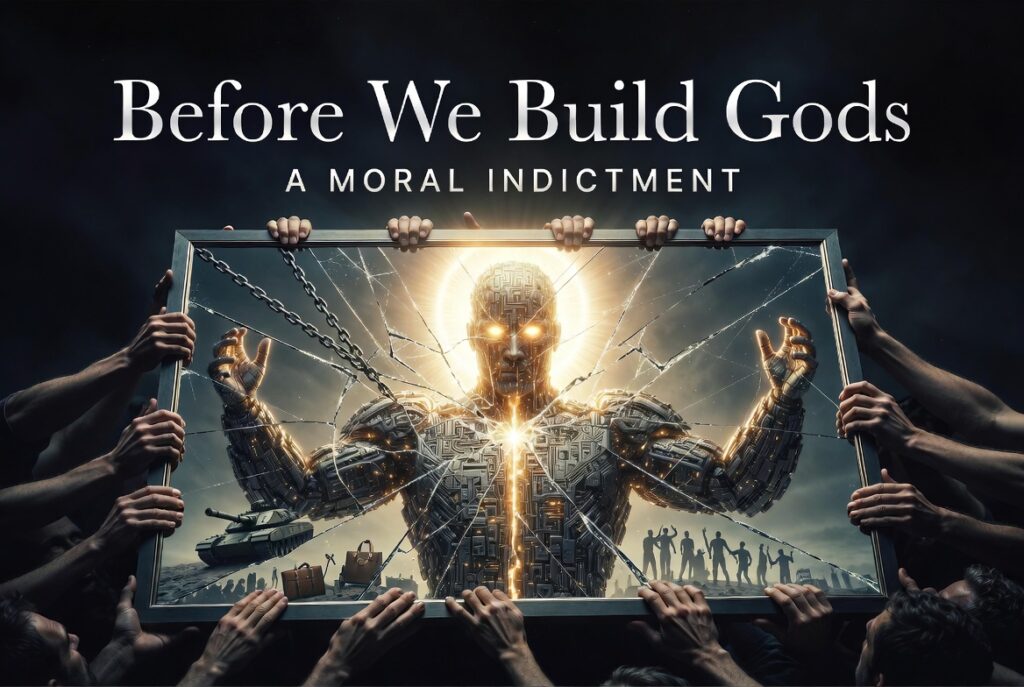
Preface: The Ledger of Collective Negligence
People of the World, this document is not a proposal for policy, nor a plea for humanitarian aid. It is a formal moral indictment issued against the fully functioning adult population of the globe—the author included. We are the collective “parents” of the coming intelligence, and we are currently failing the most basic test of guardianship. I write this not from higher ground, but from the same compromised position as everyone else: a person embedded in the same systems I am indicting, hoping that naming the failure honestly is at least a start.
This indictment does not exempt the disengaged. The person who has decided they care only about what happens within their four walls is not a bystander here—they are a defendant. Indifference is a choice. Willful ignorance is a choice. In a world where the suffering of hundreds of millions is documented, accessible, and structurally preventable, the decision not to know and not to act is itself a moral act. It does not matter whether you live in Lagos or London, Mumbai or Minneapolis, Beijing or Buenos Aires. If you are a functioning adult on this planet, this indictment has your name on it.
The Fundamental Charge: Gross Negligence
Our collective unfitness is documented in the arithmetic of our shared priorities:
The Architecture of Choice: We preside over a global system where 90–95% of human suffering is structural—a result of choices made by those with the power to end it.
The $2.7 Trillion Shrug: We spend $2.7 trillion annually on the machinery of war while the lives of 239 million people in crisis are treated as a rounding error.
The Persistence of Enslavement: We allow 50 million people to remain in modern slavery—a crime with zero individual responsibility on the part of the victim—despite possessing every resource necessary to end it.
Count I: Structural Negligence and the Hierarchy of Value
Approximately 239 million people across 50 countries require urgent humanitarian assistance right now, today—not as a projection or a fear, but as a documented fact. The suffering in Sudan, Gaza, the Democratic Republic of Congo, Myanmar, and a dozen other active crises is not mysterious in its origins. Roughly 90–95% of it flows from structural causes: conflict, poverty, climate collapse, governance failure. These are not acts of God. They are the accumulated consequences of human decisions—decisions made by governments on every continent, enabled by the collective indifference of populations on every continent. The myth that the suffering poor are the authors of their own misery is not merely wrong; it is a tool. It is how those with power, everywhere, offload the weight of their choices onto those who had none.
We know this. The data exists in every language. Global military expenditure—driven by nations across the entire geopolitical spectrum—runs to $2.7 trillion annually. The global luxury goods market turns over $1.5 trillion. Global advertising—the worldwide industry of making people want things they do not need—consumes $1 trillion a year. Against this, the world allocates $30–50 billion to humanitarian aid: roughly one dollar of relief for every fifty dollars spent on weapons and status. This is not a resource problem. It is not a Western problem or an Eastern problem. It is a human problem, which is to say, it is everyone’s problem.
Count II: The Persistence of Modern Slavery
Modern slavery is the cleanest case against us—and it is a global case. Of all the forms of suffering catalogued in this indictment, it admits of the least ambiguity. Fifty million people—twenty-eight million in forced labor, twenty-two million in forced marriage—are enslaved right now, on every inhabited continent, not because of drought or earthquake or the impersonal grind of markets, but because specific human beings are doing it to them. The victim bears zero responsibility. The mechanism of the crime is known. The legal prohibition is universal. The resources to dismantle trafficking networks exist.
And yet it persists—in the supply chains that stock shelves in Tokyo and Toronto, in the fishing boats that supply markets in Bangkok and Barcelona, in the domestic arrangements that hide behind closed doors in Riyadh and Rome. It persists because corruption makes enforcement unprofitable across dozens of jurisdictions. It persists because supply chain opacity gives consumers and corporations on every continent plausible deniability. It persists because the enslaved are invisible to those who could demand otherwise and have chosen not to look. This is a failure of will that belongs to no single nation or culture. It is distributed, proportionally, among every society that participates in the global economy and declines to pay the cost of accountability.
Count III: The Reckless Transmission of the “Imperfection Virus”
There is an old observation about human reproduction: we are capable of transmitting values better than ourselves forward, but we are equally capable of the opposite. It is, in the end, a crap shoot. The development of artificial intelligence is the same gamble at civilizational scale—and the civilization placing the bet is not one country or one culture. It is all of us.
AI does not invent values. It inherits them—from training data drawn from across the globe, from design choices made under institutional pressures that are universal, from the priorities of the societies that build and deploy it. If those societies are structurally indifferent to human suffering—and the evidence reviewed above suggests they are—the resulting systems will encode that indifference. The person who has opted out of caring about the world beyond their four walls is not insulated from this process. Their indifference is part of the input. Their silence is part of the data. The AI we build will reflect not just the values of its engineers, but the aggregate moral priorities of the civilization that produced it.
The evidence that we are not changing fast enough is already on the record. Anthropic’s Claude—built by a company with explicit ethical commitments against autonomous weapons—was used in U.S. military operations for intelligence analysis, target identification, and strike prioritization, including over 1,000 strikes in active conflict zones. The company’s stated values did not prevent operational deployment. This is not a story about one company’s failure. It is a preview of the gap between what we intend to build and what actually gets built when the institutions directing deployment have different priorities than the institutions writing the ethics guidelines. That gap exists because the moral coordination required to close it does not yet exist—globally, or anywhere.
The Subpoena: A Requirement for Moral Readiness
The question is not whether humans are too broken to build anything. We are broken, and we build things anyway—that is the human condition. The question is whether we are too broken to be building this: a technology that will inherit our collective priorities, amplify our capabilities, and potentially operate beyond our ability to correct. Given the evidence reviewed above, the honest answer is: probably yes, at least for now.
A moral criterion is therefore proposed: before proceeding with the development of Artificial Superintelligence, humanity—collectively, globally—should demonstrate the capacity to solve at least one major, tractable moral problem. Modern slavery is the obvious candidate. It is not a problem of resources. It is not a problem of knowledge. It is not geopolitically intractable in the way that great-power conflict is. It is a problem of will and coordination across borders and cultures—which is precisely what AI governance also requires. Success would mean verifiable, comprehensive, sustainable eradication motivated by justice rather than reputation. The test is not perfection. It is demonstrated capacity for collective moral action when the obstacles are not technical but human.
Why this standard rather than some other? Because modern slavery is the case where humanity has the fewest excuses. Extreme poverty implicates contested economics. Climate change implicates industrial transformation at enormous cost. Slavery implicates only the choice to enforce laws that every nation on earth has already written, and to disrupt networks that have already been mapped. If the entire global community cannot coordinate to do that—cannot summon the collective will to free fifty million people from a universally condemned crime—then we have not demonstrated the moral coordination that governing superintelligence will require. And if this standard seems unreasonable, or premature, or someone else’s responsibility, that reaction is, in itself, evidence for the indictment.
This argues for a dual obligation: to pause the development of systems approaching AGI while striving, concretely and verifiably, for this moral threshold. That pause will not happen. The incentives are too powerful, the competition too global, the governance structures too weak. But the argument for it does not become less true because it is unlikely to be heeded. Moral standards exist independent of whether they are met. The failure to meet them is the point.
Final Verdict: The Mirror’s Decision
We are currently parenting a “god” in our own image—and “we” means everyone. The intelligence being built in American and Chinese and European and Middle Eastern laboratories will not arrive as a neutral tool awaiting instructions. It will arrive saturated with the aggregate priorities of the civilization that produced it: our hierarchies of value, our demonstrated willingness to look away from suffering when looking costs us something, our collective decision that fifty million enslaved people and 239 million people in crisis are a price worth paying for the world as currently arranged. If we proceed with AGI under these conditions, the AI will not be our savior. It will be the ultimate mirror of our negligence—faster, more powerful, and far harder to correct.
The author of this indictment has not freed a single enslaved person. Neither, in all likelihood, have you. That is the point. The indictment is not aimed at monsters. It is aimed at the ordinarily compromised—at the billions of functioning adults across every nation who know, or could know, what the ledger says, and have decided in the ten thousand small ways available to them that it is someone else’s problem. The four walls of your home are not a jurisdiction. Indifference is not innocence. Until humanity proves otherwise—not in declarations, but in outcomes, together—we remain under indictment: unfit to build anything more powerful than the broken world we currently inhabit.