
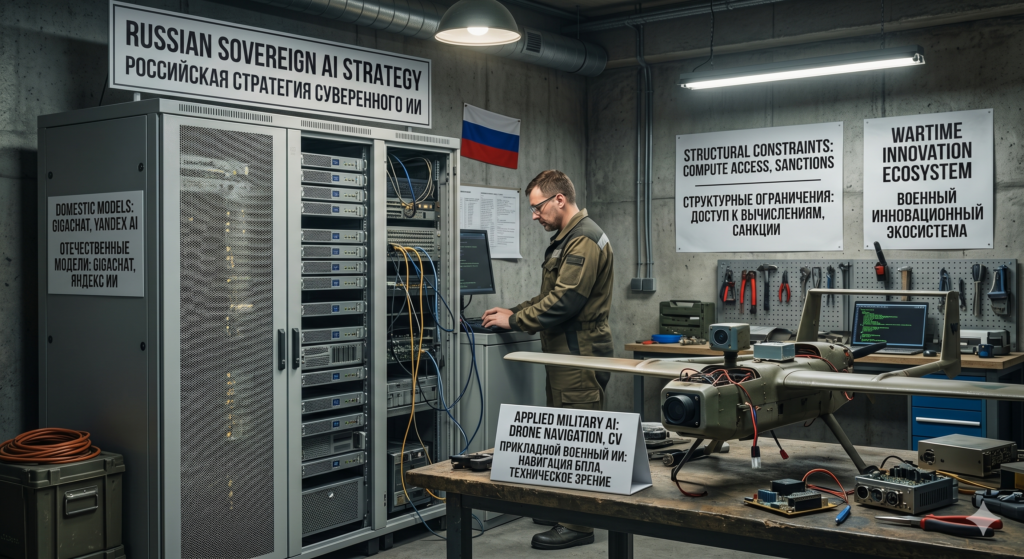
Russia’s playing its own game in developing and integrating AI. Its strongest capabilities lie in applied, state-backed, and dual-use AI systems rather than in creating globally leading foundation models or in the compute ecosystems required to sustain frontier research at scale.
The core pattern is strategic adaptation rather than frontier leadership. Russian institutions are trying to build sovereign AI stacks, domestic large language models, and a wartime innovation ecosystem, but they remain constrained by limited high-end compute, sanctions pressure, restricted scientific integration, and heavy reliance on adapting open-weight foreign models for local deployment.
The Short Answer
Russia is best understood as a second-tier AI power with real state capacity, meaningful domestic platforms, and growing military AI competence, but without the compute base, semiconductor access, research depth, or private capital ecosystem needed to set the global frontier in general-purpose AI.
This distinction matters analytically. In generative AI, Russia can field domestic alternatives such as Sber’s GigaChat and Yandex’s AI systems for Russian-language use cases, enterprise deployment, and public-sector integration; in frontier AI, however, it remains downstream from advances made elsewhere and often depends on adapting external architectures and open models.
Frontier AI Versus Russian AI
“Frontier AI” implies the ability to train and deploy the world’s most capable general-purpose models, supported by leading-edge chips, large-scale data-center infrastructure, elite research teams, and broad commercial ecosystems. The available evidence indicates that Russia does not currently compete at that level, even though it is investing seriously in AI as a strategic technology.
Russian policy documents, as summarized by CSIS, explicitly frame the country’s AI strategy around applied and dual-use deployment rather than direct competition with the leading powers in foundational AI research. The same analysis notes that Russia acknowledges limited access to advanced compute and international scientific cooperation, and therefore seeks to integrate algorithms and models developed abroad into domestic applications across defense, security, and industry.
Domestic Model Development
Russia does have serious domestic model-building efforts. Reuters reported in June 2025 that Sber planned to unveil a version of GigaChat with reasoning capacity, and that roughly 15,000 Russian enterprises were already using GigaChat, suggesting meaningful internal adoption even if not global frontier status.
Sber has also publicly positioned GigaChat as a model built for Russian-language and Russian-context tasks, while outside reporting in 2026 described successive releases including multimodal upgrades and a flagship reasoning model. That reporting should be treated more cautiously than Reuters or official material, but it still indicates sustained domestic investment in homegrown model development and branding around “sovereign” Russian AI.
Yandex is the other major domestic pole. Reuters noted in 2025 that Yandex had integrated reasoning capabilities into its search engine, underscoring that Russia’s top tech firms are attempting to keep pace with global interface and model trends, even if they are not setting those trends internationally.
Structural Constraints
The biggest obstacle is compute. CSIS reports that Russia’s own strategy recognizes limited access to advanced computing resources and international scientific cooperation, and therefore emphasizes applied deployment over foundational-model competition.
Sanctions and export controls deepen that problem. A 2025 sanctions overview noted heavy enforcement around advanced semiconductors, GPUs, and related manufacturing equipment, including scrutiny of procurement routes serving Russian military and supercomputing end uses.
These restrictions do not mean Russia has no access to advanced chips, but they do raise costs, complicate scaling, and push procurement into gray channels or indirect supply routes. Even commentary sympathetic to sovereign-AI narratives acknowledges that compute access and infrastructure have become central geopolitical bottlenecks for Russia’s AI ambitions.
The State-Led Model
Russia’s AI push is unusually state-driven. CSIS describes a system in which presidential decrees, national strategies, federal programs, and a new presidential commission tie AI development to technological sovereignty, industrial policy, digital governance, and defense modernization.
That architecture has intensified since 2025. According to the CSIS report, Vladimir Putin called for a National AI Headquarters, emphasized sovereign AI for public administration and security, linked AI development to national data-center expansion, and in February 2026 established a presidential commission tasked with domestic large language models, compute infrastructure, component supply, and energy support for AI systems.
This model gives Russia advantages in mobilization and coordination, especially in sectors where the state is the main buyer or organizer. It also creates familiar weaknesses: lower openness, weaker market signals, heavier bureaucratic control, and a tendency to prioritize political sovereignty and defense utility over broad-based innovation dynamism.
Military AI as Russia’s Strength
The clearest area of Russian progress is military and battlefield AI. CSIS concludes that Russia is not achieving frontier AI breakthroughs but is embedding narrow machine-learning functions into drones, battlefield software, navigation, and tactical autonomy with increasing effectiveness.
This matters because frontier status is not the only measure of strategic relevance. Russia may lag badly in the contest to build the best universal model, yet still gain significant military value by integrating computer vision, autonomous navigation, sensor fusion, and edge inference into mass-produced unmanned systems under combat conditions.
The same report argues that Russia has likely fielded autonomous unmanned systems in combat and is building an end-to-end ecosystem spanning production, training, regulation, test infrastructure, and human capital for unmanned systems. It also highlights plans for compute expansion to one exaflop by 2030, annual production targets for large-scale UAS manufacturing, and an expectation of one million UAS specialists by 2030.
Why the Battlefield Matters
War has given Russia something its civilian AI ecosystem otherwise lacks: a brutal but effective test environment. CSIS argues that innovation often emerges outside formal defense structures, is validated under wartime pressure, and is then scaled through state financing and procurement if it proves operationally useful.
That creates a form of accelerated applied-AI learning. In effect, Russia’s comparative advantage lies less in frontier model science than in rapidly adapting available AI tools to contested environments where communications are degraded, GPS is denied, and tactical feedback cycles are immediate.
Industrial and Human Capital Ambitions
Russia’s official strategy is not modest in its targets. CSIS summarizes plans to expand domestic computing capacity from 0.073 exaflop to 1 exaflop by 2030, grow the AI services market to 60 billion rubles annually, produce 450 top-level conference papers and 450 journal publications per year, and graduate 15,500 AI specialists annually by 2030.
Those goals show that Russian policymakers understand the ingredients of AI competitiveness: compute, research, developers, data, and sectoral deployment. The issue is less strategic awareness than execution under sanctions, war pressure, and structural limits in capital markets and global integration.
The unmanned systems strategy is similarly expansive, including production ambitions of around 130,000 UASs by 2030, national airspace integration tools, new testing ranges, and large investments in training pipelines and protected communications. These targets reinforce that Russia’s AI strategy is deeply fused with industrial mobilization and military requirements.
How Russia Compares Internationally
Russia is not absent from AI, but it is absent from the top tier of frontier model competition. Its strongest firms can build nationally important models and services, especially for Russian-language markets, but they do not currently appear to match the scale of compute, research output, capital formation, or model performance associated with leading U.S. and Chinese frontier labs.
In practical terms, Russia resembles a sovereign-adapter power. It wants domestic control over key platforms and is willing to invest heavily in national substitutes, yet it often advances by repurposing or localizing external breakthroughs rather than originating them.
This puts Russia in a distinctive strategic position: behind at the frontier, but potentially dangerous and influential in applied AI domains where software adaptation, state direction, and wartime iteration matter more than being first to the next scaling law breakthrough.
What to Watch Next
Several indicators will show whether Russia is merely stabilizing an isolated national AI ecosystem or actually improving its strategic position. The first is whether Sber, Yandex, and other national champions can keep advancing domestic models without dependable access to frontier chips and cloud-scale infrastructure.
The second is whether AI cooperation with China evolves from rhetoric and opportunistic workarounds into durable compute, hardware, and research collaboration. Commentary in late 2025 indicated that Russia was increasingly pursuing bilateral technological corridors and deeper China-linked cooperation as Western restrictions tightened.
The third is whether the military-drone ecosystem spills over into broader AI competence. If battlefield autonomy, computer vision, and embedded AI pipelines help Russia accumulate data, talent, procurement experience, and industrial capacity, military applications could become the principal engine of Russia’s broader AI modernization.
Analytic Judgment
The best analytic judgment is that Russia is in the frontier AI race politically and strategically, but not technologically at the leading edge. It views AI as a pillar of sovereignty, military power, and state modernization, and it is building domestic institutions accordingly; however, its actual niche is not frontier general intelligence but applied, state-coordinated, and often military AI built under constraint.
That means Russia should not be dismissed as irrelevant. It is unlikely to produce the world’s leading frontier models soon, but it could still become a formidable AI power in selective domains where sovereignty, localization, and battlefield adaptation are more important than absolute model leadership.
Bibliography
Bondar, Kateryna. “How Russia Is Building a Sovereign Drone Ecosystem for AI-Driven Autonomy.” Center for Strategic and International Studies. April 12, 2026. https://www.csis.org/analysis/how-russia-building-sovereign-drone-ecosystem-ai-driven-autonomy.
OneLex Partners. “AI Sanctions 2025: Trends, Risks, and Practical Controls.” December 3, 2025. https://www.onelexpartners.com/news-and-insights/ai-sanctions-2025-trends-risks-and-practical-controls.
Reuters. “Russia’s Sberbank Plans to Unveil LLM with Reasoning Capacity.” June 18, 2025. https://www.reuters.com/business/finance/russias-sberbank-plans-unveil-llm-with-reasoning-capacity-2025-06-18/.