
Russia’s AI Supply Chain and the Architecture of Its Development Partnerships
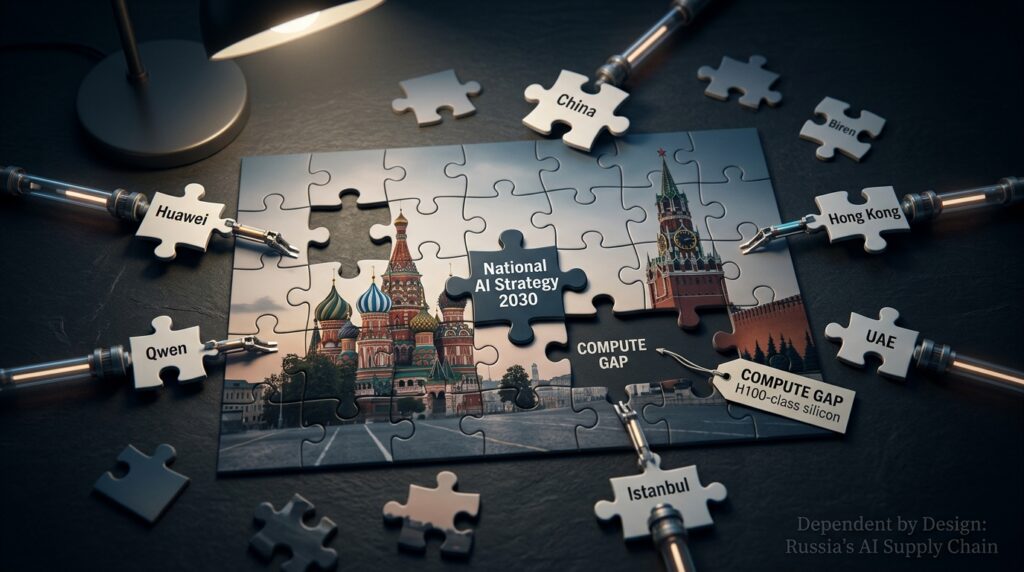
Russia entered the artificial-intelligence era with the rhetorical ambition of a great power. Its National AI Development Strategy, adopted by presidential decree in October 2019 and substantially revised in 2024, pledges to raise AI’s contribution to Russian GDP to eleven trillion rubles by 2030 and frames the technology as a theater of civilizational competition with the United States and China.1 That framing was already strained before the invasion of Ukraine, given Russia’s modest share of global AI research and its narrow semiconductor base. After February 2022, it became something stranger. The question for Moscow was no longer how to catch up with Silicon Valley or Hangzhou, but how to build any modern AI stack at all under export controls, sanctions, and the collapse of Western cloud, research, and capital-goods access.
The answer Russia has constructed over the past four years is not a sovereign program in any meaningful sense. It is a patchwork: a near-total dependence on Chinese distributors for advanced semiconductors, a grey-market procurement architecture that routes Western chips through Hong Kong, the United Arab Emirates, Turkey, Malaysia, India, and a shifting cast of Eurasian transit states, and a set of asymmetric bilateral relationships with Iran and North Korea that trade battlefield data and weapons know-how for parts, people, and tactical leverage. Behind that external scaffolding sits a domestic ecosystem — Sberbank, Yandex, T-Bank, and a handful of smaller players — capable of producing useful Russian-language models but structurally unable to train at the frontier because the compute is not there to be had.
That architecture matters beyond Russia. It reveals the limits of technological autarky under sanctions, the real exchange rate between military leverage and chip access, and the contradiction at the heart of “sovereign AI” when the hardware, models, and compute come from elsewhere. The supply chain tells a quieter story than the Kremlin’s strategy documents, but it may be the more decisive one.
I. The Hardware Problem: Life After Sanctions
Before 2022, Russia sourced advanced semiconductors through three channels that were unremarkable by global standards: direct imports of AMD, Intel, and Nvidia products; a modest line of Russian-designed processors fabricated at TSMC in Taiwan; and a small domestic, defense-oriented production base concentrated around Zelenograd. The February 2022 invasion collapsed two of the three almost overnight. Western vendors exited. Taiwan cut off fabrication. Russia was left with a hardware base defined by whatever could be smuggled, substituted, or re-engineered.
By 2023, Chinese distributors had absorbed the resulting void. American Enterprise Institute analysis by Chris Miller, echoed in parallel reporting by Tom’s Hardware, put China’s share of Russian semiconductor imports at roughly 88 to 89 percent by value, much of it flowing through Shenzhen and Hong Kong intermediaries operating, in Miller’s formulation, “in a grey area of international laws” with Beijing’s tacit forbearance.23 Prices reflected the constraint. Russian buyers paid approximately $2,730 per kilogram of imported chips in 2023, compared with $1,411 per kilogram in 2021. That near-doubling functions as a structural tax on every Russian sector that depends on digital hardware.
The rest of Russia’s frontier-relevant chip flow moves through a sprawling sanctions-evasion network. Between August and December 2022, Hong Kong alone exported an estimated $750 million in controlled high-priority goods to Russia. Investigative reporting has traced roughly $300 million in Dell PowerEdge XE9680 AI servers and comparable Nvidia-powered systems to the Indian pharmaceutical trader Shreya Life Sciences, re-exported through Malaysia between April and August 2024.4 Malaysia has become a principal node for AI-grade hardware. Turkey contributed about $158 million in dual-use goods to Russian buyers in the first nine months of 2023, routed through Istanbul firms such as Enütek Makina; UAE microchip exports to Russia rose from $1.6 million in 2021 to $24.3 million in 2022, with total electronic-component shipments up roughly sevenfold.56
The Lansing Institute described the resulting system in a December 2025 assessment as a “hybrid procurement” architecture that existing export-control regimes cannot effectively trace: shell companies, layered offshore ownership, and serial re-export chains that rename the cargo at each frontier.7 A 2026 Kharon compliance survey documented active transit schemes through Armenia, the Maldives, Kyrgyzstan, Belarus, and Serbia, each functioning as a paper screen for chips whose ultimate consignee is often a Russian defense integrator or cloud provider.8
Domestic substitution has been the official answer, and it is not going well. MCST’s Elbrus-8C, still the flagship of Russia’s sovereign-processor line, is fabricated on a 28-nanometer process at a time when Intel and TSMC have moved into sub-5-nanometer territory. The newer Elbrus-8V7 adds basic INT8 and BF16 accelerator paths suitable for edge inference, but it benchmarks against mid-range Western CPUs from roughly 2016 to 2018. Baikal Electronics, now pivoting to RISC-V microcontrollers, plans to ship a million Baikal-U units in 2026 — useful for embedded applications, irrelevant to large-model training, and tellingly far removed from the company’s earlier high-end CPUs, which were fabricated at TSMC before the break.9 Russia has begun limited domestic RAM production, but it lacks the foundry capacity, EUV photolithography tools, and upstream materials networks required to close the gap without outside help. For frontier AI, the domestic stack is not merely behind. It is missing the category.10
II. The China Partnership: The Asymmetric Axis
The February 2022 joint statement between Vladimir Putin and Xi Jinping, with its much-quoted phrase about a friendship with “no limits,” provided the rhetoric for what the hardware data now show plainly: Russia’s AI program is materially Chinese. Chinese distributors account for the overwhelming majority of Russian chip imports. Chinese cloud infrastructure increasingly hosts the training and inference workloads that Russian firms cannot economically run on sanctioned Western silicon. Chinese open-weight models, rather than Western ones, now form the substrate on which several Russian developers fine-tune.
The relationship deepened through 2024 and 2025. Putin ordered the Russian government and Sberbank to build a structured AI cooperation track with China, covering joint research, the possible launch of an international AI journal, and coordinated training runs.11 Sberbank CEO German Gref acknowledged in the same period that graphics processing units were among the most difficult Western technologies for Russia to substitute domestically. By January 2025, the Shanghai AI Research Institute had confirmed plans to deepen its relationship with Sberbank.12
The technical consequences are visible in the Russian model roster. Several emerging Russian language-model efforts now fine-tune atop Chinese open-architecture releases — especially DeepSeek and Qwen — on compute borrowed or rented from Chinese providers. The Valdai Club, a pro-Kremlin analytical forum, has argued that “joint AI clusters and distributed China-Russia data centers may become a new form of energy diplomacy,” framing Chinese compute as a counterpart to Russian gas: cross-border, infrastructurally embedded, and politically mediated.13 The Russia-China Investment Fund has also directed capital into Chinese AI-chip firms, including Biren Technology, whose GPUs are positioned to compete with Nvidia’s data-center line.14
Huawei anchors the corporate side of the relationship. Its OpenLab in Moscow, established in 2019, seeded a Russian developer ecosystem around the Ascend AI processor family and the Atlas compute platform. In 2020, a joint cloud service with Sberbank — SberCloud.Advanced — brought Huawei infrastructure directly into Russia’s largest digital estate. Huawei has since delivered hundreds of projects across Russian industry, spanning telecoms, transport, and state-sector AI deployment.15
The military dimension tracks the civilian one. Defense officials from the two countries have discussed joint applications of AI to battlefield systems; Russian and Chinese forces have conducted exercises incorporating AI-enabled autonomy; and both states are collaborating on autonomous-weapons research programs whose outputs are rarely disclosed. The December 2024 launch of the BRICS AI Alliance Network, covering eighteen associations across fifteen countries, gave Moscow a multilateral vehicle for institutionalizing what is, at its core, a bilateral dependence on Beijing.16
The asymmetry is the part most often softened in official statements. Russia ranks thirty-first on the Tortoise Media Global AI Index. China ranks second. What Moscow can offer Beijing in exchange for chips, compute, and open weights is not comparable AI capability. It can offer battlefield experience against a NATO-armed adversary, legacy submarine and helicopter technology, and operational data from years of high-intensity combat in Ukraine. That is a meaningful exchange, but it is unmistakably the junior side of the ledger. The AI axis is real. It is also structurally tilted toward the partner that controls the fab.
III. Iran and the Weapons-for-Technology Circuit
Russia’s partnership with Iran is both the loudest of its AI relationships and the most narrowly military. A twenty-year strategic partnership treaty signed in January 2025 and ratified by the Iranian parliament in May of that year gave formal shape to what had, since 2022, been an improvised weapons-and-services circuit built around the Shahed-136 loitering munition.17 In December 2025, officials from both states met in Moscow at the fifth Joint Working Group on Communications and Information Technology and signed a memorandum of cooperation spanning AI, cybersecurity, smart-government platforms, blockchain, fintech, and the broader digital economy.18
The substance, however, remains dominated by the drone file. Under a $1.7 billion agreement concluded after the invasion, Iran supplied Russia with Shahed airframes and production assistance. Russian engineers then retrofitted the platform with AI-enabled autonomous-piloting routines, improved satellite connectivity, anti-jamming hardening, and updated navigation stacks. By March 2026, reporting in the Wall Street Journal and elsewhere indicated that those upgrades were flowing back to Iran, completing a closed technology loop in which each partner incrementally improves a shared weapon.1920
In March 2024, the two states formalized a parallel AI cooperation track covering joint research, AI-enabled defense systems, and industrial automation. Russian specialists have since delivered advanced training courses in machine learning and robotics inside Iran. Dual-use semiconductor flows round out the picture: British-designed microchips, tracked by The Telegraph across roughly eight hundred shipments between 2022 and 2024, reached Russian cruise-missile assembly lines through intermediaries in North Korea and Hong Kong, with Iran often serving as a downstream recipient of reverse-engineered components.
The partnership’s limit is structural. Neither Russia nor Iran can supply the other with frontier AI compute. Both import their advanced silicon from third parties, and both are constrained by overlapping sanctions regimes. What they exchange is operational data, drone architecture, routing expertise for sanctioned hardware, and a shared interest in proving that the Western technology perimeter leaks. That is real tactical value, especially for electronic warfare and autonomous navigation. It is not a basis for catching the frontier.
IV. North Korea: The Silent Partner
The June 2024 Comprehensive Strategic Partnership between Russia and North Korea is the most opaque leg of the architecture, and deliberately so. Its science-and-technology cooperation clause includes an explicit provision that “certain programs should not become the subject of public disclosure,” language that functions in practice as a secrecy regime over advanced-technology transfer.
What is visible is the barter. North Korean munitions support — troops, artillery shells, and ballistic components — between August 2023 and December 2025 has been valued at between $7.67 billion and $14.4 billion, with analysts estimating that 80 to 96 percent of that value was settled not in hard currency but in advanced military technology and precision components flowing from Russia to Pyongyang.21 Those flows include satellite and missile-related know-how whose AI adjacency is obvious even where the specifics remain hidden.
The AI component is real but narrow. North Korean students and researchers are being sent to Moscow to acquire AI capability, and Pyongyang’s own institutes have published progress on the Riyongma translation application, covering seven languages. At the same time, North Korea has functioned as a transit jurisdiction for Western dual-use chips moving into the Russian defense sector, placing it inside the same grey-market architecture that runs through Hong Kong and Central Asia. Its three operating semiconductor facilities impose a hard ceiling on how much of an AI stack Pyongyang can itself contribute. For now, this is a munitions-for-technology trade with AI as a subsidiary file.
V. The Domestic Ecosystem: Ambition Against Constraint
Inside Russia, the AI market is projected to grow 25 to 30 percent in 2025, reaching roughly 1.9 trillion rubles, or about $21 billion. It is dominated by five firms, led by Sberbank, Yandex, and T-Bank. The headline program is Sberbank’s GigaChat line, launched in April 2023 on the proprietary NeONKA architecture, a Mixture-of-Experts design. GigaChat Ultra, released in March 2026, open-sources its model weights, ranks first on the Russian-language MERA benchmark, and reportedly outperforms GPT-4o and DeepSeek-V3 on Russian-specific tasks. Approximately 15,000 Russian companies have deployed it, and Sberbank has announced plans to embed the model in Roscosmos ISS systems.222324
T-Bank, formerly Tinkoff Bank, brings a different profile. Russia’s second-largest bank by customers, with 48 million users as of the end of 2024, it has pursued an “AI First” strategy dating back to 2019, when it built the Kolmogorov cluster, then ranked the eighth most powerful supercomputer in Russia. Its AI research division, T-AI Research, released the Gen-T family of large language models: T-Lite, a 7-billion-parameter model released in July 2024, and T-Pro, a 32-billion-parameter model released in December 2024. Both were openly built on Alibaba’s Qwen 2.5 open-weight architecture and fine-tuned for Russian. T-Pro ranks first among open models in its weight class on MERA, ruMMLU, and MT Bench Russian-language benchmarks, and second among all models behind only GPT-4o. T-Technologies has reported approximately ten billion rubles in measurable AI-driven financial impact across the bank’s operations.3435
Yandex has pursued a parallel track. YandexGPT 5.1 Pro, released in August 2025, offers a 128,000-token context window and a Chain-of-Reasoning mode; the company’s Alice AI now tops the Russian-language SLAVA benchmark. Yet independent evaluations have found that Russian models “do not outperform international competitors even on Russia-specific tasks,” with Chinese systems such as Kimi K2.5 handling Russian legal and cultural scenarios at least as well as domestic offerings.25
The gaps that matter are structural. Russia allocated ₽7.7 billion, about $86 million, to the federal “Artificial Intelligence” project in 2025 — a sum Amazon alone would spend in roughly eleven hours at its announced 2026 capital-expenditure rate of $200 billion per year. Meta, Microsoft, Google, and Amazon collectively plan to deploy more than $630 billion in AI and data-center infrastructure in 2026, with Alphabet committing approximately $185 billion, Meta up to $135 billion, and Microsoft on track for roughly $120 billion in the fiscal year ending June 2026. Amazon and Microsoft each individually outspend Russia’s entire federal AI budget by more than 2,000 to one.2631 Sberbank’s own first deputy CEO has publicly acknowledged that Russia is falling “months behind” China and the United States across a range of AI parameters. The compute gap is not merely an outside diagnosis. It is conceded inside the sector.
The human layer has thinned as well. Between February and November 2022, an estimated 11 to 28 percent of Russia’s active open-source software developers left the country, and those who left were disproportionately the most productive and internationally connected, accounting for roughly one-fifth of all collaborations between Russian and foreign developers.27 Russia’s Ministry of Digital Development has claimed that a large share of that émigré cohort had returned by 2024, using the figure to suggest a managed reversal of the brain drain.2836 But the claim is difficult to sustain. OutRush longitudinal data collected for the European University Institute found that only 8 percent of the full emigrant population had actually returned by 2023-2024.39
The difference is not a rounding error. Much of the higher official count appears to include workers who maintained Russian payroll while living abroad under precarious visa arrangements. RussiaPost reported in February 2025 that returning Russians most often said they had “no other choice,” citing financial stress, unstable living conditions, denied residence renewals, and trouble transferring money.37 Host countries associated with Russian tech-emigre concentrations, including Turkey and Georgia, reported widespread legal uncertainty. Only 5 percent of Russian emigrants intended to return within the next year, while 54 percent were concerned about their ability to remain legally in their current country. Sociologist Margarita Zavadskaya summarized the dynamic bluntly: “The probability of return for Russians who have lived abroad for more than two years tends toward zero.”38
Meanwhile, demand for European residency permits among Russian IT workers surged 233 percent in the first quarter of 2024. The pattern is not reconciliation so much as sorting. Some workers are being pulled back by visa pressure, banking problems, and payroll dependency. The genuinely mobile — those with EU residency, foreign employer relationships, or enough savings to weather uncertainty — continue to move west. The research-infrastructure side has fared worse. The Skolkovo-MIT partnership collapsed in the first weeks of the invasion, and sanctions hit Skolkovo itself in February 2022, ending the clearest conduit between Russian AI research and the Western academic mainstream.29
Against that erosion, Putin signed an updated National AI Strategy in 2024 and, in January 2026, established a national AI headquarters intended to coordinate the Ministry of Digitization, federal agencies, and private industry — an implicit admission that the existing governance model lacked, in official language, “enough administrative resources to manage the industry.” The same period has seen Russian regulators harden their definition of “sovereign AI”: systems whose development, training, and operation take place entirely on Russian soil, by Russian citizens, using only domestically formed datasets. The framework is politically useful, but it forecloses cheap integration with foreign cloud compute and foreign data corpora, accelerating the very isolation it claims to overcome.30
That regulation creates an immediate paradox. T-Bank’s T-Pro and T-Lite models, released in December 2024 and July 2024 respectively and benchmarked favorably against GPT-4o in Russian-language tasks, are openly built on Alibaba’s Qwen 2.5 architecture. T-Technologies has acknowledged that this reduces development costs by 80 to 90 percent compared with training from scratch.3233 Sberbank’s GigaChat family, while architecturally proprietary, relies on Chinese cloud infrastructure and Huawei’s Atlas computing platform for training workloads that cannot be accommodated on domestic hardware. The models that most successfully serve the Russian-language market are, under the letter of Russia’s own sovereign-AI framework, non-compliant. The government has chosen not to enforce that contradiction because enforcing it would cripple the sector entirely.
VI. Belarus and the Eurasian Perimeter
Belarus occupies a strange place in Russia’s AI architecture: not a technology partner in any serious sense, but an indispensable logistics corridor and political buffer. A Belarusian national was arrested in November 2025 for allegedly orchestrating a scheme that routed US-sourced aviation components to Russia through Armenia and the Maldives, a case that captures the country’s practical role more accurately than any ministerial communique.
Through the Shanghai Cooperation Organisation, the Collective Security Treaty Organization, and the BRICS AI Alliance Network, Russia has stitched together a looser outer ring of cooperation agreements with Azerbaijan, Serbia, Ethiopia, Indonesia, Cuba, Morocco, and others. These states mostly offer market access, regulatory alignment, and diplomatic cover rather than meaningful technical collaboration. Belarus itself remains interwoven with Russian digital infrastructure through shared networks and joint state programs, but its indigenous AI capability is negligible. Its real contribution is geography: a sanctions-porous land bridge between Russia and the European Union, and a co-signatory to whatever multilateral framework Moscow next chooses to announce.
VII. Strategic Assessment: The Architecture of Dependence
Viewed whole, Russia’s AI supply chain is not a strategy so much as an adaptive patchwork. Its four main elements are easy to identify: a China dependency that accounts for roughly 88 to 89 percent of all chip imports; a grey-market procurement network that moves frontier AI hardware through Hong Kong, the UAE, Turkey, Malaysia, India, Armenia, the Maldives, Kyrgyzstan, Belarus, and Serbia; militarized bilateral exchanges with Iran and North Korea that convert weapons and operational data into tactical AI capability; and a domestic ecosystem that is functional at the Russian-language application layer but fundamentally compute-constrained at the frontier.
The binding constraint is compute. Sberbank’s Alexander Vedyakhin acknowledged in November 2025 that the computing-capability gap between Russia and the leading AI powers “may widen,” language that functions as a quiet concession that current trajectories are not closing it. Without access at scale to H100-class GPU clusters — or to Chinese equivalents, themselves constrained by US export controls — Russian laboratories cannot train frontier models on their own. They can only fine-tune open Chinese architectures, refining the top layer of someone else’s stack.
That dependency has political consequences. Beijing controls the hardware, the dominant open-weight releases, and an increasing share of the cloud on which Russian workloads run. In exchange, it receives military technology transfers, operational data from the Ukraine theater, and geopolitical cover in forums ranging from the UN Security Council to the BRICS. Iran and North Korea offer Russia tactical upside in drone targeting, autonomous navigation, and electronic warfare, but neither can contribute to frontier AI. Both are customers of the same grey-market supply that feeds Russian defense integrators.
The “sovereign AI” framework codified in recent Russian regulation is, from a policy standpoint, both a political necessity and a strategic liability. It makes Russian AI legally legible and defensible in Kremlin terms, but also increasingly inaccessible to the global open-source ecosystem on which smaller AI programs usually depend. Russia’s implicit bet is that the BRICS AI Alliance Network and the continued rise of Chinese silicon will, over a decade-long horizon, construct an alternative technology stack that routes around Western semiconductor dominance. That bet is not obviously wrong in the long term. But in the near term — the horizon that matters for the Ukraine war, economic modernization, and the political legitimacy of the regime’s technological claims — Russia occupies a structurally dependent position in a supply chain it does not control, reliant on partners whose incentives it cannot fully align with its own.
Conclusion
Russia is building AI under conditions of siege, and the resulting partnerships have sorted themselves by function. China is indispensable: it supplies the chips, the open-weight models, and increasingly the compute on which Russian AI depends, and it does so on terms that reflect Moscow’s junior position. Iran and North Korea are tactical: useful for drones, barter, and sanctions-evasion infrastructure, but incapable of contributing to a frontier program. Belarus and the broader Eurasian perimeter are logistical: corridors and political cover rather than technology partners. The domestic ecosystem is politically necessary and technically constrained; it can produce credible Russian-language products, but it cannot, on its current trajectory, close the frontier gap.
What Russia has constructed, in other words, is not an independent AI program. It is a dependency architecture — an arrangement that trades military technology, battlefield experience, and geopolitical alignment for the hardware, models, and compute it cannot generate at home. That architecture may prove durable, particularly if the Chinese stack continues to mature and the Western export-control regime continues to leak. But it is also an architecture in which Russia, for the first time since the early Cold War, has accepted technological junior-partner status on the frontier its leaders insist will define the century. Whatever the National AI Strategy’s rhetoric says about competing with Washington and Beijing, the supply chain says something quieter and more decisive. Russia’s AI future, for now, is being built on borrowed silicon, and the lender holds the terms.
Notes
1. Russian Federation, “National Strategy for the Development of Artificial Intelligence for the Period Until 2030,” Presidential Decree No. 490 (October 10, 2019), revised 2024, https://tadviser.com/index.php/Article:National_Strategy_for_the_Development_of_Artificial_Intelligence.
2. Chris Miller, “China Providing 90% of Chips Used in Russia Despite Sanctions,” American Enterprise Institute, cited in Asia Financial, https://www.asiafinancial.com/china-providing-90-of-chips-used-in-russia-despite-sanctions.
3. Anton Shilov, “Nearly 90% of Chips Used in Russia Come From China Despite US Sanctions,” Tom’s Hardware, https://www.tomshardware.com/pc-components/cpus/nearly-90-of-chips-used-in-russia-come-from-china-despite-us-sanctions-report.
4. “Russia Finds Ways to Buy Sanctioned Nvidia Chips via India,” Yahoo Finance / Bloomberg, https://finance.yahoo.com/news/russia-finds-way-buy-sanctioned-092722601.html.
5. “How Russian Companies Circumvent Sanctions Through Turkey and the UAE,” Evidencity, https://www.evidencity.com/how-russian-companies-circumvent-sanctions-through-turkey-and-the-uae.
6. “Fortune Hunting: Russia and Sanctions Evasion,” Harvard International Review, https://hir.harvard.edu/fortune-hunting-russia-and-sanctions-evasion/.
7. “The Failure of Export Controls: A Legislative Blueprint to Prevent Technology from Powering Russia’s War Machine,” Lansing Institute, December 11, 2025, https://lansinginstitute.org/2025/12/11/the-failure-of-export-controls-a-legislative-blueprint-to-prevent-technology-from-powering-russias-war-machine/.
8. “Russia Sanctions and Export Controls Compliance in 2026: Detecting Evasion Networks and Layered Ownership,” Kharon, https://www.kharon.com/resources/article/export-controls/russia-sanctions-and-export-controls-compliance-in-2026-detecting-evasion-networks-and-layered-ownership.
9. “New Russian Chip on RISC-V Architecture: Baikal Electronics to Produce One Million Baikal-U Microcontrollers in 2026,” https://www1.ru/en/news/2026/02/17/novyi-rossiiskii-cip-na-arxitekture-risc-v-baikal-elektroniks-vypustit-million-mikrokontrollerov-baikal-u-v-2026-godu.html.
10. “Russia’s War-Driven Chip Exports Drop as Sanctions Bite,” Business Insider, https://www.businessinsider.com/russia-war-semiconductor-chip-advanced-tech-exports-us-sanctions-china-2024-7.
11. Guy Faulconbridge, “Putin Orders Russian Government, Top Bank to Develop AI Cooperation with China,” Reuters, January 1, 2025, https://www.reuters.com/technology/artificial-intelligence/putin-orders-russian-government-top-bank-develop-ai-cooperation-with-china-2025-01-01/.
12. “China-Russia Relations, January 2025,” Council on Foreign Relations, https://www.cfr.org/articles/china-russia-relations-january-2025.
13. “China-Russia Cooperation in the AI Era,” Valdai Discussion Club, https://valdaiclub.com/a/highlights/china-russian-cooperation-in-the-ai-era/.
14. “The Building Blocks of an AI Axis,” Special Competitive Studies Project, https://scsp222.substack.com/p/the-building-blocks-of-an-ai-axis.
15. “China-Russia AI Cooperation Enters a New Phase,” Global Times, October 2025, https://www.globaltimes.cn/page/202510/1346786.shtml.
16. “Russia Teams Up With BRICS to Create AI Alliance, Putin Says,” Reuters, December 11, 2024, https://www.reuters.com/technology/artificial-intelligence/russia-teams-up-with-brics-create-ai-alliance-putin-says-2024-12-11/.
17. “Iran-Russia AI and Cybersecurity Pact Signed in Moscow,” Iran International, December 2025, https://www.iranintl.com/en/202512063626.
18. “Iran and Russia Formalize AI and Cyber Cooperation in Moscow,” BABL AI, https://babl.ai/iran-and-russia-formalize-ai-and-cyber-cooperation-in-moscow/.
19. “Russia Sharing Satellite Imagery and Drone Technology With Iran, Report Says,” Times of Israel, https://www.timesofisrael.com/russia-sharing-satellite-imagery-and-drone-technology-with-iran-report/.
20. “Russia Is Sending Drone Tech Back to Iran,” Associated Press, https://apnews.com/article/russia-iran-drones-shahed-war-israel-ukraine-840b4f885d99714bdb7813c0d56213cf.
21. “North Korea-Russia Alliance: Barter, Advanced Tech, Risks and Human Cost,” AInvest, https://www.ainvest.com/news/north-korea-russia-alliance-barter-advanced-tech-risks-human-cost-strategic-overreach-2603/.
22. “Russia’s Sberbank to Unveil Reasoning LLM GigaChat Ultra,” CryptoRank, https://cryptorank.io/news/feed/fefe1-russia-sberbank-to-unveil-reasoning-llm.
23. “Sberbank Launches GigaChat Ultra,” Al-Ahram English, https://english.ahram.org.eg/News/564776.aspx.
24. “Sberbank AI Strategy: An Analysis of Dominance in Banking AI,” Klover AI, https://www.klover.ai/sberbank-ai-strategy-analysis-of-dominance-in-banking-ai/.
25. “YandexGPT Review 2026,” MySummit, https://mysummit.school/blog/en/yandexgpt-review-2026/.
26. Margarita Konaev et al., “Russia’s AI Capabilities Gap,” Washington Quarterly, https://www.tandfonline.com/doi/full/10.1080/0163660X.2024.2435162.
27. “Emigration of Russian Developers After the Invasion of Ukraine,” EPJ Data Science, https://pmc.ncbi.nlm.nih.gov/articles/PMC10184088/.
28. “Russia’s War-Driven Brain Drain Reverses as Up to 45% of Émigrés Return Home,” Intellinews, https://www.intellinews.com/russia-s-war-driven-brain-drain-reverses-as-up-to-45-of-emigres-return-home-333531/.
29. “Ukraine War, Russia and the Remnants of Its Tech Industry,” MIT Technology Review, April 4, 2023, https://www.technologyreview.com/2023/04/04/1070352/ukraine-war-russia-tech-industry-yandex-skolkovo/.
30. “New AI Club Will Bestow ‘Nuclear-Like’ Power on Winners, Russia’s Top AI Executive Says,” Reuters, November 24, 2025, https://www.reuters.com/business/finance/new-ai-club-will-bestow-nuclear-like-power-winners-russias-top-ai-executive-says-2025-11-24/.
31. Alexandra Canal, “Big Tech’s $320 Billion Data Center Spending Spree Is Just the Beginning,” Fortune, February 6, 2026, https://fortune.com/2026/02/06/what-is-a-data-center-capex-spending-630-billion-dollars-amazon-microsoft-google-meta/.
32. “T-Bank Releases 32-Billion-Parameter LLM to the Public,” ForkLog, https://forklog.com/en/t-bank-releases-32-billion-parameter-llm-to-the-public/.
33. “T-Pro (Large Language Model, LLM),” TAdviser, https://tadviser.com/index.php/Product:T-Pro_(Large_Language_Model,_LLM).
34. “T-Bank Releases 32-Billion-Parameter LLM to the Public,” ForkLog, https://forklog.com/en/t-bank-releases-32-billion-parameter-llm-to-the-public/.
35. “T-Technologies Announces IFRS Financial Results for 4Q and FY 2024,” T-Technologies Investor Relations, March 20, 2025, https://tinkoff-group.com/company-info/news/20032025-t-technologies-announces-ifrs-financial-results-for-4q-and-fy-2024-eng/.
36. “Two-Thirds of Tech Workers Who Fled Country Have Returned, Russia Says,” Moscow Times, April 5, 2024, https://www.themoscowtimes.com/2024/04/05/two-thirds-of-tech-workers-who-fled-country-have-returned-russia-says-a84751.
37. “Back to Russia: Why Emigrants Are Returning,” RussiaPost, February 2025, https://russiapost.info/society/back_to_russia.
38. “Less Sadness, More Frustration,” Meduza / OutRush, March 26, 2025, https://meduza.io/en/feature/2025/03/26/less-sadness-more-frustration.
39. Emil Kamalov et al., “No Return Home: Russian Emigration After the Invasion,” European University Institute, June 2025, https://www.eui.eu/news-hub?id=no-return-home-russian-emigration-after-the-invasion-with-emil-kamalov-1.