
Greenland, Davos, and the Alliance After the Blow
When Donald Trump first floated the idea of buying Greenland in 2019, most observers treated it as an eccentric aside. Trump returned to the subject immediately after winning re-election in November 2024, and this time the framing was different. He was no longer musing about a real estate deal. He was issuing demands, attaching consequences, and deploying the instruments of American statecraft — trade policy, military alliance management, the personal authority of the presidency — against a NATO ally that had done nothing to provoke him except maintain sovereignty over an island he wanted.
What followed was not a diplomatic row. It was a structural test: of whether the post-1945 rules-based order could survive being treated as optional by the state that built it; of whether European allies could respond collectively under genuine pressure; of whether Greenland’s own population — long seeking a path to independence from Denmark — would be further liberated or further constrained by the world’s sudden attention. The answers to those questions are still unresolved, but the test itself has already changed things. Trans-Atlantic relations that emerged from Davos in January 2026 looking nominally intact were not the same as those that had entered 2025.
The Charm Offensive and the Escalation
Denmark’s national broadcaster DR identified three phases of the Trump administration’s strategy toward Greenland: a charm offensive directed at the island’s population, intensifying pressure on the Danish government, and an attempt to cultivate influence within Greenlandic society itself. This framework captures the tactical layering of what would otherwise appear to be an impulsive campaign.¹
The charm offensive came first. Trump’s son Donald Trump Jr. visited Greenland in early January 2025, landing by private jet in Nuuk with a film crew, handing out MAGA merchandise, and presenting the visit as a spontaneous gesture of solidarity with the Greenlandic people. The message was calibrated: Washington was not the enemy of Greenland’s aspirations; Washington was Greenland’s best exit from Danish control. That framing exploited a real fault line. Greenlandic politics has long been defined by a desire for self-determination — a desire deepened by the legacy of Danish colonial administration, including the forced relocation of the Inuit community of Thule in 1953 to accommodate a U.S. air base, a removal that is a matter of documented historical record.²
The pressure phase escalated rapidly. On January 6, 2025, Trump threatened to impose heavy tariffs on Denmark if it refused to cede Greenland, stating publicly that he would “tariff Denmark at a very high level.”² In December 2025, he appointed Louisiana Governor Jeff Landry as an informal special envoy to the territory. Denmark’s foreign minister Lars Løkke Rasmussen responded by summoning the U.S. ambassador and calling Landry’s public statements “completely unacceptable.”⁷
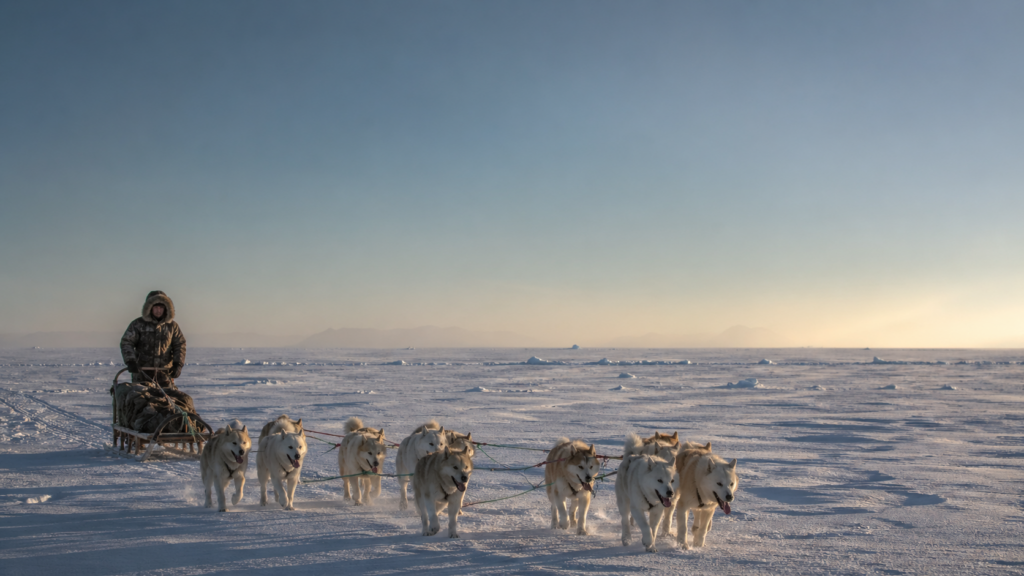
The rhetoric intensified through the turn of 2026. Trump declared that he would take Greenland “the hard way” if Denmark refused, stated that “I don’t need international law,” and suggested it “may be a choice” between seizing Greenland and preserving NATO.⁴ In January 2026, he posted on Truth Social: “NATO: Tell Denmark to get them out of here, NOW!” — alongside what he described as a condemnation of Denmark’s Arctic military forces, which he dismissed as “two dogsleds.”¹ He also posted an AI-generated image of himself, JD Vance, and Marco Rubio planting a U.S. flag on Greenlandic soil, an act of symbolic aggression that startled even allied governments accustomed to Trump’s theatrical style.
A Republican congressman, Randy Fine, introduced the Greenland Annexation and Statehood Act, providing legislative scaffolding for what the administration was presenting as a genuine policy objective rather than negotiating bluster.¹
The infiltration phase — DR’s third element — was the least documented of the three. DR’s reporting identified it as a category, noting that several American individuals had been observed conducting what the Danish foreign ministry described as “influence operations” in Greenland, which prompted Copenhagen to summon the U.S. envoy in August 2025.⁷ The specific actors and vectors were not fully detailed in public reporting. What can be said is that the strategy had a real target: a 2025 poll showed that 84% of Greenlanders want independence from Denmark, up from 67.7% in 2019.³ Greenland’s desire for self-determination is genuine and long-standing, and an influence operation designed to channel that desire toward Washington rather than Nuuk would have had something to work with. That it failed is confirmed by the polling. How hard it was actually tried remains less clear.
The three-phase framework matters regardless of how fully the third leg was executed. That a state actor would deploy charm, coercion, and societal infiltration simultaneously against a treaty partner’s dependent territory is a shift in the norms of allied behavior — not an anomaly of the Greenland case specifically, but a template whose components are individually familiar and collectively new.
The Tariff Weapon and the Trans-Atlantic Rupture
The campaign’s sharpest escalation came on January 17, 2026, when Trump announced 10% tariffs on Denmark, Norway, Sweden, France, Germany, the United Kingdom, the Netherlands, and Finland, rising to 25% on June 1. His stated justification was not trade policy. Trump explicitly named participation in Operation Arctic Endurance, a NATO military exercise conducted in Greenland, as the trigger.² Allies were being punished for exercising the collective defense that NATO exists to provide.
The response from European governments was swift and, by the standards of recent trans-Atlantic relations, unusually unified. Eight NATO allies issued a joint statement declaring “full solidarity” with Denmark and Greenland, warning that Trump’s tariffs “undermine trans-Atlantic relations and risk a dangerous downward spiral.”² UK Prime Minister Keir Starmer called the use of tariffs against allies “completely wrong.”² Sweden’s prime minister said Sweden would not be “blackmailed.” Norway’s prime minister stated that “threats have no place among allies.”²
The European Union considered retaliatory measures at a scale not previously deployed. France invoked the Anti-Coercion Instrument (ACI) — a mechanism designed to respond to economic coercion directed at EU member states — and the EU began assessing whether to activate it formally. Had the ACI been triggered, it would have been the first time since its creation. Separately, EU authorities examined a package of roughly €93 billion in retaliatory tariffs against American goods.⁵
This was not merely a political argument. It was the beginning of a structural reassessment. European governments had spent the four years since Russia’s 2022 invasion of Ukraine accelerating defense investment and debating strategic autonomy. Trump’s tariff offensive — aimed not at adversaries but at the allies who had just conducted a joint exercise in Greenland — confirmed the fears of those who had argued that American security guarantees could no longer be assumed regardless of European behavior. The message embedded in the January 17 announcement was that alliance membership itself might be conditional on acquiescence to American territorial demands.
Denmark’s Defence Committee chair Rasmus Jarlov articulated the most striking edge of this situation: he stated publicly that Denmark would invoke NATO’s Article 5 — the collective defense clause — if attacked by the United States.² Article 5 has never been invoked against a NATO member. The fact that a Danish official could raise this without it seeming absurd measured exactly how far the crisis had traveled.
The tariff episode accelerated a European defense realignment already underway. Germany amended its constitution to exempt some military and intelligence spending from its debt brake, with German defense expenditure expected to reach over €108 billion in 2026, up from €87 billion the previous year.³⁰ The EU’s ReArm Europe / Readiness 2030 plan mobilized €800 billion in defense spending; the Security Action for Europe (SAFE) instrument provided €150 billion in loans.²⁹ At the June 2025 NATO Hague Summit, alliance leaders had already agreed to a new defense spending benchmark of 5% of GDP by 2035 — split between 3.5% core military spending and 1.5% for resilience — up from the previous 2% floor.¹⁶ The Greenland crisis did not create this dynamic, but it sharpened it.
Greenland’s Own Voice
The premise of Trump’s campaign — that Greenlanders might welcome American acquisition — was contradicted immediately and repeatedly by the people it claimed to benefit.
Greenland’s Prime Minister Jens-Frederik Nielsen stated, without qualification, that “Greenland is not for sale.”³ Denmark’s Prime Minister Mette Frederiksen added: “You cannot annex another country. Greenland belongs to the Greenlanders.”³ Former Greenlandic Prime Minister Múte Egede, speaking in January 2025, put it most directly: “We do not want to be Danish, we do not want to be American. We want to be Greenlandic.”¹³
An opinion poll conducted in January 2026 found that 85% of Greenlanders opposed joining the United States, with only 6% in favor.³ This was not a population that regarded American acquisition as liberation. The gap between Trump’s framing — that he was offering Greenland freedom from Danish control — and the actual views of Greenlandic people was close to total.
The island held parliamentary elections in March 2025. Demokraatit, the Democrats, won a plurality, and the main parties across the political spectrum all voiced distrust of Trump’s intentions.¹⁴ Greenlandic politicians were navigating a genuinely complex situation. They wanted independence from Denmark — that desire is real and long-standing — but they did not want the United States to exploit that desire as a vehicle for annexation. The two goals were distinct, and the Trump administration had treated them as interchangeable.
The structural obstacle to Greenlandic independence is economic: the territory relies on an approximately $500 million annual subsidy from Denmark.³ Without economic self-sufficiency, full independence is not viable. Greenland’s path to genuine self-determination runs through resource development — fishing, tourism, and the mineral wealth beneath its ice — not through a transaction with Washington.
After the Davos de-escalation in January 2026, Greenlandic politician Tillie Martinussen put the situation plainly: “We can never really trust America again.”²⁵ That sentence carried more weight than the diplomatic communiqués. The United States had spent months asserting that it wanted to help Greenland. It had achieved the opposite of trust.
The 1951 Agreement and What America Already Had
One of the most underreported dimensions of the Greenland crisis was this: the United States already possessed extensive and legally secured rights over Greenland’s territory.
The Defense of Greenland Agreement, signed April 27, 1951, and updated in 2004, grants the United States military free access to Greenland’s designated defense areas. Its terms include freedom from compulsory pilotage and harbor dues, the right of free access to naval facilities, and the right to establish new defense zones in consultation with Denmark.¹¹ ¹² Thule Air Base — now Pituffik Space Base — has operated continuously under this framework for more than seven decades. The U.S. military presence in Greenland is not hypothetical or aspirational. It is large, legally grounded, and uncontested.
As former U.S. Ambassador to NATO Nicholas Burns told TIME magazine: “There’s a way for the Trump Administration to get what it says it wants, and that’s mineral access and military bases, by doing something that should be normal — respecting Denmark, working with them diplomatically.”⁴
The administration’s answer to that observation was implicitly given by its actions: the goal was not military access — that already existed. It was not mineral development in a narrow technical sense — that could be pursued through commercial and diplomatic channels. The goal appeared to be sovereignty itself, or at minimum the demonstration that the United States could compel European allies to accept demands that would have been unthinkable between treaty partners a decade earlier.
In June 2025, the U.S. Export-Import Bank sent a letter of interest for a $120 million loan to Critical Metals Corp for the Tanbreez rare earth mine in southern Greenland — the first proposed overseas mining investment of Trump’s presidency.⁸ The commercial rationale was genuine: as many as 25 of the 60 minerals the U.S. lists as critical for economic and national security are found in Greenland.⁸ But industry experts raised consistent objections: Greenland’s rare earth deposits are relatively low quality; extraction faces severe climate and logistics challenges; and any extracted material would still require processing in China, which holds a near-monopoly on rare earth refining.⁹ ¹⁰ Sovereignty would not resolve that bottleneck. Processing capacity would, and no amount of pressure on Denmark changes where the world’s rare earth refining infrastructure sits.
This is worth pausing on. The administration knew, or should have known, that the processing constraint exists and is not addressable by annexation. The Ex-Im loan to Critical Metals Corp is the behavior of a government pursuing commercial engagement — the normal diplomatic path Nick Burns described. The simultaneous threats of military force and tariffs are the behavior of a government pursuing something else. If the mineral rationale was sincere, the coercive approach was counterproductive. If the coercive approach was intentional, the mineral rationale was cover. Both cannot be fully true at once. The most coherent reading is the one the evidence supports: the goal was not the minerals. It was the demonstration.
NATO Under Strain
The Greenland crisis arrived in an alliance already recalibrating after years of American ambivalence. Trump’s first term had introduced genuine uncertainty about U.S. commitment to Article 5. His second term opened with a territorial demand against a member state, followed by tariffs targeting allies specifically for participating in a NATO exercise. The cumulative effect on alliance cohesion was severe.
The Trends Research Organization identified three structural shifts driving the deterioration: erosion of bipartisan U.S. support for European security commitments, increasingly divergent threat perceptions between Washington and European capitals, and the erosion of institutional trust that decades of reliable partnership had built.¹⁶ These are not temporary fluctuations. They reflect deeper realignments in American domestic politics that are unlikely to reverse regardless of which party holds the White House in future cycles.
The most acute institutional problem was the precedent. If economic coercion against allies — using tariffs to punish them for conducting joint military exercises — went unanswered and unpunished, it would become a template. European governments understood this. Their unusual degree of solidarity in January 2026, issuing a joint statement and seriously considering ACI activation, reflected not merely solidarity with Denmark but a calculation that a failure to respond would invite further demands.
Trump’s own framing made the stakes explicit. He stated publicly that it “may be a choice” between seizing Greenland and preserving NATO, presenting the alliance itself as a bargaining chip in a territorial acquisition campaign.⁴ No previous American administration, regardless of its frustrations with allied burden-sharing, had proposed dissolving NATO as leverage for a real estate negotiation.
NATO Secretary General Mark Rutte played a crucial stabilizing role through the winter, working to keep communications open between Washington and European capitals. His presence at the Davos talks in January 2026 helped broker the de-escalation — but his subsequent clarification that Danish sovereignty was not even part of those discussions underscored how far the conversation had drifted from normal alliance business.²⁶
The Arctic in Play: Russia, China, and the Governance Vacuum
Beneath the immediate diplomatic crisis lay a genuine strategic reality: the Arctic is becoming a contested space, and existing governance frameworks are weakening precisely when they are most needed.
The Arctic Council, the primary multilateral forum for Arctic governance, was partially suspended in March 2022 after Russia’s invasion of Ukraine — the seven Western member states paused participation. Norway restored partial activity under its chairmanship in May 2023, but Russia suspended its funding to the Council in 2024, leaving the body’s future uncertain.²⁰ ²¹ The institution designed to manage shared Arctic interests has been hollowing out at the moment those interests are sharpening.
China declared itself a “near-Arctic state” in 2018 and proposed a “Polar Silk Road” as part of its Belt and Road framework.¹⁸ In 2024, China and Russia conducted a joint Arctic patrol.¹⁹ The Pentagon’s 2024 Arctic Strategy identified China-Russia collaboration as the primary long-term threat to U.S. Arctic interests.¹⁹ These are not hypothetical concerns. The melting of Arctic sea ice is opening shipping lanes that could eventually allow transit from Asia to Europe in less time than the current southern routes, redistributing global trade geography in ways that make Arctic positioning strategically significant for any major power.
The paradox of the Greenland episode is that U.S. Arctic ambitions were strategically defensible in their underlying logic and strategically self-defeating in their execution. Genuine competition with China and Russia in the Arctic requires stable alliances with the countries that have Arctic territory: Canada, Norway, Denmark, Finland, Sweden, Iceland. Threatening Denmark over Greenland while tariffing Norway for participating in a NATO Arctic exercise actively damaged the alliance network that forms the foundation of Western Arctic presence. The Quincy Institute for Responsible Statecraft noted that Arctic governance requires sustained cooperation with precisely the partners the administration was simultaneously coercing.¹⁷
China’s Arctic strategy is patient, multi-layered, and explicitly long-term.¹⁸ The Trump administration’s approach was none of those things. The irony is that Trump’s stated rationale for wanting Greenland — protecting American strategic interests against Chinese and Russian expansion — was undermined by tactics that pushed European allies toward greater strategic autonomy from Washington.
Canada, Norway, and the Precedent Problem
Greenland was not the only target. Trump’s territorial maximalism ran in parallel tracks. He repeatedly threatened to make Canada the “51st state” and questioned the validity of the U.S.-Canada border treaty.²² ²³ He also linked his pressure on Norway — one of the Greenland tariff targets — partly to his frustration at not receiving the 2025 Nobel Peace Prize, writing to Norway’s prime minister that he no longer felt an “obligation to think purely of Peace.”¹ The Nobel comment is easy to read as petulance, and petulance it may partly have been. But it also revealed something structural: the administration was treating the formal infrastructure of international cooperation — prize committees, alliance exercises, trade agreements — as instruments of reward and punishment in a system where Washington sets the terms. The Peace Prize, the NATO exercise, the tariff threat: each was a node in the same transactional logic.
For Canada and Norway, the Greenland crisis raised a specific and transferable question. The Greenland playbook had three identifiable components: identify strategic value in an allied or dependent territory, frame the current governing arrangement as inadequate for security purposes, and apply economic coercion while not formally ruling out other measures. Each component is portable. Norway’s Svalbard archipelago — an archipelago with a treaty-governed demilitarized status and known mineral and fishery resources — fits the template exactly: strategic location, a sovereignty arrangement that dates to 1920 and has been contested before, and a small Norwegian administrative presence that could easily be characterized as insufficient. Canada’s Arctic territory is larger and the political complications greater, but the framing is available: Arctic shipping lanes, mineral resources, inadequate Canadian defense capacity relative to Russian and Chinese activity in the region.
The point is not that Trump was planning to move on Svalbard or the Northwest Passage next. It is that once the precedent is established — once a territorial claim against an ally can be made, sustained, and exited without cost — the threshold for the next application lowers. The template doesn’t require intent to be dangerous. It requires only that it worked.
A Policy Magazine analysis of Trump’s National Security Strategy noted that its framing explicitly treated the Western Hemisphere as a zone of U.S. primacy — a doctrine that sits in tension with Canadian sovereignty, Greenlandic self-determination, and the territorial integrity principles that undergird NATO’s collective defense commitments.³¹ Ottawa’s position was complicated by economic interdependence with the United States far exceeding Denmark’s. Canada, despite far greater vulnerability to American economic pressure, was facing pressure structurally identical to Greenland’s. That parallel was not incidental.
Norway’s response to the Greenland tariffs was among the sharpest from any Nordic country. Its prime minister’s statement — that “threats have no place among allies” — was brief and unambiguous.² Norway had been the closest European partner in U.S. Arctic strategy for decades; being tariffed for conducting a NATO exercise in Greenland was not a signal anyone in Oslo had anticipated.
The Davos Pivot and Its Ambiguities
On January 21, 2026, speaking at the World Economic Forum in Davos, Trump reversed course. He ruled out the use of military force to acquire Greenland, abandoned the tariff threats after talks with NATO Secretary General Mark Rutte, and announced “the framework of a future deal” — described as addressing Arctic security, mineral access, and the Golden Dome missile defense project.²⁴
European governments accepted the reversal with visible relief — and that relief, reasonable as it was in the moment, carried a cost. By treating Davos as resolution rather than suspension, European capitals tacitly conceded a precedent they had spent weeks resisting: that an American president can make a territorial claim against an ally, sustain it for months, threaten military force and punitive tariffs, and exit the episode without formally retracting the claim or paying a political price. The territorial claim was not withdrawn at Davos. It was paused. Europe chose to treat the pause as settlement.
CNN reported that no actual deal document exists, and that the announced framework “sounds a lot like what the United States already had” — military access, collaborative defense arrangements, commercial engagement with Greenland’s mineral sector — all of which were already operative or available under the 1951 agreement and its 2004 update.²⁵ Greenland’s Prime Minister Nielsen said at a press conference after the Davos announcement: “I don’t know what there is in the agreement, or the deal about my country.”²⁶ The prime minister of the territory at the center of the supposed deal did not know its contents. NATO Secretary General Rutte clarified that Danish sovereignty was not addressed in his talks with Trump at all; the discussion focused on Arctic security.²⁶
The Davos pivot thus had the structure of a de-escalation without the substance of a resolution. Trump retreated from his most aggressive postures — the tariff threat and the explicit invocation of military force — but the underlying claim to Greenland was not formally withdrawn. The Copenhagen Institute for Futures Studies had outlined multiple scenarios ranging from “diplomatic coercion” in which Greenland exits the Danish Realm through something resembling a Compact of Free Association arrangement, to a “hostile takeover” scenario involving U.S. military intervention and NATO fracture.²⁷ Davos produced neither endpoint. It produced a suspension.
The domestic political constraints on Trump help explain why the reversal came when it did. Only 17% of Americans supported purchasing Greenland; only 4% supported the use of force.¹⁶ A campaign with limited domestic support, mounting European resistance, and no viable mechanism for actual implementation — short of military action that would have shattered the alliance — was running into the limits of coercive posturing. Davos provided an exit ramp. Trump took it.
What Trump retained was more important than what he surrendered. The territorial claim was unretracted. The precedent was intact. European defense spending was accelerating — an outcome the administration had long demanded, now achieved not through persuasion but through demonstrated willingness to threaten allies. What Greenland gained was unclear. What the alliance gained was the partial restoration of a status quo already damaged, presided over by a secretary general who had to clarify that sovereignty wasn’t even on the table in negotiations.
What It All Means
The Greenland crisis of 2025–2026 was not, in the end, about Greenland. Its 56,000 inhabitants, its strategic location, its mineral deposits, and its 1951 base agreements with Washington were all real — but they were the occasion for a confrontation whose stakes extended far beyond any single piece of territory.
What the crisis tested was whether the institutional architecture of the post-1945 trans-Atlantic order — NATO’s collective defense framework, the norm of territorial integrity among treaty partners, the principle that trade policy is not weaponized against allies for conducting joint military exercises — could absorb being explicitly repudiated by the state that constructed and underwritten that architecture for eight decades. The short answer is that it absorbed the first wave. Absorption, though, is not the same as recovery.
Those three structural shifts — eroding bipartisan U.S. support for European commitments, divergent threat perceptions, and eroding trust — did not begin with the Greenland episode and will not end with it.¹⁶ European governments responding with the ReArm Europe initiative, the German constitutional amendment on defense spending, and serious consideration of activating the EU’s Anti-Coercion Instrument for the first time were not merely reacting to Trump’s personal behavior. They were making structural adjustments to a new assessment of American reliability — one that the European Council on Foreign Relations had been urging European capitals to plan for.⁶
The Greenland episode also clarified something about how strategic pressure gets assembled. The three-phase campaign — charm toward the population, coercion toward the governing state, infiltration of civil society — was not a product of sophisticated strategic design so much as an emergent property of available tools applied to a target. Trump’s son flew to Nuuk with MAGA merchandise because the charm-offensive tool was available and cheap. Landry was appointed because an informal envoy costs nothing and creates facts on the ground. The tariffs came from the same toolkit the administration applied to trade partners across the board. DR identified those three phases as a framework because they were visible and recognizable as a pattern — not because there is evidence that someone in Washington sat down and drew up a three-stage influence strategy. The disturbing implication is not that the operation was sophisticated. It is that it barely needed to be. The tools are ambient, and the target was a small, geographically isolated territory whose governing state had limited retaliatory options. European institutions should think about future pressure campaigns not because this one was uniquely clever, but because the next application may not even require a president who cares about the specific territory involved.
For Greenland itself, the crisis produced a paradox. International attention focused on the island as never before in its post-colonial history. That attention accelerated discussion of independence, mineral development, and self-governance. The March 2025 elections produced a Demokraatit plurality and a political class almost unanimously committed to Greenlandic agency rather than absorption by any external power — a stance that, the following year, carried into further electoral debate as Greenland’s future with Denmark moved toward a defining reckoning.²⁸ The $120 million Ex-Im Bank letter of interest for the Tanbreez mine suggested that commercial engagement with Greenland’s resources will proceed regardless of the political theater around sovereignty.⁸
But the economic arithmetic of independence has not changed. The approximately $500 million annual Danish subsidy is not easily replaced.³ Mineral extraction at scale in Arctic conditions, with processing bottlenecks in China, is measured in decades. Some analysts have speculated that Greenland might eventually seek a Compact of Free Association arrangement with either Denmark or the United States — a model that would grant self-governance while preserving security and economic ties.¹⁵ The path to genuine Greenlandic self-determination is long, and the crisis did not shorten it — it only made the island’s situation more internationally visible, which is a different thing.
The comment that may best define the period came from Tillie Martinussen after Davos: “We can never really trust America again.”²⁵ Over those months, the United States threatened military force, weaponized trade policy against allies who conducted a NATO exercise, dismissed international law as irrelevant, and posted AI-generated images of American leaders planting flags on foreign soil. Then it announced a framework deal whose contents the prime minister of the affected territory did not know. The damage to trust is not repaired by de-escalation. It is only suspended.
NATO will survive the Greenland crisis in its formal structure. The more clarifying question is whether the crisis was, by the administration’s own logic, a failure or a success. Trump did not get Greenland. He also did not pay a price for trying. The territorial claim was never retracted. European allies, despite their unified resistance, accepted an exit from the episode that preserved the American position without requiring any concession on it. European defense spending — the structural outcome the United States had demanded for years — accelerated under the pressure of the threat itself. If the crisis was the point, then Davos was its successful conclusion. The precedent is now in the record: a NATO member can face territorial demands from its treaty guarantor, backed by tariff threats and the non-exclusion of military force, and the episode can resolve with the alliance intact and the claiming state no worse off than before it started.
That reading is not comforting, but it is consistent with the evidence. Nick Burns was correct that Washington could achieve its stated goals through normal diplomacy.⁴ The administration chose not to. That choice was not a miscalculation. It was a demonstration of what the relationship between American power and allied norms now permits. Absorption, in this case, was not a temporary condition pending recovery. It may be the new equilibrium — one that the European defense build-up is designed to operate within rather than reverse.
Endnotes
1. “Greenland crisis,” Wikipedia, last modified 2026, https://en.wikipedia.org/wiki/Greenland_crisis
2. “European leaders warn Trump’s Greenland tariffs threaten ‘downward spiral,'” NPR, January 18, 2026, https://www.npr.org/2026/01/18/nx-s1-5681422/european-leaders-greenland-tariffs-downward-spiral
3. “Denmark’s Greenland dilemma: Defending a territory already on its way out,” Reuters, January 10, 2026, https://www.reuters.com/world/europe/denmarks-greenland-dilemma-defending-territory-already-its-way-out-2026-01-10/
4. “Anything Less Than U.S. Control of Greenland Is ‘Unacceptable,'” Time, January 13, 2026, https://time.com/7346104/trump-greenland-annexation-threat-us-control/
5. “Europe weighs using trade ‘bazooka’ against the U.S. as Greenland tensions escalate,” CNBC, January 19, 2026, https://www.cnbc.com/2026/01/19/europe-retaliatory-tariffs-aci-greenland-trump-threat-us.html
6. “Keep ice-cool: How Europeans should respond to Trump’s Greenland tariff threats,” European Council on Foreign Relations, January 20, 2026, https://ecfr.eu/article/keep-ice-cool-how-europeans-should-respond-to-trumps-greenland-tariff-threats/
7. “Denmark ‘deeply upset’ by Trump’s appointment of Greenland envoy,” CNN, December 22, 2025, https://www.cnn.com/2025/12/22/europe/denmark-greenland-trump-territorial-integrity-intl.
8. “Greenland, Rare Earths, and Arctic Security,” Center for Strategic and International Studies, January 8, 2026, https://www.csis.org/analysis/greenland-rare-earths-and-arctic-security
9. “U.S. Push for Greenland’s Minerals Faces Harsh Arctic Realities,” Yale Environment 360, February 4, 2026, https://e360.yale.edu/features/greenland-critical-minerals
10. “Trump’s ‘absurd’ Greenland rare earth bet faces reality,” CNBC, January 7, 2026, https://www.cnbc.com/2026/01/07/greenland-rare-earths-us-china-processing-reality-mining-arctic-shipping-lanes-route-critical-minerals.html
11. “What was the 1951 Greenland agreement between the US and Denmark?,” The Hill, January 22, 2026, https://thehill.com/policy/international/5701288-greenland-military-access-trump/
12. “Defense of Greenland: Agreement Between the United States and the Kingdom of Denmark,” Avalon Project, Yale Law School, April 27, 1951, https://avalon.law.yale.edu/20th_century/den001.asp
13. “The Greenland Dilemma: Balancing Independence, Security, and Foreign Influence,” George Mason University Center for Security Policy Studies, April 9, 2025, https://csps.gmu.edu/2025/04/09/the-greenland-dilemma-balancing-independence-security-and-foreign-influence/
14. “2025 Greenlandic general election,” Wikipedia, https://en.wikipedia.org/wiki/2025_Greenlandic_general_election
15. “After Trump threatened Greenland, what next for the island?,” OpenDemocracy, February 20, 2026, https://www.opendemocracy.net/en/trump-nato-greenland-denmark-europe-rare-earth-minerals-independence-us-2/
16. “Trump and the Transatlantic Alliance: Greenland, Tariffs, and NATO Under Strain,” Trends Research Organization, January 25, 2026, https://trendsresearch.org/insight/trump-and-the-transatlantic-alliance-greenland-tariffs-and-nato-under-strain/
17. “Restraint and Diplomacy in Arctic Policy: Cooperation Amid U.S.-Russia-China Tensions,” Quincy Institute for Responsible Statecraft, January 27, 2026, https://quincyinst.org/research/restraint-and-diplomacy-in-arctic-policy-cooperation-amid-u-s-russia-china-tensions/
18. “China’s Arctic Strategy and Hybrid Warfare: Targeting Governance and Strategic Responses,” The Arctic Institute, December 9, 2025, https://www.thearcticinstitute.org/chinas-arctic-strategy-hybrid-warfare-targeting-governance-strategic-responses/
19. “The great race for the Arctic: Why Russia, China and the US all have it in their sights,” CNN, January 21, 2026, https://www.cnn.com/2026/01/21/world/arctic-race-security-trump-explainer
20. “How and Why the Arctic Council Survived Russia’s Invasion of Ukraine,” Jordan Russia Center, January 30, 2025, https://jordanrussiacenter.org/blog/how-and-why-the-arctic-council-survived-russias-invasion-of-ukraine
21. “Shifting Ice: How the Russian Invasion of Ukraine has Changed Arctic Governance,” The Arctic Institute, May 14, 2024, https://www.thearcticinstitute.org/shifting-ice-russian-invasion-ukraine-arctic-circle-governance-arctic-councils-path-forward/
22. “Trump Intensifies Statehood Threats in Attack on Canada,” New York Times, March 11, 2025, https://www.nytimes.com/2025/03/11/us/politics/canada-trump-statehood-attacks.html
23. “Trump reiterates 51st state threat as Carney prepares for critical White House meeting,” CBC News, May 4, 2025, https://www.cbc.ca/news/politics/trump-reiterates-51st-state-threat-as-carney-prepares-for-critical-white-house-meeting-1.7526196
24. “Trump backs down on Greenland tariffs, says deal framework reached,” Reuters, January 21, 2026, https://www.reuters.com/business/davos/determined-seize-greenland-trump-faces-tough-reception-davos-2026-01-21/
25. “January 21, 2026 – Trump in Davos,” CNN, January 21, 2026, https://www.cnn.com/politics/live-news/trump-administration-news-01-21-26
26. “Greenland and Denmark exercise caution, set out ‘red lines’ after Trump’s reversal,” Le Monde, January 23, 2026, https://www.lemonde.fr/en/international/article/2026/01/23/greenland-and-denmark-exercise-caution-set-out-red-lines-after-trump-s-reversal_6749721_4.html
27. “Scenarios for Greenland: Deterrence, Dependence, or Capitulation?,” Copenhagen Institute for Futures Studies, 2025, https://www.cifs.dk/read-listen/reports-knowledge/scenarios-for-greenland
28. “Greenland’s future with Denmark faces defining election with Trump’s shadow looming,” The Independent, March 2, 2026, https://www.independent.co.uk/news/world/europe/greenland-denmark-election-vote-independence-b2929989.html
29. “Future of European Defence,” European Commission, https://commission.europa.eu/topics/defence/future-european-defence_en
30. “EU Defense Plans,” Funcas, 2026, https://www.funcas.es/wp-content/uploads/2026/03/2.-EU-Defense-Plans.pdf
31. “Trump’s NSS: A Warning to the World, a Threat to Canada,” Policy Magazine, December 9, 2025, https://www.policymagazine.ca/trumps-nss-a-warning-to-the-world-a-threat-to-canada/