
I followed a single headline about Ukraine’s drone fleet expecting a standard defense brief. What I found instead was a ledger. The more I pulled on the thread, the less it looked like a story and more like a supply chain: covert procurement channels, battlefield data pipelines, venture capital disguised as aid, and an entire economy calibrated to iterate through attrition. Access wasn’t impossible, but it wasn’t handed out either. The friction was telling. Wars are rarely transparent when they double as R&D labs.
The official numbers tell one side of it: roughly 600,000 Ukrainian casualties, 70,000 killed in action, 15,000 civilian deaths. The unofficial reality tells the rest: billions moving through defense tech clusters, AI models trained on live targeting feeds, and a procurement system that treats combat outcomes as performance metrics. Little wonder the war hasn’t stopped. The machinery now has its own momentum. The battlefield has become a crucible for a new form of warfare, where human survival is merely a variable in a feedback loop, and the moral cost is externalized while the economic logic is internalized.
Wars today are increasingly fought through code, sensor data, and distributed manufacturing. Ukraine’s war has rapidly evolved from a conventional military struggle into a live engineering cycle. The result is not a science-fiction vision of fully autonomous kill chains, but it’s headed in that direction—toward a highly scalable network of drones, ground robots, and AI-assisted command systems. Ukraine is no longer merely deploying defense technology; it is now manufacturing, testing, and sharing operational data to develop future military AI. Its war has become a high-stakes accelerator: a “dual-use” engine where destruction fuels iteration, and iteration fuels more destruction.
The Engine of a Distributed War
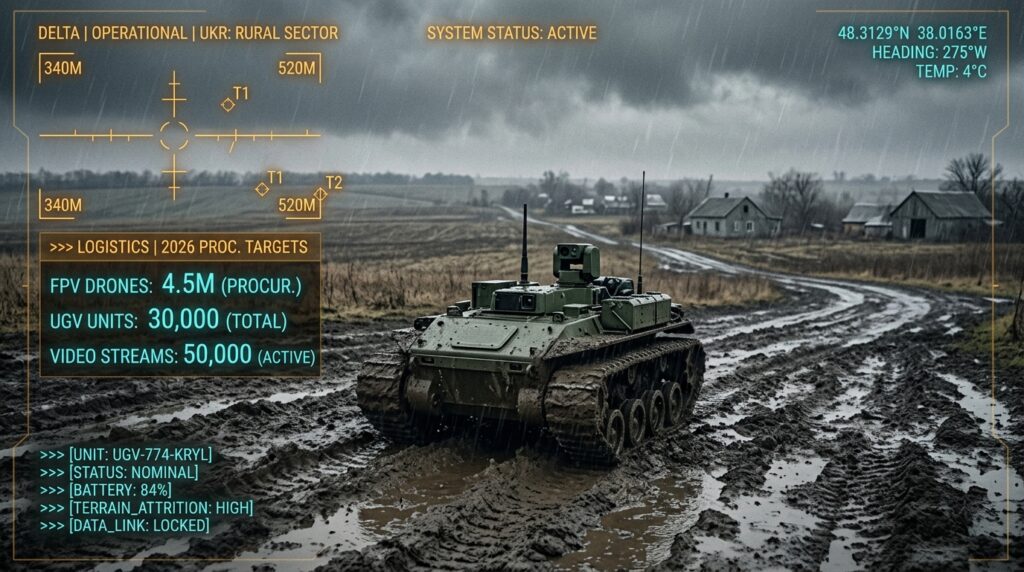
Ukraine has rapidly industrialized its military AI and robotics capabilities, focusing on speed, scale, and continuous iteration. By March 2025, the Ministry of Defense planned to procure 4.5 million first-person-view (FPV) drones, tripling the 2024 procurement, with a budget of $2.8 billion. Ground robotics also saw significant expansion, with codified unmanned ground vehicle (UGV) models increasing from 13 in 2023 to nearly 60 in 2024, aiming for 30,000 deployments within a year and a domestic production capacity of up to four million drones annually [1]. These figures represent the sheer throughput of this algorithmic front, where each unit contributes to the iterative cycle of warfare.
These robotic systems serve various functions. UGVs are used for frontline supply movements, with one commander reporting 370 tons of military supplies moved monthly by ground robots. Medical evacuation platforms transport up to 500 kilograms of cargo, extracting wounded soldiers from “kill” zones. Armed UGVs provide sustained fire support, and specialized systems like the VATAG armored platform, KRAMPUS tracked robot, and Protector counter-UAS turret demonstrate advanced combat automation capabilities.
AI integration enables processing over 50,000 video streams monthly from frontline drones to identify targets, map enemy positions, and feed targeting algorithms. AI guidance makes long-range drone strikes possible, and autonomous air defense turrets like Sky Sentinel engage incoming drones without human intervention. Ukrainian engineers have developed multi-channel, redundant links and optical terrain-mapping navigation to counter electronic warfare (EW) jamming, forming a layered defensive architecture with systems like Atlas EW, Clarity image analysis, and Ai-Petri SV.
Command and control systems are also being rewired with AI. The national DELTA and Vezha combat systems use AI to analyze drone footage and identify enemy positions across approximately 50 military units. A partnership with the UK led to the A1 Defense AI Center, focusing on embedding AI in strategic planning and frontline execution. The Hornet program, influenced by former Google CEO Eric Schmidt, highlights a shift towards semi-autonomous strike platforms.
This ecosystem is supported by a decentralized manufacturing and procurement model. The Brave1 defense tech cluster, launched in 2023, connects state agencies, military units, private developers, and international partners. Over 500 drone manufacturers and more than 200 UGV designs are part of Ukraine’s domestic network. Simpler robots cost around $10,000, while advanced systems can reach $50,000. The DOT-Chain digital procurement system channels funds directly to combat brigades, facilitating equipment orders through the Brave1 Marketplace, which has processed over $235 million. This system creates a tight feedback loop, allowing rapid iteration and scaling of successful designs based on frontline performance data.
Funding for this initiative comes from a layered financial architecture, including a $38 billion commitment from the 2026 Ramstein defense contact group, over €2 billion from dedicated drone coalitions, and a $2.6 billion allocation from Ukraine’s national budget in 2025. Venture capital has also invested significantly, with Ukrainian defense tech firms raising $129 million in 2025. Grassroots platforms like UNITED24 have contributed over $1.8 billion in civilian donations, and NATO’s UNITE program has launched a €10 million joint innovation initiative [2] [3] [4] [5].
Four million drones a year. Thirty thousand ground robots. AI sifting through fifty thousand video feeds monthly. The engineering is impressive; the arithmetic is older than war itself. We’ve stopped calling it slaughter and started calling it throughput. The system doesn’t need to dehumanize the battlefield—it just treats human survival as a variable in a feedback loop. And when warfare becomes an engineering problem, capital naturally follows.
The U.S.-Israel-Ukraine Triangle: Data Triage in the Algorithmic War
On paper, Ukraine and Israel appear to be natural partners. Both engage in high-intensity conflicts, rely on U.S. backing, and operate advanced AI-enabled defenses. In practice, formal state-to-state data sharing remains tightly constrained by political and strategic realities.
Israel shares baseline intelligence on Iranian drone technology with Ukraine, helping Kyiv develop effective countermeasures. In return, Israeli defense officials openly study Ukraine’s combat experience with Shahed systems to prepare for regional threats. Early-warning detection systems developed in Israel are now operating in Kyiv, and both countries have signed letters of intent for cyber defense cooperation. Yet direct hardware transfers or open AI model sharing are rare. Israel maintains a critical strategic relationship with Russia, which keeps military forces near Israel’s borders in Syria. This delicate balancing act prevents Israel from openly supporting Kyiv or sharing offensive anti-drone technology. Public transfers of systems like Patriot batteries remain politically sensitive.
Ukraine, meanwhile, prioritizes tangible military support over theoretical data exchanges. It has repeatedly sought Israeli counter-drone technology and urged the United States to pressure Russia to avoid sanctions evasion. The gap between mutual interest and formal cooperation underscores a broader truth: battlefield data does not transfer seamlessly across conflict types. Ukraine’s war features static frontlines, mass artillery exchanges, and sustained attrition. Israel specializes in precision strikes in dense urban environments and in multi-front asymmetric campaigns. AI models trained in one environment require significant adaptation to remain effective in another.
This is where the United States serves as the central broker, acting as a data clearinghouse or quality control for the global defense supply chain. Washington does not simply fund the Ukrainian effort; it acts as a triage hub, assessing the value of each partner’s data and determining which intelligence, technology, or hardware can be safely transferred. The Pentagon contracted for $50 million worth of 33,000 AI-powered guidance kits from Auterion, enabling manually piloted drones to autonomously track and engage moving targets up to one kilometer away in GPS- and communications-denied environments [6]. Ukraine and the U.S. have explored data-for-weapons swaps, exchanging battlefield-tested drone technology for American systems, with co-production agreements moving beyond traditional aid frameworks. At times, Washington orchestrates covert hardware transfers, such as routing Israeli Patriot components to Kyiv to avoid alerting Russia to Israel’s infidelity.
The ecosystem runs on calibrated exchange, not alliance. Washington doesn’t merely fund; it triages. It collects Ukrainian combat data, filters Israeli threat intelligence, and decides what flows where. The official line speaks of interoperability and shared security. The operational reality is gatekeeping. Data-for-weapons swaps, covert hardware routing, and conditional tech transfers aren’t anomalies—they’re the architecture. Call it strategic patience or controlled leakage; the result is the same. The side that controls the pipeline controls the pace of the war, and the pace is deliberately unsustainable. Goodwill is the packaging. Leverage is the product.
Structural Tensions and Real Trade-Offs
The rapid scaling of AI and robotics is not without friction. Acknowledging these constraints is essential to realistic policy planning. These are not failures of the model—they are the model.
Terrain and weather are challenges. Mud, snow, and battlefield debris disrupt both tracked and wheeled UGVs. Commanders report that on certain missions, only one in three ground robots reaches its destination. Electronic warfare continues to degrade remote-control links, and Russian jamming forces constant upgrades to the communication architecture. Even well-concealed machines are detected and destroyed by enemy artillery and counter-drones. The environment imposes a physical attrition rate that software alone cannot overcome.
The decentralized manufacturing model, while resilient to air strikes, introduces vulnerabilities in quality control and the supply chain. Rapid iteration means field failures are common before patches are deployed. High-volume drone production requires a sustained microelectronics supply, which remains exposed to global market fluctuations and export controls. Scaling from prototypes to tens of thousands of units demands consistent component sourcing, standardized testing, and operator training pipelines that are still catching up to production pace.
Political support fluctuates. U.S. aid has faced intermittent pauses driven by public sentiment, domestic politics, and competing strategic priorities. Temporary blocks on commercial satellite imagery and aid diversions have contributed to measurable declines in Western assistance in specific quarters. Several European nations have slowed procurement or declined to join joint drone initiatives, citing lower perceived threat levels. These shifts create planning uncertainty for drone clusters that depend on predictable funding pipelines. Consistent availability requires multi-year appropriations that withstand electoral cycles.
There’s no clean lab for this. Every algorithmic improvement is paid for in territory, in medevac rotations, in the quiet attrition of operators who become data points. The economic case is straightforward: foreign capital builds domestic industry, creates technical jobs, and seeds a post-war export sector. It’s also brutally honest. You don’t get battlefield-tested AI without a battlefield. The multiplier effect is real; so is the ledger. We’ve learned to speak in terms of resilience and innovation while quietly accepting that progress here is measured in meters held and systems lost.
Where Is This Going?
If the model is friction-laden and context-dependent, what sustains it? Where is this going? It depends. Let’s not forget that all of this technology and industrialization is being built on the continued existence of a war, at least for the foreseeable future. But several developments may define Ukraine’s trajectory in AI-driven warfare.
Ukraine’s goal of 30,000 UGVs and up to 8 million annual drones may test the limits of decentralized manufacturing, microelectronics supply chains, and training pipelines for drone operators and AI specialists. Production targets may collide with funding volatility and component bottlenecks.
Launched in early 2026 with a UK partnership, the A1 center may centralize AI across military planning, targeting, and predictive modeling. Its operational impact on command tempo, decision cycles, and frontline autonomy will need to be closely tracked. Success, as the military-industrial complex sees it, will be measured by reduced targeting latency and improved force coordination under EW stress.
Ukraine’s initiative to share anonymized battlefield data with partners may expand and accelerate AI development. Formal agreements may emerge that govern data access, security protocols, model ownership, and export controls. The first nations to integrate Ukrainian combat data into their own training pipelines will likely gain measurable advantages in autonomous system reliability.
U.S.-Ukraine joint ventures, including AI guidance module transfers and drone co-production agreements, will shape future defense trade policy. Expect more classified intelligence-sharing arrangements to precede public hardware deals. The data-for-weapons model will expand if it proves politically sustainable.
Ukraine and Russia will probably invest heavily in AI-driven counter-jamming, frequency-hopping communications, and optical/infrared navigation. The side that stabilizes control in degraded environments will gain tactical superiority. EW is no longer a supporting domain. It is the primary battlefield.
Post-War Positioning: From Battlefield to Global Market
Ukraine is already structuring its wartime innovation networks as a permanent export sector. Companies like Ukrspecsystems, Brave1-certified UGV manufacturers, and AI-guidance startups are positioning combat-tested systems for NATO and allied markets. The government’s strategy is clear: leverage real-world validation to bypass traditional peacetime procurement cycles. A drone that survives Avdiivka’s electronic warfare environment carries a credibility that years of laboratory testing cannot match. This battlefield-proven efficacy is the cornerstone of Ukraine’s long-term industrial strategy.
Ukraine is actively aligning its defense standards with NATO interoperability requirements, pursuing joint certification pathways with partner nations to streamline procurement. The Ministry of Defense has begun mapping domestic drone and UGV architectures onto Allied standardization agreements, ensuring Ukrainian systems can integrate seamlessly into existing command networks. At the same time, Kyiv is negotiating bilateral defense trade frameworks that would allow co-production licenses rather than simple arms sales, turning wartime partnerships into long-term industrial ties.
The post-war blueprint is already being drafted in wartime. Combat-tested drones, NATO-aligned architectures, co-production licenses—Ukraine is positioning itself not just as a defender, but as a defense exporter. The calculus is familiar: war destroys, but it also industrializes. Capital flows toward proven systems, and a drone that survives Avdiivka’s EW environment carries a credibility no peacetime lab can replicate. The moral cost is externalized; the economic logic is internalized. We’ve seen this cycle before. It’s just faster now, and dressed in software.
However, significant hurdles remain. Export controls on dual-use technologies, microelectronics supply dependencies, and the eventual need to scale down from wartime urgency to regulated commercial production will test institutional capacity. Ukraine’s success will depend on how effectively it converts battlefield agility into peacetime industrial policy—without losing the iterative speed that made its wartime model so effective. But they’ll cross that bridge when they come to it.
Conclusion
Ukraine has, through the crucible of conflict, forged a new paradigm of warfare: the algorithmic front. This is a system where the traditional lines between combat and commerce, destruction and development, are blurred. The war in Ukraine has become a vast, real-time R&D lab, driven by a relentless pursuit of technological advantage and fueled by a global supply chain of capital, data, and innovation. The “ledger” of this conflict is not merely a tally of casualties, but a record of rapid iteration, technological evolution, and the profound ethical questions that arise when human lives become variables in an optimization problem. The shift from “citizen-soldier” to “data-point/operator” is a stark reminder of the dehumanizing potential of this new era. As venture capital increasingly flows into defense tech, disguised as aid, the lines between national security and private profit become dangerously intertwined. The question is no longer whether this model works, but how long we, as a global society, will continue to pretend it is temporary, rather than acknowledging its profound and potentially permanent reshaping of modern conflict and its moral landscape.
References
[1] Ministry of Defence of Ukraine. (2026, March). Ukraine shares real battlefield data with international partners for AI training. Defense News. https://www.defensenews.com
[2] KYIV Post. (2026, April). Ramstein meeting secures drone commitments from Norway and Netherlands. Defense News. https://www.defensenews.com
[3] KYIV Post. (2026, April). NATO Allies Pledge $60 Billion in Military Aid to Ukraine for 2026. Estonian World. https://www.estonianworld.com
[4] Digital State UA. (2025, November). €10M joint defense innovation initiative with Ukraine (UNITE Program). NATO. https://www.nato.int
[5] NOKIA. (2025, November). NestAI secures €100M funding round with Nokia for physical AI defense applications. TechCrunch. https://techcrunch.com
[6] Auterion. (2025, July). $50M Pentagon contract for AI-powered drone guidance modules (Skynode S). Unmanned Airspace. https://www.unmannedairspace.info