
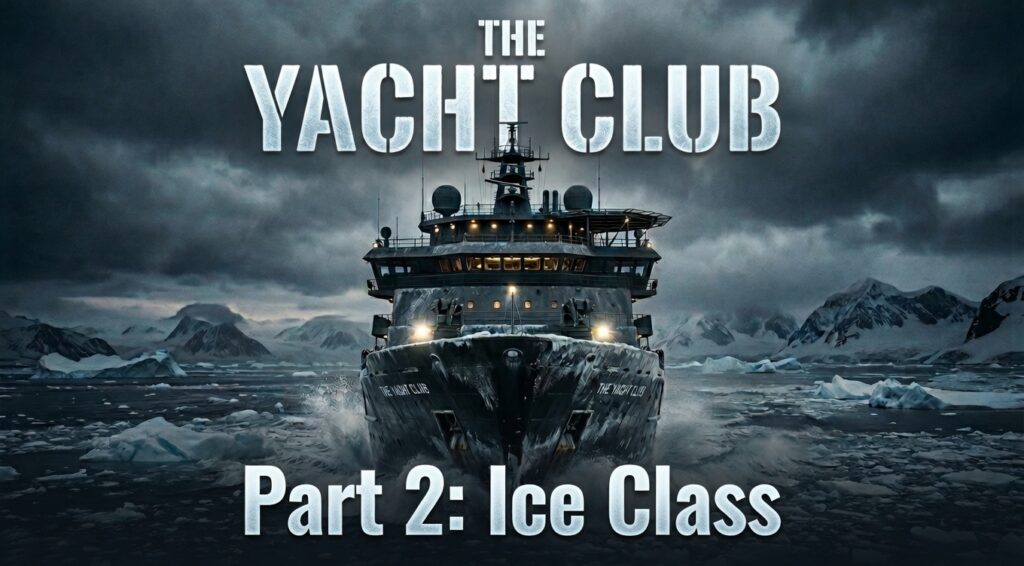
In Part 1, we mapped a market that had quietly stopped behaving like a leisure market. The volume curve flattened. The size curve climbed. Fraser’s order book filled with custom 60–80-meter projects, average buyer ages dropped a decade, and Dutch yards became the single most important node in the global supply chain. We ended with a question we declined to answer: why is the wealth at the top of the market paying a premium for long-range, autonomous, technically advanced vessels at the exact moment global instability is rising?
We’re not going to answer that yet. We’re going to do something more useful: we’re going to look at the steel.
Specifically, we’re going to look at one technical designation that keeps appearing in the order books of the largest, most expensive, most custom builds. It’s called ice class. It is boring. It is documented in public, in three places: at the International Maritime Organization, at the classification societies, and in the brochures yards publish to sell hulls. Everything that follows is on the record.
What ice class actually buys is a vessel that can do things ordinary superyachts cannot. Where, and for whom, and to what end — those are questions for later. For now, we’re going to read the spec sheet.
The Paper — What Ice Class Actually Means
Ice class is not a marketing term. It is a legal one.
In November 2014, the IMO’s Maritime Safety Committee adopted the International Code for Ships Operating in Polar Waters — universally called the Polar Code. This Code became mandatory on 1 January 2017 [1]. It applies to vessels over 500 GT (gross tonnage [GT], a measure of a ship’s overall internal volume) operating in Arctic or Antarctic waters. It sorts every vessel into one of three categories [2]:
- Category A: Designed for at least medium first-year ice. This is the heaviest hull strengthening, capable of handling ice that has survived a summer melt.
- Category B: Designed for thin first-year ice. This offers medium strengthening for less extreme conditions.
- Category C: Designed for open water or very light ice conditions.
A Polar Ship Certificate, issued under Category A, is the only piece of paper that lets a 60-meter private vessel sit in second-year ice without breaching its insurance.
Below the IMO layer, classification societies like Lloyd’s Register and DNV translate these categories into structural rules. The tiers are simplified below:
| Notation | Operating envelope | Source |
| Lloyd’s 1A / Finnish-Swedish IA | First-year ice to ~0.8 m, escorted | [3] |
| Lloyd’s 1A Super / IA Super | First-year ice to ~1.0 m, may proceed by ramming | [3] |
| IACS PC 7 / PC 6 | Summer–autumn operation in medium first-year ice | [4] |
| IACS PC 3 | Year-round operation in second-year ice | [4] |
| IACS PC 2 | Year-round operation in moderate multi-year ice up to 3 m thick | [4] |
| IACS PC 1 | Year-round operation in all polar waters | [4] |
The metrics that separate these notations are unromantic. They include hull-plating thickness in millimeters of high-tensile steel and scantlings—the internal dimensions of the ship’s structural frames. They also set the Polar Service Temperature (PST), the minimum temperature at which all systems must remain functional. This is typically set at least 10°C below the lowest expected daily low for the area [5].
A typical Category A build features a 40 mm ice belt of steel and a PST of −35°C. It also includes sea chests—recessed pockets in the hull that intake seawater for cooling—which must be heated to prevent ice blockages. Other features include ice knives to protect the rudders and double-bottom fuel tanks set nearly a meter back from the outer shell [2].
Paper alone doesn’t get you north. The Code also mandates a Polar Water Operational Manual (PWOM). This is a vessel-specific “owner’s manual” for the Arctic, detailing how the ship handles emergencies in extreme cold. It requires winterized deck machinery, heated lifeboats, and specialized crew training for the officers on watch [6].
Now the numbers. As of 2026, roughly 400 commercial vessels worldwide carry Ice Class 1A or higher [1]. Of those, roughly 150 are flagged as private pleasure yachts. The order book at the start of 2026 shows 101 explorer or expedition yachts in build worldwide [7].
No commentary. Just scarcity.
The Steel — What Ice Class Buys You
Ice class is a structural designation, but the steel dictates the strategy. Because the hull is built to survive extreme environments, every other system must follow suit. You cannot pair a Category A hull with a standard coastal fuel system; the operating profile assumes weeks of isolation. Once the bow is poured, the rest of the ship has no choice but to catch up.
The result is a manifest that has almost nothing to do with leisure. To see the difference, compare a standard 60-meter motor yacht with its Ice Class 1A counterpart:
| Capability | Typical 60 m motor yacht | 60 m Ice Class 1A expedition yacht |
| Range | ~3,000–4,000 nm | 6,000+ nm |
| Fuel capacity | ~100,000 L | ~210,000–250,000 L |
| Autonomy at sea | 10–14 days | 30–60 days |
| Helideck | Touch-and-go (none on most) | Certified for 5-ton helicopters, plus hangar |
| Crane / tender garage | 2-ton crane, single bay | 44-ton crane, 8-meter tender garage, moon pool |
This 6,000-mile, 40-day envelope isn’t a theoretical maximum. It’s an operational reality. Take the Damen SeaXplorer 77: it was delivered with a 6,000 nm range and enough storage for 40 days of total autonomy. Her captain cited “extra-large stores” for everything from provisions to waste management [8]. The Vard-built *REV Ocean* goes even further. Rated at ice class PC6, it can cover 21,120 nautical miles and support 90 people for nearly four months [9].
On these builds, the deck isn’t for sunbathing. It’s a working platform. Damen’s SeaXplorer line features an aft deck designed for seaplanes or seven-person submarines [10]. The 78-meter *Legend*—marketed as the world’s only icebreaking megayacht—carries a submarine, snowmobiles, and a heli-deck rated for a 10,000-pound Super Puma [11, 12]. *REV Ocean* even includes a moon pool—an opening in the floor of the hull that allows divers or submersibles to enter the water directly from inside the ship, protected from the surface ice [9].
Independence is the final requirement. These vessels use dynamic positioning to hold station in three-meter seas without an anchor. They carry zero-discharge waste systems to meet strict polar regulations. Even the communications stack is over-engineered, using Iridium Certus and Starlink arrays adapted for the high Arctic. The goal is simple: 60 days of operation without a single port call.
This is where the “capability premium” becomes tangible. Fraser recently secured thirteen new-build projects in the 60–80-meter bracket—double the volume of its nearest competitor. Look at the spec sheets and you’ll see a pattern: 6,000-mile ranges, five-ton helidecks, and hulls strengthened to at least 1A. The marketing departments call it “expedition spec.” The Polar Code calls it “Category A.” The brochures don’t explain the difference.
This provides our first real answer. The market isn’t just buying “better boats.” It is buying a regulatory envelope—the legal and physical right to be in places where other yachts cannot go, for as long as the mission requires.
The Map — Where Ice Class Lets You Go
A non-ice-class hull can visit Svalbard, but the window is narrow. Most cruise traffic arrives between May and September, when the midnight sun and retreating pack ice make the islands navigable for conventional steel [13, 14].
Ice Class 1A widens that window into November. Category A removes the window entirely. With second-year-ice capability, the archipelago is reachable year-round.
The geography that opens with this capability is short and specific. The places reached reliably only by ice-class vessels share a distinct profile:
- Jan Mayen (Norway): A volcanic island 600 miles west of Norway. It has no permanent civilians, only a small meteorological and navigation team. It features an airstrip and a sheltered anchorage [15, 16].
- Franz Josef Land (Russia): An Arctic archipelago of 191 islands. It is inhabited only by military personnel. The Nagurskoye base was recently expanded with a year-round runway for heavy transport [17].
- Tuktoyaktuk (Canada): A deepwater harbor near the Mackenzie Delta. Its airport was historically a node for the Distant Early Warning Line, a Cold War-era radar network [18].
- Ittoqqortoormiit (Greenland): A declining settlement at the mouth of the world’s largest fjord system. A new dedicated airport was approved in 2025, financed by the Danish state [19].
Four points; four populations under one thousand; four deepwater anchorages; four functioning airstrips. Three of the four have current or historical government/military infrastructure. That is the geography.
The Northern Sea Route (NSR) ties these points together. Data from shipping registries shows a massive expansion in international transit voyages along the NSR:
| Year | International transit voyages |
| 2010 | 1 |
| 2013 | 14 |
| 2018 | 17 |
| 2024 | 97 |
| 2025 | 103 |
*Sources: [20, 21, 22]*
This is a two-order-of-magnitude expansion in fifteen years. While these are mostly cargo vessels, they are all, by registration, Category A or B.
The supply of these vessels is tighter than it seems. Dutch yards dominate the market, joined by a few specialist yards in Norway, Italy, and Turkey. With delivery slots now stretching into 2031, the number of ice-class private yachts on the water at the end of this decade is essentially fixed [7, 23].
Conclusion: What the Spec Sheet Says
We started with a question: why is the top of the market paying a premium for vessels that can operate independently for sixty days?
Part 2 has not answered it directly. Instead, it has read the public record.
The Polar Code says a Category A ship can operate in second-year ice. The classification societies say that means 40 mm steel and heated sea chests. The yards say their builds can go 6,000 miles, deploy submarines through moon pools, and recover five-ton helicopters. The order books say 101 such vessels are coming. And the European Commission is awarding millions for marine surveys to carry a 17,000-kilometer trans-Arctic submarine cable system through these same waters [24].
Capability. Geography. Funding. Three documents, three registries, three public bodies.
The reader is invited to draw their own line.
In Part 3, we will. We will look at who is signing the contracts and what the operational profiles of this fleet actually look like. We will ask whether “capability” in 2026 is still a leisure category, or whether it has quietly become something else.
For now, the boat is built. The paper is signed. The map is drawn. And the ice is melting on a schedule that nobody set.
References
[1] IMO: https://www.imo.org/en/ourwork/safety/pages/polar-code.aspx
[2] Bahamas Maritime Authority: https://www.bahamasmaritime.com/wp-content/uploads/2021/12/MN088-Polar-Code-v1.0.pdf
[3] MAN Energy Solutions: https://www.man-es.com/docs/default-source/marine/tools/5510-0140-01_preview.pdf?sfvrsn=f6b56a5a_8
[4] IACS via Wikipedia: https://en.wikipedia.org/wiki/Polar_Class
[5] Rood Boven Groen Maritime Training: https://www.roodbovengroen.com/en/polar-water-operational-manual/
[6] IMO / classification society registries: https://www.imo.org/en/ourwork/safety/pages/polar-code.aspx
[7] Boat International, 2026 Global Order Book: https://www.boatinternational.com/boat-pro/global-order-book/global-order-book-2025-report
[8] YachtStyle, “Damen Yachting’s SeaXplorer 77 La Datcha heads for Kamchatka”: https://yachtstyle.co/damen-yachtings-seaxplorer-77-la-datcha-heads-for-kamchatka/
[9] YachtBuyer, REV Ocean: https://www.yachtbuyer.com/en-us/fleet/rev-ocean-639-vard
[10] Damen Yachting fleet page: https://www.damenyachting.com/fleet
[11] Worth Avenue Yachts, Legend listing: https://www.worthavenueyachts.com/explore/expedition-yachts-for-sale/
[12] IYC explorer yacht fleet listing: https://iyc.com/yacht-types/explorer-and-expedition-yachts/
[13] Chimu Adventures, “Best Time to Visit Svalbard”: https://www.chimuadventures.com/en/blog/best-time-visit-svalbard
[14] Poseidon Expeditions: https://poseidonexpeditions.com/about/articles/the-best-time-to-visit-svalbard/
[15] Wikipedia, Jan Mayen: https://en.wikipedia.org/wiki/Jan_Mayen
[16] Adventure Life: https://www.adventure-life.com/arctic/articles/island-discovery-on-a-jan-mayen-cruise
[17] Wikipedia, Franz Josef Land: https://en.wikipedia.org/wiki/Franz_Josef_Land
[18] Wikipedia, Tuktoyaktuk: https://en.wikipedia.org/wiki/Tuktoyaktuk
[19] Wikipedia, Ittoqqortoormiit: https://en.wikipedia.org/wiki/Ittoqqortoormiit
[20] Gunnarsson & Moe, “Ten Years of International Shipping on the Northern Sea Route” (CHNL, 2022): https://chnl.no/research/research-articles/ten-years-of-international-shipping-on-the-northern-sea-route-trends-and-challenges/
[21] CHNL, “Main Results of NSR Transit Navigation in 2024”: https://chnl.no/news/main-results-of-nsr-transit-navigation-in-2024/
[22] CHNL, “Main Results of NSR Transit Navigation in 2025”: https://chnl.no/news/main-results-of-nsr-transit-navigation-in-2025/
[23] SuperYacht iQ, 2026 Global Order Book analysis: https://www.boatinternational.com/boat-pro/global-order-book/global-order-book-2025-report
[24] HaDEA, “CEF Highlight of the Month: will the Arctic be the next Digital Gateway?”: https://hadea.ec.europa.eu/news/cef-highlight-month-will-arctic-be-next-digital-gateway-2024-06-05_en