
AI, Web Development, and the Path to Inclusive Innovation
I’ve had something on my mind lately. Pull up a chair.
Introduction: Two Worlds, One Divide
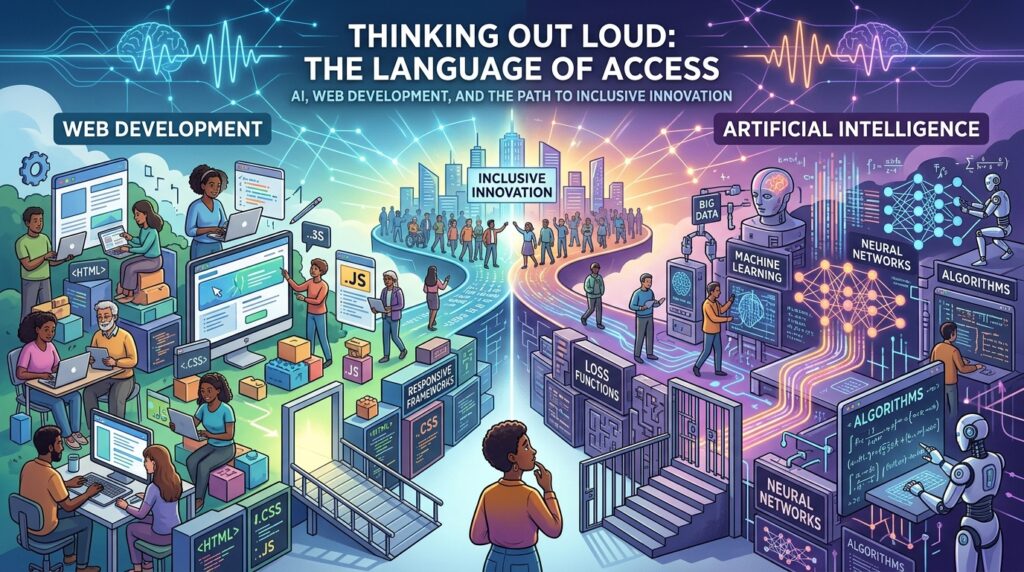
The digital revolution has given rise to two of the most exciting and transformative fields of our time: web development and artificial intelligence (AI). Both areas have dramatically changed industries, economies, and our daily lives, opening new possibilities. Despite their common technological foundation, they have evolved with their own unique languages, cultures, and entry barriers—shedding light on who is welcomed into these fields and who might feel left out.
Web development is warmly inviting and easy to grasp. Its language—buttons, menus, frontend, backend—draws from everyday life, making it feel familiar even to those without technical experience. On the other hand, AI development can seem a bit intimidating. Its terms—neural networks, tensors, backpropagation, and embeddings—are deeply rooted in math and computer science, hinting that it might be a bit out of reach for many.
This linguistic divide isn’t accidental. It reflects intentional and unintentional choices about who these fields are designed to serve. Web development’s language evolved to invite collaboration, while AI’s has, until recently, reinforced exclusivity. But as AI becomes increasingly embedded in everyday life, its language—and its accessibility—must adapt. The question is no longer whether this adaptation will happen, but how it will unfold, and what the consequences will be if we fail to act proactively.
The Contrast: Web Development’s Open Door vs. AI’s Ivory Tower
Web Development: The Language of Inclusion
The early web wasn’t born perfectly inclusive. In its first decade of public accessibility, domain and hardware costs, dial-up limitations, and a steep technical learning curve kept it out of reach for most people.
Early tech circles had their own gatekeeping and accessibility standards, like WCAG and screen-reader compatibility. Clear documentation only emerged after years of grassroots advocacy and deliberate design shifts.
Yet, what set the web apart was its underlying architecture and the way its language was deliberately guided to invite broader participation. The tools and language we settled on were meant to nurture a spirit of collaboration and openness.
- Familiar Metaphors: Terms like “homepage,” “navigate,” and “bookmark” are borrowed from everyday life, making the concept of the web immediately understandable. Even technical terms like “frontend” (what users see) and “backend” (what powers it) are self-explanatory.
- Visual Feedback: Web development offers instant gratification. Write a line of HTML, refresh the browser, and see the result. This immediate feedback loop lowers the barrier to entry, allowing beginners to experiment and learn by doing.
- Community-Driven Growth: The web thrived on open-source collaboration. Platforms like GitHub, Stack Overflow, and countless tutorials made it possible for anyone with a computer to contribute. The language of web development wasn’t just technical—it was communal.
As a result, web development became an inviting field where anyone, even those without a formal background, could explore and create. You don’t need a degree in computer science to build a website—just curiosity and a willingness to learn are enough. It’s wonderful to see how accessible this field has become for everyone eager to dive in and discover what they can achieve!
AI Development: The Language of Exclusion
AI development has usually grown in universities and industry research labs, giving its terminology a somewhat abstract, mathematical, and sometimes intimidating feel to those outside the field.
- Technical Jargon: Terms like “stochastic gradient descent,” “latent space,” and “transformer architectures” assume a baseline knowledge of linear algebra, probability, and computer science. For someone without that background, these terms don’t just describe concepts—they erect walls.
- Lack of Immediate Feedback: Unlike web development, where you can see the results of your code in real time, AI development often involves long training cycles and opaque outputs. You might spend days tuning a model only to find it doesn’t work as expected, with no clear explanation as to why.
- Research-First Culture: AI has long been the domain of PhD researchers and engineers. The tools and frameworks (e.g., TensorFlow, PyTorch) were designed for experts, not hobbyists. The language of AI development wasn’t just technical—it was elite.
This linguistic and cultural barrier has fostered a “Private Club” mentality around AI. Whether intentional or not, the message has been: This is only for the initiated. However, as AI continues to grow more powerful and becomes a seamless part of our daily tools, clinging to this sense of exclusivity simply isn’t sustainable anymore.
The “Private Club” Problem and Its Consequences
AI language doesn’t just mirror its culture—it also helps shape it. When the terminology in this field feels difficult or unapproachable, it can turn people away, keeping them from sharing unique insights, ideas, or innovations. This kind of exclusion can have meaningful effects in the real world.
- Limited Diversity of Thought: If only a narrow demographic (e.g., those with advanced degrees in STEM) can engage with AI, the field risks groupthink. Diverse voices lead to more creative solutions, better problem-solving, and a broader range of applications.
- Power Imbalances: When AI development is dominated by a few corporations or research institutions, power consolidates in the hands of the few. This can lead to biases in AI systems and a lack of accountability.
- Public Distrust: If AI feels like a “black box” that only experts can understand, the general public may reject it outright—even when it could benefit them. Trust is built on transparency, and transparency requires accessibility.
The web development model clearly shows that including everyone isn’t just a good idea—it’s also essential to success. When barriers are reduced, it opens the door to amazing innovation and teamwork. AI has the same potential to bring positive change, but only if it moves away from its “Private Club” mentality and becomes more open and welcoming.
The Inevitability of Change
AI is becoming more accessible and user-friendly. Tools like MidJourney, DALL·E, and GitHub Copilot are making AI accessible even to those without specialized expertise, while platforms such as Hugging Face and Kaggle are opening access to models and datasets for everyone. The emergence of “Prompt Engineering” as a skill also signals a move towards more natural, conversational ways of interacting with AI, making it easier for people from all walks of life to engage with this technology. As these positive trends grow, AI language will need to evolve to better serve its expanding user base.
I know that adapting takes time, and I’m not suggesting we rush, but if we wait until AI becomes as common as the internet to tackle its accessibility challenges, we might end up deepening the very issues we’re aiming to fix. That’s why I think it’s important we start taking steps today. Every little bit helps.
Misunderstandings Are Inevitable—But So Is Progress
Some might worry that making AI’s language simpler could cause confusion or misuse. And that’s understandable: no matter how we present AI, there will always be people who interpret it incorrectly, use it improperly, or even misuse it. However, misunderstandings aren’t exclusive to AI—they’re common in any complex system, whether it’s medicine, finance, or the internet itself.
The key insight is that misunderstandings are bound to happen, but we can reduce their impact on us. The aim isn’t to prevent all misunderstandings, but to create systems that handle them well. This involves:
- Layered Complexity: Start with simple, intuitive interfaces for beginners, but allow users to dig deeper as they gain experience.
- Guardrails and Warnings: Even simplified tools should include clear disclaimers about limitations, biases, and potential risks. For example: “This AI can generate text, but it doesn’t understand context like a human. Always verify its outputs.”
- Feedback Loops: Create channels for users to report issues, ask questions, and learn from others’ mistakes. Communities like Stack Overflow have shown how powerful peer-to-peer learning can be.
The alternative—keeping AI’s language technical and exclusive—can still lead to misunderstandings, but in a different way. Instead of oversimplification causing confusion, exclusion can create barriers. When people don’t understand AI, they might feel fearful, distrustful, or simply overlook things that can be just as damaging as misuse.
Power, Accessibility, and the Case for Proportional Restrictions
If language alone can’t stop misuse, then what can? I think the key may be proportional restrictions—an idea as old as civilization itself.
Lessons from Everyday Life
Society has these interesting layered rules to help keep a good balance between freedom and safety. They are so much a part of our daily lives that we sometimes forget how important they are.
It’s easy to forget that the freedoms we enjoy daily are supported by necessary restrictions. For example, we don’t need a license to ride a bike, but we do to fly a plane. Rules in gyms and swimming pools keep everyone safe, and speed limits on roads help prevent accidents. Wearing seat belts is a simple way to stay protected while in a vehicle. These aren’t restrictions that limit us—they are the guardrails that help us enjoy our freedoms safely.
In many areas, such as car safety and public health, we’ve learned that activities with higher risks require more precautions, while safer activities require fewer barriers. Developing AI is just the latest ‘territory’ where we need to carefully draw these kinds of safety maps.
The Library of Access: A Framework for Stewardship
To further illustrate, consider a “Library of Access” framework: a system where access is determined by the risk a capability poses to the “collection” (society) as a whole.
The purpose of a library is to keep information easy to access for everyone. However, different materials need different kinds of attention and care. By adopting a tiered approach to AI regulation, we can encourage innovation and creativity for low-risk applications while ensuring that high-risk applications are carefully managed to prevent harm.
| AI Capability | Risk Level | Proposed Restrictions | Library Analogy | User Responsibility |
| Text generation | Low | Minimal; basic content filters for illegal outputs | The Open Stacks: High utility with a low barrier to entry | Basic Literacy: Reporting issues and recognizing that AI doesn’t understand context like a human. |
| Image generation | Moderate | Watermarking, disclaimers, and limits on realistic content | The Reference Desk: Materials stay in-building; users may show ID | Ethical Disclosure: Respecting watermarks and disclosing AI assistance in creative works. |
| Deepfake generation | High | Licensing, identity verification, and usage logging | The Restricted Archives: Access requires “Special Collections” clearance | Intentionality: Providing a clear statement of purpose and accepting legal accountability for outputs. |
| Medical/Legal advice AI | High | Professional certification required for deployment | Professional Journals: Access granted based on verified credentials | Expert Verification: Ensuring all AI-generated outputs are cross-referenced with established professional standards. |
| Autonomous weapons systems | Extreme | Banned or strictly restricted to government oversight | The Locked Vault: Classified materials restricted to prevent public harm | Strict Compliance: Adherence to international laws, ethical audits, and non-proliferation treaties. |
This tiered system ensures that:
- Low-risk activities have low barriers, allowing for the “bottom-up” creativity discussed earlier.
- High-risk activities have high barriers, providing the “top-down” structure and protection necessary for public trust.
- Safety is a shared responsibility, where the goal isn’t to lock the door, but to ensure that the person entering has the right level of “literacy” and intent.
The Path Forward: Bottom-Up Participation and Top-Down Regulation
The future of AI accessibility and governance will be shaped through a collaborative effort that combines both grassroots participation and top-level regulation. It’s all about finding a healthy balance where each side supports and guides the other, creating a more inclusive and well-regulated landscape.
Bottom-Up: The Power of Public Participation
Public engagement truly fuels innovation. When folks connect with AI personally or within their communities, it opens up exciting possibilities and helps us grow together.
- Creativity flourishes: Open-source contributions, modding communities, and grassroots projects are truly inspiring, often leading to surprising and transformative applications that benefit everyone.
- Norms emerge organically: Users create their own friendly guidelines, like promoting ethical prompt engineering and sharing useful advice, which help guide how tools are used in a positive way.
- Demand for solutions grows: As more people engage with AI, they’ll recognize potential risks and advocate for safeguards, making sure the technology truly supports our human needs.
Bottom-up participation helps keep AI responsive, inclusive, and adaptable, ensuring it’s a tool for everyone, not just a select few.
Top-Down: The Necessity of Government Regulation
While grassroots energy sparks new ideas, clear regulations help keep everything organized, accountable, and safe. Governments are in a special position to:
- Set baseline standards: Set clear minimum standards for transparency, safety, and ethics, such as ensuring that “AI systems must be auditable.”
- Enforce accountability: Hold companies and individuals accountable for any harm caused by AI, such as imposing fines for biased algorithms or enforcing legal actions for malicious uses.
- Fund public interest AI: Invest in open-source models, research into alignment and safety, and publicly accessible AI tools to help ensure that the technology benefits everyone—more than just corporations.
Standardized Terminology acts as a guiding framework. Just as the web adheres to W3C standards, AI development could also benefit from a concept called “standardized transparency.” This would involve encouraging companies to describe their models in clear and understandable language, making the technology more accessible and trustworthy for everyone.
Currently, high costs serve as a natural barrier to accessing AI. Training top-tier models needs millions of dollars’ worth of computing power and energy, and implementing custom AI solutions usually requires specialized expertise. However, as hardware becomes more affordable and tools easier to use, these obstacles will gradually decrease. When that time comes, government regulation will likely be needed. The real question isn’t if regulation will happen, but when—and if we’ll be ready for it.
Regulation doesn’t have to hold back innovation. It can begin with gentle oversight, like voluntary guidelines or industry self-regulation, and expand as necessary. The important thing is to act early, before the situation gets out of control.
The Happy Medium: Collaboration in the Middle
The “middle ground”—where public participation and government regulation come together—is often where the most effective systems are born. Here’s an idea of how it could work in practice:
- Public Experimentation: Encourage citizen science, open-source contributions, and community-driven AI projects to flourish. This helps keep the ecosystem lively and adaptable.
- Government Frameworks: Create overarching principles, like “AI systems must be transparent and easy to review,” that offer some flexibility in how they’re put into practice.
- Industry Self-Regulation: Support AI ethics boards, promote open-source audits, and seek third-party certifications to help cover the areas where government might be a bit slow to keep up. Working together like this can really strengthen the trust and safety in AI development.
- Feedback Loops: Establish ongoing conversations among policymakers, developers, and users to make sure regulations are sensible, fair, and flexible. This way, everyone can work together smoothly and effectively.
- Pilot Programs: Make sure to test regulations in controlled settings, like sandboxed AI deployments in cities or industries, before expanding them widely.
This balance allows for agility without chaos and stability without stagnation.
The Inevitability of Change and the Urgency of Action
AI is constantly evolving and progressing at an incredible speed, opening up exciting new possibilities for our society. As it continues to develop, more people will be able to enjoy its benefits, and we’ll need to stay vigilant with careful oversight and accountability to keep everything on the right path.
The chance to influence the future of AI is happening right now. If we wait too long to implement safeguards—until AI becomes as widespread as the internet—we risk spending our time constantly fixing problems rather than preventing them early. History reminds us that it’s always better to stay proactive and ahead of the curve rather than rushing to catch up later.
This means:
- Proactive Adaptation: AI’s language and tools should continuously evolve to invite everyone’s participation, helping prevent anyone from feeling left out or excluded.
- Proportional Restrictions: We should establish tiered access and safeguards that reflect the level of risk involved, similar to how we handle other areas of life. This way, we can better protect everyone while maintaining fairness.
- Collaborative Governance: The future of AI will be greatly influenced by the combined efforts of the public and policymakers, working together to create a fair, safe, and innovative ecosystem.
Conclusion: A Call for Inclusive Innovation
The story of web development and AI is really all about making things accessible for everyone. Web development’s open and inclusive language helped it become a global phenomenon for creativity and connecting people. AI has the same wonderful potential—if it’s willing to let go of that “Private Club” attitude and move towards a future where everyone has a seat at the table. The words we choose, the barriers we remove or erect, and the policies we create will determine whether AI becomes a helpful tool for broad human progress or remains an exclusive club. The moment for thoughtful adaptation, fair rules, and teamwork in governance is now. By creating an environment where AI’s language is easy to understand, its risks are carefully managed, and its growth is a collective effort, we can make sure this powerful technology benefits all of us.
What do you think?