
Collective Character, Political Consequence, and the Burden of Responsibility
I’ve had something on my mind lately. Pull up a chair.
“Every nation gets the government it deserves.” Joseph de Maistre wrote these words in 1811, not as a cynical dismissal but as a profound observation about human agency. Far from excusing tyranny or corruption, the statement insists that political systems do not descend upon passive populations from some external void. They are forged, sustained, and ultimately shaped by the collective character, values, habits, culture, and choices of the citizenry—whether through active consent, quiet acquiescence, or cultural norms. James Madison echoed this in Federalist No. 51 when he declared that government itself is “the greatest of all reflections on human nature.” Plato and Aristotle saw regimes as mirrors of the dominant soul of a society; Alexis de Tocqueville traced America’s democratic success not to its Constitution alone but to the “manners, customs, and habits” of its people.
To say that a nation gets the government it deserves is not to say that every individual deserves every injury inflicted by that government. Children do not deserve tyranny. Dissidents do not deserve prison. The innocent do not deserve corruption, conquest, or collapse. The claim operates at the level of collective political consequence, not individual moral guilt. Over time, a society becomes answerable for the habits it tolerates, the leaders it rewards, the lies it accepts, the duties it neglects, and the forms of power it permits to harden into normal life. By “the people,” I do not mean every individual citizen equally. I mean the dominant civic culture of a society: its habits, fears, loyalties, tolerances, incentives, expectations, and capacity for collective action.
This essay argues that institutions do not arise or endure in a vacuum; they are shaped by the prevailing moral and cultural substrate. Apparent exceptions—foreign conquests, elite coups, or brutal dictatorships—do not automatically disprove the principle. They complicate it. Even imposed regimes must take root in some relationship to the society beneath them. Recognizing this truth shifts the burden from blaming outsiders or “the system” to embracing personal and societal responsibility. By exploring philosophical foundations, empirical evidence, historical patterns, and the mechanisms of this reflection, this essay reinforces the call for greater accountability.
Philosophical Foundations
The idea that government mirrors the people is as old as political philosophy, but classical thinkers did not merely assert this reflection—they explained its mechanics. In The Republic, Plato described a cycle of regimes (aristocracy, timocracy, oligarchy, democracy, tyranny) not as a sequence of mechanical political changes, but as a cascade of psychological ones. For Plato, a regime changes because the dominant soul-type—the psychological disposition most widely cultivated and socially rewarded—gradually shifts. In a late-stage democracy, when the permissive, pleasure-seeking soul is celebrated, it produces a generation that resents all restraint. It is this psychological shift that eventually welcomes the strongman who promises to satisfy appetites and punish enemies. The political change is downstream of a cultural-psychological change that has been accumulating for a generation.
Aristotle deepened this mechanism through his concept of ethos—the habituated disposition of a community. When Aristotle insisted that constitutions succeed or fail based on the character of the citizenry, he was not merely referring to individual moral choices. Ethos is formed collectively, transmitted through institutions, and reproduced through social practice, largely below the level of conscious choice. This means that a society cannot simply decide to have a better civic culture overnight. The ethos required to sustain a republic must be cultivated over time through the design of laws, the content of education, and the norms of daily social life.
These ancient insights find modern expression in Alexis de Tocqueville’s analysis of American democracy. Tocqueville observed that America’s success relied on the “manners, customs, and habits” of its people—their religious faith, associational life, and self-reliant ethos. But Tocqueville also warned of a specific vulnerability: that the equality of conditions could produce a new, softer form of despotism. He foresaw a condition in which citizens, atomized by individualism and absorbed in private life, might gradually surrender their political agency to an administrative state that quietens and infantilizes rather than terrorizes them. A society in which citizens are prosperous, entertained, and politically passive is not a healthy democracy; it is a democracy hollowing itself out. This warning has lost none of its force; if anything, the rise of algorithmically driven media environments—engineered to maximise engagement rather than inform judgment—has made Tocqueville’s soft despotism a more immediate danger than he could have anticipated.
Madison’s warning in Federalist No. 51 that the very need for government reflects human imperfection—that neither those who govern nor those who are governed can be presumed angelic—is the constitutional expression of the same insight: the design of government must account for the character of the people it serves. De Maistre’s maxim, therefore, is the logical conclusion of two millennia of philosophical argument: political forms are cast from the moral and cultural material the people themselves provide, and when that material degrades—whether into Platonic license, Aristotelian corruption, or Tocquevillian passivity—the government will inevitably follow.
Empirical Evidence from Cultural Studies
Modern social science supplies robust confirmation. The World Values Survey (WVS) demonstrates that dimensions such as “self-expression values” (emphasizing trust, tolerance, autonomy, and post-materialist concerns) versus “survival values” (emphasizing hierarchy, conformity, security, and material scarcity) explain roughly 70 percent of the variation between stable democracies and authoritarian regimes.[^1] For example, high-trust, egalitarian cultures—such as those in the Nordic countries—sustain generous welfare states, low corruption, and high-quality governance. Conversely, cultures high in “power distance” or low in interpersonal trust tend toward more authoritarian or extractive institutions.
While governments can influence culture through education, propaganda, and policy, the causal arrow runs primarily from deep-seated values to institutions. Attempts to transplant liberal institutions into mismatched cultural soil consistently underperform—a phenomenon documented in the institutional economics literature as the “transplant effect” (Berkowitz, Pistor, & Richard, 2003). In post-invasion Iraq, for instance, the sudden removal of an authoritarian regime and the imposition of a democratic framework failed to produce stability. This failure occurred not merely because the dictatorship had degraded civic trust, but because the pre-existing cultural substrate—deeply divided by sectarian loyalties, tribal affiliations, and low horizontal trust—was fundamentally incompatible with the demands of a liberal democracy. The legal framework could not outpace the cultural norms required to sustain it. Acemoglu and Robinson (2012) would recognize this pattern: where extractive institutions have long suppressed the horizontal trust and civic participation on which inclusive institutions depend, the mere removal of the extractive regime is insufficient to produce a durable transition.
Even in an era of globalization, supra-national forces are filtered through the domestic cultural lens. Self-reliant, rule-of-law societies selectively integrate beneficial elements, while low-trust or fatalistic societies import both the benefits and the pathologies.
Yet modern technology introduces a complication that earlier theorists could not have anticipated. When a population is exposed to algorithmically driven, polarized digital echo chambers—platforms engineered to maximize engagement rather than inform judgment—civic cohesion and social trust can be artificially degraded from within. The dominant civic culture fractures into competing sub-cultures, each with its own facts, enemies, and emotional register. This raises a question the reflection principle must now contend with: when a government reflects a digitally fragmented and algorithmically distorted public, does it reflect the true character of the people, or a warped caricature of them? Tocqueville’s soft despotism—the comfortable surrender of political agency to a power that infantilizes rather than terrorizes—finds its modern expression not only in the administrative state but in the attention economy itself, which pacifies citizens with outrage and entertainment in equal measure while quietly eroding the horizontal trust on which self-government depends.
A Contemporary Case Study: Singapore
Singapore is sometimes cited as evidence that a determined state can manufacture culture from above, thereby undermining the reflection principle. The objection does not survive scrutiny. Lee Kuan Yew’s government was indeed interventionist—its housing policies, education system, and social legislation were designed with explicit cultural goals in mind. But those interventions succeeded only because they operated with the grain of a pre-existing substrate rather than against it.
Singapore’s founding population—largely composed of immigrant communities carrying strong traditions of collective discipline, deference to authority, and a vivid memory of existential vulnerability—was culturally predisposed to accept the bargain the state offered: individual constraint in exchange for collective security and prosperity. A population with a different cultural inheritance would have rejected or subverted the same policies. The state did not create the values of order, meritocracy, and collective survival; it identified them in the material already present, formalized them in law, and amplified them through institutions. Singapore’s success is therefore not a refutation of the reflection principle but one of its most instructive confirmations: the government reflected what the people, at the deepest level, were already willing to become.
Addressing Apparent Exceptions: Coercion and Capture
Critics often point to foreign invasions, colonial rule, elite coups, or dictatorships propped up by secret police as proof that government can be disconnected from the people. These cases deserve to be taken seriously. Some regimes are imposed by force. But even then, the reflection principle is not erased. Institutions can typically only reshape culture long-term to the extent that the people—through passivity, division, or the absence of civic virtue—permit them to. Even coercive institutional capture is, at its root, a reflection of a prior cultural condition: the failure of sufficient citizens to imagine, organise, or sustain resistance.
Perhaps no case in modern history more starkly illustrates this than the division of the Korean Peninsula. In 1945, North and South Korea shared a single language, a single set of Confucian social values, and a single history of Japanese colonial rule. There was no meaningful difference in civic infrastructure between the two halves at the moment of division; the divergence that followed was driven not by pre-existing cultural asymmetry but by the brute force of competing geopolitical spheres of influence. The Soviet-backed North and the American-backed South were, in effect, a natural experiment in what external institutional imposition can do to an identical cultural substrate.
What the Korean case illustrates is not that the North specifically lacked the capacity to resist, but that post-colonial exhaustion and the absence of organized civic structures made the entire peninsula vulnerable to capture by whichever external power moved first and most decisively. The reflection principle is not refuted by this; it is deepened. Coercive institutional imposition exploits a universally present vulnerability—the disruption and disorientation of a post-colonial transition—rather than a uniquely Northern deficiency. The more instructive half of the story is the South. Over the following four decades, rapid economic development, a burgeoning middle class, and the gradual accumulation of civic experience created the cultural conditions that the imposed institutional framework alone could never have manufactured. The democratic uprisings of the 1980s, culminating in the 1987 transition, were not a foreign gift; they were the reassertion of a cultural capacity for self-governance that had been suppressed but never extinguished. The people’s enduring character—not the institutions imposed upon them—was the decisive variable.
Mechanisms of Reflection
The reflection of collective character into political reality occurs through multiple channels. In democracies, the mechanism is overt: voting, turnout, tolerance of corruption, and the selection of leaders all aggregate the electorate’s values and priorities. If a democratic public prioritizes short-term material gain over long-term institutional health, the government will inevitably reflect that preference through deficit spending and populist policies.
In non-democracies, the mechanism is subtler, operating through the degree of popular acquiescence, the success of propaganda, or the cultural norms that discourage resistance. Even the most repressive systems rely on some baseline of resignation, material dependency, or compatibility with authority. The collapse of communist regimes across Eastern Europe in 1989 illustrates this with unusual precision. These governments were not defeated by external military force or organized armed insurrection. They fell because the cultural substrate beneath them had quietly evolved beyond the point of compatibility. Decades of rising education levels, exposure to Western media, and the accumulated private experience of institutional failure had shifted the underlying values of the population away from the survival-oriented deference on which the regimes depended. When enough citizens ceased to perform the rituals of compliance—when the resignation that had substituted for consent was finally exhausted—the institutional structure above had nothing left to stand on. The Berlin Wall did not fall because a government was defeated; it fell because a culture had changed. The reflection principle, operating in reverse, had made the regime’s continuation impossible.
Conclusion: The Imperative of Responsibility
If governments are mirrors of the people, then complaints about “bad government” must ultimately become self-examination. Recognizing the reflection principle does not invite fatalism or victim-blaming; it restores agency. It tells us that, over the long run, we shape our governments more than we are shaped by them—and that this asymmetry is precisely what makes civic responsibility both possible and necessary.
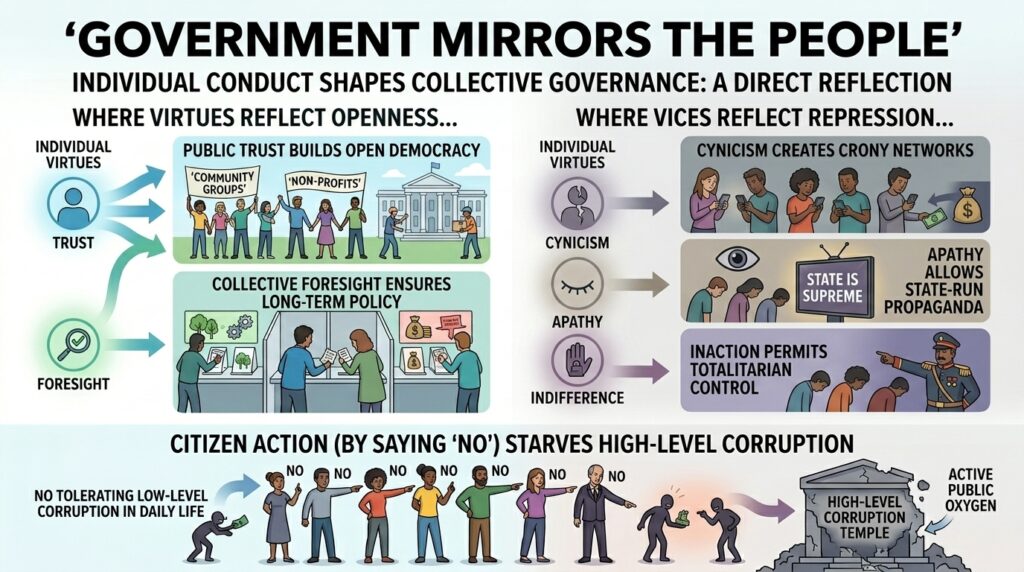
This truth carries a direct challenge: if we want better government, we must cultivate a better civic ethos. But this is not merely a call for private moral purity; it is a call for civic translation. Individual virtues must scale into collective action. In a free society, trust must translate into a willingness to build and join civic organizations, and foresight must translate into voting for sustainable policies over short-term handouts. In a repressive system, this translation may take quieter forms: maintaining private trust networks, preserving cultural memory, and refusing to internalize the regime’s values. Across all systems, mutual accountability must translate into a refusal to tolerate low-level corruption in daily life, thereby starving high-level corruption of its cultural oxygen.
Societies improve not by waiting for perfect leaders, but by citizens who demand better of themselves and one another, and who actively build the horizontal ties that make authoritarianism impossible and democracy functional. The path to better countries requires the generational transmission of better civic habits. Every nation gets the government it has earned—and the future for which it has prepared.
What do you think?
References
Berkowitz, D., Pistor, K., & Richard, J.-F. (2003). The transplant effect: How legal institutions matter for economic development. American Journal of Comparative Law, 51(1), 163–200.
Hofstede, G. (2001). Culture’s consequences: Comparing values, behaviors, institutions and organizations across nations (2nd ed.). Sage.
Inglehart, R., & Welzel, C. (2005). Modernization, cultural change, and democracy: The human development sequence. Cambridge University Press.
Inglehart, R. (2003). Political culture and democracy: Analyzing cross-level linkages. Comparative Politics, 36(1), 61–79.
World Values Survey Association. (2022). World Values Survey [Data set]. https://www.worldvaluessurvey.org
Rothstein, B., & Stolle, D. (2008). The State and Social Capital: An Institutional Theory of Generalized Trust. Comparative Politics, 40(4), 441-459.
Acemoglu, D., & Robinson, J. A. (2012). Why nations fail: The origins of power, prosperity, and poverty. Crown Business.
Sunstein, C. R. (2017). #Republic: Divided democracy in the age of social media. Princeton University Press.
[1] This figure is a widely cited approximation of the statistical relationship found in Inglehart and Welzel’s framework, though the precise causal direction remains a subject of ongoing debate in comparative politics.