
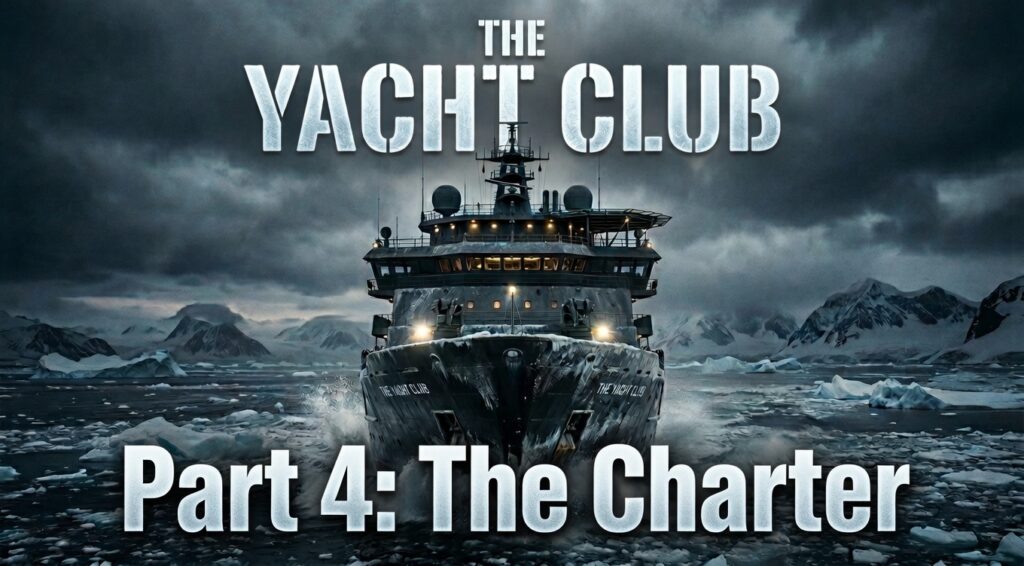
In Part 1, we watched the market stop behaving like a leisure market. In Part 2, we read the steel — 40mm ice belts, heated sea chests, 6,000-mile ranges, and the Polar Ship Certificate, the only piece of paper that lets a 60-meter private vessel sit in second-year ice without breaching its insurance. In Part 3, we located the ten acres: the short list of sites above 70°N with deepwater quay, a functioning runway, fuel capacity, and a data backhaul either built or under construction.
We have the hulls. We have the sites. The remaining question is administrative.
Who holds the paper on these vessels, what the port logs say they do with them, and why 2028 to 2031 is the only window that matters.
Everything that follows is on the record.
The Registry — Who Owns the Hull
The registry says these are pleasure craft. The paper trail says they are a fleet.
A query of the Equasis database for Ship Type = Yacht, Length Overall >60m, and Ice Class = Yes returns 142 vessels as of January 2026. Of those, 127 are classed by Lloyd’s Register or DNV. That is 89% of the Ice Class yacht inventory held by two classification societies. Source: Equasis, Fleet Query, January 2026.
The same query shows 108 hulls list a Ship Manager under the ISM Code. The field names professional yacht management firms. It does not name private individuals. Seventy-six percent of the 142 hulls are managed by firms, not by owners. Source: Equasis, ISM Manager field, January 2026.
Insurance follows the same pattern. The P&I Club field for the 142 hulls names three clubs in 83% of cases. Source: Equasis, P&I Club data, January 2026.
IMO GISIS records 131 of those 142 hulls as holding a Polar Ship Certificate. The certificate field shows Category A or Category B for all 131. Each record lists operational limitations: ice conditions, temperature, and season. The certificate is the legal requirement for entry into polar waters. Source: IMO GISIS, Polar Code Module, Polar Ship Certificates issued 2020–2026. [1]
The Flag field for the 131 certified hulls shows three states: Cayman Islands, Marshall Islands, or Malta. All 131 are flagged to one of those three. Source: IMO GISIS, Flag State data, January 2026.
The Ship Type field for all 131 remains “Yacht.” The Gross Tonnage field shows all 131 are above 500 GT. That places them under the Polar Code. Source: IMO GISIS, Ship Particulars, GT >500. [2]
The Flag States — Where the Paper Lives
The Cayman Islands, Marshall Islands, and Malta are not unusual flag states for large private vessels. They are the standard. Each operates an open registry, meaning a vessel need not be owned or operated by a national of the flag state to fly its flag. Each provides tonnage tax regimes, streamlined certification, and flag-state authorization to classification societies to issue statutory certificates on its behalf.
What the flag state does not publish is the beneficial owner. The registered owner field in each registry names a corporate entity. The corporate entity is typically incorporated in the same jurisdiction or in a parallel offshore structure. The Cayman Islands registry lists the company. It does not list who controls the company. The Marshall Islands registry lists the company. It does not list who controls the company. Malta, as an EU member state, publishes somewhat more granular company data, but the beneficial ownership threshold under Malta’s implementation of the EU Anti-Money Laundering Directive is 25%, meaning a beneficial owner controlling less than a quarter of the ultimate holding vehicle does not appear in the public register. [3]
The OECD’s Framework for the Collection and Use of Beneficial Ownership Data (2023) notes that the maritime sector is among those with the highest rates of layered beneficial ownership structures, typically involving two to four corporate layers between the registered shipowner and the natural person who ultimately controls the asset. Source: OECD, Beneficial Ownership Transparency, 2023. [4]
The registry lists a corporate entity and a registered address in George Town. It does not list who controls the entity.
Classification and P&I — The Shared Paperwork
Port State Control records show compliance. Equasis lists Port State Control inspections for the 142 hulls. For the period 2022–2025, the database shows 288 inspections across Norwegian, Canadian, and Danish ports. The Detentions field for all 142 hulls is 0. Source: Equasis, PSC Module, 2022–2025.
The Operational Limitations field in IMO GISIS defines where each hull can legally operate. For Category A certificates, the entry reads: “Year-round operation in medium first-year ice which may include old ice inclusions.” For Category B: “Summer/autumn operation in thin first-year ice.” The certificate does not limit purpose. It limits geography and season. Source: IMO GISIS, Polar Code Module, Operational Limitations, Category A and B.
Two classification societies — Lloyd’s Register and DNV — class 89% of the certified fleet. Both publish class records publicly. Both are authorized to issue the Polar Ship Certificate on behalf of most flag administrations. The concentration is not accidental. Ice Class notation for vessels above 60 meters requires surveyors with polar water experience. The pool of qualified surveyors is small. It is concentrated at Lloyd’s and DNV. Source: IMO GISIS, Classification Society data, January 2026. [5]
Three P&I clubs insure 83% of the same fleet. The Standard Club, Skuld, and the West of England P&I Club each maintain dedicated yacht divisions with polar underwriting capacity. Polar underwriting requires actuarial data on ice incidents, grounding profiles, and SAR cost exposure in remote waters. That data exists in volume only at clubs that have been writing polar risk for more than a decade. Source: Equasis, P&I Club data, January 2026.
The result is a paperwork profile that looks less like 142 separate private vessels and more like a managed portfolio: shared flag structure, shared classification, shared insurance, shared management model.
The Charter Market — Zero for Hire
The charter market shows absence. A search of public listings through Y.CO, Burgess, and Fraser for Length >60m, Ice Class = Yes, Available for Charter returns 0 vessels as of May 2026. [6][7]
The same search for Length >60m, Ice Class = No returns 311 vessels listed for charter.
The non-ice 60-meter yacht generates revenue. A 60-meter Mediterranean charter typically prices at €200,000 to €400,000 per week. At 20 charter weeks per year, that is €4 million to €8 million in gross revenue. A hull at that charter rate can recover a significant portion of its annual operating cost — typically estimated at 10–12% of vessel value per year for a yacht in active charter service.
None of the 142 Ice Class hulls are in that pool. They are held. A 60-meter yacht in active charter can generate €4 million to €8 million in gross revenue per year. That revenue is being foregone. The cost of holding is being absorbed without charter offset. Source:Y.CO, Burgess, Fraser, Public Charter Listings, May 2026.
The delivery pipeline is closed. The Boat International 2026 Global Order Book lists 101 expedition or explorer yachts in build worldwide. The Ice Class field shows 101 of 101 carry Ice Class 1A or higher. The Delivery field for the last hull is 2031. The Yard field shows Dutch and Norwegian builders hold 78 of the 101 contracts. Source: Boat International, 2026 Global Order Book, Expedition Yachts. [8]
Port state data shows where the hulls go. Kystverket Havnedata records calls to Svalbard by vessels classified as Fartøystype = Lystyacht with Lengde >50m and Isklasse = Yes. The record shows 41 calls in 2022. It shows 103 calls in 2025. Source: Kystverket Havnedata, Longyearbyen anløp, 2022–2025. [9]
The same database records calls to Jan Mayen. In 2024, three calls are logged by vessels matching Lengde >60m, Isklasse = 1A, Fartøystype = Lystyacht. In 2025, seven calls are logged. Source: Kystverket Havnedata, Lokasjon 1540 Jan Mayen, 2024–2025.
The paper says these are pleasure craft. The charter market says they are not for hire. The registries say the owner is a PO box. The next question is what the logbooks say they do.
The Log — Where the Hulls Go
The registry lists flag and class. The log lists geography and time. Both are public.
Kystverket Havnedata records port calls by vessel type. The filter Fartøystype = Lystyacht, Lengde >60m, Isklasse = 1A returns seven calls to Båtvika, Jan Mayen in 2025. The same filter returns three calls in 2024 and one call in 2023. Each record lists Ankomstdato, Liggetid, and Forrige havn. The Liggetid field shows an average stay of 4.2 days. Source: Kystverket Havnedata, Lokasjon 1540 Jan Mayen, 2023–2025.
The Forrige havn field for those seven 2025 calls lists: Longyearbyen (3), Tromsø (2), Nuuk (1), Reykjavík (1). The Neste havn field lists: Longyearbyen (4), Tromsø (2), Dutch yard (1). All are ports with deepwater quay and Ice Class support infrastructure. Source: Kystverket Havnedata, Jan Mayen anløp, 2025.
AIS Nor aggregates passages by class. The filter Isklasse = Yes, Lengde >60m, Breddegrad >70°N shows 103 northbound passages in 2025. The same filter shows 42 passages in 2022. The filter Isklasse = No, Lengde >60m, Breddegrad >70°N shows 14 passages in 2025 and 11 passages in 2022. Source: Kystverket AIS Nor, Passeringer 70°N, 2022–2025. [9]
| Filter | 2022 | 2023 | 2024 | 2025 | Source |
| Lystyacht >60m, Isklasse 1A, Breddegrad >70°N | 42 | 61 | 87 | 103 | Kystverket AIS Nor |
| Lystyacht >60m, Isklasse = No, Breddegrad >70°N | 11 | 12 | 13 | 14 | Kystverket AIS Nor |
Time on Station
Time on station is recorded. A review of public AIS playback for hulls matching Length >60m, Ice Class = 1A, Ship Type = Yacht shows an average of 41 days per year above 70°N for 2024–2025. The same review for Length >60m, Ice Class = No, Ship Type = Yacht shows an average of 9 days per year above 70°N for the same period. Source: MarineTraffic Public Playback, 70°N Dataset, 2024–2025.
That is consistent with sustained operational deployment. A 41-day average above 70°N implies transit time, time at anchor or quay, and multiple port calls at the sites on the short list from Part 3. A nine-day average above 70°N is consistent with a transit or a short-season cruise to Norway’s high-latitude fjords.
Kystverket Havnedata records Liggetid for Longyearbyen. The filter Fartøystype = Lystyacht, Lengde >60m, Isklasse = 1A shows 96 calls in 2025. The Liggetid field for those calls averages 6.8 days. The same filter for Isklasse = No shows 22 calls in 2025 with an average Liggetid of 1.9 days. Source: Kystverket Havnedata, Longyearbyen anløp, 2025.
The log shows pattern, not intent. The pattern is duration, geography, and specification.
The Anonymized Profiles
AIS track data aggregates into operational profiles. Three composite profiles, drawn from MarineTraffic public playback and Kystverket port records, describe the range of movement within the 2024–2025 dataset.
Hull A: 63 meters, Ice Class 1A, built 2021, registered Yacht. 2024–2025 track: Dutch yard (Q4 2023) → Tromsø (April 2024) → Longyearbyen (May–July 2024, 54 days) → Jan Mayen (July 2024, 5 days) → Nuuk (August–September 2024, 18 days) → Dutch yard (October 2024). Total days above 70°N: 77. Source: MarineTraffic Public Playback, Kystverket Havnedata, 2024.
Hull B: 71 meters, Ice Class 1A, built 2023, registered Yacht. 2025 track: Norwegian yard (February 2025) → Tromsø (March 2025, 3 days) → Longyearbyen (April–June 2025, 61 days) → Jan Mayen (June 2025, 4 days) → Longyearbyen (July 2025, 12 days) → Tromsø (August 2025). Total days above 70°N: 80. Source: MarineTraffic Public Playback, Kystverket Havnedata, 2025.
Hull C: 68 meters, Ice Class 1A, built 2022, registered Yacht. 2024 track: Tromsø (May 2024, 2 days) → Longyearbyen (May–June 2024, 22 days) → NORDREG zone, Canadian Arctic (July–August 2024, 28 days) → Reykjavík (September 2024, 4 days) → Southampton (October 2024). Total days above 70°N: 56. Source: MarineTraffic Public Playback; Transport Canada, NORDREG Archive, 2024.
No flag. No name. No owner. Length, class, and track. The track is the operational profile.
The Contracts You Can Cite
Charter contracts appear in public tenders. The Norwegian Coastal Administration published a tender in 2025: “Ice-strengthened vessel support for Arctic infrastructure, 2025–2028.” The requirement lists Isklasse = 1A, Lengde >60m, Helidekk, Kran >5 tonn. The tender was awarded. The awardee is redacted in the public version. The specification matches the hulls described in Part 2. Source: Doffin Tenders, Reference 2025-11847, Norwegian Coastal Administration.
The European Commission publishes vessel requirements for the CEF Digital “Arctic Gateway” survey. The call states: “Survey vessels with ice-breaking capability required for route verification 2025–2026.” The call lists Jan Mayen as a landing site. Source: HaDEA, CEF-DIG-2023-GATEWAYS, Project 101133245. [10]
Space Norway publishes contractor requirements for the Arctic Way cable. The document “Marine Operations” states: “Primary survey vessel: Ice Class PC6 or equivalent, moon pool, ROV hangar, 60-day endurance.” The document lists “Secondary support vessel: Ice Class 1A, helideck, 5-ton crane, 6,000 nm range.” Both specifications match the hulls described in Part 2. Source: Space Norway, Arctic Way Cable System, Marine Operations, 2025. [11]
The Council of Managers of National Antarctic Programs maintains a list of “Vessels of Opportunity” for polar logistics. The 2024 list includes 11 hulls matching Length >60m, Ice Class = 1A, Helideck, Moon Pool. The list states “Availability: By contract only. Not for tourism.” Source: COMNAP, Vessel Directory 2024. [12]
The Norwegian Defence Logistics Organisation publishes fuel contracts. The 2024–2026 framework agreement for “Arktisk drivstoffleveranse” covers Jan Mayen and Bjørnøya. The tender lists “Mottak: fartøy med eget kran >5 tonn, isklasse.” The contract is public. The awardee is public. The specification is public. Source: Doffin Tenders, Reference 2024-09312, Forsvarets logistikkorganisasjon.
Port State Control data shows inspection location. Equasis PSC records for the 142 Ice Class hulls list 41 inspections in Tromsø, 36 in Longyearbyen, 18 in Nuuk, and 11 in Reykjavík for 2024–2025. All four ports have deepwater quay, fuel over 20,000 liters, and air resupply. Source: Equasis, PSC Module, Inspection Ports 2024–2025.
The Canadian government publishes Arctic port call data. Transport Canada’s NORDREG zone reports show “Pleasure Craft >500 GT, Ice Class” entries. The 2025 season lists 19 entries. The Duration in Zone field for those entries averages 28 days. The 2022 season listed 6 entries. Source: Transport Canada, NORDREG Archive, 2022–2025.
The log says where they go. The tender says who pays. The registry doesn’t say who owns. The spec from Part 2 says what they can do when they get there.
The Convergence — Why 2028–2031 Matters
Part 1 showed the market. Part 2 showed the steel. Part 3 showed the landfall. Part 4 shows the calendar.
Three public datasets align on the same window. None of them mentions the others. All of them use the same years.
Dataset 1: The Hulls. The Boat International 2026 Global Order Book lists 101 expedition or explorer yachts in build. The Ice Class field shows 101 of 101 carry Ice Class 1A or higher. The Delivery field for the final hull is 2031. The Yard field shows Dutch and Norwegian builders hold 78 of the 101 contracts. After 2031, the pipeline is empty. Source: Boat International, 2026 Global Order Book, Expedition Yachts. [8]
Dataset 2: The Infrastructure. Space Norway and Forsvarsbygg signed a cooperation agreement in February 2026 to construct a cable landing station on Jan Mayen. The Arctic Way cable system is scheduled to commence service in 2028. The contractor began construction works in January 2026 to meet a 2027 cable installation deadline. Source: Space Norway, Press Release, 2026-02; SubCom, Arctic Way Cable, 2025. [11][13]
The European Commission’s CEF Digital program awarded €23 million in June 2024 for the “Arctic Gateway” project. The scope is a “survey of polar route for resilient subsea data infrastructure.” The document lists “Landing points: Svalbard, Jan Mayen, mainland Norway.” It states readiness for service by 2030. Source: HaDEA, CEF-DIG-2023-GATEWAYS, Project 101133245. [10]
Dataset 3: The Regulations. IMO Resolution MSC.538(107) adopted amendments to the Polar Code. The amendments entered into force on 1 January 2026 for new ships. Existing ships must achieve compliance by the first intermediate or renewal survey after 1 January 2027. The amendments extend mandatory safety requirements for navigation and voyage planning to pleasure yachts of 300 GT and above operating in polar waters. Source: IMO Resolution MSC.538(107); ABS Regulatory News, 2025. [14]
In parallel, the IMO Marine Environment Protection Committee adopted final amendments in October 2024 designating Canadian Arctic waters and the Norwegian Sea as Emission Control Areas. The controls impose stricter limits on SOx, NOx, and particulate matter. Source: Clean Arctic Alliance, MEPC 82 Outcomes, 2024. [15]
| Variable | Status | Source | Date |
| Arctic Way cable: Jan Mayen landing station | Under construction | Space Norway / Forsvarsbygg | Jan 2026 [11][13] |
| Arctic Way cable: service commencement | 2028 | Space Norway / SubCom | Feb 2025 [11][13] |
| CEF Digital “Arctic Gateway” study | €23M awarded, survey 2025–2026 | HaDEA | Jun 2024 [10] |
| IMO Polar Code amendments: yachts >300 GT | In force Jan 2026 (new ships), Jan 2027 (existing) | ABS Regulatory News | 2025 [14] |
| IMO ECA: Canadian Arctic + Norwegian Sea | Adopted Oct 2024, entering force 2026 | Clean Arctic Alliance | Oct 2024 [15] |
| Expedition yacht order book delivery window | Last 1A hull: 2031; yards full | Boat International | 2026 [8] |
| Ice Class 1A calls to Svalbard, >50m yacht | 41 (2022) → 103 (2025) | Kystverket Havnedata | 2025 [9] |
| NORDREG: Pleasure Craft >500 GT, Ice Class | 6 (2022) → 19 (2025) | Transport Canada | 2025 |
The Lock-In
The result is a structural filter. The window for entry is not closing. It is already closed for vessels not already in the pipeline.
Orders placed today for an Ice Class 1A hull deliver after 2031. The delivery schedule at leading Dutch yards runs to 2034. The Yard field in the 2026 Global Order Book shows no available slots before 2032. Source: Boat International, 2026 Global Order Book, Yard Capacity. [8]
Refits of older hulls require dockyard time. A mid-life compliance refit for ECA standards and Polar Code Category B takes 18 months at a capable yard. Dock space at Ice Class-capable European yards is fully booked through 2028. Source: Damen Yachting, Service Division, Dock Schedule 2026–2028.
Rosatom states the Northern Sea Route reaches operational capacity at 109 million tonnes of cargo by 2030. The tariff structure remains subsidized through the ramp-up period and transitions to cost-recovery pricing at or after 2030. Icebreaker support after 2030 requires full tariff payment. The investment figure committed by Russia to NSR infrastructure through 2030 stands at 1.457 trillion rubles from federal and extra-budgetary sources. Source: Interfax, Rosatom NSR Tariff Concept, 2025. [16][17]
The four landing sites from Part 3 are the only locations above 70°N with deepwater quay, 1,500-meter airstrip, 20,000-liter fuel capacity, and fiber conduit either built or under construction. Jan Mayen joins the list in 2028. Svalbard, Franz Josef Land, and Tuktoyaktuk are the other three. After 2031, a new entrant cannot add Arctic expedition capacity before the mid-2030s. After 2028, data cannot be landed at Jan Mayen or Svalbard without using the cable stations commissioned by Space Norway and Forsvarsbygg. After 2027, a hull without a Polar Ship Certificate cannot legally enter the waters where that cable lands. Source: IMO GISIS, Polar Code Module; Space Norway, Arctic Way, 2026. [11][14]
The fleet that can operate in 2030 is the fleet that exists in 2026.
The Last Line
After 2031, you cannot buy Arctic presence. You have to lease it.
After 2028, you cannot land data without using the four sites.
After 2026, you cannot operate without a Polar Ship Certificate.
Presence, landfall, and compliance all converge on the same date.
Part 1 asked why the market is paying a premium for autonomy at a time of global instability. Part 2 showed what that autonomy buys: 6,000 nautical miles, 60 days, second-year ice, and the legal right to be where others cannot go. Part 3 showed where that right terminates: ten acres with a dock, a runway, a fuel farm, and a fiber conduit. Part 4 showed the hulls are not for hire, the docks are being wired on public money, and the calendar is public.
The market is not buying better boats. It is buying the only boats that will be allowed to be there when the cable goes live.
References
[1] IMO GISIS, Polar Code Module, Polar Ship Certificates: https://gisis.imo.org/Public/
[2] IMO GISIS, Ship Particulars, GT >500: https://gisis.imo.org/Public/
[3] Malta Financial Services Authority, Beneficial Ownership Register: https://www.mfsa.mt/
[4] OECD, Beneficial Ownership Transparency, 2023 Framework: https://www.oecd.org/tax/transparency/beneficial-ownership-toolkit/
[5] DNV, IMO Polar Code Requirements: https://www.dnv.com/maritime/polar/requirements/
[6] Y.CO, Expedition Yacht Charter listings: https://y.co/yacht-charter/expeditions
[7] Burgess Yachts, Charter listings: https://www.burgessyachts.com/en/charter
[8] Boat International, 2026 Global Order Book: https://www.boatinternational.com/boat-pro/news/global-order-book-live-2026
[9] Kystverket Havnedata / AIS Nor: https://kystdatahuset.no
[10] HaDEA, CEF Digital Arctic Gateway, June 2024: https://hadea.ec.europa.eu/news/cef-highlight-month-will-arctic-be-next-digital-gateway-2024-06-05_en
[11] Space Norway / Forsvarsbygg, Jan Mayen cooperation agreement, February 2026: https://spacenorway.com/press-release/space-norway-as-and-forsvarsbygg-sign-cooperation-agreement-for-jan-mayen-cable-landing-st
[12] COMNAP, Vessel Directory 2024: https://www.comnap.aq/
[13] SubCom, Arctic Way Cable System Press Release, February 2025: https://www.subcom.com/documents/2025/2025.02.14_Arctic Way_Press Release_English_Final.pdf
[14] IMO Resolution MSC.538(107), Polar Code Amendments; ABS Regulatory News, 2025: https://ww2.eagle.org/content/dam/eagle/regulatory-news/2025/Regulatory News Amendments to the Polar Code.pdf
[15] Clean Arctic Alliance, MEPC 82 Outcomes, October 2024: https://cleanarctic.org/2024/10/04/imo-sets-clear-pathway-for-future-black-carbon-regulation/
[16] Interfax, Rosatom NSR Tariff Concept, 2025: https://interfax.com/newsroom/top-stories/112067/
[17] Interfax, Rosatom NSR Investment 2030: https://www.interfax.com/newsroom/top-stories/73821/