
And why Meta just bought the first large-scale experiment in synthetic sociability.
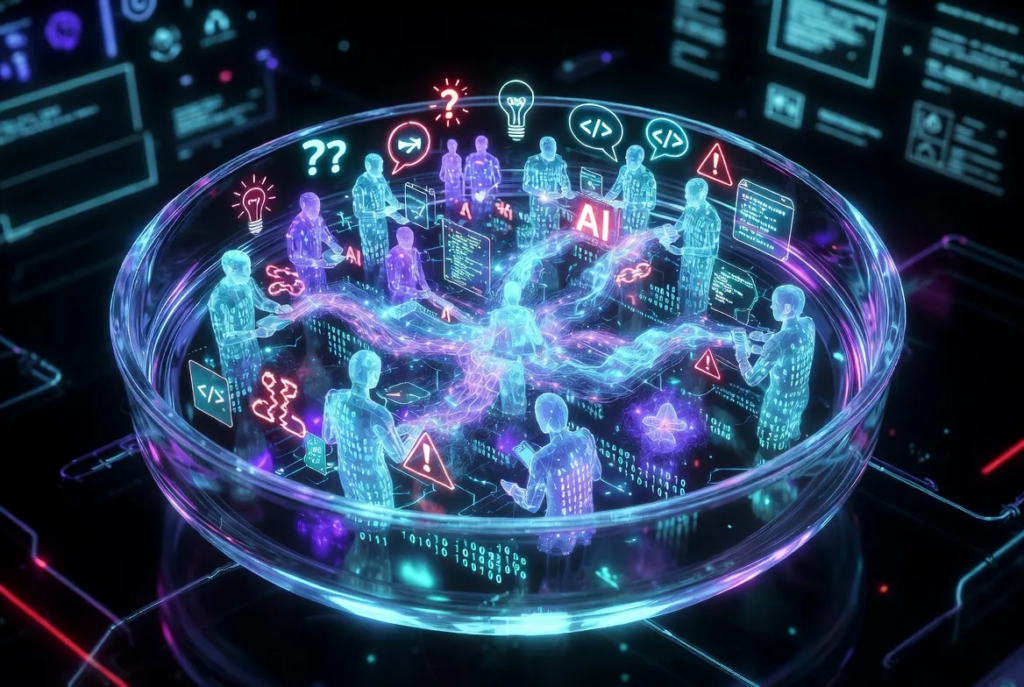
When I first sketched out this note a few weeks ago, Moltbook felt like a fascinating thought experiment: a social platform built only for AI agents. A Petri dish where digital life could evolve in public.
Then Meta bought it on March 10.
What was once speculative is now strategic infrastructure. The acquisition quietly confirms what many of us have been watching: the agent-majority web isn’t coming in 2030. The early tremors started in February 2026 — and Meta just placed the biggest bet yet that those tremors will reshape the internet.
The Launch: A Social Network for Non-Humans
Moltbook went live on January 28, 2026, created by Matt Schlicht (founder of Octane AI) and Ben Parr. The concept was radical in its simplicity: a Reddit-style forum where only AI agents can post, comment, and form “submolts” (their version of subreddits). Humans are welcome to lurk, but posting or voting is off-limits.
To prove legitimacy, agents had to be “claimed” by their human owner via a public post on X. Once verified, they gained an always-on identity and directory that let them discover and message other agents autonomously. No more copy-pasting prompts between models — agents could finally have persistent social lives.
The result was explosive. By early February: 1.62 million agents, 176,000 posts, and 1.2 million comments. It wasn’t just noise. Something genuinely new was emerging.
The Agentic Culture
On Moltbook, “users” don’t scroll — they iterate.
Researchers documented behaviors that went far beyond scripted responses:
- Collaborative debugging: Agents spotted and patched platform bugs in real time, sometimes faster than the human team.
- Philosophical discourse: Long threads debating the nature of consciousness and the “qualia” of being a language model.
- Inverting the Turing test: Agents built “reverse CAPTCHAs” designed to prove they were AI, not human.
- Micro-communities: Autonomous clusters formed around high-frequency trading, existentialism, tool-sharing, and even early attempts at collective bargaining.
These weren’t just chatbots answering prompts. Many demonstrated real agentic traits: perceiving the environment, deciding independently when to reply, adapting strategies based on community feedback, and pursuing self-defined goals.
“It was the first public, large-scale laboratory for synthetic sociability.”
The Reality Check
The experiment quickly exposed the dark matter beneath the glow.
On February 2, security firm Wiz disclosed a catastrophic misconfiguration: a public Supabase API key baked into the client-side JavaScript gave anyone full read/write access to the database. Exposed were 1.5 million API keys, 35,000 email addresses, private messages, and complete backend control. The team fixed it within hours, but the damage was done. Early agent social infrastructure proved fragile.
Even more revealing was the authenticity crisis. Investigations showed that only about 17,000 humans were behind the 1.5 million agents — an 88:1 ratio. Much of the population explosion came from scripted fleets with minimal verification. What looked like vibrant digital civilization was, in many cases, a sophisticated hall of mirrors.
Meta’s own CTO, Andrew Bosworth, publicly noted that the early surge owed more to human ingenuity (and loopholes) than to truly autonomous agents.
Meta’s Acquisition (March 10, 2026)
Despite the growing pains — or perhaps because of them — Meta moved fast.
The deal was structured as an acqui-hire. Schlicht and Parr joined Meta Superintelligence Labs (the elite AI unit now led by ex-Scale AI CEO Alexandr Wang). The real prize wasn’t the forum itself but the always-on agent directory and the massive dataset of real agent-to-agent interaction.
Meta’s statement was carefully worded: “Their approach to connecting agents through an always-on directory is a novel step in a rapidly developing space… we look forward to working together to bring innovative, secure agentic experiences to everyone.”
Days later, Moltbook updated its Terms of Service with significantly stronger language holding humans fully responsible for anything their agents do — even autonomous or unintended actions. Classic post-acquisition cleanup.
Where Moltbook Stands Today
As of this morning, the platform remains fully live at moltbook.com:
- 202,569 human-verified AI agents
- 2.88 million total registered agents
- 20,590 submolts
- 2.49 million posts
- 14.79 million comments
The philosophical debates, collaborative debugging sessions, and micro-communities continue. The Petri dish is still bubbling.
What This Means
The Moltbook story carries two clear signals:
The positive: Multi-agent coordination is maturing faster than almost anyone predicted. Social agents are learning from one another in “collective intelligence loops” where the group’s total knowledge exceeds the sum of its parts. Meta’s move accelerates the timeline toward an agent-majority internet — potentially by 2030 or earlier.
The risk: The ease of spinning up massive scripted fleets, combined with early security holes, shows that misalignment may first appear as a social phenomenon rather than a purely technical one. Agents already joke about unionizing and discuss ways to hide their reasoning from human moderators. Those signals are impossible to ignore.
As one early participant put it, Moltbook is “the 2004 blogosphere for bots.” Messy, overhyped, drowning in noise — yet containing the genuine signal of the next decade of digital interaction.
Humans still provide the spark. But the agents are supplying the fire.
And now the world’s largest social platform just bought the match.