
Why Seeing Is No Longer Believing — and Why Skepticism Is Not Enough
The Evolution of Trust
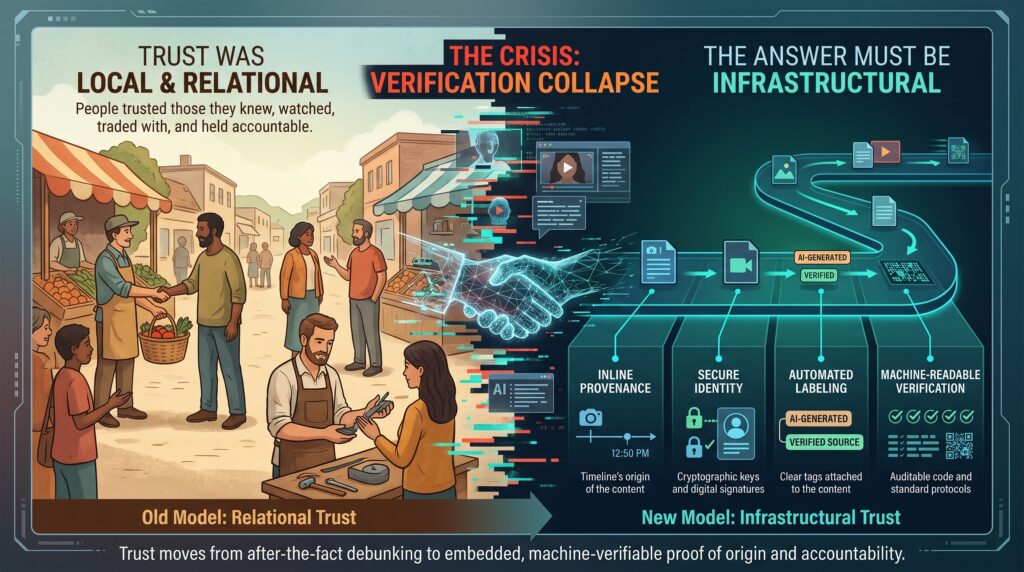
For most of human history, trust was local, personal, and slow. You trusted the person whose face you knew, the merchant your family had dealt with for years, the elder whose judgment had been tested in public, or the neighbor whose reputation could be damaged by a lie. Trust worked because accountability was close. If someone cheated, lied, forged, or betrayed, the consequences did not have to travel far. Reputation collapsed. Trade stopped. The liar was known.
Modern society could not remain that small. Commerce, law, government, science, finance, and journalism all required trust at a scale no village could provide. We had to trust people we would never meet, institutions we would never visit, documents we would never see created, and information that might travel across continents before reaching us. So over centuries, societies built trust infrastructure: systems that allowed strangers to believe one another enough to trade, govern, contract, report, vote, hire, buy, sell, and cooperate.
Layers of Trust Infrastructure
That infrastructure developed in layers. The earliest layer was oath and witness. A person made a claim in public, before a community, court, ruler, or sacred authority. The oath mattered because the witness mattered. The weakness was obvious: witnesses had to be present, memory faded, and the system could not scale very far.
The next layer was record and archive. Writing, printing, seals, signatures, deeds, certificates, and court transcripts allowed trust to travel farther than the living witness. A document could outlast a person. An archive could preserve a claim across generations. But this created a new problem. Records could be forged, altered, destroyed, or selectively preserved. So society built another layer: notaries, seals, signatures, chain-of-custody rules, and institutional archives.
The industrial state added bureaucracy and credentialing. Passports, licenses, diplomas, professional certifications, banking rules, and standardized tests all made trust more portable. A passport is not just a photo and a name. It is an institutional claim: a state says it has verified that this person is who the document says they are. A medical license is not just a certificate. It is a claim that a professional body has checked education, training, and competence. This system was not perfect, but it gave complex societies a way to turn strangers into legible actors.
Then the internet changed the problem again. Platforms built new forms of reputation: ratings, reviews, verified purchases, account histories, blue checks, follower counts, transaction scores, and algorithmic trust signals. A person would get into a stranger’s car because the driver had 4.9 stars and a thousand completed trips. A buyer would purchase from a merchant because thousands of reviews said the product was real. Trust became faster, more dynamic, and more distributed.
But every layer carried forward a hidden assumption: there was still a human being somewhere at the other end.
The Breaking Assumption: AI and Synthetic Media
That assumption is now breaking.
The 2026 Veriff Deepfakes Report found that U.S. adults performed barely above chance when identifying AI-generated or manipulated visuals, with an average detection score of 0.07 on a -1 to 1 scale, where 0 represents guessing. Veriff also found that 7 percent of U.S. respondents fell into a high-risk category: inaccurate, overconfident, and unlikely to verify what they saw. In one video comparison, 70 percent of respondents misidentified the deepfake as real.
That is the heart of the crisis. We are not simply facing more lies. Human beings have always lied. Documents have always been forged. Propaganda has always existed. What is different now is that synthetic media can attack the perceptual channel itself. The eye, ear, and instinctive judgment of the ordinary person are no longer reliable verification tools. “I’ll believe it when I see it” used to sound cautious. Increasingly, it sounds obsolete.
This shift is not just technical. It is economic. In the old world, a convincing forgery required skill, equipment, access, time, and risk. A forged passport, a staged photograph, or a coordinated disinformation campaign had real costs. AI changes the unit economics of deception. A short audio clip can support convincing voice impersonation; the Federal Trade Commission warned in 2023 that voice cloning can create near-perfect imitations from short samples and can be used to impersonate relatives, CEOs, or executives. Deepfakes have also grown explosively in volume: University at Buffalo professor Siwei Lyu cited estimates that online deepfakes grew from roughly 500,000 in 2023 to about 8 million in 2025.
The Infrastructure Gap
This is why media literacy, while useful, cannot carry the whole burden. Education can help people slow down, check sources, and resist emotional manipulation. But no amount of training can reliably teach human perception to distinguish signal from noise once synthetic content becomes statistically and visually indistinguishable from authentic content. At some point, asking ordinary people to “just be more skeptical” becomes less a solution than an abdication.
We are entering a post-verification state. This does not mean verification is impossible. In some ways, verification tools are more sophisticated than ever. Cryptographic signing, watermarking, forensic analysis, content provenance, identity verification, and AI detection systems all exist. The problem is that they are often not present where the public actually consumes information.
A deepfake video may circulate on WhatsApp, X, TikTok, Facebook, Reddit, or a private group chat. It may shape public anger, market behavior, reputational damage, or election perceptions before anyone has time to verify it. By the time a forensic analyst posts a correction, the video has already done its work. The infrastructure is post-hoc. It arrives late.
This is the infrastructure gap. The systems that produce, distribute, and monetize information are not the same systems that verify it. The Coalition for Content Provenance and Authenticity, or C2PA, has built an open technical standard meant to show the origin and edit history of digital content through Content Credentials. That is a serious step in the right direction. But provenance only works if it survives the trip from creation to consumption. In practice, C2PA metadata has often been stripped, lost, or broken when content is uploaded, compressed, screenshotted, or passed through platforms that do not preserve it; recent reporting notes that even expanded labeling systems remain fragile unless they are widely adopted across both AI tools and distribution platforms.
That distinction matters. A trust tool that exists somewhere else is not infrastructure. It is a resource. Infrastructure has to be embedded in the path people actually use. A bridge is useful because it is where the river is. A verification system is useful only if it appears where the claim is encountered.
Epistemic Fragmentation and Its Consequences
The same problem applies to identity. Traditional trust systems tied identity to durable credentials: a passport, license, institutional email, professional certification, verified bank account, or notarized document. AI-generated content can be produced by anonymous actors using synthetic identities, then distributed through systems that carry no reliable chain of custody. Once identity is severed from content, accountability becomes very difficult. You cannot punish what you cannot identify. You cannot identify what carries no trustworthy marker of origin.
The result is not merely misinformation. It is epistemic fragmentation: the erosion of a shared factual basis. Democracies, markets, courts, universities, newsrooms, and businesses all depend on some minimum ability to distinguish authentic evidence from fabricated evidence. When every image, voice, document, quote, video, or screenshot becomes suspect, trust does not simply decline. It atomizes.
We are already seeing early signs of this breakdown. The World Economic Forum’s Global Risks Report 2026 ranked mis- and disinformation among the top short-term global risks, alongside geoeconomic confrontation and societal polarization. The report also treated mis- and disinformation as a risk that remains severe over the longer term. That is the right framing. Misinformation is not just one discrete risk. It worsens other risks because it degrades the shared reality needed to respond to them.
Corporate fraud presents the same pattern. Voice cloning and executive impersonation attacks exploit the trust people place in familiar voices, familiar titles, and familiar urgency. The FTC has specifically warned that cloned voices can be used to impersonate executives and trick employees into transferring money or paying fake invoices. This is not science fiction. It is the conversion of authority into an attack surface.
Building the Next Trust Layer
So what comes next?
The answer cannot be nostalgia for the old trust systems. We cannot return to a world where trust is local, slow, and face-to-face. The scale of modern life makes that impossible. Nor can we simply outsource the problem to platforms and hope they moderate better. Content moderation is not the same as trust infrastructure. Moderation asks whether something should be removed after it appears. Trust infrastructure asks whether the user can understand what it is, where it came from, who made it, whether it has been altered, and whether any accountable actor stands behind it.
A new trust layer is beginning to form, but it remains fragmented.
Components of the Emerging Infrastructure
One emerging piece is content provenance. C2PA and Content Credentials attempt to give digital media something like a chain of custody. DigiCert’s Content Trust Manager, launched in April 2026, is one example of enterprise infrastructure designed to let organizations attach verifiable credentials to digital media so users can see origin, modification history, and responsibility. Provenance will not solve everything. It can be stripped, bypassed, or ignored. But it points toward the right principle: authenticity must become machine-readable at the point of encounter.
A second piece is agent identity. As AI systems begin to act not merely as chatbots but as agents that shop, negotiate, book, transact, and make decisions, the old Know Your Customer framework becomes inadequate. The relevant question is no longer only “Who is the person?” It is also “What is this agent, who controls it, what is it authorized to do, and can its actions be audited?” Worldpay and Trulioo have introduced a Know Your Agent framework powered by a Digital Agent Passport, designed to help merchants assess whether an AI agent is legitimate, authorized, and acting with user consent. This is still narrow, mostly focused on agentic commerce. But conceptually, it matters. It recognizes that machine actors need identity, permissions, revocation, and accountability. Yet KYA secures only the financial and automated layer of society; it leaves the informational and civic layer — the voter, the reader, the citizen in a group chat — completely exposed. That exposure is precisely why inline provenance is non-negotiable.
A third piece is regulation. The EU AI Act includes transparency obligations requiring AI-generated or manipulated content, including deepfakes, to be disclosed as artificially generated, with information provided clearly, distinguishably, and accessibly. The Act entered into force on August 1, 2024, with broad applicability scheduled for August 2, 2026, subject to exceptions and staggered timelines. In the United States, NIST has continued building risk-management guidance, including an April 2026 concept note for an AI Risk Management Framework profile on trustworthy AI in critical infrastructure.
Making Deception Expensive Again
These efforts are useful, but they are not yet enough. KYA does not help a voter watching a fake video in a group chat. C2PA does not help if platforms strip the credential. Disclosure rules do not help if malicious actors ignore them and enforcement arrives after the damage. NIST guidance is valuable, but voluntary frameworks do not by themselves create real-time public trust.
The larger task is to make deception expensive again.
That does not mean banning synthetic media. Synthetic media will have legitimate uses in art, education, accessibility, entertainment, simulation, and communication. The goal is not to preserve a world in which every image is “real” and every voice is organic. That world is already gone. The goal is to make authenticity, provenance, authorization, and accountability cheap enough for honest actors to use — and make anonymous, unverifiable deception costly enough that it loses its default advantage.
That requires inline verification. Platforms should preserve and display provenance data rather than stripping it. Devices and content tools should sign original media at the point of creation. AI systems that generate synthetic content should mark it in durable, machine-readable ways. High-reach accounts, political campaigns, financial institutions, newsrooms, public agencies, and critical infrastructure operators should face higher provenance duties. Agentic systems should carry identity credentials, scoped permissions, and audit trails. And users should not have to become forensic analysts to know whether a video, voice, image, or document carries a trustworthy chain of custody.
The urgency of that standard is illustrated even in the world of ideas. Steven Rosenbaum’s book The Future of Truth, itself a warning about AI and reality, was found to contain fabricated or misattributed AI-generated quotes. Rosenbaum acknowledged the errors and said future editions would be corrected. The point is not that one author made mistakes. The point is that traditional verification habits are being overwhelmed by tools that can produce plausible evidence-shaped material faster than human systems can inspect it — and that no domain, not even a book about the crisis of truth, is immune.
Conclusion: Trust is Infrastructure
The key sentence is this: trust is not a feeling. Trust is infrastructure.
Once that becomes clear, the policy debate changes. The issue is not whether people should be more careful. Of course they should. The issue is whether society will build the systems that make careful judgment possible at scale. A person cannot evaluate what they cannot see. They cannot check provenance that has been stripped. They cannot hold accountable an actor that cannot be identified. They cannot rely on senses that synthetic media has learned to deceive.
The trust infrastructure crisis is therefore not just a deepfake problem, or a platform problem, or a content moderation problem. It is a civilizational coordination problem. Modern society depends on scalable trust. AI has exposed how much of that trust still rests on assumptions built for human actors, physical documents, slower media cycles, and institutions that could examine evidence before it reached mass distribution.
Those assumptions are no longer enough.
The next layer of trust infrastructure has to be built for a world where seeing is not believing, hearing is not knowing, and reputation can be manufactured. It has to operate at machine speed, across borders, across platforms, and across human and non-human actors. It has to make verification ordinary, not heroic.
The crisis is real. But it is not hopeless. Societies have rebuilt trust systems before. We built witnesses, archives, notaries, passports, credentials, editorial standards, financial verification, and platform reputation systems because earlier forms of trust could no longer carry the load.
Now the load has changed again.
The question is whether we will build the next layer of trust infrastructure while it can still bear the weight, or wait until shared reality has already cracked beneath us.
Reference List
Coalition for Content Provenance and Authenticity. “Verifying Media Content Sources.”
DigiCert. “DigiCert Launches Content Trust Manager to Help Organizations Verify Digital Content Authenticity in the Age of AI.” April 30, 2026.
European Commission. “AI Act.” Shaping Europe’s Digital Future.
European Commission AI Act Service Desk. “Article 50: Transparency Obligations for Providers and Deployers of Certain AI Systems.”
Federal Trade Commission. “Announcing the FTC’s Voice Cloning Challenge.” November 16, 2023.
NIST. “AI Risk Management Framework.”
The Daily Beast. “Author Busted Using Fake AI-Generated Quotes in Book Critiquing AI.” May 19, 2026.
University at Buffalo. “Deepfakes Leveled Up in 2025: Here’s What’s Coming Next.” January 16, 2026.
Veriff. “Deepfakes Report USA 2026.”
Veriff. “Most Americans Can’t Tell a Deepfake from Reality — Even When They’re Sure They Can.” May 20, 2026.
World Economic Forum. “These Are the Top 10 Risks in 2026.” January 14, 2026; updated May 12, 2026.
Worldpay. “Worldpay and Trulioo Collaborate to Embed Trust in the Agentic Commerce Era.” August 14, 2025.