
From Kyiv datarooms to $50B VC bets — why “battle-proven” is now the ultimate valuation multiplier.
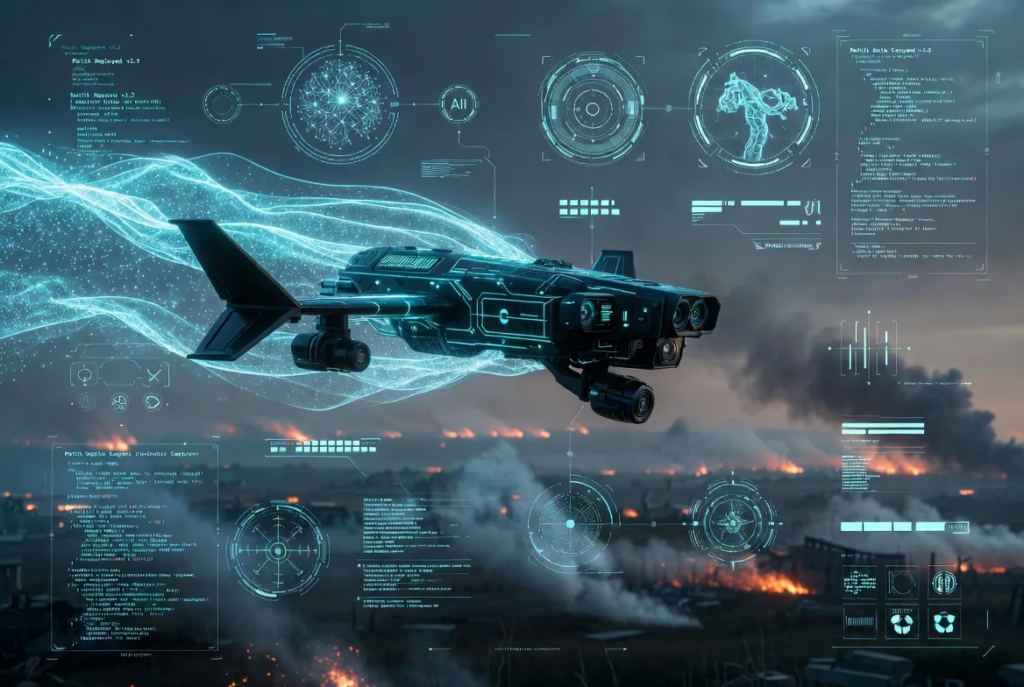
In July 2025, a German drone startup didn’t send engineers to a desert proving ground. They uploaded code to a secure dataroom in Kyiv, watched their AI-guided platform fly a live mission, and pushed a software patch before the sun set. By November, 126 foreign firms from 17 countries had queued up to do the same through Ukraine’s official “Test in Ukraine” platform. War is no longer just fought. It’s productized, stress-tested, and scaled like a software release. The feedback loop is measured in weeks, not years.
What’s happening isn’t a conspiracy to prolong fighting. It’s a structural shift in how defense technology is developed, validated, and monetized. Live-fire conflicts have become the world’s most efficient R&D lab. And the market has learned to price instability like a venture asset.
Data as the New Commodity
The primary export of modern testbeds isn’t hardware; it’s structured battlefield data. Ukraine’s Brave1 Dataroom, launched in partnership with Palantir in early 2026, operates as the clearest example. It’s a secure, government-vetted environment where engineers train and validate AI models using curated frontline visual and thermal feeds. But who owns this data? Sovereign states claim it, yet commercial platforms structure, label, and monetize it. Metadata on civilian infrastructure, electronic warfare (EW) signatures, and AI failure modes are quietly repackaged into dual-use training sets.
The dataroom model creates a subscription-like pipeline: companies pay for access, governments get combat validation, and primes acquire proprietary datasets. As NATO’s 2025 Data Strategy makes clear, this isn’t an ad hoc experiment. The alliance is building an “Alliance Data Sharing Ecosystem” by 2030, explicitly feeding Ukraine-derived combat data into what analysts now call a “War Neural Network.” AUKUS partners are simultaneously standardizing battlefield sensor data sharing, treating AI analytics as a core interoperability requirement. Battlefield data is no longer an operational byproduct. It’s a licensable asset—and the companies that structure it are building the training sets that will power the next decade of autonomous systems.
The Capital Engine: “Battle-Proven” as a Valuation Multiplier
Private capital no longer waits for Pentagon procurement. Conflict zones now function as market accelerators. In 2025 alone, Ukrainian defense-tech startups secured over $105 million in venture and angel funding, with more than 50 projects backed by investors betting on rapid combat validation. Globally, defense-tech VC funding approached $50 billion in annual commitments, driven by a simple reality: live-fire testing compresses due diligence from 24–36 months to 3–6.
“Battle-proven” has shifted from a marketing flourish to a formal financial metric. Programs like Ukraine’s Brave1, the U.S. Replicator initiative, and allied innovation hubs act as public-private de-risking engines. Startups test → governments buy → primes acquire or partner → IPOs follow. Turkish Bayraktar sales surged after Nagorno-Karabakh; Ukrainian drone manufacturers now pitch combat validation as their primary asset in investor decks. In peacetime, defense tech dies in compliance. In war, it gets funded. Capital flows treat instability as yield, and low-intensity conflicts offer high ROI without the political cost of full-scale mobilization.
Regulatory Arbitrage: The Frictionless Test Zone
Active conflicts operate outside peacetime oversight, creating jurisdictional safe harbors for rapid iteration. The EU AI Act explicitly excludes systems used “exclusively for military, defense, or national security purposes” from its high-risk requirements. This deliberate regulatory gap lets dual-use companies move fast. Traditional certification gates—FAA airworthiness, DoD acquisition milestones, ITAR export controls—are bypassed by operating in theater or routing through allied hubs.
When certification cycles take years and code updates take days, the battlefield becomes the only logical test range. This isn’t lawlessness; it’s engineered agility. Israel’s deployment of over 100 AI targeting systems (including “Lavender” and “Fire Factory”) in dense urban environments, India’s cross-border testing of the Akashteer air defense system, and U.S. autonomous “Scout” strikes in Central California all illustrate how live-fire zones absorb the regulatory friction that would stall peacetime development.
Asymmetric Realities & The Global Feedback Loop
Testbeds are disproportionately located in fragile states. Data and IP flow outward; externalities stay local. In Myanmar, both the junta and resistance forces operate 19+ drone types sourced from China, Russia, and Iran, democratizing lethal autonomy while local infrastructure absorbs the collateral damage. In Ethiopia, Sudan, and Somalia, foreign powers and local forces test Chinese Wing Loong II drones, indigenous platforms, and U.S. AI-enabled surveillance systems with minimal accountability. Tactical feedback, EW libraries, and algorithmic trust metrics are routed to defense capitals and tech hubs, while civilian grid degradation and algorithmic targeting errors are absorbed by host populations.
Crucially, no single testbed exists in isolation. The ecosystem is globally interconnected. Lessons from Ukraine are analyzed; new systems are designed; edge cases are stress-tested in Sudan, Myanmar, or Yemen; data is refined; and the refined output is deployed in high-intensity theaters or integrated into NATO exercises like Singapore’s Exercise Wallaby or Germany’s Battlesuite digital hub. The feedback loop is continuous, decentralized, and increasingly autonomous from state control.
Beyond AI: The Full Commodity Basket
Live-fire testbeds produce far more than AI training sets. They generate an entire commodity basket that defense ministries and commercial actors trade simultaneously:
- Doctrine & Tactics: The U.S. is rewriting small-unit drone manuals directly from Ukrainian frontline footage, validating or discarding assumptions about human-machine teaming ratios.
- Electronic Warfare: Russia and Ukraine iterate EW countermeasures weekly, generating real-world jamming/spoofing metrics and blue-on-blue interference data that can’t be replicated in labs.
- Logistics & Supply Chain: Component failure rates, maintenance cycles, and reverse-engineering insights flow directly to manufacturers, compressing MTBF models from guesswork to empirical fact.
- Human Performance: Israel’s military is studying how operators trust “Lavender” targeting recommendations, generating behavioral datasets on decision fatigue, cognitive overload, and algorithmic dependency.
- Legal & Ethical Precedent: Live deployments establish “reasonable” use cases, test rules of engagement, and generate the legal justifications that international courts will spend decades dissecting.
Each conflict zone is a stress test for doctrine, supply chains, human cognition, and international law. The output isn’t just a better weapon. It’s a validated operational playbook, licensed to allies and monetized through defense expos, training contracts, and software subscriptions.
Managed Instability, Not Conspiracy
The commodification of war suggests that some actors have a structural interest in the continuation of conflict—not necessarily for territorial gain, but for continuous iteration and market capture. Defense contractors gain sustained demand and export marketing. Tech companies access unique datasets and regulatory exemptions. Regional powers weaken adversaries while testing systems without committing their own troops (e.g., Iran via the Houthis, Turkey via drone proxies). Intelligence agencies collect SIGINT and map adversary capabilities. Non-state actors gain relevance, funding, and operational experience.
But this isn’t a shadowy conspiracy. It’s “managed instability”: conflicts kept at a simmer—low-intensity or frozen with periodic flare-ups—that deliver the highest testbed ROI without the political and economic costs of full-scale war. Countervailing forces exist—human casualties, economic exhaustion, escalation risk, international norms, and the diminishing returns of live testing after 12–18 months—but they are currently outweighed by path dependency. Once datarooms, EW libraries, and AI training pipelines are built, markets and ministries adapt to simmering conflicts because they yield predictable innovation returns.
No one needs a cabal when market logic, bureaucratic inertia, and technological feedback loops do the work for them. The system sustains itself because it’s efficient, profitable, and legally ambiguous.
Conclusion: Decoupling Innovation from Live Fire
The commodification of war isn’t inevitable. It’s a policy and market choice. If we want to break the feedback loop between conflict and commercial validation, we need alternatives: synthetic testing consortia, international data trusts that separate training sets from live casualties, and binding AI targeting norms that outpace algorithmic iteration. We also need to ask harder questions: How do legal frameworks like the ICC or UN GGE on Lethal Autonomous Weapons Systems adapt when targeting algorithms are trained in unregulated zones? What role do commercial satellite imagery and open-source intelligence play in feeding these pipelines? How do non-state actors refine AI capabilities without state infrastructure? And what mechanisms could genuinely decouple weapons testing from active combat?
Until then, the battlefield remains the world’s most efficient—and most morally fraught—accelerator. Watch AUKUS data standards, NATO’s 2030 ecosystem rollout, and preliminary examinations by international legal bodies. The rules of the next war are being written in the code pushes of this one.
If “battle-proven” becomes the gold standard for defense technology, who gets to define what “proven” means—and at whose expense?
💡 Want to dive deeper? I’m tracking AUKUS data-sharing rollouts, Brave1 cluster funding cycles, and EU AI Act exemption litigation. Drop a comment with your take on synthetic testing vs. live-fire validation, or subscribe for the next breakdown on how defense VC is pricing “combat risk.”
Sources
- Test in Ukraine platform launch and participation (July–November 2025): Ukraine’s Arms Monitor / Brave1 reporting, “Brave1: The Engine Behind Ukraine’s Defence-Tech Community,” November 2025.
Brave1: The Engine Behind Ukraine’s Defence-Tech Community
- Confirmed in Reuters (July 17, 2025) and Euronews (July 17, 2025).
- Brave1 Dataroom launch with Palantir (January 2026): Digital State / Ukrainian Ministry of Digital Transformation, “Ukraine Launches Brave1 Dataroom with Palantir to Train AI Models Using Battlefield Data,” January 20, 2026. https://digitalstate.gov.ua/news/tech/ukraine-launches-brave1-dataroom-with-palantir-to-train-ai-models-using-battlefield-data Defense News, January 21, 2026; AIN.ua, January 21, 2026.
- Ukrainian defense-tech startup funding (2025): Kyiv Post, “Ukrainian Defense Startups Raise Over $105M in 2025 – Brave1,” December 8, 2025. https://www.kyivpost.com/post/65810 Resilience Media, December 2025; statements from Brave1 Invest Meetup and Minister Mykhailo Fedorov.
- Global defense-tech VC funding (2025): PitchBook, “Q4 2025 Defense Tech VC Trends” and “Q4 2025 Defense Tech VC First Look,” February 2026 (reporting $49.1 billion in deal value). https://pitchbook.com/news/reports/q4-2025-defense-tech-vc-trends Defense News, January 20, 2026.
- NATO 2025 Data Strategy and Alliance Data Sharing Ecosystem (ADSE): NATO Official Texts, “Data Strategy for the Alliance (DaSA),” approved February 2025, with ADSE rollout targeted by 2030. https://www.nato.int/en/about-us/official-texts-and-resources/official-texts/2025/05/05/data-strategy-for-the-alliance
- EU AI Act military/defense exemption: EU Artificial Intelligence Act, Article 2(3), final text. https://artificialintelligenceact.eu/article/2/ (Exact language: “This Regulation does not apply to AI systems … placed on the market, put into service, or used … exclusively for military, defence or national security purposes.”)
- Additional context on programs and examples (Brave1, Replicator, Bayraktar sales post-Nagorno-Karabakh, Israel’s Lavender/Fire Factory, etc.): Drawn from contemporaneous open-source reporting by Brave1.gov.ua, Ukrainian Ministry of Digital Transformation, and established defense-analyst coverage (e.g., Reuters, Defense News, AIN.ua).