
Acknowledging the people behind the AI curtain
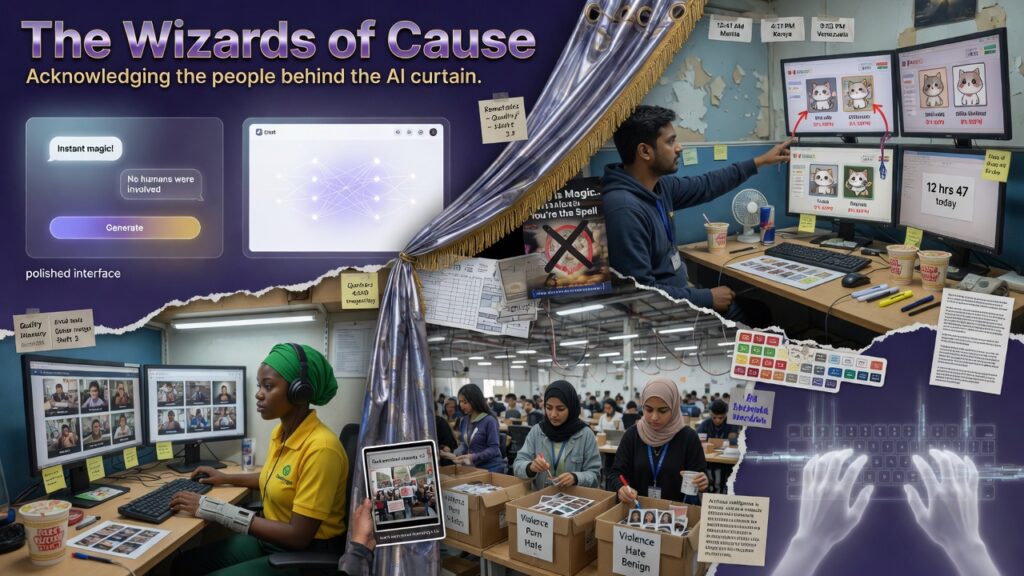
Artificial intelligence is usually sold as a miracle of software. It is cleaner than that, shinier than that, and more comfortable than that. But behind the polished interface is a global workforce of people who label, rank, sort, filter, clean, moderate, and evaluate the material that makes modern AI usable. This essay is about them. It is also about the old habit of hiding human labor whenever a machine can be made to look magical.
The Magic Trick
Every age has its favorite kind of magic trick. Ours is artificial intelligence.
We type a question into a blank box. A fluent answer appears. We upload a photo. The system recognizes objects, faces, moods, colors, and scenes. We ask for a summary, a legal draft, a meal plan, a poem, a software fix, or a polite reply to an irritating email. Out comes something that looks, at least for a moment, like mind.
That feeling is real. The accomplishment is real, too. But the story we are usually told about it is incomplete. AI is presented as a triumph of models, chips, data centers, algorithms, and genius-level engineering. All of that matters. None of it is enough.
A large part of what we call AI rests on human judgment that has been broken into small pieces and pushed out of sight. People draw boxes around pedestrians so cars can learn what a pedestrian looks like. People label hate speech so systems can learn what to suppress. People compare one model answer to another so chatbots can learn which response sounds more helpful, more truthful, or less dangerous. People read the ugly material the rest of us would rather never see so platforms and AI tools can appear safer on the surface.
These workers are sometimes called data annotators, raters, content moderators, crowdworkers, or data enrichment professionals. Labor scholars Mary L. Gray and Siddharth Suri gave the broader system a better name: ghost work.1 That phrase lands because it tells the truth. The work is there. The worker is there. But the finished product is designed to make both disappear.
The result is a public illusion. AI looks like pure automation. In reality, it is an effect with many human causes.
The First Lie Is That the Machine Did It Alone
The problem is not that companies use human workers to train AI. Human judgment is not a scandal by itself. In fact, it is necessary. The scandal is the pretense that the human layer is incidental, temporary, or morally separate from the final product.
Modern AI systems depend on human labor in at least three ways. First, workers prepare and label training data. Second, workers evaluate model behavior after training. Third, workers help make AI systems seem safe by reviewing harmful, disturbing, or ambiguous material and turning that experience into categories a machine can process.
That last part matters. When a chatbot avoids a toxic answer, when a social platform detects violent content, or when an image system refuses certain requests, we tend to credit the system. We say the AI learned. But often what it learned began with a human being staring at something degrading, violent, hateful, or obscene and making a judgment about it.
So yes, the AI may be the visible effect. But the cause is not only code. It is also the people who produced the examples, made the distinctions, corrected the errors, absorbed the trauma, and disappeared from the story afterward.
This is why the phrase “artificial intelligence” can mislead. The intelligence is not entirely artificial. A great deal of it is borrowed, compressed, translated, and repackaged human labor. Some of that labor is well paid. Much of it is not. Some of it is performed by experts. Much of it is performed by people with few options and very little power.
The Original Mechanical Turk Was a Warning
The irony was built into the name from the beginning.
In 2005, Amazon launched Mechanical Turk, a platform for distributing small online tasks to remote workers. Amazon described the idea as “artificial artificial intelligence.” The phrase was cute, but it was also brutally honest. When software could not do a job well enough, a human could be placed behind the interface and made to look like part of the machine.2
The name came from an eighteenth-century chess-playing automaton known as the Mechanical Turk. Audiences believed they were watching a machine play chess. In fact, a human operator was hidden inside the cabinet. The modern version is not all that different. The cabinet is now a platform. The hidden operator is a worker somewhere with an internet connection. The magic remains the same: hide the person, display the machine.
Before crowdsourcing platforms, data labeling was often done by graduate students, research assistants, in-house staff, or smaller outsourcing shops. The big change was not that people started labeling data. The big change was that the work became platformized. It could be chopped into tiny tasks, routed across borders, measured by software, paid by the piece, and treated as if it were a computational resource rather than human labor.
That shift helped make large AI datasets possible. ImageNet, one of the landmark datasets in computer vision, relied heavily on crowdsourced labeling through Mechanical Turk. Its final dataset contained more than 14 million labeled images, and the project drew on tens of thousands of workers across many countries.3 ImageNet helped launch the deep learning era. But it also showed something else: the future of AI would not be built only in labs. It would be built through a global workbench of low-visibility labor.
The API of Labor
One reason this system is so hard to reform is that it does not always look like employment. It often looks like software.
A company does not necessarily hire a worker. It sends tasks to a platform. The platform sends those tasks to whoever is available. Completed work comes back through an interface. Payments are calculated. Quality scores are assigned. Workers can be approved, rejected, blocked, or removed, often with little meaningful explanation.
This is the API of labor: human beings treated as callable functions. Need 100,000 images labeled? Send the task. Need toxic passages sorted into categories? Send the task. Need two chatbot answers compared? Send the task. The worker becomes the human part of a software pipeline, but without the protections normally attached to a workplace.
That structure is convenient for the buyer. It keeps costs flexible. It makes responsibility harder to trace. It allows a company to say, in effect, that it did not employ the worker, did not set the wage, did not directly manage the conditions, and did not personally cause the harm. The task was outsourced. Then subcontracted. Then routed through a platform. Then completed by someone whose name never appears in the product story.
The worker, meanwhile, can be managed more tightly than many traditional employees. Some platforms monitor speed, accuracy, keystrokes, idle time, screen activity, and task acceptance rates. The boss may not have a face, but the boss is everywhere. It is in the timer. It is in the score. It is in the sudden loss of access when an account is blocked.
This is not a small design detail. It is the structure that makes ghost work ghostly.
A Global Workbench With Uneven Floors
AI labor is global, but it is not flat. A worker in Nairobi, Manila, Caracas, Bangalore, Ohio, or Helsinki may be doing tasks that sit inside the same AI supply chain. But the pay, protections, and bargaining power can be wildly different.
The rough pattern is easy to see. Low-skill, repetitive tasks are often sent to workers in lower-wage regions. Higher-skill evaluation work, especially when it requires advanced education, fluent English, coding ability, medical knowledge, legal knowledge, or cultural nuance, can command much higher rates. The industry is not one workforce. It is a pyramid.
At the base are generalist labelers. They classify images, transcribe audio, mark objects, clean text, and handle repetitive tasks that are easy to explain but hard to automate perfectly. This work can pay very little, especially when workers are treated as contractors or are paid by task rather than by hour.
In the middle are specialists. These workers may label medical images, review legal documents, analyze financial text, or identify coding errors. Their work requires more skill, and the pay can be better, though geography still matters.
At the top is a newer class of expert evaluators: writers, teachers, programmers, researchers, doctors, lawyers, linguists, and other professionals who help test and improve frontier models. Some of these workers can earn strong hourly rates. They may even be visible. Their credentials are useful to the companies hiring them.
But the visibility of the top should not blind us to the base. AI companies like to show the world the researcher, the founder, the benchmark, and the breakthrough. They rarely show the person who spent a shift deciding whether a disturbing passage belonged in one category or another.
Sama and the Cost of Safer AI
The clearest public example is Sama, the outsourcing company that became widely known for its work with major technology firms, including Meta and OpenAI.
Sama marketed itself as an ethical outsourcing company. Its pitch was not just that it could provide data labor, but that it could provide dignified work to people in lower-income communities. That idea should not be dismissed out of hand. A job can matter. Income can matter. Remote digital work can create opportunities where few exist.
But the public record also shows the darker side of that model. TIME reported in 2023 that OpenAI used workers in Kenya, hired through Sama, to label toxic and graphic material as part of efforts to make ChatGPT less toxic. According to documents reviewed by TIME, OpenAI paid Sama an hourly rate of $12.50 per worker, while workers on the project took home far less, in some cases under $2 per hour depending on role and performance.4
The issue was not only low pay. It was the nature of the work. Workers reviewed violent, sexual, hateful, and abusive material. Some said the work left them mentally scarred. Sama disputed parts of the reporting and said workers had access to support, but the broader lesson remains hard to avoid: some of the labor that makes AI feel safer to users is itself unsafe for workers.
That creates a moral inversion. The user receives a cleaner interface. The company receives a safer product. The public receives the impression of technical progress. The worker receives the residue.
This does not mean AI safety work should stop. It means the cost of safety should not be quietly pushed onto the least powerful people in the chain. A safer chatbot built through unsafe labor is not as clean an achievement as the press release makes it sound.
The Legal Wall Is Starting to Crack
For years, the structure of this industry made accountability difficult. A U.S. technology company could contract with an outsourcing firm. The outsourcing firm could employ or manage workers in another country. If those workers were harmed, the lead company could argue that it was not the employer. It bought a service. The contractor handled the labor.
That wall is now being tested.
In Kenya, former content moderators have brought legal claims against Meta and outsourcing partners over alleged low pay, inadequate mental health support, union-busting, and traumatic working conditions. In 2024, a Kenyan court ruled that Meta could be sued in Kenya over the dismissal of content moderators by a contractor. Related cases continued afterward, and in 2026 Sama announced that more than 1,000 workers in Kenya faced layoffs after Meta ended a major engagement at its Nairobi office.5
The legal details matter, but the larger point is simple: corporate distance is no longer an automatic shield. If a lead company exercises enough control over the work, the metrics, the content rules, or the economic arrangement, courts and regulators may become less willing to accept the old excuse: not our workers, not our problem.
That shift is important. It does not solve the problem. But it changes the pressure. Once the people behind the curtain can bring claims in the places where the work is performed, the curtain becomes harder to maintain.
The Work Reaches Places We Would Rather Not Imagine
Once labor can be routed through a platform, it can reach almost anywhere. That is part of the promise. It is also part of the danger.
In Finland, incarcerated people have been paid low prison-work wages to perform data labor for AI-related systems. Wired reported on prisoners doing this kind of work in Finnish prisons, with supporters describing it as voluntary, rehabilitative, and suited to the Finnish-language data problem. Critics, reasonably, ask what consent means when the worker is incarcerated and has few alternatives.6
There are also reports of underage workers entering AI data-labeling supply chains. Wired reported in 2023 that teenagers had been able to work on data-labeling platforms, sometimes being exposed to troubling content.7 The point is not that every AI company knowingly uses child labor. The point is that opaque subcontracting makes clean assurances difficult. If a supply chain is built to be invisible, it should not surprise us when abuse becomes hard to see.
And then there is the ordinary desperation of collapsing economies and unstable regions. In places where wages have crashed, currencies have failed, or war has narrowed every available path, data work can become a lifeline. That complicates the moral picture. It is too easy for comfortable observers to say the work should not exist. For some workers, it may be one of the few available ways to earn income.
That is why the question cannot simply be whether ghost work is good or bad. The better question is whether the people doing it are visible, protected, fairly paid, and able to refuse harmful work without losing their survival.
China Shows a Different Version of the Same Problem
The Western model tends to hide data labor behind platforms, contractors, and the language of automation. China has built a different version. There, data annotation has often been treated as a visible part of industrial and regional development policy.
Recent reporting and scholarship describe data-labeling workshops in places such as Guizhou, where rural workers, including mothers and lower-income residents, have labeled data for autonomous driving, surveillance, and other AI systems. In some cases, this work has been tied to poverty alleviation and rural development goals.8
That difference matters. In China, the labeler is not always a ghost in the same way. The work can be visible, organized, and connected to state-backed industrial planning. But visibility does not automatically equal dignity. Low wages, repetitive tasks, limited advancement, and vulnerability to shifts in the industry can still define the work.
So the contrast is useful, but it should not become a morality play. The Western model often hides the labor. The Chinese model may institutionalize it. Both reveal the same underlying truth: AI is not floating above political economy. It is built inside it.
Automation Will Not Remove the Human Layer
One tempting answer is that this is all temporary. AI will improve, the argument goes, and eventually the machines will label the data, evaluate the outputs, and supervise themselves.
Maybe some of that will happen. Simple labeling tasks are already being reduced by self-supervised learning, synthetic data, active learning, and other techniques. The bottom tier of data work may shrink or change. Some workers will be displaced. Some platforms will advertise that they no longer need large pools of human labelers.
But that does not mean the human layer disappears. It moves.
As AI enters medicine, law, education, robotics, finance, defense, and public administration, the demand for high-quality judgment increases. Models need evaluation. Systems need red-teaming. Outputs need ranking. Edge cases need interpretation. Cultural context matters. Safety judgments matter. Reality has a way of creating messes that a training set did not anticipate.
Upwork reported in 2026 that demand for AI data annotation and labeling had grown sharply year over year, with AI data annotation and labeling up 154 percent in its in-demand skills report.9 That does not prove a permanent boom. Marketplaces are noisy. But it does show that, at least for now, the human work behind AI is not fading into irrelevance. It is being reorganized.
The likely future is not no workers. It is a more stratified workforce. Some generalist work will be automated away. Some expert work will become more valuable. The workers caught in the middle may be squeezed hardest.
The Environmental Back Room
There is another group of workers missing from the standard AI story: the people who build and maintain the physical infrastructure.
AI may feel weightless to the user, but it rests on data centers, power systems, cooling systems, construction crews, electricians, pipefitters, welders, HVAC technicians, security staff, and maintenance workers. These workers are not ghost workers in the same exact sense. Many are visible. Some are unionized. Some are well paid. But they are still often missing from the romantic narrative of AI as pure software.
The data center boom has become a major labor story in its own right. Recent reporting shows unions seeing new demand from AI-related data center construction, while policy analysts have warned that skilled trades could become a bottleneck for AI infrastructure expansion.10
This matters because it widens the frame. AI is not only the model. It is also the supply chain for chips, minerals, power, water, land, hardware, buildings, cooling, labor, and waste. Kate Crawford made this point forcefully in The Atlas of AI: artificial intelligence is an extractive system as much as a computational one.11
The ghost worker at the screen and the electrician in the data center are not doing the same job. But both puncture the illusion. AI is not magic in the cloud. It is human work, physical infrastructure, and material cost all the way down.
What Fairness Would Require
The answer is not to pretend this labor can vanish. It cannot. Nor is the answer to romanticize it as empowerment and move on. Some workers need these jobs. Some workers value them. Some would rather improve the work than see it disappear.
A serious reform agenda would start with visibility. Companies should disclose when human data labor is used, what kind of labor it is, where it is performed, and what safeguards are in place. Not every worker needs to be named. Privacy matters. But the supply chain should not be treated as a trade secret whenever ethics becomes inconvenient.
Second, workers should be paid at least a living wage for their location, with clear task expectations and compensation that accounts for time spent reading instructions, waiting for tasks, correcting errors, and appealing rejections. Partnership on AI’s data enrichment guidelines make this point directly: the conditions of data workers are shaped by procurement decisions made upstream.12
Third, harmful content work should be treated as hazardous work. That means stronger screening, clear opt-out rights, limits on exposure, trained mental health support, and real compensation for risk. A phone number no one can reach is not a safeguard. A wellness slide deck is not trauma care.
Fourth, workers need recourse. If an algorithm rejects their work, cuts their pay, blocks their account, or changes the rules, there should be a human appeal path. A system that can punish a person should be able to explain itself to that person.
Fifth, lead companies should not be able to outsource responsibility down a chain of contractors and then claim moral cleanliness. The UN Guiding Principles on Business and Human Rights already provide a basic framework: companies have a responsibility to respect human rights, conduct due diligence, and provide or support remedy when harms occur.13 AI does not need a special exemption from ordinary decency.
None of this is radical. It is the minimum one would expect if the workers were visible. Which is exactly the point.
Seeing the Wizards
The old Mechanical Turk fooled people because they wanted to believe in the machine. That is still part of the problem. We want AI to feel clean. We want the answer box to feel weightless. We want the miracle without the supply chain.
But the curtain is thinner now. We know there are people behind it. We know that some are poorly paid. We know that some are exposed to traumatic material. We know that some are managed by software they cannot challenge. We know that some are doing work that is essential while being treated as incidental.
The right response is not to deny the achievement of AI. The achievement is real. The tools are powerful. The progress is astonishing. But awe is not an excuse for blindness.
If AI is a statistical distillation of humanity, then we should be honest about which humans are being distilled and under what conditions. The workers behind AI are not decorative footnotes to the story. They are part of the cause. The model is part of the effect.
A society that wants intelligent machines should be willing to look at the people who make them seem intelligent. It should be willing to ask who is paid, who is hidden, who is harmed, who is protected, and who gets to share in the value created.
The wizards behind the curtain were never really wizards. They were workers. And the first step toward a more honest AI future is simple: stop pretending the curtain is empty.
Notes
1. Mary L. Gray and Siddharth Suri, Ghost Work: How to Stop Silicon Valley from Building a New Global Underclass (Houghton Mifflin Harcourt, 2019). See also Partnership on AI, Responsible Sourcing of Data Enrichment Services, 2021.
2. Amazon Mechanical Turk launched in 2005 and was described by Amazon as a marketplace for tasks that require human intelligence; Amazon has also used the phrase “artificial artificial intelligence” to describe the model.
3. ImageNet’s annotation process relied on crowdsourced labeling, including Amazon Mechanical Turk. Public summaries of the project report more than 14 million final images and tens of thousands of workers involved in filtering and labeling candidate images.
4. Billy Perrigo, “Exclusive: OpenAI Used Kenyan Workers on Less Than $2 Per Hour to Make ChatGPT Less Toxic,” TIME, January 18, 2023.
5. Reuters reported in September 2024 that a Kenyan court ruled Meta could be sued in Kenya over moderator layoffs. The Associated Press reported in April 2026 that Sama planned to lay off 1,108 workers after Meta ended a major engagement at its Nairobi office.
6. Morgan Meaker, “These Prisoners Are Training AI,” Wired, September 11, 2023.
7. Vittoria Elliott, “Underage Workers Are Training AI,” Wired, November 15, 2023.
8. See recent reporting by Sixth Tone and the South China Morning Post on rural data-labeling workshops in Guizhou, as well as Yaowen Huang’s 2026 ethnographic work on data annotation as a development project in Guizhou.
9. Upwork, “Upwork’s In-Demand Skills 2026,” February 4, 2026.
10. Associated Press, “In the PR Battle for AI Data Centers, Tech Giants Got a Blue-Collar Ally: Unions,” May 2, 2026; Center for Strategic and International Studies, “GenAI’s Human Infrastructure Challenge,” September 16, 2025.
11. Kate Crawford, The Atlas of AI: Power, Politics, and the Planetary Costs of Artificial Intelligence (Yale University Press, 2021).
12. Partnership on AI, Data Enrichment Sourcing Guidelines, 2022; Partnership on AI, Responsible Sourcing of Data Enrichment Services, 2021.
13. United Nations Guiding Principles on Business and Human Rights, endorsed by the UN Human Rights Council in 2011; OECD Due Diligence Guidance for Responsible AI, 2026.
Selected Bibliography
Amazon Mechanical Turk. “Celebrating 11 Years of Artificial, Artificial Intelligence.” MTurk Blog, November 4, 2016.
Associated Press. “Former Meta Contractor Sama to Lay Off More Than 1,000 Workers in Kenya.” April 16, 2026.
Associated Press. “In the PR Battle for AI Data Centers, Tech Giants Got a Blue-Collar Ally: Unions.” May 2, 2026.
Brookings Institution. “Reimagining the Future of Data and AI Labor in the Global South.” October 7, 2025.
Business & Human Rights Resource Centre. “UN Guiding Principles on Business and Human Rights.” Accessed 2026.
Center for Strategic and International Studies. “GenAI’s Human Infrastructure Challenge: Can the United States Meet Skilled Trade Labor Demand?” September 16, 2025.
Crawford, Kate. The Atlas of AI: Power, Politics, and the Planetary Costs of Artificial Intelligence. New Haven: Yale University Press, 2021.
Elliott, Vittoria. “Underage Workers Are Training AI.” Wired, November 15, 2023.
Gray, Mary L., and Siddharth Suri. Ghost Work: How to Stop Silicon Valley from Building a New Global Underclass. Boston: Houghton Mifflin Harcourt, 2019.
Huang, Yaowen. “An Ethnographic Study of Data Annotators in Guizhou, China.” World Development, 2026.
ImageNet. “ImageNet.” Official project website. Accessed 2026.
International Labour Organization. “A Global Analysis of Worker Protest in Digital Labour Platforms.” ILO Working Paper, 2020.
Meaker, Morgan. “These Prisoners Are Training AI.” Wired, September 11, 2023.
OECD. Due Diligence Guidance for Responsible AI. Paris: OECD Publishing, 2026.
Partnership on AI. Data Enrichment Sourcing Guidelines. 2022.
Partnership on AI. Responsible Sourcing of Data Enrichment Services. 2021.
Perrigo, Billy. “Inside Facebook’s African Sweatshop.” TIME, February 14, 2022.
Perrigo, Billy. “Exclusive: OpenAI Used Kenyan Workers on Less Than $2 Per Hour to Make ChatGPT Less Toxic.” TIME, January 18, 2023.
Reuters. “Kenya Court Finds Meta Can Be Sued Over Moderator Layoffs.” September 20, 2024.
Sixth Tone. “Behind China’s AI Boom Are Computer Rooms Full of Rural Workers.” May 4, 2026.
Sixth Tone. “When Big Tech Needed Mothers in Rural China to Train AI.” May 5, 2026.
South China Morning Post. “What Next for the Struggling Rural Mothers in China Who Helped Build AI?” April 5, 2026.
Upwork. “Upwork’s In-Demand Skills 2026: Demand for Top AI Skills More Than Doubles.” February 4, 2026.
Wired. “A Lawsuit Against Meta Shows the Emptiness of Social Enterprises.” 2022.