
Why Civilian Immunity Fails Without Consequence
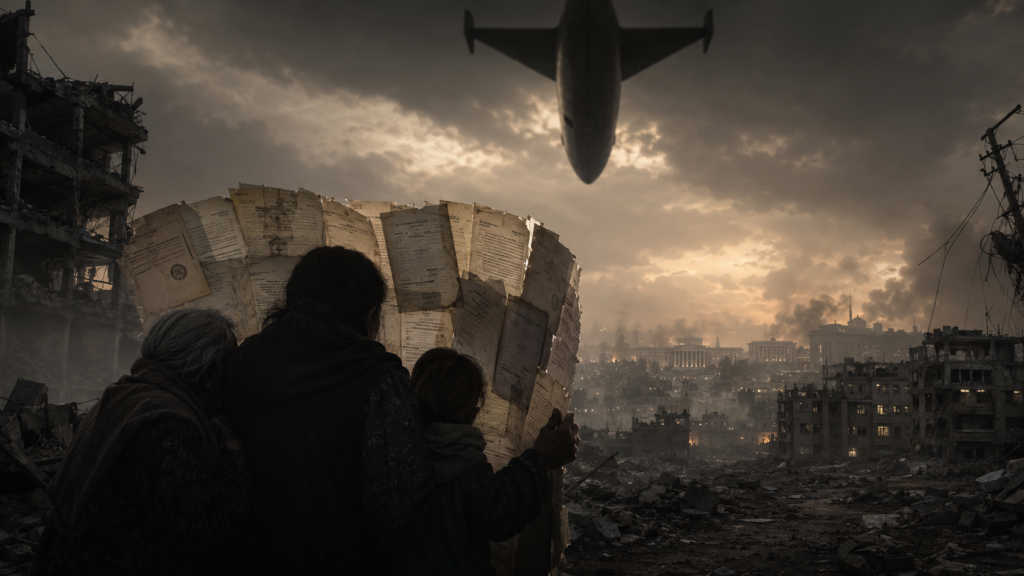
The targeting of civilians in war bothers me to a degree I can’t begin to express. I’ve seen so much of it lately. Children pulled from rubble. Families burned in their homes. Whole neighborhoods erased, then explained away by men in suits. It made me wonder where this came from. It felt foreign. Barbaric. New. I didn’t remember this kind of slaughter being the norm.
So I decided to look into it. It didn’t take long to find the answer. And the answer was not what I expected.
Targeting civilians is not a modern innovation. It is the default setting of warfare. The anomaly was the brief 20th-century attempt to protect them.
That’s a hard thing to sit with. We tend to think of history as a slow climb out of cruelty. We tell ourselves we used to be savage, and now we know better. But the record doesn’t support that story. For most of human history, the civilian was not protected by some natural law of decency. The civilian was the war.
I want to be honest about what I found. And I want to be honest about what it means. Because the deeper I looked, the clearer one thing became. The law that’s supposed to protect civilians is one of humanity’s most necessary inventions. But it rests on a fragile bargain. Civilians are protected only when power is made afraid to harm them. When that fear disappears, the law remains. The speeches remain. The conventions remain. The tribunals remain. But the protection vanishes.
A right no one will enforce is not a shield. It is an appeal.
That’s the thesis of this essay. I’ll try to earn it.
The modern law of war did not begin as a pure wall around civilians. It began as a compromise between humanity and necessity. The tragedy is that necessity has always had better lawyers.
The History We’d Rather Not Remember
Start with the brutal truth. Civilians were never naturally outside of war.
For most of recorded history, they were the prize. They were the tax base, the labor force, the food supply, the hostage pool, and the message sent to the next city down the road. Armies didn’t accidentally harm civilians on the way to a battle. Harming them was often the strategy. Burn the crops. Starve the town. Sell the survivors. The point of the violence was the population, not some distant uniformed enemy.
The numbers tell it plainly. The Thirty Years’ War killed something close to a fifth of Central Europe’s population. Most of those people died from famine, plague, and direct violence against people who carried no weapons. They weren’t bystanders. They were the terrain the war moved through, and the war consumed them.
But I don’t want to flatten the history. The picture is more complicated than “the default was always to kill everyone.” That would be lazy, and it would be wrong.
There were efforts to restrain the cruelty long before modern law. Medieval just war theory, including the work of Thomas Aquinas, tried to draw a line between combatants and noncombatants. The line was crossed constantly. But the line existed, and people argued for it. Religious authorities sometimes claimed protection for clergy or peasants. Some rulers feared indiscriminate killing because it radicalized the survivors or burned down a tax base they wanted to keep.
The Mongols are a cold example of this. They sometimes spared artisans and farmers while they slaughtered the elites who resisted. That wasn’t mercy. It was math. A dead artisan can’t make you a sword. A dead farmer can’t feed your army next winter.
So here’s the sharper version of the truth. Civilians were never naturally protected by war. They were protected only when morality, religion, reciprocity, discipline, future utility, or fear restrained the armed power standing over them.
That last word matters most. Fear. Hold onto it. We’ll come back to it.
The Bargain Gets Written Down
Something did change in the 19th and early 20th centuries. For a while, it looked like real progress.
Professional armies rose. Treaties followed. The Hague and Geneva conventions created what we now call civilian immunity. For the first time, the idea that noncombatants should be spared got written into law and signed by states.
Part of this was pragmatic, and I won’t pretend otherwise. Industrial states needed their populations intact. They needed people to work the factories and pay the taxes. A dead worker builds no tanks. So protecting civilians was partly just good business.
But part of it was real. People actually believed it. The idea that a child has a right to live through a war, regardless of which flag flies over her house, took genuine hold in human conscience. That belief was not fake. It was one of the better things we ever talked ourselves into.
The trouble is what got written down alongside it.
Look at the Lieber Code. It was issued during the American Civil War, and it was one of the first serious attempts to codify the laws of war for a modern army. It tried to restrain cruelty. It tried to protect civilians and regulate occupation and forbid wanton violence. In many ways it was a humanitarian milestone.
But it embedded something else, too. It embedded the logic of military necessity. The Code protected civilians, unless military necessity was made to say otherwise. That little word, “unless,” is the whole problem in miniature. The protection was real. The exception was also real. And the exception was written by the same hand that held the gun.
That’s the dilemma, stated early and clearly. The modern law of war didn’t begin as a wall. It began as a negotiation between humanity and necessity. And necessity, as I said, has always had better lawyers.
There’s one more thing I have to name here, because leaving it out would be dishonest.
The modern laws of war were never applied evenly. They were strongest where states regarded one another as legitimate members of the same political and moral order. They were far weaker in colonial, imperial, counterinsurgency, occupation, and racialized contexts. Against the Herero in Southwest Africa, against Native Americans, against Algerians, the targeting of civilians continued with little restraint. The rules were European rules for European wars. Everyone else was a footnote, if that.
So civilian immunity was never fully universal in practice. Some civilians were always easier to abandon than others. When we talk about the “erosion” of civilian protection today, we should be honest. Part of what we’re seeing is the return of a double standard that never actually left.
The Battlefield Moved Into the Living Room
Now let’s talk about how the rules get bypassed today. Because the rules haven’t vanished. They’ve been tunneled under.
Start with where wars happen now. Modern wars are increasingly fought inside cities. Not on open fields between two armies, but in dense neighborhoods full of apartments, schools, clinics, and markets. Gaza. Aleppo. Mariupol. Mosul. Grozny. The list is long, and I don’t need to recite all of it for you to know the shape of it.
When a city becomes a battlefield, the civilian becomes the terrain. There’s no clean way around this. The fighter hides among the families. The weapon designed for an open field gets fired down a crowded street. The distinction between soldier and civilian, which the law treats as sacred, dissolves in the dust and the concrete.
This isn’t an accident of geography. It’s the condition of modern war. And it puts the civilian at the center of the violence, not the edge of it.
Everything Around the Civilian Is a Target
Here’s a quieter way the protection fails. Modern life runs on systems. Electricity. Water. Hospitals. Ports. Bridges. Telecom. Fuel. Banking. Food logistics. Data.
The civilian is still legally protected. The problem is that nearly everything around the civilian has become targetable.
You don’t have to bomb a family to kill a family. You can take out the power station that runs their hospital. You can destroy the water plant. You can cut the bridge that brings in food. None of those targets is a person. Each one can be called “military infrastructure” or “dual-use.” And each one can kill just as surely as a shell, only slower, and with less mess on camera.
This is the dual-use trap. Almost everything that keeps a population alive can also be claimed to serve the enemy’s war. So almost everything becomes fair game, while the law keeps insisting the people themselves are off-limits. The people are off-limits. The water they drink is not.
And the tools keep getting cleaner. In the 20th century, you needed a fleet of strategic bombers to wreck a city. Today a sophisticated cyber operation can disable a power grid, a water system, or a financial network from a keyboard. No bomb falls. No smoke rises. But the hospital still goes dark, and the dialysis patient still dies.
The old siege surrounded a city. The new siege enters its operating system.
Because no bomb falls, this kind of attack is harder to see and harder to blame on anyone. It looks clean. It is not clean. The human result can be just as deadly. And the cleaner it looks, the easier it is to normalize.
Horror Turned Into Arithmetic
Now I want to be careful, because this part is easy to get wrong.
The law has a doctrine called proportionality. It does not, on its face, allow the targeting of civilians. I won’t claim it does. What it allows is this: civilian deaths are permitted if they’re “not excessive” in relation to the military advantage gained. The idea was to restrain commanders. To force them to weigh the cost.
In practice, it can become something else. It can become a permission structure.
Proportionality was designed as a restraint. But when civilian death gets treated as a calculation instead of a moral catastrophe, the restraint flips into a license. A number goes into a formula. A target gets approved. A family dies. And everyone involved can point to the paperwork and say the law was followed.
This is the transformation of horror into administration. The dead child becomes a line item. The grief becomes a variable. And the people running the math can sleep at night because, technically, they did the calculation. The law gave them a way to process the unbearable through a spreadsheet.
That’s worth saying plainly. The formalization of the law can become the very vehicle through which civilian harm gets justified. By turning a moral absolute into a legal calculus, we handed technocrats a tool to explain away the unexplainable.
And now the calculation is getting faster than we are.
For most of history, the arithmetic of war ran at human speed. A commander looked at a map, weighed a target, and gave an order. It was often cold, and often wrong, but a person did it, and a person could be asked why. That’s changing. Militaries now use automated systems to generate targets at machine speed. Software sorts through data, flags a building or a name, and recommends a strike. A human still signs off. But when the system produces targets faster than any person can truly examine them, the sign-off becomes a formality. The moral check doesn’t vanish on paper. It gets compressed into a few seconds, which is the same as vanishing.
This is the arithmetic taken to its end. The proportionality calculation that once let a technocrat explain away a death now runs at the speed of a server. The horror isn’t just processed into administration. It’s processed into automation. And automation doesn’t pause. It doesn’t flinch. It doesn’t lie awake afterward.
That last part matters more than it sounds. A machine cannot be afraid. It can’t fear reprisal, or shame, or God, or the grave it’s about to fill. And fear, as I’ll argue, is the one thing that ever reliably restrained the power standing over the civilian. The more we hand the decision to systems that feel nothing, the more we strip out the only variable that protection has ever depended on. We’re not just speeding up the killing. We’re removing the hesitation that was sometimes the last thing between a family and the bomb.
The Civilian as Audience
There’s another shift, and it’s newer than the rest.
States no longer see civilian populations only as labor or tax base. They see them as data and as audience. Modern war includes a battle for the narrative, and the civilian is the viewer it’s fought in front of.
I want to be precise here, because the law is clear and I don’t want to muddy it. A civilian does not become a combatant by posting online, voting, sympathizing, or holding an opinion. The law is right about that, and it should stay right about it.
But here’s what’s happening anyway. When a belligerent decides the enemy population is a weaponized mass of political pressure, the immunity of that population starts to slip in practice. Not in law. In treatment. The people get treated as if they’re participants in the war, because their grief, their phones, and their votes can move politics.
The civilian does not legally become a combatant. But politically, they start being treated like one.
And there’s a strange twist in all of this. The civilian used to be hidden behind geography. Far away. Anonymous. Now the civilian is everywhere, constantly broadcasting, constantly connected. Total war has become total presence. You might think that visibility would protect people. Sometimes it does. But it can also make them more of a target, not less, because they’re no longer faceless. They’re a feed. And a feed can be a weapon, a witness, or a casualty, depending on who’s looking.
Moral Mechanics, Not Moral Equivalence
Let’s talk about why both sides so often end up in the same dark place.
When one side has overwhelming conventional power, the weaker side’s only real leverage is often civilian pain. Hostage-taking. Hiding among the population. Hitting soft targets. Human shielding. It’s monstrous, and it’s also a predictable product of being outgunned.
The stronger side then uses those tactics as justification. If the enemy hides among civilians, the reasoning goes, then the whole population is suspect. The whole population becomes complicit. And the target widens.
One side violates civilian immunity directly. The other answers by widening the target. Each side points to the other as permission to descend.
I want to be clear about what I’m saying and what I’m not. This is not moral equivalence. I’m not claiming both sides are equally guilty, or that the math always balances. I’m describing a mechanism. It’s moral mechanics. Each violation lowers the floor for the next one. And the race to the bottom has no floor.
Terrorism feeds this directly. When non-state actors deliberately target civilians, states often respond with doctrines that blur the very same line. Drone strikes. Night raids. Siege logic. Indefinite detention. Broad targeting categories. “Support infrastructure” arguments that sweep in anyone nearby.
Terrorism doesn’t only kill civilians. It teaches states how to excuse killing civilians.
That’s a hard sentence, and I mean it carefully. The point isn’t to excuse the terrorist. The point is that the terrorist’s crime becomes the state’s alibi. The atrocity becomes a permission slip.
The Architecture of Impunity
Here’s the part that turns a battlefield failure into a system failure.
A right is only as strong as its enforcement. And the enforcement is broken at the top.
The UN Security Council is paralyzed by the veto. The most powerful states, and their clients, can block any real consequence. The ICC has no army and depends on state cooperation it rarely gets where it matters most. Enforcement is selective. The weak and the defeated get tried. The strong and the protected do not.
When impunity is predictable, restraint becomes irrational. Why hold back if nothing happens to you? That’s not cynicism. It’s the logic the system actually rewards.
Impunity is not a failure of the system. In many cases, it’s the system working as designed for the powerful.
And the responsibility runs wider than the soldier who pulls the trigger. Modern wars are sustained by a whole network behind the front line. Weapons shipments. Intelligence sharing. Diplomatic cover. Fuel. Finance. Logistics. Friendly media framing. Legal memos that bless the targeting in advance. Reconstruction contracts that reward the aftermath.
The modern civilian target is not created only by the soldier or the pilot. It’s also created by the patron state, the arms pipeline, the targeting data, the veto, the legal memo, and the press briefing afterward.
Spread the guilt where it belongs. The bomb has a long supply chain, and a lot of hands touch it before it falls.
There’s an economic layer here, too. The old international order leaned on deep economic interdependence. The rough idea was that countries too entangled in trade wouldn’t destroy each other. As that fabric frays, through protectionism, sanctions, decoupling, and autarky, the cost of breaking the rules goes down. If you don’t need your adversary for trade or stability, the practical incentive to keep their population alive disappears. The economic leash that quietly restrained some violence is getting longer, or getting cut.
We Haven’t Stopped Caring. We’ve Started Sorting.
People often say the endless news has numbed us. That we’ve seen so many bodies we no longer feel anything. I used to believe that. I don’t anymore, at least not in the simple form.
It’s not that people stopped caring. Many people care intensely. The problem is that the caring has become selective.
We condemn the atrocities committed by our enemies. We rationalize the atrocities committed by our allies. Social media shows us the bodies, but it also sorts our grief into tribes. The same image produces fury or silence depending on who did it to whom.
And here’s the harder part. This sorting isn’t only organic. It can be engineered. Powerful states don’t sit and wait for public outrage to fade. They manage it. They flood the zone with competing narratives. They withhold the footage that would damn them and release the footage that excuses them. They label the dead as fighters before anyone can count them. They brief the press in language built to numb. The goal is simple: keep the home audience from feeling the consequence sharply enough to demand one.
That’s worth pausing on, because it changes how we should think about fear. Fear of domestic backlash is supposed to be a real check on power. A government that answers to its people should hesitate before doing things its people would punish at the ballot box. But if that government can shape what its people see, believe, and feel, it can insulate itself from the very consequence that was supposed to restrain it. The check is still there on paper. It’s just been quietly disconnected.
The modern public has not lost the ability to mourn civilians. It has learned to mourn selectively.
This matters for the argument, so let me be exact. What’s really eroded isn’t the basic norm. Polling still shows that people punish open, indiscriminate killing of civilians. The norm is alive. What’s broken is the cross-partisan agreement on what even counts as a violation in the first place. The taboo remains. But the shame has become partisan.
There’s one more trap worth naming. Precise weapons were supposed to make this better. And in one sense they raise the stakes. When a military claims it can hit exactly what it aims at, every dead civilian becomes evidence of either incompetence or intent. “You had one job, and you killed a wedding.” That should heighten the outrage, and sometimes it does. But it cuts the other way, too. Precision lets a state rebrand systematic civilian harm as a rare accident. A tragic glitch. The exception that proves how careful they were being. The better the weapon, the easier the excuse.
The Strongest Argument Against Me
I owe you the best version of the counterargument, because if it holds, my whole essay falls apart.
Here it is. Civilian immunity hasn’t weakened in law. It has grown stronger. Far stronger.
After the worst civilian catastrophe in modern history, the Second World War, the postwar order tried to build a legal wall around civilians. And it built a real one. The Geneva Conventions of 1949 went further than anything before them. The Additional Protocols of 1977 went further still. They outlawed the starvation of civilians, collective punishment, and indiscriminate attacks, more explicitly than any prior law. The Rome Statute of 1998 made attacking civilians a prosecutable war crime and created a court to try it.
So the rules didn’t vanish. They expanded. By that measure, we’re more protective of civilians on paper than any generation before us. If you want to argue I’m wrong, this is the ground to stand on.
I take it seriously. And here’s my answer.
The problem isn’t the disappearance of the law. The problem is the widening gap between legal language and enforceable consequence.
The wall got built. The wall is real. It created standards. It named crimes. It gave victims and investigators a shared vocabulary. It gave courts something to apply. That’s not nothing.
But it didn’t make civilians safe.
The Real Revelation
So what is actually going on? Here’s the deepest thing I found.
The norm against civilian slaughter still governs the vocabulary of war. It no longer reliably governs the conduct of war.
Almost everyone still condemns the killing of civilians in principle. No general stands up and says, “Yes, we target the children.” That means the norm isn’t dead. It’s powerful enough that everyone must still pay it lip service. But every side has learned the same trick. Its own civilian harm is tragic necessity. The enemy’s civilian harm is barbarism. Same act. Opposite verdict, depending on who’s holding the gun.
What does that reveal?
It reveals that civilian immunity has moral force but weak political enforcement. It reveals that the law is strongest as an accusation and weakest as a prevention. It reveals that the taboo survives, but the shame has become a team sport.
Most of all, it reveals this. Modern war has not abandoned the language of civilian protection. It has learned to speak that language while tunneling underneath it.
That’s the whole game. The vocabulary stays clean. The conduct does not. We’ve built a beautiful wall and learned to walk through it.
The Paper Shield
This brings me back to where I started, and to the thing I most need to say.
A paper wall is not nothing. But it is not protection.
Law can name the crime. Law can preserve the evidence. Law can shame the guilty. Law can sometimes punish the defeated, the weak, or the unlucky. But law without consequence cannot protect the civilian standing under the bomb. It cannot reach down into the moment before the trigger and stop it.
A right no one will enforce is not a right in any practical sense. It’s an appeal. It’s a hope addressed to power, asking nicely. And power has never been moved by an appeal it doesn’t have to honor.
That’s why I keep coming back to fear. Across all of history, in every period I looked at, civilians were spared for one reason that actually held. Power was afraid. Afraid of reprisal, of God, of revolt, of losing a tax base, of facing a real consequence. Where that fear existed, restraint followed. Where it disappeared, so did the protection. Every time.
And that’s what makes this moment so dangerous. We’ve found new ways to take the fear out of the equation. We automate the decision until no human conscience has time to flinch. We manage the narrative until no public has the facts to object. From two directions at once, the hesitation is being engineered away. The machine doesn’t fear. The insulated leader doesn’t either. And a power that feels no fear has never, in any century I could find, spared the civilian for long.
The 20th-century interlude wasn’t a permanent moral upgrade. It rested on conditions that happened to line up for a while. A balance of terror between great powers. Functioning international institutions. The brief ideological dominance of human rights. Those conditions were real, but they were contingent. They weren’t fixed features of the world. And now they’re fraying.
The default is reasserting itself.
What Has to Be Said at the End
Come back to the image I started with. A parent burying a child who died for no reason except that the war needed somewhere to land. That image is not decoration. It’s the standard. Every clause of every convention, every legal memo, every press briefing, has to answer to that grave. If the law can’t reach that moment and prevent it, then all the rest is commentary.
So here’s the true test. It isn’t whether the law can describe the crime afterward. Courts and historians and journalists can always describe it afterward. The bodies make sure of that.
The true test of civilian immunity is whether power was afraid enough not to commit the crime in the first place.
That’s the whole thing. That’s what I learned looking into something I thought I already understood.
Not sentiment.
Not declarations.
Not “never again” carved into stone.
Consequence.
That’s where this has to land. Not in despair, exactly. But in a hard, clear-eyed recognition. Civilian protection without consequence is not protection.
It is paper.
And paper does not stop bombs.
A Reading List
This essay is an argument, not a survey, but the historical and legal claims behind it are real and worth checking. If you want to go to the source, start here.
The law itself, in its own words
- The Lieber Code (General Orders No. 100, 1863). The early American codification of the laws of war — and the document that wrote “military necessity” into the modern bargain. Full text via Yale Law’s Avalon Project: General Orders No. 100: The Lieber Code.
- The Hague Conventions (1899 / 1907). The first multilateral attempt to regulate the conduct of war. Collected texts at the Avalon Project: Laws of War.
- The Geneva Conventions (1949) and the Additional Protocols (1977). The postwar wall around civilians, including the bans on starvation, collective punishment, and indiscriminate attacks. Read them directly from the International Committee of the Red Cross: Additional Protocols, with the ICRC’s plain-language overview of the Protocols.
- The Rome Statute (1998). The treaty that made attacking civilians a prosecutable war crime and created the International Criminal Court. Full text from the ICC: Rome Statute.
The history behind the claims
- The Thirty Years’ War and the ~20% figure. The ICRC’s own analysis of the war’s civilian toll, and why famine and disease did most of the killing: The Thirty Years’ War: the first modern war?.
- The colonial double standard and the Herero genocide. On how the laws of war did, and did not, reach colonial populations: Redressing Colonial Genocide: The Hereros’ Cause of Action Against Germany and the Journal of Namibian Studies on the Herero and international law.
The argument, deepened
- Samuel Moyn, Humane: How the United States Abandoned Peace and Reinvented War (2021). The strongest scholarly companion to the central worry of this essay: that the law of war can make war more humane in vocabulary while making it easier to wage and harder to end. See the H-Diplo roundtable on Humane for a serious critical discussion.
- Michael Walzer, Just and Unjust Wars (1977). The modern touchstone for proportionality, military necessity, and the moral standing of civilians — useful background for the sections on calculation and restraint.
A note on method: where I cite a number or a legal fact, I’ve pointed to a primary text or an authoritative source. Where I make a moral claim, that’s mine to defend, not theirs.