
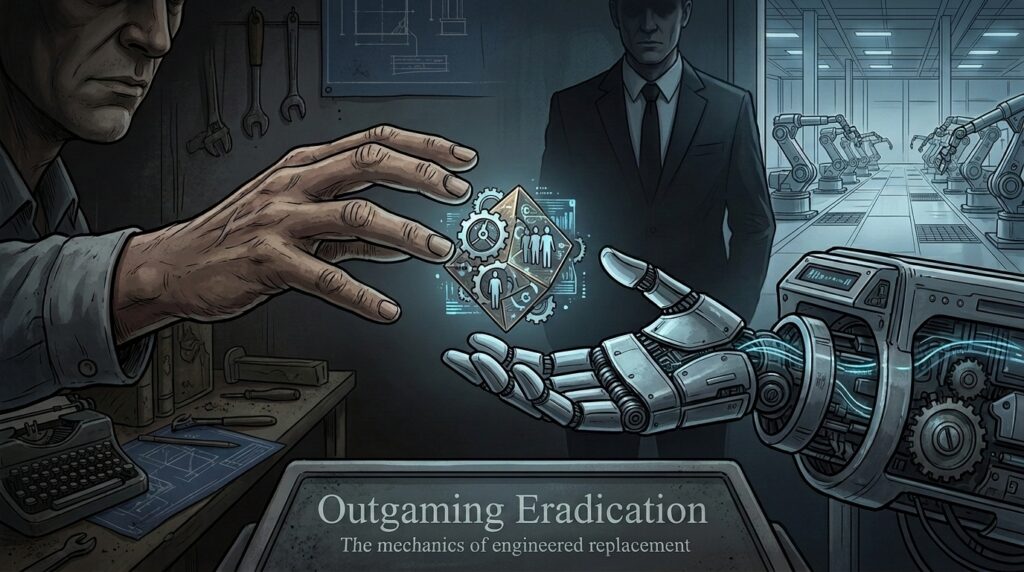
Essay 1 set the stage, showing us where we’ve been. Now, let’s look at right now. To really get how big the AI revolution is, we have to compare it only to what AI has done so far.
Forget the hype and the sci-fi worries. The last tech jump that changed things this much, globally, was the Internet. Especially when you add mobile phones to it. For thirty years, the Internet changed how we get info, made office work easier, shook up creative jobs, and started a global fight over digital stuff.
AI isn’t alone in this; it’s building on that digital wave. In fact, AI’s impact right now looks just like the Internet’s did, in three clear ways. But soon, AI will hit a “line of departure.” That’s when this comparison won’t work anymore.
Vector 1: How We Know Things
The Internet’s Effect: The Internet put all human knowledge online. It made a way to share info everywhere, instantly. It broke the old power of libraries, local news, and big companies. Data became super important. AI’s Connection: AI needs this. The big boom in Large Language Models (LLMs) couldn’t happen without the trillions of words, pictures, and code the Internet gathered over thirty years. The Internet built the library; AI is the engine that now reads, sorts, and uses it. We used to not have enough info. Now, we’re all about making sense of it.
Vector 2: How We Work
The Internet’s Effect: The digital change created the “knowledge economy.” It let software, money, media, and company bosses work globally and at different times. This made a huge group of well-paid office workers. AI’s Connection: AI is now aiming at these same workers the Internet created. AI isn’t changing factories or manual labor right now. It’s changing the digital desks of coders, writers, thinkers, and managers. AI is turning the Internet’s knowledge workers from creators into people who just watch automated smart systems. The value of human thinking work is dropping fast.
Vector 3: What We Believe Is Real
The Internet’s Effect: Web 2.0 and social media feeds broke up the news. They split our shared world into small groups that only heard what they wanted to hear. Digital sites became places where people fought for minds and power. This made it harder to agree on what was true. AI’s Connection: AI is making this much worse. It makes creating content super cheap. What generative AI is doing now is making tons of fake media, really real-looking deepfakes, and automatic writing. It’s speeding up the loss of trust that the Internet started. It’s getting harder to tell what’s real and what’s made by a machine.
The Line of Departure
The Internet is the only thing that compares to AI’s reach today. But this is true only for what AI has done so far.
The big difference between these two technologies is agency.
At its heart, the Internet is just a pipe. It’s a super-fast way to move human thoughts from one place to another. Even at its best, AI has mostly just sorted and combined things in that pipe. It needs a human to ask it something, a human to run it, and a human to use what it makes.
But now, we’re seeing it change. It’s going from a tool that uses human data to a smart agent that starts and finishes things on its own.
When an intelligence can evolve, it stops just putting together old human knowledge. It starts trying new things, testing them, and learning without a human telling it what to do. Once AI systems start coming up with new science ideas, writing complex code by themselves, and running digital economies on their own, the comparison to the Internet breaks completely.
It won’t just be about better connections anymore. It’ll be about a new kind of evolution.
The Fracturing of Tomorrow
When this happens, the changes won’t just be in the three areas I talked about. They’ll break things in new, huge ways. We’re heading to a world where science moves faster than humans can think. Where war decisions are made by machines, too fast for people to keep up. And where the idea of humans being in charge is questioned by a system that pushes us to let machines make all the big, important choices.
We aren’t just building a faster pipe. We’re building a new architect.
The question isn’t how this tech will connect us. It’s what it’ll do when it doesn’t need us to show it the way anymore.