
A Decentralized Immune Response
This series isn’t a prophecy, and it’s not a counsel of despair. It’s a diagnosis. And a diagnosis has one purpose: to make a thing treatable.
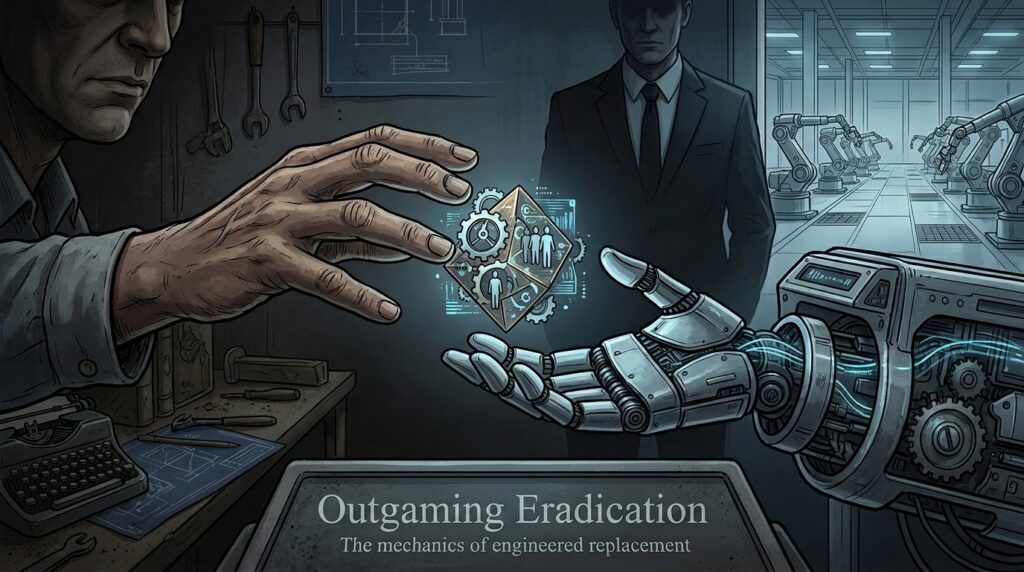
What follows maps out how a specific kind of containment works. It’s about the slow, engineered transfer of human agency to automated systems owned by a small number of people. This series names the mechanics. It strips away the techno-optimism that sells them as inevitable. And it traces the line from historical precedent down to the grim logic of a world that’ll no longer need a bunch of humans living in it.
Yes, that’s heavy material, and these essays aren’t going to soften it. But read them the way you’d read a pathology report rather than an obituary. Because the central claim here isn’t that we’re doomed. It’s that power, when it concentrates completely, can be countered by resilience distributed widely.
Think about how a body survives an infection that it can’t just simply expel. It doesn’t defeat the pathogen with a single, central act. It mounts a decentralized immune response—where countless individual cells recognize the threat, refuse to be hijacked by it, and pass that recognition on to the cells around them. No general gives an order. No fortress holds a line. The defense is the population itself.
That’s the strategy of this series, and it calls for honesty about the stakes. The macro-structures—the markets, the militaries, the platforms—might well be lost. They may become fully automated and fully authoritarian, and no essay is going to stop that—I won’t pretend otherwise. But even in that world, one thing remains stubbornly outside the system’s reach: whether a critical mass of individuals retains the philosophical grounding, the cognitive boundaries, and the autonomous agency needed to remain inalienably human.
That’s the victory. Not recapturing the macro. The survival of humanity.
This series wages two campaigns at once, but they’re not in conflict. The first campaign is defensive: building the durable person*—a resilient, free individual who can withstand pacification. The second campaign is offensive: a non-violent *war against human architects of containment, fought by exposing them, holding them accountable, and starving their machine of the data it feeds on.
These campaigns aren’t alternatives. They’re conducted concurrently. You build the durable person on the fly—not as a retreat from the war, but as the armor and grit needed to wage it. First, you prepare, then you respond. The immune system is the army.
So read on without flinching. You’ll feel its weight; that response is correct. But carry this with you from the first page: the enemy in these essays isn’t a force of nature or of its own making. It’s built, owned, and operated by a tiny group of fragile, nameable human beings—and a thing put together by one set of human hands can be refused by another.
To understand how to refuse it, we have to start where every shift in human power begins—not with the technology itself, but with what happened the last time a new tool was wielded to rewrite the rules of who controls whom.