
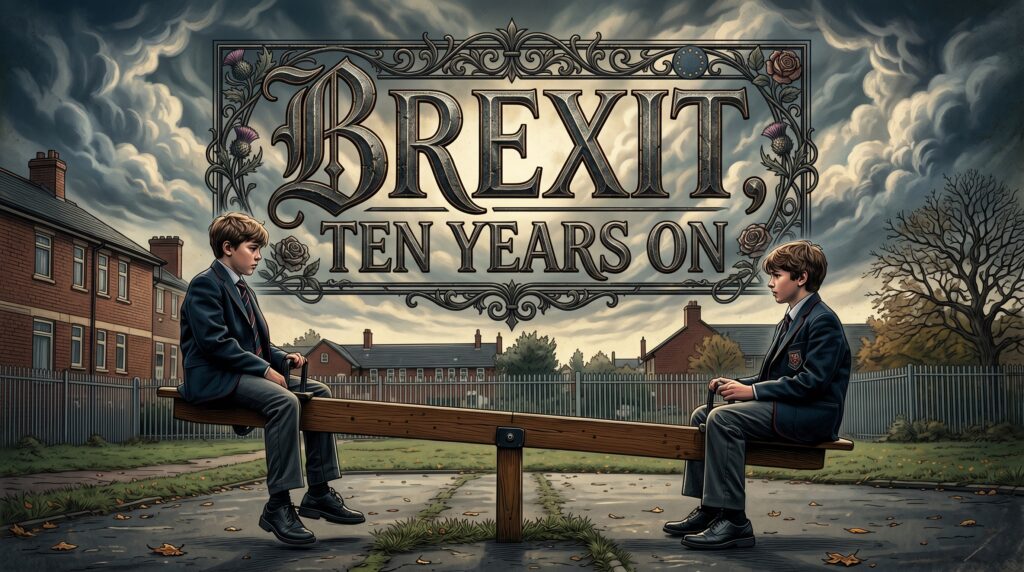
Ten years. That’s how long it’s been since the vote. Brexit isn’t just a thing that happened. It’s how things are now. It’s in the country’s bones. It touches trade, laws, who comes and goes, how we talk to other nations. It even changes how we see ourselves.
Let’s be straight about it. Some folks thought the sky would fall. It didn’t. Others hoped for a brand new day. That didn’t happen either. Here in mid-2026, it looks like the UK paid a real economic cost. We got more control over our politics and laws. But the big questions? About who we are, what our institutions mean, where we’re headed long-term? Those are still up in the air.
The public side
Trade and the economy
The money side of things, that’s pretty clear. Most serious groups now say the UK economy is smaller than it would’ve been if we’d stayed in the EU. Trade’s not as smooth. Businesses aren’t investing as much. We’re not making as much as we used to.
The Office for Budget Responsibility, they’ve said for years that Brexit’ll cut how much the UK produces by about 4 percent in the long run. That’s compared to staying in the EU. Some say it’s even more. People still argue about the exact number. They wonder how much is Brexit, how much is Covid, energy prices, or just global mess. But you can’t really argue about where things are going. It’s down.
Trade friction? It’s real. It shows up every day. Customs forms, checking where things come from, health rules, just plain old delays. All of it makes life harder for exporters. Especially the small ones. Goods trade got hit harder than services. Our big service industries – finance, law, consulting – they’ve held up better than some thought. But losing that easy access, and some work slowly moving to EU cities, that’s still part of the picture.
Business investment tells its own story. The UK started the years after the vote with less investment than expected. That weakness stuck around through all the other shocks. Brexit isn’t the only reason. But it’s definitely one of them. Especially for companies that need those smooth European supply chains.
New trade deals
Brexit did let Britain make its own trade deals. That was a big promise. We’ve signed deals with Australia and New Zealand. We joined the CPTPP, that Pacific trade group.
But those deals? They don’t add much to the economy. Government reports and other studies keep saying the gains are tiny. We’re talking tenths of a percent over many years. Not enough to make up for losing easy access to the EU market. Supporters of Global Britain say these deals are about strategy, about being strong, not just quick money. Critics say strategy is fine, but it doesn’t fill the hole left by weaker EU trade.
The big US trade deal? It never happened. That used to feel like a bigger deal, a symbol. But it still shows something important. Leaving the EU gave Britain room to move. But room to move isn’t the same as having power.
Regulation and control
Here, the Leave argument holds up better. Brexit did give real power back to Westminster, to government departments, to UK regulators and courts. The country has gone its own way in areas like gene editing, some financial rules, clinical trials, and how it handles AI.
For some industries, that means they can move fast. Ministers can act quicker. Regulators can make rules that fit our needs better. That’s not nothing. We should say so.
But there’s a catch. The EU is still Britain’s biggest trading partner. So lots of companies still have to meet EU standards. Even if the UK makes its own rules. What does that mean? Sometimes it means following two sets of rules. More paperwork. More cost. For some businesses, though, having our own rulebook, with ministers we can vote out, feels worth the hassle. Others’d happily trade that feeling for easier access to a bigger, stable market.
Immigration
Brexit changed immigration. You can see it. But maybe not how many voters thought it would. Free movement ended. Fewer people came from the EU. The government got more control over who could come and how.
But at the same time, overall net migration went way up in the mid-2020s. Most of those people came from outside the EU. Health workers, care workers, students. People from Ukraine and Hong Kong. So the new system didn’t give us the neat “lower numbers, higher skills” outcome many Leave voters pictured.
Those who back the new system would say that, in theory, the UK can change things if the mix of migrants or the total numbers don’t feel right anymore. Whether governments actually use that power well? That’s another question. So far, we’ve stopped EU free movement. But we’re still short on workers in places like hospitality, farming, logistics, and care.
Politics and the union
Politically, Brexit closed one chapter. It broke the gridlock in Westminster from 2016 to 2019. It gave us a working, if thin, agreement with the EU. Relations between London and Brussels? They’re not as bitter now. More practical.
But the country’s internal stress hasn’t gone away. Northern Ireland is still the trickiest part. The Windsor Framework helped with some trade issues. But it didn’t fix the deeper fight over who’s in charge, who belongs, and where Northern Ireland fits in the UK. Scotland’s a different story, but it’s connected. Brexit still makes a lot of independence supporters angry. Even if daily stuff like public services and living costs are also on their minds.
Neither of the big parties is pushing to rejoin the EU, the single market, or the customs union. Some who wanted to Remain or Rejoin see this as just being careful politically. They think public opinion could shift back to closer ties. Others think the country’s just too split for another big European project anytime soon.
Public mood
People’s feelings have changed. Polls over the years show most folks feel regret or aren’t happy. But a good chunk still think Brexit was needed. Or that the good parts are just taking longer to show up.
That split matters. Brexit isn’t just some campaign promise anymore. It’s how we live. Some people see slower growth, higher prices, less money for public services, and things feeling harder with Europe. They figure we made a bad deal. Others look at having our own say, making our own laws outside Brussels. They say it was still worth it.
The private side
The public story, it’s important. But it’s not everything. Brexit also lives in small choices. In hopes that got bruised. In quiet goodbyes that don’t show up in economic reports.
It lives in the young researcher who thinks it’s easier to build a career in Amsterdam than Manchester. It lives in the small company in the Midlands. Their German customer is still nice, still friendly. But they just won’t deal with the paperwork anymore. It lives in the musician on tour. Europe used to be the next train ride. Now it’s a customs headache waiting to happen.
Soft power and influence
For years, a lot of the UK government’s energy went into managing Brexit. That meant time, attention, and negotiating effort. Time that could’ve gone to leading on other world issues. Outside the EU, Britain still matters, of course. We’re still a big military power. We’re on the UN Security Council. We’re important in NATO and the G7.
Brexit supporters would fairly say that being in the EU wasn’t the only way to have influence. But those who wanted closer ties would say influence costs more now. It’s more scattered outside the bloc. Especially in areas like digital rules, trade standards, sanctions, and AI. The EU still has a lot of power to make those rules.
This is tough to measure. But it might be one of the most important things. Inside the EU, the UK helped write the rules. Outside, we often try to shape rules from the sidelines. Not from the table where they’re made.
Brain drain and cultural thinning
Just looking at migration numbers misses part of it. Brexit also meant a quieter loss of smart people and confidence. Some EU professionals, researchers, artists, and skilled workers left Britain. Others just stopped seeing it as the obvious place to come.
That doesn’t mean Britain stopped being attractive. It clearly didn’t. But now, being attractive has to fight with friction. Even after the UK got back into Horizon Europe, it’s often been harder to work on big research projects. Harder than when we were a member.
The cultural stuff is harder to count. But it’s real. Touring, working together, moving around easily. It all got more complicated. That hits young artists and smaller acts the hardest. The very people who can least afford delays and extra costs.
Identity and belonging
Brexit didn’t just change policies. It changed how the country sees itself. For a long time, Britain liked to think it was European, but also not quite. In the room, but a little apart. Brexit forced us to face that fuzzy idea.
For many older Leave voters, that moment felt clear. It felt like fixing something democratic. Like taking back decisions from far-off institutions. For many younger voters, and folks in big cities and university towns, it felt like things got smaller. Like a decision about their future was made before some of them could even vote.
That divide hasn’t healed. It’s settled into our politics. Age, where you live, your education, your background. All those things still shape how people remember Brexit. And how they judge its good and bad parts.
The parts still in play
An honest look has to allow that some good things from Brexit might just take longer to show up than the bad things did. There are a few areas where that idea makes sense.
One is farming tech and gene editing. The UK has moved faster than the EU on precision breeding. Over time, that could give British farming more room to try new things. Another is financial services. Our own tailored rulebook could still create a special spot for us. Somewhere between America’s huge scale and Europe’s careful approach.
A third is immigration policy. In theory, a points-based system gives the government more power. It can shape the workforce it wants. Instead of just taking whatever labor comes. Fair-minded experts admit we don’t know yet how these experiments will turn out. The same rule changes that could make the UK quicker could also leave us more alone. If global standards go the other way.
This part of the Brexit story? It’s still open. Ten years is enough time to see the early economic and institutional effects. It’s not enough time to settle every big argument. About national strategy, democratic control, and making our own rules.
A fair verdict
So what can we honestly say after ten years?
First, Brexit cost us real money. On trade, how much we produce, how much businesses invest, and how well people live. The evidence points to things getting worse. Even if we still argue about how much worse. Second, Brexit did give power and choices back to the British state. For many, that matters on its own. Even if the clear benefits are small or slow to appear.
Third, neither side got everything they predicted. Britain didn’t fall apart. But it didn’t jump into some amazing new era either. Some Leave supporters would say the cost was worth it for democratic control. They’d say the real test is still coming, as new policies get going. They’re right that having our own say has a value. One that doesn’t show up neatly in economic numbers.
What we have instead is less dramatic. More lasting. A country that’s not as close to its biggest market. A more strained union at home. More freedom in laws and policies. And a never-ending argument about what Britain is now. That might not make everyone happy. But it’s pretty close to the truth.