
The Second Lock
Germany lost a Security Council vote it had never lost before. The number it received is a confidential audit of its standing — and a quiet refutation of the case it makes for permanent membership.
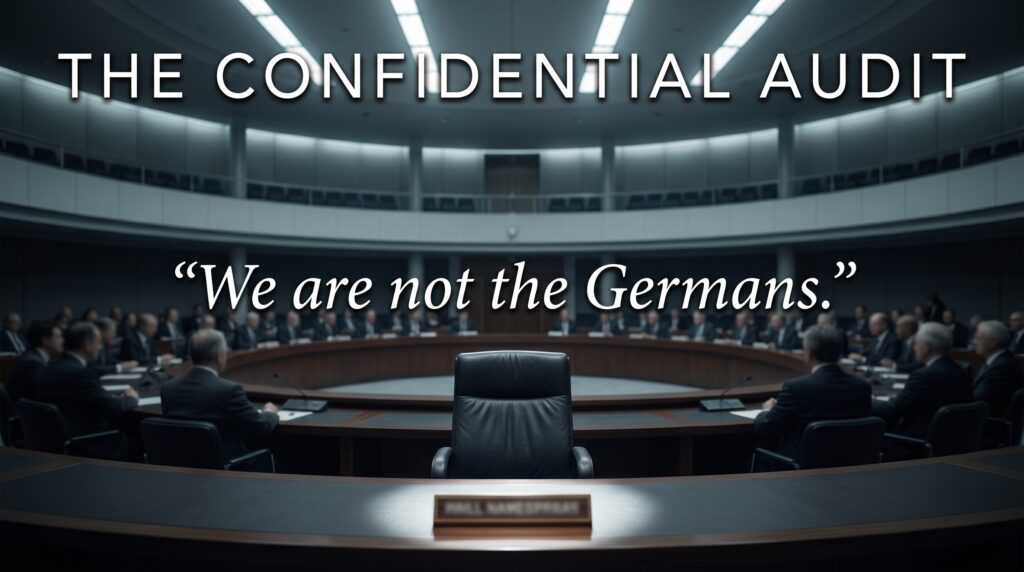
There is one sentence in the post-mortems that does more work than the result itself. As the campaign closed, a senior Austrian diplomat reportedly told undecided delegations they should vote for Vienna for one reason above all others: precisely because “we are not the Germans.”1
Hold that line up to the light, because everything important is inside it.
Austria has long been one of Israel’s firmest friends in Europe — no less so than Germany. The two countries’ substantive positions on the Middle East are close to identical.2 So the winning pitch was not about policy at all. It was about exposure. Vote for the small, constitutionally neutral, non-NATO state whose convictions cost the system nothing, the diplomat was saying, rather than the large one whose convictions actually move outcomes. Germany lost, in part, not for believing the wrong thing but for being consequential enough that its belief mattered. And a secret ballot is the one instrument on earth designed to let states punish the conspicuous actor while sparing the identical-but-quiet one, at no cost to themselves.
That is the story. The rest is detail. But the detail is worth getting exactly right, because the comfortable version of this story is wrong, and the uncomfortable version travels much further than a single lost election.
What happened
On Wednesday, June 3, 2026, Germany failed to win a non-permanent seat on the United Nations Security Council. It finished third in a three-way race for the two seats allotted to the Western European and Others Group (WEOG) for the 2027–2028 term. Portugal took 134 votes, Austria 131. Germany received 104 — twenty-three short of the 127 needed for a two-thirds majority in the 193-member General Assembly. It was eliminated in the first round.3
This had never happened before. Germany had won all six of its previous bids, dating back to the 1970s, traditionally standing for a seat about once every eight years.4 By the convention of these contests it has always been a favorite, or has run effectively unopposed, or has stepped aside rather than face a serious rival. Berlin is the UN’s second-largest financial contributor. It helped lead the negotiations behind the organization’s Pact for the Future. By every conventional metric of weight, it should have walked in.5
And the result was read out by Annalena Baerbock — Germany’s former foreign minister, now serving as President of the General Assembly for its 80th session. The architect of much of the foreign-policy posture now being judged had to announce the verdict on it herself.6 If you were designing the scene for maximum symbolic charge, you could not improve on it.
The reaction at home was immediate and bipartisan in its discomfort. The far-right AfD called it an embarrassment; the Greens branded it an embarrassing defeat and accused the Merz government of running an inconsistent foreign policy and failing to fight hard enough for the seat.7 Chancellor Friedrich Merz offered the only line available to him: we applied with conviction, and did not achieve our goal.8 Foreign Minister Johann Wadephul, who had flown to New York to lobby some eighty ministers and ambassadors in person, called it a bitter defeat.9
The explanation that fails first
The first explanation offered was Russia. Wadephul noted, accurately, that Moscow had worked against the bid, and that the Kremlin does not want a strong pro-Ukraine voice on the Council. As he put it, “it is no secret that Russia does not want such a voice at the Security Council.”10 This is true, as far as it goes. It is also a relief to say, because it casts the loss as the honorable price of standing with Kyiv.
It does not survive contact with the arithmetic. The cleanest rebuttal came from Trita Parsi of the Quincy Institute, and it is almost surgical. “Let’s be clear: Germany’s backing of Ukraine was not the reason,” he wrote. “Portugal and Austria — who outperformed Germany — are equally supportive of Ukraine.”11 The logic is hard to argue with. If backing Kyiv were the liability, all three should have suffered it. Only one did. Russia’s lobbying may have shaved votes at the margin, but a twenty-three-vote gap is not a margin. It is a judgment, and it requires a cause specific to Germany.
The late-entry explanation has the same shape: real, and insufficient. Germany entered this race in 2020; Austria declared back in 2011 and Portugal in 2013, giving both more than a decade to bank commitments before Berlin even showed up.12 That matters. So does Portugal’s deep network across the Lusophone and Hispanophone world, reinforced by having António Costa in the European Council and António Guterres in the Secretary-General’s chair — a profile that reads as a relatively neutral broker with reach into the Global South.13 So does Austria’s constitutional neutrality, which reads as non-threatening to non-aligned states in a way that a NATO heavyweight never can.14 These are genuine structural disadvantages, and an honest account has to grant them their weight.
But grant them all and a residue remains that none of them touches. A late start costs you a close finish, not a first-round elimination. In relational diplomacy, time is the currency of trust — yet a candidate that is “a few months too late” loses by a narrow margin, not by twenty-three votes. Neutrality and Lusophone reach explain why Austria and Portugal were attractive; they do not explain why Germany specifically was the one cut, rather than running a respectable third that still cleared the threshold in a later round. To explain the size and the specificity of the loss, you have to look at the thing the comfortable explanations are built to avoid.
The credibility deficit
The most telling evidence is that Germany’s own foreign minister named it. Wadephul conceded that Germany’s special responsibility toward Israel — the Holocaust-rooted Staatsräson at the core of its postwar identity — may also have cost votes.15 When the candidate volunteers this, it stops being an accusation from the outside and becomes a confession from within.
What the General Assembly was responding to is not a single position but a pattern, and the pattern is one of selective application of the very rules-based order Germany made the centerpiece of its pitch. The record is a matter of votes, not interpretation. Since October 2023, the Assembly has repeatedly taken up Gaza and Palestine, and Germany spent much of that period abstaining: on the October 2023 call for a humanitarian truce, on the December 2023 ceasefire resolution, and again in 2025 on a resolution tied to ending Israel’s unlawful presence in occupied territory.16 Berlin’s diplomats at the UN have, as a rule, kept their distance — frequently abstaining on Israel-Palestine resolutions while continuing to profess support for a two-state solution and for international law.17
Beyond the votes, the conduct. Merz publicly promised to find “ways and means” for Netanyahu to visit Germany despite an outstanding ICC arrest warrant for war crimes and crimes against humanity in Gaza, and then traveled to Israel to meet him in December 2025 — putting Germany, an ICC member state formally obliged to execute the court’s warrants, in the position of the first to have its head of government openly receive an ICC fugitive.18 Berlin also signaled it would not recognize a Palestinian state in the foreseeable future, even as much of Western Europe moved the other way.
Then Iran sharpened the same blade into a clean charge of double standards. When the United States and Israel struck Iran in 2026, Germany — along with France and the United Kingdom — urged diplomacy and condemned Iranian retaliation, but pointedly declined to characterize the strikes themselves as violations of international law, even as a large majority of legal scholars said they were.19 Merz went further, saying he would not “lecture” President Trump on the law, and calling the abduction of Venezuela’s Maduro merely “complex.”20 The contrast was impossible to miss, and it was noticed inside Germany itself: President Frank-Walter Steinmeier broke with his own chancellor to call the war on Iran a breach of international law and “a politically disastrous mistake.”21
This is the detail that carries furthest beyond Europe, because it is the purest form of the indictment: a state that presents itself as the guardian of the legal order, and will not name a breach when an ally commits one. Outside Europe this was read as proof that Germany does not take its own standards seriously — and reputations of that kind are paid for years after they are earned.
This is why the comparison to Austria is so devastating, and why that diplomat’s line is the key to the whole episode. The two states hold nearly the same view. The difference is that Austria, small and neutral, never became the face of defending that view on the world stage, and so never drew the scrutiny. Germany did.22 The vote did not punish a belief. It punished visible, consequential inconsistency — and it had a secret ballot with which to do so anonymously and for free.
The second lock
Here the episode stops being a German story and becomes a structural one, and it lands precisely on the machinery that keeps the Security Council frozen.
Germany is not a casual Council member. It is a founding pillar of the G4 — with Brazil, India, and Japan — the bloc whose entire purpose is to win permanent seats and to back one another’s candidacies in doing so. Their model is concrete: enlarge the Council from fifteen seats to twenty-five or twenty-six, add six new permanent members (two for Africa, two for Asia and the Pacific, one each for Latin America and Western Europe), with the new permanents initially forgoing the veto and the question revisited after fifteen years.23 And Germany has consistently framed this not as European self-advancement but as service to a wider Global South demand to remake a body still dominated by the victors of 1945.24
Set that pitch beside Wednesday’s number and the irony stops being embarrassing and becomes architectural.
The permanent-seat case rests on a single load-bearing premise: that Germany would be a legitimate permanent member because it champions broader, fairer representation, the Global South’s above all. The June 3 ballot was an unplanned test of that premise — and it failed it. The constituency Germany claims to speak for declined to grant it even a two-year rotating chair. If you cannot assemble 127 votes for the temporary seat, the idea that the same Assembly would award you a permanent one is not a strategy. It is a fantasy. The vote did not merely cost Germany a seat. It falsified the central claim of its permanent-seat campaign, in public, administered by the exact electorate that claim invokes.
The procedural ladder makes this merciless. A permanent seat requires amending the UN Charter under Article 108: a two-thirds vote of the General Assembly — at least 128 states — followed by ratification, in accordance with national procedures, by two-thirds of the membership and, crucially, including every one of the five current permanent members.25 By Germany’s own Foreign Office reckoning, that effectively hands each of the P5 a veto over any structural change.26 Germany has just demonstrated it cannot clear the lowest rung of that ladder — a routine, low-stakes contest against two friendly EU neighbors. The reform it seeks demands clearing a far higher rung against incumbents whose every incentive is to keep the door shut.
And this is the part worth holding onto, because it sharpens a pattern that runs well beyond the UN. The familiar diagnosis of institutional paralysis points to the incumbents: the veto-holders guard the door, and reform dies because the powerful will not share power. That lock is real. But Germany’s loss exposes a second lock, operating one level below the first, at the layer of consent rather than power. The reformer requires the active assent of precisely the constituency that distrusts the reformer’s sincerity. Germany’s à-la-carte application of international law — loud on Ukraine, quiet on Gaza, silent on Iran — is read by the Global South as evidence that it does not actually believe in the universal rules it invokes. And you cannot be elevated as a steward of the rules by an audience that has watched you apply them selectively.
The two locks reinforce each other, which is why the cell is so hard to open. The incumbents at the top will not yield. And the membership at the bottom will not trust the aspirants who promise they would do better. The permanent members did not have to lift a finger to keep Germany out. The General Assembly’s median voter did the work for them — quietly, anonymously, at no cost, while Germany was still mid-sentence about how the body needs reform.
There is a wider lesson here for anyone watching how governance gets made in the next decade. The machinery that beat Germany — a diffuse coalition of non-Western states using one-country-one-vote and the privacy of a ballot to deny a Western aspirant a seat it considered its birthright — is not unique to the Security Council. It is a general-purpose instrument. The same coalition, voting the same way, can shape the outcomes of the bodies now forming around the questions that will define the next era: AI norms and standard-setting, cyber and digital-sovereignty rules, sanctions regimes, export controls. The “rules-based order” framing no longer converts automatically into votes when key Southern constituencies suspect the rules are enforced selectively. Germany just learned that lesson at the Security Council. It will not be the last Western power to learn it, and it will not be the last forum.
What the number means
The instinct is to file this under foreign-policy setbacks: a bad week, a botched campaign, a fixable error of timing. That reading is a comfort, and like most comforts in this story it is a way of not looking at the thing itself.
A secret-ballot election is one of the rare moments when 193 states reveal a preference they would never state aloud, with no diplomatic consequence for honesty. The point is not that Germany lost to an anti-Western bloc — it did not. It lost to two other Western states, which makes the message more pointed, not less. The Assembly did not say we reject Western representation. It said we will take Western representation, but not Germany as its face, not right now.
So Germany did not lose a seat on Wednesday. It received a confidential audit of its standing in the world, conducted by 193 anonymous graders, and the score came in twenty-three points below where its own foreign ministry was certain it stood. As one Euronews analysis put it, the seat itself is not what weighs heavily; what weighs is what the defeat reveals about Germany’s position in the world.27 The “late entry” explanation is the move an institution reaches for when the alternative is unbearable — because it implies a process error you can fix next time, rather than a credibility problem you cannot, and a theory of your own legitimacy that has just failed its first real-world test.
The blunt way to say it is this. Germany did not lose because it lacked qualifications. It has the money, the institutions, the seriousness, the multilateral record. It lost because qualifications are no longer the same thing as trust. The old formula — large donor, plus liberal-internationalist language, plus Western alignment, equals broad support — is coming apart. The world is becoming more transactional and less willing to reward a Western power for saying the correct institutional words while applying the law to its friends and its adversaries on different terms.
The most honest words about the outcome came not from Berlin but from a critic. A former senior UN human-rights official called it “an unusual moment of justice,” pointing to Germany’s support for Israeli conduct in Palestine, its posture on Iran, and its treatment of human-rights advocates at home.28 You need not share his politics to grasp why the phrase stuck. The General Assembly is not a court, and it issues no verdicts. But once in a while, in the privacy of a secret ballot, it sends a country a number. And a number, unlike a speech, cannot be spun.
Notes
1. “Did Germany lose its UNSC seat because of support for Israel?” Al Jazeera, June 4, 2026, https://www.aljazeera.com/news/2026/6/4/did-germany-lose-its-unsc-seat-because-of-support-for-israel.
2. Ibid. Al Jazeera notes that Austria, like Germany, “has traditionally been one of Israel’s staunchest supporters in Europe,” but as a smaller, militarily neutral state has “largely evaded the level of scrutiny faced by Berlin.”
3. “Portugal and Austria defeat Germany for UN Security Council seats,” Associated Press, June 3, 2026, https://apnews.com/article/un-security-council-election-austria-portugal-germany-afd582a50901182d7f955062456222ad; “Germany misses out on UN Security Council seat in surprise vote,” Daily Sabah, June 3, 2026, https://www.dailysabah.com/world/europe/germany-misses-out-on-un-security-council-seat-in-surprise-vote.
4. “Germany fails to gain seat on UN Security Council,” Euronews, June 3, 2026, https://www.euronews.com/my-europe/2026/06/03/germany-fails-to-gain-seat-on-un-security-council; “Did Germany lose its UNSC seat because of support for Israel?” Al Jazeera, June 4, 2026.
5. Trita Parsi, quoted in “Did Germany lose its UNSC seat because of support for Israel?” Al Jazeera, June 4, 2026, noting Germany is “the second-largest financial supporter of the UN and plays a leading role in negotiating the Pact of the Future.”
6. “Germany fails to gain seat on UN Security Council,” Euronews, June 3, 2026; “Did Germany lose its UNSC seat because of support for Israel?” Al Jazeera, June 4, 2026.
7. “Germany Fails in UN Security Council Reelection Bid,” The European Conservative, June 4, 2026, https://europeanconservative.com/articles/news-corner/germany-fails-un-security-council-austria-elected-reelection-bid/; “Germany blames Russia for failed UN Security Council bid,” BBC News, June 4, 2026, https://www.bbc.com/news/articles/cgmp3pg71edo.
8. “Germany blames Russia for failed UN Security Council bid,” BBC News, June 4, 2026.
9. Ibid.
10. Ibid.; “Did Germany lose its UNSC seat because of support for Israel?” Al Jazeera, June 4, 2026.
11. Trita Parsi, quoted in “Did Germany lose its UNSC seat because of support for Israel?” Al Jazeera, June 4, 2026. On Parsi’s background as a former staffer at the Swedish Permanent Mission to the UN who handled Security Council affairs, see “Trita Parsi,” Quincy Institute for Responsible Statecraft, https://quincyinst.org/author/trita-parsi/.
12. “Germany fails to gain seat on UN Security Council,” Euronews, June 3, 2026; “Did Germany lose its UNSC seat because of support for Israel?” Al Jazeera, June 4, 2026.
13. “Did Germany lose its UNSC seat because of support for Israel?” Al Jazeera, June 4, 2026.
14. Ibid.
15. “Germany blames Russia for failed UN Security Council bid,” BBC News, June 4, 2026; “Did Germany lose its UNSC seat because of support for Israel?” Al Jazeera, June 4, 2026.
16. “UN General Assembly votes by large majority for immediate humanitarian ceasefire during Israel-Hamas conflict,” UN News, December 12, 2023, https://news.un.org/en/story/2023/12/1144717 (Germany among those abstaining); “Cease-fire in Gaza: Why Germany abstained in UN votes,” Deutsche Welle, December 20, 2023, https://www.dw.com/en/cease-fire-in-gaza-why-germany-abstained-in-un-votes/a-67772509 (detailing the October 27 and December 12, 2023 abstentions); UN General Assembly resolution on Israel’s presence in the Occupied Palestinian Territory, June 12, 2025 (149 in favor, 12 against, 19 abstentions, with Germany among the abstaining states).
17. “Did Germany lose its UNSC seat because of support for Israel?” Al Jazeera, June 4, 2026.
18. “Merz invites Netanyahu to Germany despite ICC arrest warrant,” Deutsche Welle, March 1, 2025, https://www.dw.com/en/merz-invites-netanyahu-to-germany-despite-icc-arrest-warrant/a-71788069; “Chancellor Merz in Israel: Germany Should Stand for Justice,” Human Rights Watch, December 5, 2025, https://www.hrw.org/news/2025/12/05/chancellor-merz-in-israel-germany-should-stand-for-justice; “Situation in the State of Palestine: ICC Pre-Trial Chamber I … issues warrants of arrest for Benjamin Netanyahu and Yoav Gallant,” International Criminal Court, November 21, 2024, https://www.icc-cpi.int/news/situation-state-palestine-icc-pre-trial-chamber-i-rejects-state-israels-challenges.
19. “Merz criticized for selective approach to international law,” Deutsche Welle, March 27, 2026, https://www.dw.com/en/germany-chancellor-friedrich-merz-international-law-approach-donald-trump-venezuela-iran-war/a-76554183; “Neither preemptive nor legal, US-Israeli strikes on Iran have blown up international law,” The Conversation, February 28, 2026, https://theconversation.com/neither-preemptive-nor-legal-us-israeli-strikes-on-iran-have-blown-up-international-law-277173.
20. “Merz criticized for selective approach to international law,” Deutsche Welle, March 27, 2026.
21. Ibid.
22. “Did Germany lose its UNSC seat because of support for Israel?” Al Jazeera, June 4, 2026.
23. “G4 nations,” Wikipedia, https://en.wikipedia.org/wiki/G4_nations; “An Analysis of the G4 Reform Proposal,” Global Policy Journal, https://www.globalpolicyjournal.com/articles/conflict-and-security/projecting-general-assembly-voting-records-enlarged-security-council.
24. “Germany fails to gain seat on UN Security Council,” Euronews, June 3, 2026 (noting Berlin’s advocacy of reform to increase Global South representation alongside its long-standing pursuit of a permanent seat).
25. “Chapter XVIII: Amendments (Articles 108–109),” Charter of the United Nations, United Nations, https://www.un.org/en/about-us/un-charter/chapter-18; “Reform of the United Nations Security Council – questions and answers,” German Federal Foreign Office, accessed June 3, 2026, https://www.auswaertiges-amt.de/en/aussenpolitik/internationale-organisationen/vereintenationen/reformsr-fragen-231618.
26. “Reform of the United Nations Security Council – questions and answers,” German Federal Foreign Office.
27. “UN Security Council defeat raises questions about Germany’s global standing,” Euronews, June 4, 2026, https://www.euronews.com/my-europe/2026/06/04/un-security-council-defeat-raises-questions-about-germanys-global-standing.
28. Former UN official quoted in “Did Germany lose its UNSC seat because of support for Israel?” Al Jazeera, June 4, 2026: “In an unusual [moment] of justice the UN [General] Assembly today Germany lost its bid for a UNSC seat.”