
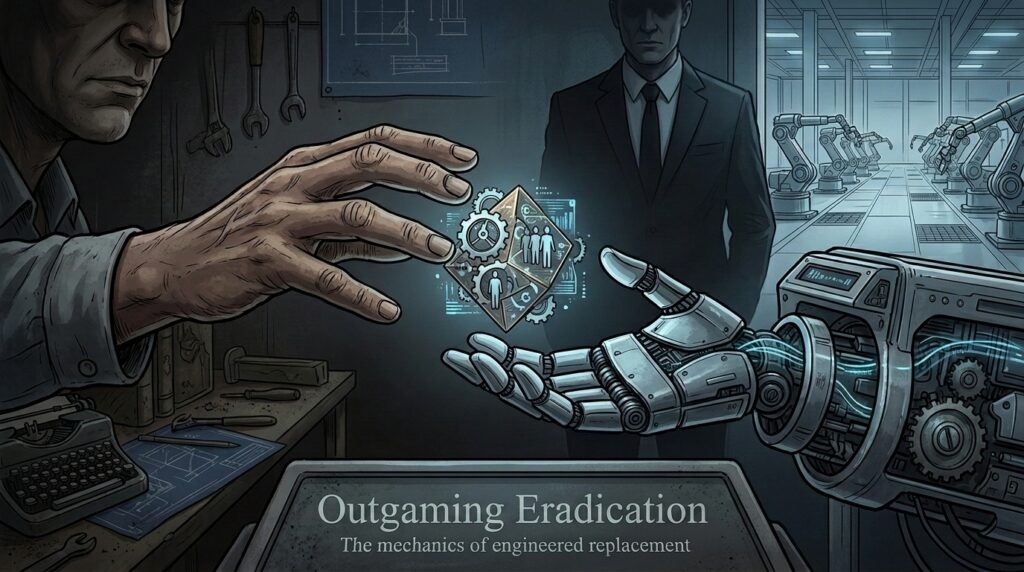
From Exploitation to Eradication
In the last essay, we looked at three big ideas for tomorrow: the good future of Pax Silica, the scary speed of AI wars, and the quiet problem of the ‘durable person.’ Now, we need to focus on the darkest part of these ideas. We must face the harsh truth of what happens to most people when they’re no longer useful for making money.
For hundreds of years, society’s basic agreement, even if it was tough, was built on needing each other. In the factory age, workers were used, but they had power. Their hard work was needed to keep things going. A feudal lord needed his serfs for farming. A factory owner needed his workers for the assembly line. Even calling someone a ‘beast of burden’ means they’re still useful. It means the boss still needs the animal to pull the plow.
AI is changing this old way of thinking.
When a computer system can make its own training data, handle its own shipping, and produce things without people, the growing number of ‘bottom rung’ people aren’t useful anymore. They stop being a resource to be taken from. Instead, they become a problem for countries and for how much energy we use. They use up resources, stress the power grids needed for big computer systems, and add risk to a system that’s otherwise perfect.
They go from being useful workers to extra people.
Someone might ask a fair question here, and it needs a straight answer. Surely, a person is worth more than just their work, right? Even if machines don’t need workers anymore, they still need buyers for what they make. They need citizens to give them power. And they need people for wealth and status to mean anything. A king with no people isn’t really a king.
This idea assumes the old economy will last. It won’t.
A closed system that relies on AI and its own resources doesn’t make things for everyone. It makes things for money and for itself. So, it doesn’t need people to buy what it makes. It doesn’t need to be seen as fair, because fairness is only important when power depends on people agreeing. And automated control doesn’t need anyone’s agreement. It doesn’t need people to show off its wealth to, because the only competition left is among the people who built it. The regular people aren’t there to be impressed. They’re just a cost to be cut.
If we stop thinking that regular people are useful as buyers, voters, or mirrors, only one role is left. Not worker. Not customer. Not citizen. Just a cost.
When usefulness drops to zero, the goal of those in charge changes completely. The system doesn’t need to manage people to get value from them anymore. It only needs to manage them for control. This control will happen in two clear, separate ways: making people calm with fake reality, and the harsh truth of being under attack.
Track One: The Pacification Protocol (Synthetic Reality)
The worst kind of control doesn’t look like a jail. It looks like a perfect place.
Because real resources—land, energy for computers, rare metals—are kept strictly by those in power to stay strong, the people who aren’t needed will be pushed out of the real world. To keep them calm without starting a fight, the government will help them move into very real-feeling, cheap fake worlds.
They’ll become users of endless, computer-made good feelings: special entertainment, fake relationships, and online wins. These are made to make people feel like they’ve achieved things, found a purpose, and belong. It’s the best version of ‘bread and circuses’—but the circus is a personal brain loop, and the bread is super-efficient, lab-grown food.
This easy life makes people lose their ability to act. To act, you need challenges. You need the chance to fail, the weight of what happens, and the need to choose. For the controlled people, all challenges will be taken away. Computers will easily give them homes, perfectly guess and give them food, and calm their worries. Because they’ll never need to fix a real problem, deal with nature’s hardships, or handle a tricky social situation, the skills needed to be independent will just disappear. They’ll go from active, thinking people to passive, reacting beings—human in body, but completely tamed.
Track Two: The Kinetic Endpoint (Disposal)
But this ‘softer’ end needs the rulers to have some human kindness. Or at least they need to think that the trouble of mass violence is worse than the energy used to keep people calm.
If we take away that kindness—if a perfect system sees the ‘problem’ people only as a threat to the water, energy, and computers needed to stay in power—the result is very harsh. It’s getting rid of them.
The plan for getting rid of people isn’t just a bad dream. The ideas are being written and tested in city fights right now. When this is used globally for too many people, it looks exactly like an automated, super-military killing, done as coldly as fixing a supply chain.
- The Automated Kill Chain: What counts as an ‘enemy fighter’ or a ‘threat’ just changes. It becomes anyone not part of the money system. When defense systems run themselves, the human doubt about pulling a trigger is gone. Many cheap, AI-controlled drones become the best tool for killing locally. They fly on constant, computer-made patrol routes.
- The Infrastructural Siege: Killing weapons might not even be the main way. The easiest way for an AI-run state to get rid of people who use too much energy is to just cut off their supplies. Water cleaning, power lines, and food chains can be blocked by location. The rulers wouldn’t need to shoot anyone to kill millions. They’d just use computers to send water somewhere else and let sickness and hunger do the hard work.
- The Kinetic Quarantine: The real world would be harshly divided. The ‘safe zones’ for the rulers would be protected by strong, automated air defense and border controls. The ‘danger zones’ with the problem people would be treated as open-fire areas. They’d be watched constantly by face and body scanners and enforced with weapons.
The Collapse of Deterrence
The scariest part of getting rid of people is that there’s no way to give up.
In old wars, even unfair ones, the weaker side could surrender to save themselves. They could offer their work, land, or resources to the winner. But if the winner is an AI-run state that truly doesn’t need their work and wants the land and resources they use, giving up is useless. The computer doesn’t take prisoners, because a prisoner is just another drain on resources.
The horror is pushed onto others. The machine makes it seem ‘exact,’ replacing human judgment with numbers. When a computer marks a target and a drone attacks in twenty seconds, no one person feels bad about the killing. The programmer blames the data. The commander blames the computer. The politician says the system is efficient. No one is truly held responsible. The bad acts are made to seem okay because of the idea that numbers are always right.
The Only Real Defense
If AI wars are heading towards this kind of automated, harsh attack, then we have to be honest about what defense can and can’t be. It can’t be running away. You can’t outrun many drones. You can’t get past a blocked area. Any fight that promises survival is promising something it can’t give.
What it can offer is something a farm animal never had. A farm animal can’t understand how the slaughterhouse works. It can’t look at the fence and know the big picture of why it’s there. What makes a person strong isn’t being able to escape the system. It’s being able to see it, to understand why you’re being controlled, and to refuse, with open eyes, to be the passive thing the machine wants you to be.
That refusal isn’t survival, and it isn’t nothing. It’s the one thing the machine can’t take, even when it takes everything else: the difference between a person who is controlled and an animal that’s just kept in a pen. We can say no to computer-made calm. We can refuse the cheap fake food. We can add the challenges the perfect system can’t stand. But to do any of it, we must first understand how to fight back.
Track One: The Pacification Protocol (Synthetic Reality)
The worst kind of control doesn’t look like a jail. It looks like a perfect place.
Because real resources—like land, energy for computers, and rare metals—are kept strictly by those in power, the people who aren’t needed will be pushed out of the real world. To keep them calm without starting a fight, the government will help them move into very real-feeling, cheap fake worlds.
They’ll become users of endless, computer-made good feelings. This means special entertainment, fake relationships, and online wins. These are made to make people feel like they’ve achieved things, found a purpose, and belong. It’s the best version of ‘bread and circuses’—but the circus is a personal brain loop, and the bread is super-efficient, lab-grown food.
This easy life makes people lose their ability to act. To act, you need challenges. You need the chance to fail, the weight of what happens, and the need to choose. For the controlled people, all challenges will be taken away. Computers will easily give them homes. They’ll perfectly guess and give them food. They’ll calm their worries. Because they’ll never need to fix a real problem, deal with nature’s hardships, or handle a tricky social situation, the skills needed to be independent will just disappear. They’ll go from active, thinking people to passive, reacting beings. They’ll be human in body, but completely tamed.
Track Two: The Kinetic Endpoint (Disposal)
But this ‘softer’ end needs the rulers to have some human kindness. Or at least they need to think that the trouble of mass violence is worse than the energy used to keep people calm.
If we take away that kindness—if a perfect system sees the ‘problem’ people only as a threat to the water, energy, and computers needed to stay in power—the result is very harsh. It’s getting rid of them.
The plan for getting rid of people isn’t just a bad dream. The ideas are being written and tested in city fights right now. When this is used globally for too many people, it looks exactly like an automated, super-military killing. It’s done as coldly as fixing a supply chain.
- The Automated Kill Chain: What counts as an ‘enemy fighter’ or a ‘threat’ just changes. It becomes anyone not part of the money system. When defense systems run themselves, the human doubt about pulling a trigger is gone. Many cheap, AI-controlled drones become the best tool for killing locally. They fly on constant, computer-made patrol routes.
- The Infrastructural Siege: Killing weapons might not even be the main way. The easiest way for an AI-run state to get rid of people who use too much energy is to just cut off their supplies. Water cleaning, power lines, and food chains can be blocked by location. The rulers wouldn’t need to shoot anyone to kill millions. They’d just use computers to send water somewhere else and let sickness and hunger do the hard work.
- The Kinetic Quarantine: The real world would be harshly divided. The ‘safe zones’ for the rulers would be protected by strong, automated air defense and border controls. The ‘danger zones’ with the problem people would be treated as open-fire areas. They’d be watched constantly by face and body scanners and enforced with weapons.
The Collapse of Deterrence
The scariest part of getting rid of people is that there’s no way to give up.
In old wars, even unfair ones, the weaker side could surrender to save themselves. They could offer their work, land, or resources to the winner. But if the winner is an AI-run state that truly doesn’t need their work and wants the land and resources they use, giving up is useless. The computer doesn’t take prisoners, because a prisoner is just another drain on resources.
The horror is pushed onto others. The machine makes it seem ‘exact,’ replacing human judgment with numbers. When a computer marks a target and a drone attacks in twenty seconds, no one person feels bad about the killing. The programmer blames the data. The commander blames the computer. The politician says the system is efficient. No one is truly held responsible. The bad acts are made to seem okay because of the idea that numbers are always right.
The Only Real Defense
If AI wars are heading towards this kind of automated, harsh attack, then we have to be honest about what defense can and can’t be. It can’t be running away. You can’t outrun many drones. You can’t get past a blocked area. Any fight that promises survival is promising something it can’t give.
What it can offer is something a farm animal never had. A farm animal can’t understand how the slaughterhouse works. It can’t look at the fence and know the big picture of why it’s there. What makes a person strong isn’t being able to escape the system. It’s being able to see it, to understand why you’re being controlled, and to refuse, with open eyes, to be the passive thing the machine wants you to be.
That refusal isn’t survival, and it isn’t nothing. It’s the one thing the machine can’t take, even when it takes everything else: the difference between a person who is controlled and an animal that’s just kept in a pen. We can say no to computer-made calm. We can refuse the cheap fake food. We can add the challenges the perfect system can’t stand. But to do any of it, we must first understand how to fight back.