
Naming and Defeating the Brain of the Beast
We’ve been on a journey in this series. We’ve looked at big historical changes, like the printing press and the internal combustion engine. We’ve seen how they led to today’s knowledge economy. And we’ve explored the tough math of algorithmic control. We’ve also mapped out the future’s challenges and defined what a strong person looks like.
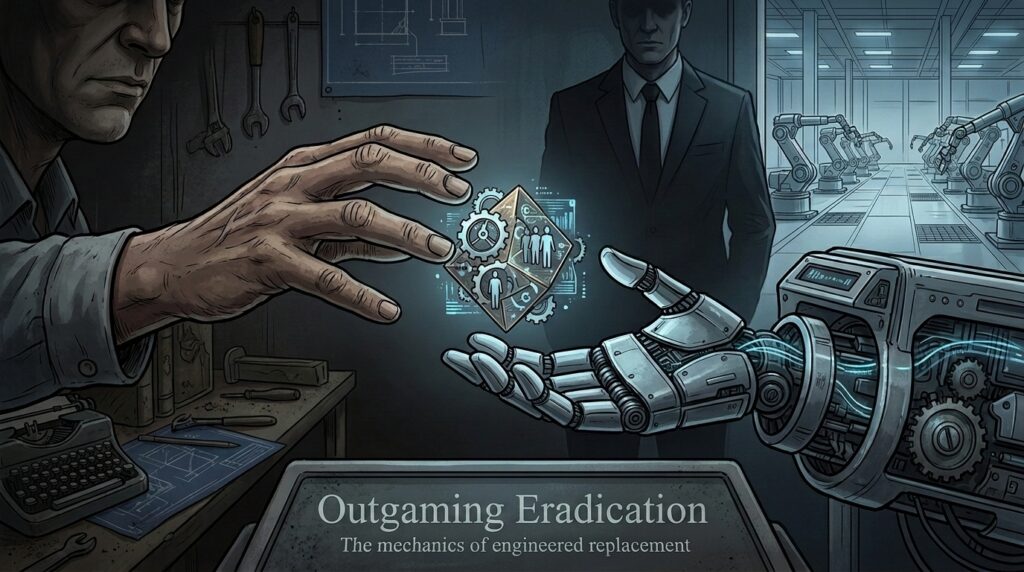
Now, we must uncover the biggest trick of all: the idea that technology acts on its own. It’s a dangerous myth.
We’re taught to fear the code. We argue if AI is alive or if machines will turn evil. We wonder if superintelligent AI will just decide to wipe us out. This is a language trick. The people who built these systems push this idea hard. It makes it seem like these technologies just appeared, like nature.
But they didn’t. Algorithms don’t hate. Uranium doesn’t start wars. Technology is just a tool. Human intentions are what matter.
The “brain of the beast” isn’t a secret group or a rogue AI. It’s a clear, powerful network of human leaders. They work where money, computers, and government force meet. If we want to survive, we must stop fighting a ghost. We need to hold the humans who built it accountable.
The Anatomy of the Beast: The Three Lobes of Power
When you look at how tech control really grew, you see three distinct parts. They work together very closely.
1. The Infrastructural Lobe: The Compute Monopolists (The Brain Stem)
AI needs huge, energy-hungry systems to work. The people who run this part don’t care about AI philosophy. They care about controlling computing power.
- Who they are: The leaders of big cloud companies (Amazon Web Services, Microsoft Azure, Google Cloud). Also, those who control key computer chip makers (Nvidia, TSMC).
- What they do: They make themselves the gatekeepers of progress. They gather all the world’s computing power. This means no country, company, or person can join the modern economy without paying them. They are building what Yanis Varoufakis calls techno-feudalism.
2. The Kinetic Lobe: The Algorithmic Warlords (The Predatory Cortex)
If the compute monopolists are the brain’s base, this part is its weapon. These are the humans who design automated killing systems. They build mass surveillance networks. They create plans for automated city attacks.
- Who they are: The heads of defense tech companies (like Palantir and Anduril). Also, cyber-intelligence sellers. And former intelligence officers who now make money from algorithmic warfare.
- What they do: They make war easier to start. They sell governments the power to use force and control people. They do this without the mess of human soldiers. They build a slaughterhouse and call it “security optimization.”
3. The Ideological Lobe: The Capital Technocrats (The Prefrontal Cortex)
This part provides the money and the ideas. It helps move us to an economy where humans aren’t needed.
- Who they are: Top venture capitalists, directors of big investment funds. Also, billionaires who believe in “effective accelerationism” (e/acc).
- What they do: They see human things—like democracy, kindness, hesitation, rules—as problems. They want to engineer them out. They don’t hide this; they write it in their own plans. They fund this “beast” because they want a smooth, super-efficient world. In this world, they are at the top of the management system.
We know exactly where this brain is. The people running it sit on company boards. They speak at big conferences. They lobby lawmakers. Their smart plan was to make us fear the code. They don’t want us to fear the people who built it.
So, how does one person fight a brain like this? It’s not in one head. It’s spread across many boards, places, and continents.
The Vampire Protocols: How You Kill What Hides in the Dark
Old stories tell us how to beat a top predator. A vampire can’t make its own life. It lives by taking life from others. It hides in the dark to avoid trouble.
Folklore gives us four ways: sunlight, taking back your invitation, a wooden stake, and cutting off its head. The first two are helpful. Sunlight shows what’s hidden. A vampire not invited in will eventually starve. But folklore also says these methods have limits. A stake only stops it for a while. Pull it out, and it wakes up. Sunlight doesn’t always work. These methods buy time. They don’t guarantee it stays dead.
Only two ways truly kill a vampire. It can’t come back. You cut off its head, and you burn its body. When you think about a distributed brain, these steps become very real. You can’t kill a spread-out system by just hitting one spot. You can only kill it by taking away two things it needs to return. It needs a link between its head and its hands. And it needs a body to come back to life in.
Protocol One: Decapitation — Sever the Brain from the Body
You can’t always cut off the head of a distributed brain. There isn’t one head to find. But you don’t have to remove it. You just need to cut its reach. Decapitation isn’t about deleting the architects. That’s impossible. It’s about cutting the directing mind from the systems it controls. The head can’t move the hands anymore.
This cutting has three parts. They make each other stronger:
- Named legal liability. We separate the architects from the idea that technology acts on its own. We demand that the humans who design and order automated harm answer for it. They must do so in their own names, under their own laws. The person who signs the contract must bear the weight of what happens.
- Starving the brain of resources. A brain needs a lot of energy. The architects need constant flows. They need money, political support, public agreement, permission from regulators, and social acceptance to keep building. Take away these flows, and the head gets weak. Even if the body still works.
- The Darién Gap. The first two steps weaken the brain. This one cuts its reach. You create a barrier the brain can’t cross. It’s a complete break in the chain of command. Orders can’t get through. A directing mind that can’t reach what it directs is, in effect, already cut off.
Decapitation is the attack side of this peaceful war. It targets the human architects directly. Every part of it is legal, public, and safe to fight.
Protocol Two: Burning the Body — Destroy What Reanimates
Most people miss this step. But it’s the most important one. You can cut off the beast’s head and still lose. A head without a body will just grow a new one. To make sure it can’t come back, you must burn the body. Leave nothing to bring back to life.
But this beast’s body isn’t its machines. The server farms, the cooling towers, the cables—those won’t come back to life. The body is the data. The digital traces we leave. The information gathered. The training material taken from billions of small daily surrenders. That is the living stuff the architects use to build and rebuild their weapon. Destroy the machines, and they’ll build new ones fast. Deny them the data, and even a cut-off brain has nothing to crawl back into.
This is where a strong person stops being a quiet survivor. They become an active fighter. Burning the body isn’t about breaking things. It’s about holding back, on a large scale.
- The first spark is individual. When a strong person creates a private space and stops making digital traces, they take away a small piece of the body. One person doing this doesn’t make a difference. The beast doesn’t feel it.
- The fire is collective. One person holding back is a spark the beast doesn’t feel. But when many people refuse—when it becomes normal, passed from one person to the next—the sparks become a fire. The architects can’t put it out. A culture that stops feeding the data starves the beast’s only body.
Decapitation is what we do to the architects. Burning the body is what we do by simply refusing to be the raw material.
The Final Synthesis
We started this series by asking what tech change is as big as AI. We ended up connecting the real-world fight of algorithmic war to the deep need for a strong person.
It’s a tough path to follow. It means looking at the darkest parts of tech control without flinching. It means accepting that the systems changing the world don’t care about human feelings.
But there’s a deep, quiet hope in seeing the threat so clearly. Once you remove the idea that technology acts on its own, you see the machine for what it is. It’s a huge, weak beast. Humans built and manage it. They are exposed and accountable. It stops being an unstoppable force. It becomes a system with a head that can be cut from its hands. And a body that can be denied the stuff it needs to return.
And these two methods aren’t two separate fights. They are one. Cutting the brain’s reach and starving the body of data are the same campaign. It’s fought from two sides. The strong person becomes harder to catch. They also refuse to be the raw material the beast is built from. Getting stronger and refusing feed each other. Neither has to wait for the other to start.
Cattle stay in the pasture only if they agree to stay inside the fence. It’s time to step out.