
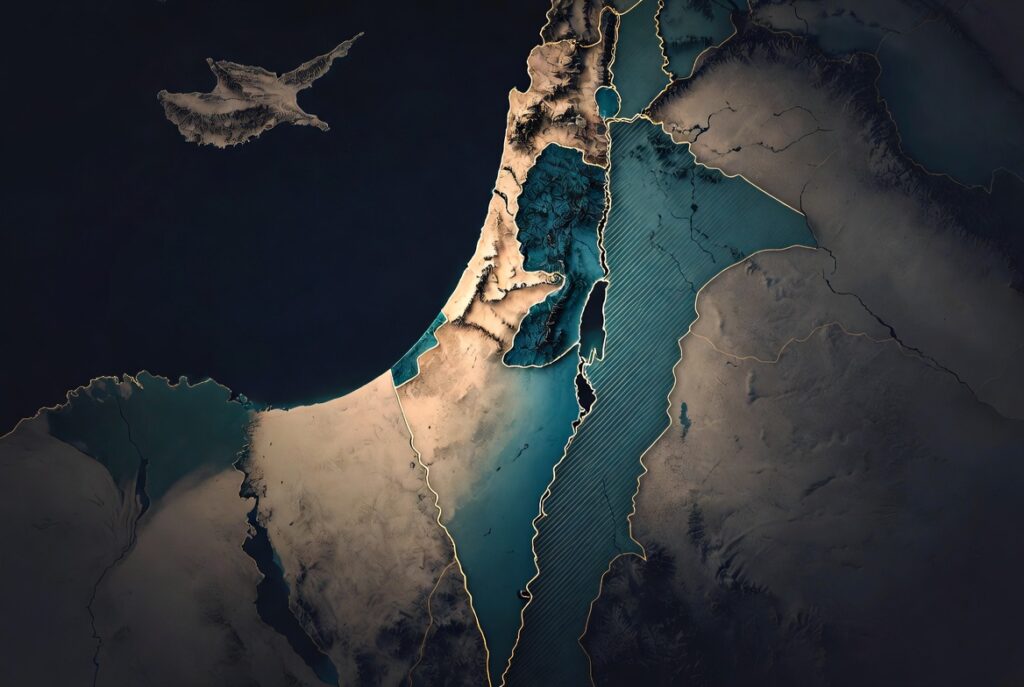
Executive Summary: Israel’s Policy Recalibration
Overview This analysis examines Israel’s fundamental departure from its decade-long management-and-containment strategy toward a posture of proactive threat prevention and territorial expansion. Driven by internal political realignments, the trauma of the October 7, 2023 attacks, and a permissive international environment, this recalibration has significantly reshaped Israel’s security doctrine, domestic social contract, and regional footprint.
Core Thematic Shifts
- Proactive Security Doctrine: Israeli military strategy has transitioned toward forestalling threats before they materialize. This is evidenced by preemptive strikes against Iran’s nuclear infrastructure and Hamas leadership, as well as the establishment of indefinite buffer zones beyond Israel’s recognized borders to hold Iran-aligned forces at a distance.
- West Bank Governance and Territorial Expansion: Sweeping administrative changes implemented in February 2026 have effectively transitioned West Bank governance from military to civilian control. By removing legal barriers to settlement expansion and dismantling transaction-permit requirements, the government has adopted an unapologetic posture toward permanent territorial control, reflecting a narrower implementation of the “Greater Israel” ideology designed to foreclose a future Palestinian state.
- Domestic and Economic Strains: Sustaining this aggressive military posture has placed unprecedented burdens on the state. A record defense budget nearing NIS 143 billion and sustained reservist call-ups have created severe structural disruptions in the civilian labor market. Simultaneously, the domestic social contract is fracturing over a Supreme Court mandate requiring the military conscription of ultra-Orthodox men, sparking violent protests and exposing deep societal divides.
- The Architecture of the Shift: The acceleration of Israel’s territorial and military ambitions is underpinned by continuous, bipartisan United States support. Through consistent military aid, intelligence sharing, and diplomatic cover at the United Nations, Washington has effectively removed external limits on Israeli action. Ultimately, Israel’s recalibration relies on the calculation that a divided international community will not impose meaningful consequences amidst broader regional disorder.
Security Doctrine
Two operations in 2025 illustrate how Israel’s military posture has changed. Between June 13 and June 24, Israeli forces carried out a campaign of roughly twelve days against Iran’s nuclear program and missile infrastructure. On September 9, they struck Hamas leadership in Doha, though the senior figures targeted survived. Both actions departed from the management-and-containment approach that had guided Israeli strategy for much of the preceding decade, replacing it with operations meant to anticipate and forestall threats before they materialized. Benny Gantz lent this reorientation a doctrinal frame in November 2025, when he set out a security proposal calling for a shift from conflict management toward proactive prevention of threats, a posture that commentators characterized as a return to a 1948 mindset. Israeli officials have since articulated a broader objective: dismantling the threats they associate with the Iranian regime and establishing buffer zones beyond Israel’s recognized borders that would hold groups such as Hezbollah and other Iran-aligned forces at a distance. The approach draws support that reaches past the governing coalition into parts of the centrist opposition, Gantz among them.
When the war with Iran concluded, Israel’s military chief signaled that operational attention would return to Gaza, where the stated aims remain the dismantling of Hamas and the recovery of hostages.
West Bank Policy
On February 8, 2026, Israel’s security cabinet approved a set of measures designed to loosen legal constraints on settlers and quicken settlement expansion across the West Bank, including the extension of Israeli civil enforcement into Areas A and B that had previously fallen under Palestinian Authority administration. The package rescinds a Jordanian-era bar on land sales to non-Arabs, declassifies West Bank land registries, removes a transaction-permit requirement, and revives a state mechanism for purchasing land. Israeli officials presented the steps as the normalization of civilian life in the territory; Finance Minister Bezalel Smotrich described their purpose more bluntly, saying the government would continue to bury the idea of a Palestinian state. Critics read the measures as movement toward the long-discussed Greater Israel vision and an effort to consolidate Israeli control over the West Bank and adjacent territories. Governments across the Arab and Muslim-majority world, joined by a number of European states, condemned the steps.
Rights groups and policy analysts who monitor the territory expect the measures to narrow Palestinian access to land and resources and to tilt the economic balance further toward Israeli settlers. Several warn that the steps risk seeding a protracted cycle of violence rather than any durable settlement. The Israeli government rejects that reading, presenting the changes as administrative rather than as a prelude to annexation.
Domestic Tensions
Israel’s Supreme Court has held that the government must end the military service exemptions long granted to ultra-Orthodox men. The court ruled unanimously in June 2024 that no legal basis existed for the exemptions, and in November 2025 it ordered the government to produce an enforcement policy that would lead to actual conscription. Segments of the ultra-Orthodox public have answered with violent protest, including a June 2026 assault on the home of a deputy Supreme Court justice and recurring clashes with police. Because the governing coalition depends on ultra-Orthodox parties for its majority, it has moved slowly to enforce the rulings. Critics across the legal and political establishment describe the resulting impasse as a strain on the rule of law.
Analysts expect the 2026 elections to turn into a referendum on the legacy of the October 7, 2023 attacks and on the terms of what Israelis call the country’s internal contract. The conscription dispute has emerged as the central flashpoint, tying the question of who bears the burden of military service to the larger argument over that social contract and the place of ultra-Orthodox exemptions within it.
International Perception
International criticism of Israel’s conduct in Gaza and the West Bank continues to mount. Those critics have pressed for action against settler violence, for the prosecution of soldiers accused of abuses, and for an end to practices they characterize as collective punishment. So far the evidence of such changes is scant.
The picture is complicated by voices within the United States. Some officials and commentators have publicly endorsed Israeli territorial ambitions, presenting them as strategically sound or otherwise acceptable, and that endorsement has worked to normalize policies that might otherwise carry greater stigma.
Israel’s diplomatic position in certain capitals rests less on its conduct in the conflict than on its standing in cybersecurity and defense technology. A number of governments treat it as a partner in those fields and hold that partnership apart from the questions raised by Gaza and the West Bank.
Economic and Military Priorities
Defense spending reached close to nine percent of gross domestic product in 2024, which by one international measure placed Israel’s military burden second only to Ukraine’s, and it has remained elevated since. The 2026 defense allocation grew through the budget process to figures reported at roughly NIS 144 billion, with the sum enacted by the Knesset standing near NIS 143 billion. Beyond direct military expenditures, the broader economy faces severe structural disruptions as reservist call-ups have drawn workers away from civilian employment. One survey found that a large share of returning reservists had lost or left their jobs, straining several sectors.
The cabinet approved closing the military radio station Galei Tsahal in December 2025, a decision the Supreme Court later suspended pending review. The defense minister justified the move as removing politically divisive content, while the attorney general and opposition figures characterized it as part of a wider effort to restrict public broadcasting and freedom of expression ahead of the elections. The episode has sharpened existing divisions over the relationship between the state and the press.
Regional Alliances
Some analysts describe a possible reorientation in which Israel would treat Iran less as its singular adversary and look instead toward Sunni powers, including Turkey and Saudi Arabia, as potential counterweights. Whether such a pivot is genuinely underway, and whether it would serve Israeli interests, remains a matter of dispute.
Greater Israel
Ideology and Current Policy
The Greater Israel concept, known in Hebrew as Eretz Yisrael HaShlema, draws on biblical claims and on the lineage of Zionist movements that includes Gush Emunim. In its maximalist expression it imagines Israeli territory reaching from the Nile to the Euphrates, a vision that has remained at the political margins. A narrower formulation, focused on retaining the West Bank, the Golan Heights, and portions of Lebanon, has fared differently. It has gained ground among Israeli political elites, particularly on the right, with Smotrich openly advocating for expanded settlement construction on land once designated for a future Palestinian state.
The February 2026 cabinet decisions carried this narrower vision toward implementation by shifting elements of West Bank governance from military toward civilian control and extending Israeli enforcement into areas previously administered by the Palestinian Authority. The United Nations coordinator for the peace process and outside analysts have described the broader trend as a gradual de facto annexation; the Israeli government rejects that term, calling the steps administrative normalization.
Territorial Expansion
In the West Bank, this ideology has taken institutional form. Through the sweeping administrative changes introduced in February 2026, governance has explicitly shifted from military to civilian ministries. Critics contend that the cumulative purpose of these maneuvers is to foreclose the possibility of a Palestinian state and bring the land between the Jordan River and the Mediterranean Sea under permanent Israeli control.
In Lebanon, Israel mounted a ground offensive into the south with the stated aim of carving out a buffer zone against Hezbollah, and it has continued to strike targets in Syria. Some analysts read these operations as efforts to reshape borders by force, and they draw the comparison to Israel’s earlier annexation of the Golan Heights.
In Gaza, Israel frames its continuing military operations as defensive. Critics situate them within a wider territorial and political project, and a number of far-right figures within Israel have invoked the Greater Israel map directly in public statements, lending weight to that reading.
Political and Military Signaling
In an August 2025 television interview, after the host presented him with an amulet said to depict a map of Greater Israel, Netanyahu affirmed that he felt connected to that vision. He has separately said that Hezbollah must be pushed back behind the Litani River, a demand he frames as a security requirement rather than a claim of sovereignty over southern Lebanon. The further step of describing the Litani as Israel’s border has come from Finance Minister Smotrich rather than from the prime minister. Some observers characterize the buffer zones established in Lebanon and the West Bank as practical instruments of the same territorial project, joining a security rationale to the holding of ground; the government maintains that they are defensive.
International Reactions
The policy shifts have drawn condemnation across much of the world, most pointedly from Arab and Muslim-majority countries and from human rights organizations. The United Nations has warned that the measures erode Palestinian self-determination and carry the risk of further regional destabilization.
The United States has long served as Israel’s principal backer, and a live debate concerns whether that support has enabled the Greater Israel project to advance. Some analysts argue that changes in American policy over the 2026 to 2028 period could prove decisive in either direction, accelerating Israel’s territorial ambitions or holding them in check.
Official Policy or Fringe Ideology
The maximalist vision remains outside the bounds of declared state policy. The narrower version has migrated toward the political mainstream, and the present government’s actions reflect a commitment to it that operates in fact if not in formal proclamation. A number of observers contend that Israel is using the instability across Gaza, Lebanon, and the confrontation with Iran to pursue territorial aims under the justification of security.
A Postural Shift
From Denial to Open Advocacy
For decades, Israeli governments steered clear of explicit talk of annexation. Settlement expansion was presented either as a security requirement or as a matter to be resolved in some future negotiation, and officials disavowed any settled intention to absorb the West Bank permanently.
That reticence has given way, perhaps in part due to Netanyahu’s open affirmation of his connection to the vision of a Greater Israel during that August 2025 television interview. The sweeping West Bank administrative changes of early 2026 were notable for their unapologetic rollout. Where earlier governments presented settlement expansion as a security requirement or a temporary matter, this cabinet advanced the same aims without that framing. The posture shifted from guarded to explicit.
Israeli leaders have likewise grown less inclined to describe military operations as strictly temporary. Government statements about buffer zones in Gaza, Lebanon, and Syria increasingly present them as positions the military intends to hold indefinitely, with the defense minister stating that forces would remain in cleared security zones in any temporary or permanent arrangement. Officials describe these as defensive belts rather than as expansions of sovereign territory, a characterization that critics dispute.
In Gaza, official statements about the impossibility of a Palestinian state point toward a long-term horizon of Israeli control that need not depend on any formal act of annexation.
Domestic Political Shift
Far-right factions, chief among them those led by Smotrich and National Security Minister Itamar Ben-Gvir, now wield substantial influence within the governing coalition. Their open advocacy for annexation and territorial expansion has carried positions once confined to the fringe into the center of coalition politics, and that migration has made it easier for Israeli leaders to speak plainly about objectives that were formerly unspeakable.
The Supreme Court’s conscription ruling, together with the backlash it provoked among ultra-nationalist groups, has contributed to the same hardening, accustoming the political culture to a more confrontational stance toward criticism from within and without.
Regional and International Context
Israel appears to be acting within a window of regional instability. The wars in Gaza and Lebanon and the confrontation with Iran have produced conditions that Israeli leaders appear to read as opportunity. The international response has lacked unity, and the United States has refrained from imposing meaningful constraints.
The urgency of Israeli decisions suggests leaders believe the window will not stay open. American political conditions could shift after 2026, and that anticipated change may account for the pace of action.
The Greater Israel concept has moved further into mainstream political and media discourse within Israel as well, as Netanyahu’s affirmation in the August 2025 interview indicated. American figures, among them Ambassador Mike Huckabee, have suggested in public statements that Israeli territorial expansion is acceptable or even desirable, remarks the U.S. embassy later said had been misconstrued.
The cabinet’s December 2025 decision to close Galei Tsahal, since suspended by the Supreme Court, drew accusations of political interference and the suppression of dissent. Critics view it as an attempt to govern the domestic narrative; the government defends it as a corrective to broadcasting it considers politically slanted.
Washington’s Role
U.S. Military Support
Throughout 2025 and 2026, the United States continued to supply military aid, share intelligence, and extend diplomatic protection, including during the war with Iran and the campaigns in Gaza and Lebanon. In March 2025 the secretary of state invoked emergency authorities to expedite roughly four billion dollars in assistance and reversed a partial hold on weapons that the previous administration had imposed. By independent tallies, American military aid since October 2023 exceeded twenty billion dollars across the two administrations. That support continued without formal conditions through the southern Lebanon offensive and the operations beyond the Litani River in 2026; the main exception was a brief and partial pause on certain weapons and intelligence under the Biden administration, which did not amount to a sustained constraint. The effect was to remove external limits on Israeli military planning and to allow operations to proceed without American opposition or conditions.
U.N. Diplomatic Cover
The United States has repeatedly exercised its Security Council veto to block resolutions critical of Israel, including several demanding a ceasefire in Gaza. By September 2025 it had cast the veto on this conflict seven times. The effect has been to shield Israel from binding action at the United Nations and to allow its military and territorial operations to proceed without multilateral consequence.
Huckabee and other American figures have publicly endorsed Israeli territorial expansion. Such statements lessen the international stigma attached to expansionist policy and signal to Israel that its actions enjoy political backing in Washington.
No Economic Pressure
Israel has not faced sanctions, reductions in aid, or sustained public rebuke from the United States over settlement expansion, military operations, or annexation-style policy in the West Bank. Critics observe that this restraint stands apart from how Washington has responded to other states subject to comparable international criticism. American policy in the region has tracked Israel’s security priorities, most visibly in the effort to counter Iran and its proxies, and the United States has not pressed Israel to halt settlement expansion or to reverse the administrative changes in the West Bank.
Rhetorical and Ideological Alignment
Some American policymakers and commentators have spoken of expansive Israeli territorial aims as compatible with American strategy, casting them as part of a shared effort to reshape the region. That framing strengthens Israel’s assessment that its conduct is not merely tolerated but supported. Critics of American press coverage further contend that mainstream outlets have scrutinized Israel’s territorial ambitions less searchingly than they have the conduct of other states in comparable circumstances, though this is a contested judgment rather than a settled finding.
The Result
Taken together, American support across the military, diplomatic, economic, and rhetorical dimensions has widened the space in which Israel pursues its aims openly. The argument advanced here is that this involves more than passive permissiveness, since the active components of American support have lifted constraints and furnished cover.
On this reading the American role is not neutral. Absent Washington’s backing, Israel’s capacity to act at the present pace and scale would likely face greater limits, though the counterfactual cannot be proven. The combination of few consequences and active support appears to have produced a reinforcing dynamic in which each Israeli advance draws continued American backing, which in turn eases the next advance.
The Architecture of the Shift
The American stance toward Israel has maintained its fundamentals across administrations. Democratic and Republican governments alike have furnished consistent military, diplomatic, and economic support even as Israeli conduct has grown more assertive. While the Trump administration has explicitly aligned itself with Israel’s hardest-line positions—publicly endorsing territorial claims and offering diplomatic cover at the United Nations—the Biden administration extended its own unbroken support during the Gaza war of 2023 and 2024, declining to impose costs for Israeli actions despite intensifying global criticism. This continuity conveyed a consistent message that the United States would not meaningfully constrain Israel’s conduct.
The current shift, therefore, does not stem principally from a change in American administration. Instead, it reflects a convergence of conditions. Domestically, the trauma of October 7, 2023, and the subsequent wars pushed Israeli public opinion toward a hawkish, security-focused posture, weakening resistance to aggressive policy as support for territorial ambitions grew. Concurrently, far-right factions occupying key government positions have normalized annexation rhetoric that once belonged to the political fringe.
These internal realignments have met a highly permissive external environment. Israel’s actions proceed on the judgment that regional disorder—spanning Gaza, Lebanon, and Iran—combined with long-standing American permissiveness, has opened a window for bold action. The ideological foundation for Greater Israel, laid over decades, is now nearing practice because Israel operates with the confidence that no major power stands ready or able to impose meaningful costs. Ultimately, this confidence stems from a fractured international community, allowing Israel’s actions to continue under the belief that neither Washington nor the broader global coalition will act to stop them.
Bibliography
Israel’s Policy Recalibration
Prepared in the Chicago notes-bibliography style (Chicago Manual of Style, 17th ed.). Entries are grouped into three tiers reflecting their evidentiary weight, and alphabetized by author or organization within each tier. Tier 1 comprises primary and official sources. Tier 2 comprises contemporaneous journalism from outlets with established editorial standards. Tier 3 comprises analytical and advocacy publications, whose directional framing is noted so that readers can weigh it.
Tier 1 — Primary and Official Sources
Albanese, Francesca. “Special Rapporteur Condemns Israeli Attempts to Further Annex West Bank.” United Nations Information System on the Question of Palestine (UNISPAL), February 18, 2026. https://www.un.org/unispal/document/special-rapporteur-condemns-israeli-attempts-to-further-annex-west-bank/.
Foundation for Defense of Democracies. “Israel 2040: Benny Gantz’s Vision for Security and Cooperation.” Event transcript, November 3, 2025. https://www.fdd.org/wp-content/uploads/2025/11/FDDEvent_Israel2040BennyGantzsVisionforSecurityandCooperation_Transcript.pdf.
Israel Defense Forces. “The Chief of the General Staff in the Gaza Strip.” IDF Press Releases: Israel at War. June 27, 2025. https://www.idf.il/en/mini-sites/idf-press-releases-israel-at-war/june-25-pr/the-chief-of-the-general-staff-in-the-gaza-strip/.
Israel Defense Forces. “IDF Press Releases: Israel at War.” Accessed June 24, 2026. https://www.idf.il/en/mini-sites/idf-press-releases-israel-at-war/.
Rubio, Marco. “Military Assistance to Israel.” U.S. Department of State, March 1, 2025. https://www.state.gov/military-assistance-to-israel.
Rubio, Marco. “Veto of the United Nations Security Council Resolution on Gaza.” U.S. Department of State, Office of the Spokesperson, June 4, 2025. https://www.state.gov/releases/office-of-the-spokesperson/2025/06/veto-of-the-united-nations-security-council-resolution-on-gaza.
Stockholm International Peace Research Institute. Trends in World Military Expenditure, 2024. SIPRI Fact Sheet, April 28, 2025. https://www.sipri.org/sites/default/files/2025-04/2504_fs_milex_2024.pdf.
United Nations Security Council. “Israel’s Actions ‘Threaten Syria’s Fragile Political Transition,’ Senior UN Officials Tell Security Council.” SC/16042. April 10, 2025. https://press.un.org/en/2025/sc16042.doc.htm.
United Nations Security Council. “Security Council Fails to Adopt Resolution on Gaza Ceasefire.” SC/16174. September 18, 2025. https://press.un.org/en/2025/sc16174.doc.htm.
United Nations Security Council. “Window for Peace in Gaza Not Indefinite, Speakers Stress, Urging Parties to Make Ceasefire Permanent, at Security Council Meeting.” SC/16299. February 18, 2026. https://press.un.org/en/2026/sc16299.doc.htm.
United Nations. “Joint Statement on Recent Israeli Decisions Extending Unlawful Israeli Control over the West Bank.” UNISPAL, February 23, 2026. https://www.un.org/unispal/document/joint-statement-on-recent-israeli-decisions-extending-unlawful-israeli-control-over-the-west-bank-non-un-document/.
United Nations News. “US Vetoes Algerian Resolution Demanding Immediate Ceasefire in Gaza.” February 20, 2024. https://news.un.org/en/story/2024/02/1146697.
United Nations News. “US Vetoes Security Council Resolution Demanding Permanent Ceasefire in Gaza.” June 4, 2025. https://news.un.org/en/story/2025/06/1164056.
UN Special Coordinator for the Middle East Peace Process. “Security Council Briefing — 18 February 2026.” UNSCO, February 18, 2026. https://unsco.unmissions.org/en/news/security-council-briefing-18-february-2026.
Tier 2 — Contemporaneous Journalism
Al Jazeera. “Arab, Islamic Countries Condemn Netanyahu’s ‘Greater Israel’ Remark.” August 16, 2025. https://www.aljazeera.com/news/2025/8/16/arab-islamic-countries-condemn-netanyahus-greater-israel-remark.
Al Jazeera. “Eight Muslim-Majority Countries Condemn Israel’s ‘Illegal’ West Bank Control Measures.” February 9, 2026. https://www.aljazeera.com/news/2026/2/9/muslim-countries-slam-israel-for-illegal-annexation-push-in-west-bank.
Al Jazeera. “Israel Carries Out Strikes Targeting Iran’s Nuclear, Military Sites.” June 13, 2025. https://www.aljazeera.com/news/2025/6/13/sounds-of-explosions-heard-in-irans-capital-tehran.
Al Jazeera. “Timeline: The Biden Administration on Gaza, in Its Own Words.” March 7, 2024. https://www.aljazeera.com/news/2024/3/7/timeline-the-biden-administration-on-gaza-in-its-own-words.
Anadolu Agency. “Israeli Army Shifts Focus to Gaza after Ceasefire with Iran.” June 24, 2025. https://www.aa.com.tr/en/middle-east/israeli-army-shifts-focus-to-gaza-after-ceasefire-with-iran/3611898.
Anagnostopoulos, Christina, Farouq Suleiman, Kylie Maclellan, Ju-min Park, Ros Russell, and Alexandra Hudson. “Israel Hit Iran’s Nuclear Sites and Killed Its Top Military Commanders. Here’s What We Know.” Reuters, June 13, 2025. https://www.reuters.com/world/middle-east/live-updates-israel-hits-iran-nuclear-facilities-missile-factories-2025-06-13/.
Bachner, Michael. “Netanyahu Says He’s on a ‘Historic and Spiritual Mission,’ Endorses ‘Vision of Greater Israel.'” Times of Israel, August 12, 2025. https://www.timesofisrael.com/liveblog_entry/netanyahu-says-hes-on-a-historic-and-spiritual-mission-endorses-vision-of-greater-israel/.
Council on Foreign Relations. “U.S. Aid to Israel in Four Charts.” Updated October 7, 2025. https://www.cfr.org/articles/us-aid-israel-four-charts.
Danan, Deborah. “As IDF Raises Reservist Call-Up Cap to 450,000, Weary Troops Decry Low Haredi Enlistment.” Times of Israel, May 30, 2025. https://www.timesofisrael.com/as-idf-raises-reservist-call-up-cap-to-450000-weary-troops-decry-low-haredi-enlistment/.
Davenport, Kelsey. “Israel and U.S. Strike Iran’s Nuclear Program.” Arms Control Today, Arms Control Association, July 11, 2025. https://www.armscontrol.org/act/2025-07/news/israel-and-us-strike-irans-nuclear-program.
Deutsche Welle. “From the Nile to the Euphrates: Inside Israel’s Expansionist Ambitions.” April 10, 2026. https://www.dw.com/en/from-the-nile-to-the-euphrates-inside-israels-expansionist-ambitions/a-76711994.
Euronews. “Arab and Islamic States Protest US Ambassador to Israel’s Remarks on Israel Land Expansion.” February 22, 2026. https://www.euronews.com/2026/02/22/arab-and-islamic-states-protest-us-ambassador-to-israels-remarks-on-israel-land-expansion.
Euronews. “Israel Begins Ground Offensive against Hezbollah in Southern Lebanon.” October 1, 2024. https://www.euronews.com/2024/10/01/idf-says-it-has-begun-a-limited-ground-operation-in-southern-lebanon.
Ford, Matt. “Israel: Netanyahu to Shut Down Respected Army Radio Station.” Deutsche Welle, December 22, 2025. https://www.dw.com/en/israel-netanyahu-to-shut-down-respected-army-radio-station/a-75272453.
Globes. “Israel Military Expenditure Up 65% in 2024.” April 28, 2025. https://en.globes.co.il/en/article-israel-military-expenditure-up-65-in-2024-1001508986.
The Guardian. “Israel Orders Evacuation of Southern Lebanon Villages as Ground Raids Begin.” October 1, 2024. https://www.theguardian.com/world/2024/oct/01/israel-order-evacuation-southern-lebanon-border-villages-incursion.
The Guardian. “Israel Strikes Hundreds of Military Targets in Syria.” December 10, 2024. https://www.theguardian.com/world/2024/dec/10/israel-strikes-hundreds-of-military-targets-in-syria.
The Guardian. “Israeli Military Deploys Fourth Division in Lebanon Ground Offensive.” October 8, 2024. https://www.theguardian.com/world/2024/oct/08/israel-lebanon-ground-offensive-hezbollah-gaza.
Jerusalem Post. “PM: Soldiers Crossed Litani River, IDF ‘Operating in Beirut, Bekaa Valley.'” May 29, 2026. https://www.jpost.com/israel-news/defense-news/article-897759.
Jerusalem Post. “Rising War Costs Push Israel’s Defense Budget Higher.” March 17, 2026. https://www.jpost.com/israel-news/article-890212.
Jerusalem Post. “Ultra-Orthodox Jews Clash with Israel Police in Riots.” January 20, 2026. https://www.jpost.com/israel-news/article-883949.
Jewish Insider. “Gantz: Iran’s Nuclear Program Still a Threat.” November 4, 2025. https://jewishinsider.com/2025/11/benny-gantz-iran-nuclear-program-foundation-for-defense-of-democracies/.
Jewish Insider. “Netanyahu Has Less Than Two Weeks to Pass a Budget.” March 19, 2026. https://jewishinsider.com/2026/03/israel-netanyahu-elections-haredi-conscription-budget/.
Jewish News Syndicate. “Israel’s High Court Rules Government Must Draft Ultra-Orthodox.” June 25, 2024. https://www.jns.org/israel-news/israels-high-court-rules-government-must-draft-ultra-orthodox.
Jewish News Syndicate. “Netanyahu Condemns Haredi Draft Dodgers over Attack on Supreme Court Justice’s Home.” June 4, 2026. https://www.jns.org/news/israel-news/netanyahu-condemns-haredi-draft-dogers-over-attack-on-supreme-court-justices-home.
Jewish News Syndicate. “Netanyahu Touts War Gains, Rebukes Critics of Gaza and Iran Campaigns.” June 24, 2026. https://www.jns.org/news/israel-news/netanyahu-touts-war-gains-rebukes-critics-of-gaza-and-iran-campaigns.
The Jerusalem Strategic Tribune. “Israel in 2026: A New Consensus on Security.” January 8, 2026. https://jstribune.com/israel-in-2026-a-new-consensus-on-security/.
Karmel, Ariela, and Sam Sokol. “Knesset Approves 2026 Budget, Israel’s Largest Ever, Sending Billions to Haredi Institutions.” Times of Israel, March 30, 2026. https://www.timesofisrael.com/knesset-approves-2026-budget-israels-largest-ever-sending-billions-to-haredi-institutions/.
Middle East Eye. “Netanyahu Says He Backs ‘Greater Israel,’ Which Includes Parts of Jordan and Egypt.” August 13, 2025. https://www.middleeasteye.net/news/netanyahu-embraces-greater-israel-vision-including-parts-jordan-and-egypt.
Middle East Eye. “US Does Not Oppose Israeli Development of West Bank Settlements, Huckabee Says.” August 18, 2025. https://www.middleeasteye.net/news/us-does-not-oppose-development-west-bank-settlements-huckabee-says.
The National. “US Ambassador Huckabee Says Israel Has ‘Biblical Right’ to Land from Euphrates to Nile.” February 20, 2026. https://www.thenationalnews.com/news/us/2026/02/20/mike-huckabee-tucker-carlson-israel/.
Newsweek. “Israeli Forces Deploy in Syria Buffer Zone for First Time in 50 Years.” December 9, 2024. https://www.newsweek.com/israeli-forces-enter-syria-first-time-50-years-1997492.
The New York Times. “Arab Leaders Condemn Remarks by U.S. Ambassador to Israel.” February 22, 2026. https://www.nytimes.com/2026/02/22/world/middleeast/huckabee-israel-tucker-carlson.html.
The New York Times. “Israel’s Ultra-Orthodox Riot against Military Draft Outside Judge’s Home.” June 4, 2026. https://www.nytimes.com/2026/06/04/world/middleeast/israel-orthodox-riot-military-draft-judge.html.
The New York Times. “A Sprawling Israeli Intelligence Effort Underpinned the Iran Strikes.” June 13, 2025. https://www.nytimes.com/2025/06/13/world/middleeast/israel-intelligence-iran-strikes.html.
PolitiFact. “Donald Trump and Joe Biden on Israel and Gaza.” June 25, 2024. https://www.politifact.com/article/2024/jun/25/joe-biden-and-donald-trump-on-israel-and-gaza-comp/.
Politico. “Biden Celebrates Cease-Fire in Gaza.” January 19, 2025. https://www.politico.com/news/2025/01/19/biden-cease-fire-gaza-00199176.
Reuters. “Israel Launches Attack on Hamas Leaders in Qatar, Blasts Heard in Doha.” September 9, 2025. https://www.reuters.com/world/middle-east/israel-launches-attack-hamas-leaders-qatar-blasts-heard-doha-2025-09-09/.
Reuters. “Israel Strikes Syria after Projectiles Fired, Holds Sharaa Responsible.” June 3, 2025. https://www.reuters.com/world/middle-east/israeli-military-says-two-projectiles-crossed-syria-towards-israel-2025-06-03/.
Reuters. “Israeli Cabinet Approves West Bank Land Registration, Palestinians Condemn De-Facto Annexation.” February 15, 2026. https://www.reuters.com/world/middle-east/israeli-cabinet-approves-west-bank-land-registration-palestinians-condemn-de-2026-02-15/.
Reuters. “Rubio Signs Declaration to Expedite Delivery of $4 Billion in Military Aid to Israel.” March 2, 2025. https://www.reuters.com/world/rubio-signs-declaration-expedite-delivery-4-billion-military-aid-israel-2025-03-02/.
Reuters. “US Briefly Withheld Some Intelligence from Israel during Biden Era.” December 12, 2025. https://www.reuters.com/world/us/us-briefly-withheld-some-intelligence-israel-during-biden-era-2025-12-12/.
Reuters. “US Vetoes UN Security Council Resolution on Gaza Ceasefire.” November 21, 2024. https://www.reuters.com/world/middle-east/us-will-veto-un-security-council-resolution-gaza-war-its-current-form-says-2024-11-20/.
Shalev, Tal. “Israeli Government Approves Controversial Closure of Army Radio after 75 Years.” CNN, December 22, 2025. https://www.cnn.com/2025/12/22/middleeast/israeli-army-radio-closure-intl.
Times of Israel. “Expansion of West Bank Rule Appears to Shift ‘Creeping Annexation’ into Higher Gear.” February 19, 2026. https://www.timesofisrael.com/expansion-of-west-bank-rule-appears-to-shift-creeping-annexation-into-higher-gear/.
Times of Israel. “IDF Chief Hails ‘Phenomenal Achievement,’ but Says ‘Campaign against Iran Is Not Over.'” June 24, 2025. https://www.timesofisrael.com/liveblog_entry/idf-chief-hails-phenomenal-achievement-but-says-campaign-against-iran-is-not-over/.
Times of Israel. “In Historic Ruling, High Court Says Government Must Begin Drafting Haredi Men into IDF.” June 25, 2024. https://www.timesofisrael.com/in-historic-ruling-high-court-says-government-must-begin-drafting-haredi-men-into-idf/.
Times of Israel. “Netanyahu Confirms Troops Crossed Litani, as Pentagon Hosts Israeli-Lebanon Security Talks.” May 29, 2026. https://www.timesofisrael.com/pm-confirms-troops-crossed-litani-as-pentagon-hosts-israeli-lebanon-security-talks/.
Times of Israel. “Supreme Court Freezes Closure of Army Radio, Says Government Must Justify Position.” February 2, 2026. https://www.timesofisrael.com/supreme-court-freezes-closure-of-army-radio-says-government-must-justify-position/.
Times of Israel. “Supreme Court President: Haredi Rampage at Justice’s Home Was ‘Attack on Rule of Law.'” June 4, 2026. https://www.timesofisrael.com/supreme-court-president-haredi-rampage-at-justices-home-was-attack-on-rule-of-law/.
Times of Israel. “Visiting Border, PM Vows to Restore Security in North ‘with or without an Agreement.'” November 3, 2024. https://www.timesofisrael.com/visiting-border-pm-vows-to-restore-security-in-north-with-or-without-an-agreement/.
The Washington Post. “Israel’s Government Wants to Pull the Plug on Its Own Military Radio.” February 21, 2026. https://www.washingtonpost.com/world/2026/02/21/israel-military-radio-galei-tzahal/.
The Washington Times (Associated Press). “Israel’s Security Cabinet Approves Measures to Strengthen Control over the West Bank.” February 8, 2026. https://www.washingtontimes.com/news/2026/feb/8/israels-security-cabinet-approves-measures-strengthen-control-west/.
Xinhua. “Israeli Military Chief Approves Continued Lebanon Offensive amid Ceasefire Collapse.” April 16, 2026. https://english.news.cn/20260416/25d2e44c481d4058acf06a8c3527b3ef/c.html.
Xinhua. “Israeli PM Orders Expansion of Lebanon ‘Buffer Zone.'” March 30, 2026. https://english.news.cn/20260330/e427635a0aa34f009574f40587082437/c.html.
Tier 3 — Analysis and Advocacy
The publications in this tier interpret events from declared standpoints. The advocacy organizations in particular employ framing language, such as annexation, ethnic cleansing, and apartheid, that the Israeli government and several Western governments dispute. The entries are retained because they document the February 2026 measures in granular detail and articulate the critical case advanced in the essay, but their orientation should be weighed rather than treated as neutral.
Amnesty International. “Erasing Anything Palestinian: Israel’s Ethnic Cleansing of West Bank Bedouin and Herding Communities.” MDE 15/1103/2026, June 10, 2026. https://www.amnesty.org/en/latest/research/2026/06/israel-west-bank-ethnic-cleansing/. (Human rights advocacy organization; framing is directional.)
Amnesty International. “Global Impunity Fueling Israel’s Unlawful Annexation Measures in the West Bank.” February 26, 2026. https://www.amnesty.org/en/latest/news/2026/02/israel-opt-global-impunity-fueling-israels-unlawful-annexation-measures-in-the-west-bank/. (Human rights advocacy organization; framing is directional.)
Bloomsbury Intelligence and Security Institute. Parashar, Trishnakhi. “Israel’s West Bank Policy Shift.” March 9, 2026. https://bisi.org.uk/reports/israels-west-bank-policy-shift. (Security and policy research institute; analytical orientation.)
Chatham House. Darkazally, Zizette. “Israel’s Accelerating De Facto Annexation of the West Bank Has Dangerous Implications.” April 17, 2026. https://www.chathamhouse.org/2026/04/israels-accelerating-de-facto-annexation-west-bank-has-dangerous-implications. (International affairs think tank; analytical orientation with policy-advocacy framing.)
Chatham House. Svetlova, Ksenia. “Israel in 2026: Elections Will Be a Referendum on the Legacy of 7 October and the Future Social Contract.” January 21, 2026. https://www.chathamhouse.org/2026/01/israel-2026-elections-will-be-referendum-legacy-7-october-and-future-social-contract. (International affairs think tank.)
Foundation for Middle East Peace. “Settlement & Annexation Report: February 13, 2026.” February 13, 2026. https://fmep.org/resource/settlement-annexation-report-february-13-2026/. (Advocates a two-state solution; settlement-monitoring framing is directional.)
Foundation for Middle East Peace. “Settlement & Annexation Report: February 27, 2026.” February 27, 2026. https://fmep.org/resource/settlement-annexation-report-february-27-2026/. (Advocates a two-state solution; settlement-monitoring framing is directional.)
Israel Democracy Institute. “Conscription of Haredi Yeshiva Students to the IDF and the Supreme Court.” January 21, 2026. https://en.idi.org.il/articles/63168. (Nonpartisan research institute; legal-policy analysis.)
Israel Policy Forum. “Israel’s New Escalation of West Bank Annexation.” February 11, 2026. https://israelpolicyforum.org/israels-new-escalation-of-west-bank-annexation-2/. (Supports a two-state solution; analysis takes directional positions on annexation.)
Israel Policy Forum. “Why Your Hair Should Be on Fire About Israel’s New West Bank Policies.” February 12, 2026. https://israelpolicyforum.org/2026/02/12/why-your-hair-should-be-on-fire-about-israels-new-west-bank-policies/. (Supports a two-state solution; commentary takes directional positions.)
Counterpoint — Official Israeli Government Rationale
Because the essay advances a pointed thesis, the following official statements are included so that the bibliography records the Israeli government’s reasoning in its own terms. The government characterizes the buffer zones as defensive, the operations against Hamas and Hezbollah as matters of national survival, and the West Bank measures as administrative normalization rather than annexation. Each of these characterizations is contested by the United Nations, the advocacy organizations cited above, and neighboring states.
Foundation for Defense of Democracies. “Netanyahu Outlines Five Goals of Counterattack on Hamas.” October 9, 2023. https://www.fdd.org/analysis/2023/10/09/netanyahu-outlines-five-goals-of-counterattack-on-hamas/.
The Epoch Times (Associated Press). “Israel Won’t Withdraw from Security Zones, Defense Minister Says.” April 16, 2025. https://www.theepochtimes.com/world/israel-wont-withdraw-from-security-zones-defense-minister-says-5842984.
Jerusalem Post. “Israel’s New Defense Strategy: Buffer Zones and Border Security.” March 2, 2025. https://www.jpost.com/israel-news/article-844337.
Netanyahu, Benjamin. “Israel Will Fight until Gaza Is Demilitarized.” Wall Street Journal, December 2023. (Print and subscription; op-ed setting out Israel’s stated war conditions.)