
Documented Damage, the Tools That Were Ignored, and Where to Look Next
Executive Summary
Parts 1 and 2 established the ecological mechanisms and the regulatory architecture that make cumulative watershed collapse nearly invisible. This final installment shows the damage is no longer hypothetical. In Paulding County, Georgia — and in watersheds like the Potomac and Morrow County, Oregon — the early signals of irreversible damage are already measurable. The scientific tools that could have prevented this — IWI, HIP, ELOHA, and IHA — were available but not used. The evidence is now in the public record. The question is no longer whether harm is occurring, but how quickly we will acknowledge it and act.
I. From Earth Day 1970 to the Etowah River
I remember sewing a bright green felt “Earth — ecology” symbol on the right thigh of my faded, tattered bell-bottomed jeans for the first Earth Day on April 22, 1970.
Fifty-six years later, I find myself pulling watershed integrity scores from a federal database that nobody in the permitting process appears to have consulted, for river systems about to absorb the largest single wave of industrial development in American history.
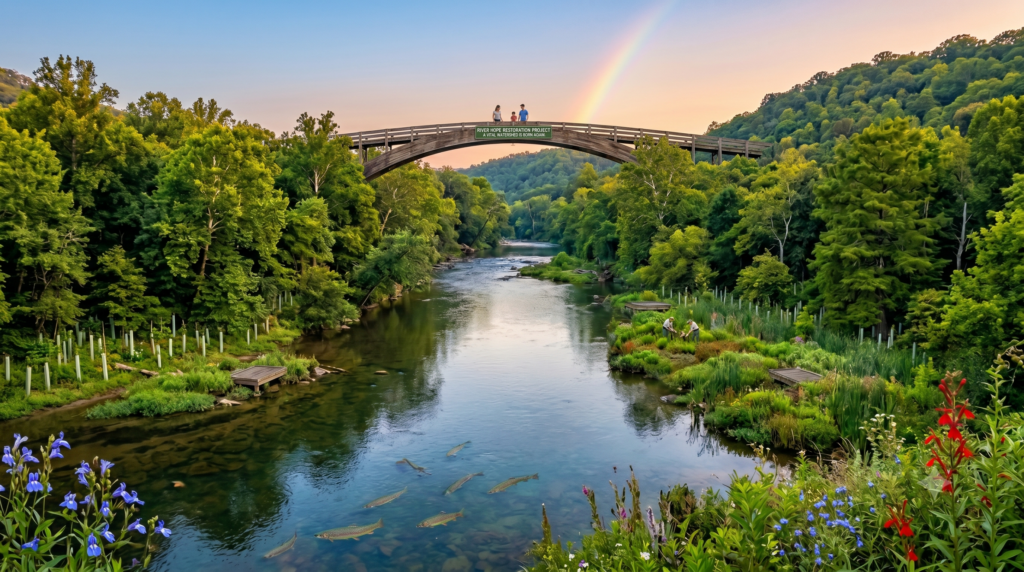
The Etowah River has been tended for millennia. Ancient Native American fish weirs still line its banks — stone structures built by people who understood, without databases, that what happens upstream determines what lives downstream. The Etowah drains one of North America’s highest freshwater biodiversity hotspots. It doesn’t know what’s coming.
II. Paulding County, Georgia: A High-Integrity Watershed on the Brink
Paulding County, northwest of Atlanta in the Etowah River watershed, offers a clear, data-rich snapshot of the rural recharge zones now in the crosshairs of data center expansion.
EPA StreamCat Analysis (324 NHDPlus catchments):
- Mean impervious cover: 4.49% (well below the 10% biological degradation threshold).
- 86.1% of catchments remain <10% impervious — currently intact.
- Critical tipping-zone catchment: COMID 6498674 (346 sq km watershed, 8.79% impervious in 2019 and rising).
IWI Sub-Component Scores (0–1 scale; higher = more intact) for the five priority catchments remain high, but the largest and most vulnerable already shows the first cracks:
| COMID | Size | Chem | Hyd | Sed | Conn | Temp | Habt | Approx. IWI |
|---|---|---|---|---|---|---|---|---|
| 6498674 | 346 km² | 0.942 | 0.979 | 0.971 | 0.973 | 0.962 | 0.965 | ~0.798 |
| Others | — | >0.944 | >0.979 | >0.971 | >0.973 | >0.966 | >0.966 | 0.81–0.87 |
Impervious Surface Trajectory (2001–2019) tells the story of accelerating pressure. COMID 6498674 gained +3.51 percentage points — the fastest rate among the priority catchments.
A single large data center campus (typically adding 1–3+ percentage points of impervious cover) would represent 5–15 years of prior development pressure applied in one stroke, with no gradual ecological adjustment period. These catchments also show baseflow index values of ~48–49%, meaning groundwater pumping directly affects streamflow during dry periods.
These are the precise conditions the Index of Watershed Integrity and companion tools were built to flag before permits are issued. They were not applied here.
III. The Pattern Is Already Visible Elsewhere
Potomac River (2026 America’s Most Endangered River): Approximately 300 data centers. Summer peak water use in Loudoun County reaches 8% of basin withdrawals. Cumulative hydrological stress has pushed the system into recognized crisis.
Morrow County, Oregon (Amazon facilities): Data centers have supercharged an existing nitrate contamination crisis in the Lower Umatilla Basin aquifer. Facilities draw and return water that mixes with agricultural wastewater, elevating nitrate levels in private wells far above safe limits. The result: documented health impacts including miscarriages, cancers, and kidney failure. Local political corruption tied to Amazon-related deals further complicated accountability.
Individual permits looked compliant. The cumulative outcome is a degraded aquifer and a public health emergency.
IV. The Tools That Were Never Used
As detailed in Part 2, mature, publicly accessible frameworks (IWI, HIP, ELOHA, and IHA) exist to detect these risks. In Paulding County they would have identified COMID 6498674 as high-risk due to its size, baseflow dependence, chemical regulation score, and proximity to the 10% impervious threshold. No such cumulative assessment was required.
V. Pointing the Hounds: Practical Next Steps
This does not require a 10-part investigation. Citizens, journalists, and local groups can act now:
- Public Records Requests — Demand full IWI/ICI scores and StreamCat exports for any county with proposed data centers. Contact EPA’s Marc Weber (weber.marc@epa.gov) for missing composite scores.
- Establish Baselines — Use USGS StreamStats + IHA software on local gauges before new facilities break ground.
- Citizen Monitoring — Well testing networks, photo documentation of stream conditions, impervious surface tracking via NLCD.
- Legal and Regulatory Pressure — Support ESA petitions (e.g., Birmingham darter), challenge water withdrawal permits, pursue RCRA notices where contamination is evident.
- Local Engagement — Organize “meetings of the minds” at county commissions and watershed boards. Demand mandatory use of the existing toolkits.
Conclusion
The data from Paulding County, the Potomac, and Morrow County, Oregon, drive the final nail. High-integrity watersheds with strong IWI sub-scores and low impervious cover are being converted into industrial sites without the cumulative assessments that basic professional standards demand.
This is not opposition to AI or data centers. It is a demand for the same level of rigorous, evidence-based planning we apply to any other major infrastructure that permanently alters geological and ecological systems.
We assessed soil bearing capacity before we poured foundations. We modeled traffic before we built highways. We can — and must — assess watershed integrity before we site the infrastructure of the AI age.
The Etowah, the Potomac, and dozens of other systems are waiting. The choice, and the responsibility, remains ours.
References
- EPA StreamCat Dataset (Paulding County exports, June 2026)
- USGS Circulars 1139 & 1186
- American Rivers 2026 Most Endangered Rivers Report
- HEATED/FERN Morrow County investigation (2025)
- Parts 1 and 2 of this series