
The United States of America’s 250th Anniversary of Independence
July 4, 2026
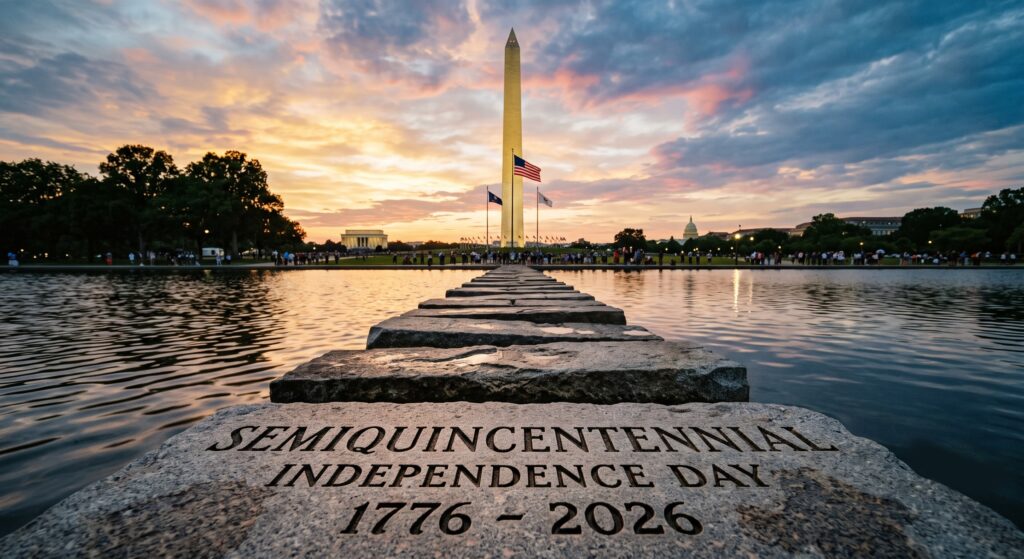
Anniversaries are like stepping stones.
This anniversary is one of those stones — not a destination, but a place to pause before taking the next step.
So, where are we? Ask a lot of different people that question, and you’ll get a lot of different answers. But for what it’s worth, here’s mine:
We pause on this day to reflect on where we’ve been and where we want to go. But just for 24 hours. Tomorrow, we’ll be right back in the gap. That space in the next step between here and there.
Are we where we want to be? I don’t think so. We are still powerful, but nothing about that power feels settled. China is rising. Alliances are under strain. Artificial intelligence is beginning to rearrange work, politics, war, and daily life faster than our institutions can comfortably absorb. The way to progress is not smooth. By choice, history, and necessity, our country walks an uneven path of eggshells and hot coals. It’s not a way for the faint of heart. But look at the founders. They didn’t begin with a secure, settled, perfectly self-governing nation — they started with a rough draft, and the generations that followed have spent 250 years arguing about how to live up to it.
At its birth, the United States was less a finished nation than a wager. The founders had brought into being a fragile experiment filled with enormous promise, unresolved contradictions, and enormous risk.
Independence came first. Stable self-government came later, and not easily.
The new nation had won a war against Britain, the most powerful empire in the world, and secured political independence. That was no small achievement. But victory did not produce order by itself. The country was deeply in debt from the Revolutionary War. Its first national government, under the Articles of Confederation, proved too weak to raise revenue effectively or hold the states together with real authority. Internal unrest, including Shays’ Rebellion, exposed just how fragile the arrangement was. Britain and Spain still threatened American interests in North America. Political divisions were sharp and often bitter. And beneath all of it sat the grotesque contradiction of slavery — legally protected, morally indefensible, and embedded deeply enough in the new republic to tear the nation apart generations later.
The Constitution did not arrive as proof that the experiment was already secure. It arrived because the experiment was in danger. It was an attempt to give the young republic enough structure to survive its own contradictions, ambitions, fears, and competing ideas of liberty.
In short, the United States was not born into stability. It was born into crisis, improvisation, argument, compromise, and hope.
Having survived those humble, ragged, and war-torn beginnings, our nation became a beacon for the outcasts and unwanted. The tired, the poor, the huddled masses yearning to breathe free, the wretched refuse of some distant teeming shore, the homeless, and the tempest-tost, have banded together and overcome many obstacles to get where we stand today. Imperfect, still often lost and wandering, we stand united in spirit and hope for that better world at the end of our path, whatever that may be, and however it may come.
We have many miles to go.
Meanwhile, we span the gap.
We reach for the stars, and accept the stripes for our shortcomings.
We strive to learn from our mistakes and make amends. But we do not cower in fear of oppressors, nor run from any worthy fight. We do not bend the knee to those who try to break us, but humbly bow in service to those we find in need.
We are Americans. Not better than others. Not exempt from history. But heirs to a dangerous promise, one that has always required more courage than self-congratulation. We know the price of failure. And for that reason, we keep stepping forward.