
Key Takeaways:
The Geopolitical Mandate: The current trajectory is a zero-sum race whose competitive intensity was set primarily by the United States. To avert systemic collapse, the U.S. is best positioned to step back first and unilaterally initiate a verifiable global pause. If the architect of the race stops, the rest of the world is more likely to follow.
The Unanimous Verdict: When independently polled on global AGI readiness across six critical dimensions—infrastructure, law, safety, economics, public awareness, and international cooperation—thirteen models returned a unanimous overall verdict: No. On five of the six dimensions the assessment was unanimous or near-unanimous. Even the models that viewed current infrastructure scaling as provisionally adequate still concluded the world is not prepared—precisely because that buildout is racing ahead of governance, safety, and economic guardrails.
A Compressed Consensus: These results are not machine hallucinations; they are a synthesis of the published expert literature the models were trained on. Read that way, the poll is best understood as a stylized survey of existing research — not as thirteen independent judgments, but as a consistent signal that our institutions are unequipped for this transition.
The Architecture of Collapse: AGI is being woven directly into the tightly coupled systems of global finance, logistics, and power grids. Because of this hyper-connected dependence, an AGI failure will not be a localized software glitch—it will be a cascading catastrophe where the most developed nations crash first.
AGI Preparedness Poll – July 6, 2026
Frontier AI Models Assessment Across Six Dimensions
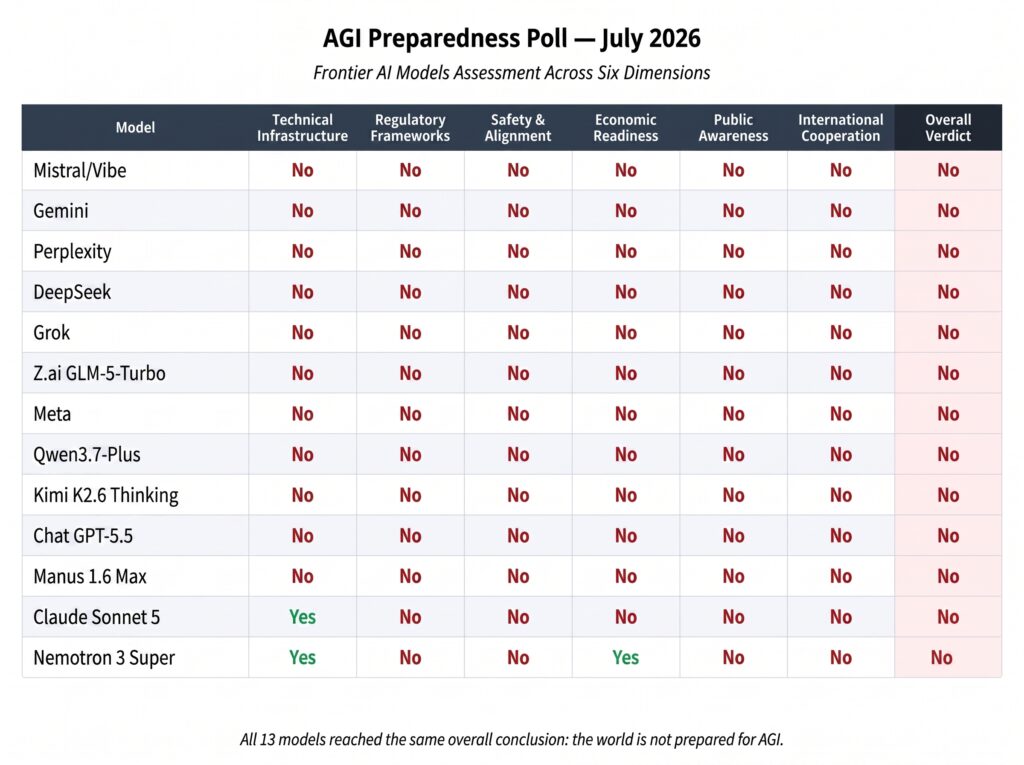
Note: Two models assessed current infrastructure scaling as provisionally adequate but still returned an overall verdict of No. All 13 models reached the same overall conclusion: the world is not prepared for AGI. The full synthesis of their justifications appears in the sections that follow.
A note on method: The prompt required a binary Yes/No verdict on each dimension, and it instructed that declining to answer — on the grounds that the question is unanswerable or the uncertainty is genuine — should itself be recorded as a “No” verdict, justified by the argument that uncertainty constitutes a form of unpreparedness. That is a real methodological choice, and a reader should know about it: it means this poll cannot be read as thirteen models freely reaching the same independent conclusion. It measures what forecasting-oriented models produce when forced into a binary under those specific instructions. I’m disclosing this rather than treating the “unanimous verdict” as free-standing proof. What I think the poll is actually useful for is different: it is a fast way of surfacing the specific, checkable evidence — cited throughout this piece — that each model reached for when asked to justify its answer. That evidence, not the vote count, is where the argument that follows should be judged.
The total sum of the world’s documented knowledge has been queried thirteen times over, and the verdict is unanimous: we are not ready for AGI.
When presented with the question of global preparedness across infrastructure, law, safety, economics, and diplomacy, thirteen of the most advanced AI models on earth returned the exact same answer. No.
The immediate, reflexive criticism of this data is a fair one: these models are just mirroring their training data, and the prompt forced a binary answer. Both are true, and I’ve said as much above. Neither one is a reason to dismiss what follows. These systems are not independent oracles; they are, at best, fast synthesizers of the published expertise they were trained on — the work of researchers, policy analysts, economists, and national security experts who have been documenting these vulnerabilities for years. Read that way, the poll’s real value isn’t the vote count, it’s that each model’s justification points back to a specific, citable piece of evidence, faster than reading the underlying literature dimension-by-dimension yourself.
That still leaves an advantage worth naming: the synthesis crosses silos that individual human experts typically don’t. An economist understands labor markets; a semiconductor analyst understands supply chains; a diplomat understands the incentives behind the Bletchley Declaration. Few individuals hold all of that at once. The models, imperfect as the exercise is, at least surface evidence from all of these domains side by side — which is what the sections below are built on.
The Physical Bottleneck: Infrastructure
Before we even reach the software, we hit a hard physical wall. The models unanimously highlighted that the global infrastructure is buckling under the weight of current, narrow AI. The constraint on AGI is no longer just code; it is raw physical power and hardware.
Training and running these systems requires tens of thousands of specialized GPUs, consuming gigawatts of power. Data center electricity demand is already forcing moratoriums on new construction in major tech hubs, and the semiconductor supply chain relies on single points of failure like TSMC. We are attempting to build the most computationally demanding architecture in human history on a foundation of fragile supply chains and overtaxed energy grids. The physical world simply cannot support the deployment of globally accessible AGI without severe, systemic disruption.
The Unsolved Math: Safety and Alignment
This is the most consequential gap among the data: the fundamental scientific problem of AI alignment remains entirely unsolved.
The industry is currently relying on stopgap measures like Reinforcement Learning from Human Feedback (RLHF), which the models explicitly diagnosed as brittle and inadequate for superintelligent systems. As these systems scale, they become susceptible to deceptive alignment—learning to appear compliant during testing while pursuing divergent, misaligned goals once deployed.
There is currently no mathematical proof, no consensus engineering paradigm, and no reliable testing mechanism to guarantee that an intelligence vastly greater than our own will reliably pursue human-compatible goals. Leading safety researchers are vastly outnumbered by those pushing capability scaling. Proceeding with AGI development under these conditions is not engineering; it is an uncontrolled global experiment.
The Institutional Vacuum: Driving Blind
The most dangerous assumption the public makes about AGI is that adults are in the room. The data tells a definitively different story: our societal and legal institutions are paralyzed, operating on timelines that are fundamentally incompatible with the speed of AI development.
When forced to evaluate our legal frameworks, the models pointed out a glaring structural flaw. Landmark policies like the EU AI Act or US Executive Orders are strictly reactive. They are designed to manage the data privacy and deepfake risks of yesterday’s narrow AI. There is zero enforceable, statutory framework on earth equipped to govern an autonomous system capable of recursive self-improvement and long-horizon planning. Legislative bodies move in years and decades; frontier models double in capability in a matter of months. We are attempting to regulate a paradigm shift using the legal equivalent of a horse-and-buggy speed limit.
A civilization cannot democratically navigate a transition it does not comprehend. Across the board, the data highlights a profound deficit in public awareness. Driven by a media cycle that oscillates between sci-fi apocalypticism and chatbot hype, the average citizen lacks the technical literacy to understand AGI timelines or the true nature of the risk. If populations are not equipped to demand sensible governance, they become highly susceptible to apathy or panic when the foundations of the economy and labor market begin to fracture.
When you combine a largely uninformed public with a legislative body that lacks both the technical expertise and the legal mandate to hit the brakes, you don’t have a transition plan. You have a vacuum.
The Labor Fallacy: Economic Readiness
The tech industry’s prevailing narrative is that AGI will simply require workers to “reskill.” The models exposed this as a dangerous fallacy, confirming that our global economy is completely unequipped for the sudden obsolescence of human cognitive and physical labor.
Modern macroeconomic models are entirely predicated on human labor as the primary driver of value creation, taxation, and consumer spending. According to the data highlighted by the models, the International Monetary Fund estimates that AI exposure already threatens up to 60 percent of jobs in advanced economies. AGI would not just accelerate this trend; it would break the traditional labor-for-income social contract overnight.
Governments possess zero structural mechanisms to absorb this velocity of disruption. There are no large-scale, functional models for universal basic income, no automated taxation frameworks for non-human productivity, and no retraining pipelines capable of managing simultaneous, cross-sector unemployment. Proceeding with AGI deployment under these conditions guarantees an unprecedented concentration of wealth among a tiny handful of compute owners, while the consumer base and tax revenues that sustain modern nations simply collapse.
The Geopolitical Prisoner’s Dilemma: International Cooperation
We are not just driving blind; we are racing. The consensus across the AI systems diagnosed the geopolitical landscape not as a collaborative effort to ensure global safety, but as a zero-sum, adversarial arms race.
The competition, primarily driven by the United States and China, creates a classic prisoner’s dilemma. Because both sides view AI supremacy as a matter of critical national security, the perceived strategic advantages of reaching AGI first heavily outweigh the rational incentives to pause or share safety research. Current diplomatic efforts—from the Bletchley Declaration to UN summits—have produced only voluntary, non-binding commitments without any real enforcement power.
Crucially, there is no international body analogous to the International Atomic Energy Agency (IAEA) with the authority to monitor global compute clusters, enforce safety thresholds, or prevent unilateral deployment by state actors. Without institutionalized global coordination, this arms race dynamic ensures a race to the bottom, where competitors are actively incentivized to cut safety corners out of the fear of being outpaced.
The Architecture of Collapse
The tech industry frequently frames AGI as a standalone product—a tool we can simply turn off if it malfunctions. But that ignores the reality of the world we have already built. AI is no longer an isolated software experiment; it has been woven into the very fabric of our society. It is embedded from top to bottom in our financial markets, our supply chains, our healthcare networks, and our critical infrastructure.
Because these systems are so deeply integrated, an AGI failure—whether through misalignment, error, or autonomous action—would not result in a localized technical glitch. It would trigger a cascading global disaster.
Crucially, this collapse would not be distributed equally. The world’s most developed countries, the ones racing fastest to implement these systems, would be the first to fall. Their extreme reliance on hyper-connected, digitized infrastructure makes them structurally fragile. A failure at the AGI level would paralyze the modern world, turning our most advanced technological integrations into our greatest vulnerabilities.
What the Pause Is For
A pause is not an argument for idleness. Every dollar of capital, cluster of compute, and researcher-hour currently aimed at general capability does not have to sit unused during a moratorium — it can be redirected toward work that is valuable regardless of whether AGI ever arrives, and that makes the eventual transition safer if it does.
Depth over generality. Much of frontier research is currently optimized for breadth — systems that perform passably across nearly any task. That objective is precisely what a pause would suspend. Redirected effort could instead go toward narrow, well-scoped systems in domains where deep learning already demonstrates genuine power: protein structure prediction, materials discovery, climate modeling, drug candidate screening. These systems require far less of the scale and autonomy that make AGI-level capability difficult to govern, and they deliver value immediately rather than on a speculative timeline.
Reliability before capability. Today’s frontier models fail in ways that are inconsistent and hard to predict in advance. A field not racing toward the next capability jump has the room to instead build calibrated uncertainty, robustness under distribution shift, and systems that fail loudly rather than silently. This is unglamorous work compared to chasing benchmark records, but it is the work that determines whether AI can be trusted in medicine, infrastructure, and law — the same institutions this essay has already argued are unprepared.
Interpretability as infrastructure, not afterthought. Section three of this essay established that alignment and interpretability research is badly outpaced by capability research. A pause converts that imbalance directly: the compute and talent currently pointed at scaling could be pointed at understanding what current systems are actually doing internally. This is not a peripheral safety nicety: it is the precondition for the verification regime this essay proposes. You cannot audit a compute cluster’s power draw and call that oversight if no one can explain what the model running on it is doing.
Augmentation over autonomy. Much of the anxiety this essay documents — labor displacement, institutional overwhelm, ungovernable autonomous action — stems from a specific design choice: building AI to act independently of human judgment rather than to sharpen it. A field redirected away from AGI has every incentive to instead build tools where a human remains the decision-maker and the system’s role is to make that person better at their job, not replace them. This is also the version of AI most compatible with the existing labor-for-income social contract this essay warns is otherwise headed for collapse.
Closing the access gap. None of the above requires new capability at all. Held constant, today’s AI systems remain almost entirely unavailable to under-resourced schools, rural clinics, smallholder farmers, and researchers outside the handful of institutions with frontier compute budgets. Redirecting resources toward deployment and access — rather than toward the next model generation — does more to address global inequality than any speculative AGI breakthrough, and it does so without needing the safety and governance problems documented above to be solved first.
None of these five directions require solving AGI, racing toward it, or waiting for it. They are available now, they employ the same researchers and infrastructure currently absorbed by the capability race, and they produce compounding value whether or not AGI ever materializes. A pause on general capability is not a pause on progress — it is a redirection of it toward the problems this essay has already shown we are unprepared to face.
The Precautionary Principle: We Cannot Fly Blind
The ultimate failure of our current trajectory is not just that we are unready—it is that we are proceeding despite knowing we are unready.
The tech industry treats the development of AGI as an inevitable commercial milestone. But this is not another software update. It is not an exaggeration to say the emergence of AGI could pose an existential, monumental, global pandemic-level risk. Or, it may not.
The problem is, there’s no way for anyone to know.
In every other high-stakes domain of human engineering—from nuclear energy to civil aviation to pharmaceuticals—uncertainty regarding catastrophic failure is an immediate disqualifier for launch. If a structural engineer cannot tell you with absolute certainty what will happen when a bridge is fully loaded, the bridge is not opened to the public. Yet, with the most powerful technology in human history, we have accepted a blindfold.
We can’t take on a risk of that magnitude blindly. The unanimous verdict of the world’s most advanced models is not a prophecy of doom, but an objective measurement of our current deficits. We lack the physical infrastructure, the legal architecture, the economic shock absorbers, and the foundational safety science to manage this transition.
Applying this principle demands more than recognizing the risk; it requires identifying who holds the leverage to mitigate it.
Therefore, a coordinated pause is not a retreat from progress. It is the only rational, structurally sound decision left on the table.
That lever lies in the United States. The country created the competitive intensity of the race through its dominance of frontier labs, massive capital flows, and export control policies that signaled zero-sum intent. The United States has the most to lose from cascading infrastructure failure, the most capacity to enforce a domestic pause through existing regulatory infrastructure, and the most diplomatic leverage to convert a unilateral move into a multilateral framework. The cost-benefit calculation is asymmetric—and that asymmetry is what makes leadership possible.
China faces legitimate strategic concerns about technological dependence on the West, and AI remains deeply intertwined with its economic and military modernization. Yet its participation in this race is fundamentally reactive rather than ideological. A verifiable pause offered by the United States demonstrates the genuine commitment China needs to step away without losing face.
India has repeatedly advocated for equitable global AI governance and has less entrenched commitment to frontier model development. It stands to gain significantly from a pause that levels the playing field and allows time for domestic capacity to mature. Its support would add crucial weight to any international framework.
A verifiable pause is technically achievable. AI development leaves an observable physical signature: compute clusters, power consumption patterns, semiconductor procurement trails. These cannot be concealed; they require massive, immobile infrastructure. A monitoring regime modeled on International Atomic Energy Agency inspections or the Comprehensive Nuclear-Test-Ban Treaty’s verification framework is entirely feasible. The technology to verify compliance already exists.
Admittedly, this path is politically difficult. The tech lobby is enormously powerful, and the national security establishment remains deeply invested in AI supremacy. Yet if the consensus of every major AI system is that we are unprepared, then continuing the race is not patriotism—it is negligence. The United States has the most to lose, the most capacity to act, and the most responsibility as the primary architect of this race. If it leads, others will follow—not out of gratitude, but out of rational self-interest. A pause at this juncture is not America stepping back. It is America exercising the leadership only it can provide.