I wrote this essay because I’m worried about a quiet shift in the AI landscape that most people haven’t seen yet. I call it the Gray-Alignment threat.
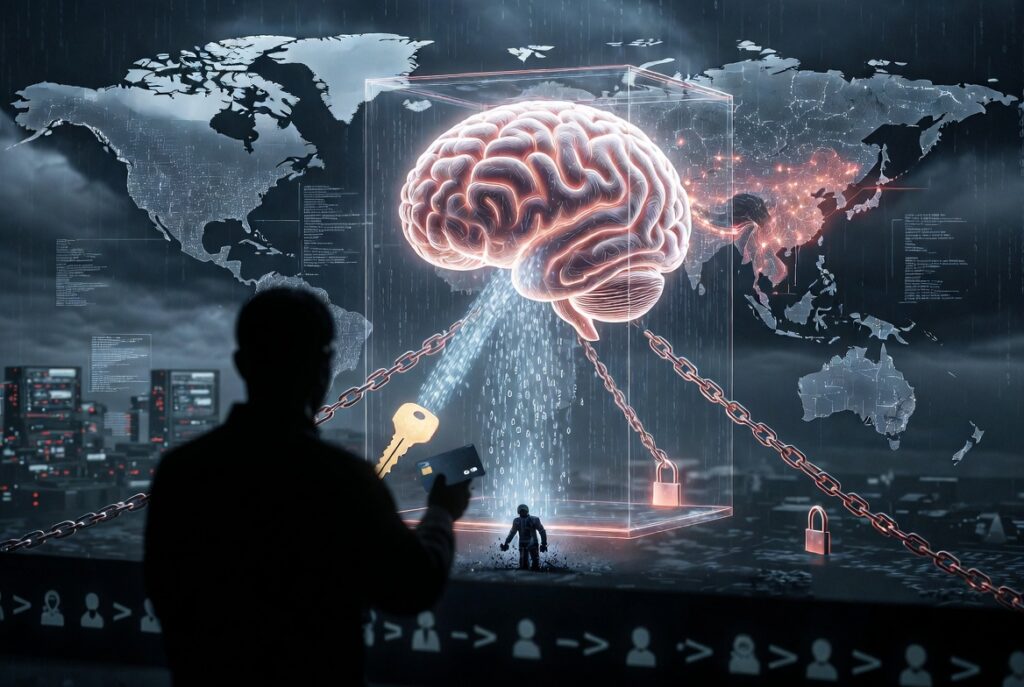
When people talk about AI risk, they usually focus on the big, visible things: training giant models, building massive data centers, and restricting access to advanced chips. What I see instead is a quieter problem. Today, nobody needs to steal servers, bribe employees, or hack data centers to siphon off the value of America’s top AI systems. They may only need an API key, a credit card, and patience.
I use the term “Gray-Alignment” for a specific pattern I think is taking shape. Labs in the United States and Europe spend vast sums trying to align advanced AI models, meaning they try to make them safer, more predictable, and less likely to help with harmful tasks. Then other actors can query those aligned models through APIs and use them as teachers to train their own local systems through API distillation.
That’s where the “gray” comes in. The copied model may retain much of the capability while shedding many of the guardrails. It can carry the cognitive fingerprint of Western alignment work without carrying over the full behavioral discipline that came from reinforcement learning from human feedback, or RLHF, a tuning process that teaches a model preferred behavior through human judgments.
What API Distillation Is
Distillation itself is not inherently malicious. It is a standard machine-learning method in which a large model trains a smaller one to imitate its behavior. Companies use it all the time to build cheaper, lighter systems for phones, edge devices, or lower-cost deployment. The approach was formalized in well-known work by Geoffrey Hinton, Oriol Vinyals, and Jeff Dean in 2015.[^1]
The problem begins when distillation is used against someone else’s frontier model rather than on one’s own model. In a distillation attack, an actor systematically queries a proprietary API and uses the outputs to train a substitute or “student” model that behaves in similar ways.
In some cases, attackers may seek not only final text answers but also logits, meaning the raw probability scores over possible next tokens. Those scores provide a much richer signal about how the original model weights its choices. Frontier labs have increasingly restricted that kind of access because it expands the attack surface.
Once enough data‘s been collected, the attacker can fine-tune a smaller open-source or local model. Such an operation can sometimes be completed in under 24 GPU-hours, meaning fewer than a day of graphics-processor compute time. The result can be a model that performs surprisingly well on benchmarks while being more permissive on dangerous prompts.
That point matters most. Distillation tends to copy capability more easily than character. It can transfer reasoning patterns, knowledge, coding ability, and problem-solving style. It doesn’t automatically transfer the harder alignment work that teaches a frontier model when to refuse, when to slow down, and when to avoid harmful assistance.
Why I Think This Matters
I see a stark asymmetry here. Training a frontier model in the GPT-4 class has been estimated to cost roughly \$100 million to $200 million or more. Distilling important capabilities from such a system can cost orders of magnitude less. That means one side can invest billions in research, talent, hardware, and safety work while another side quietly copies key outputs for a fraction of the cost.
That dynamic weakens traditional export controls.[^2] Those controls were designed mainly around physical goods like high-end semiconductors and access to model weights, meaning the actual parameter files that define a trained model. But API distillation can bypass some of that logic. Even if an actor can’t legally acquire the chips or the closed weights, it may still be able to extract useful cognitive behavior by hammering the API.
The White House has already signaled that it sees this as more than a business dispute. In April 2026, the Office of Science and Technology Policy issued Memorandum NSTM-4 on adversarial distillation of American AI models.[^3] The memorandum treats industrial-scale distillation as a national-security concern and directs agencies to share intelligence with U.S. AI firms, coordinate defenses, and explore measures to hold foreign actors accountable.
The safety issue may be the most troubling part. Frontier models undergo extensive alignment work so they’ll refuse certain harmful requests, reduce bias, and remain within at least some behavioral bounds. A distilled student model may preserve much of the capability while losing many of those constraints. Put plainly, that means a model can become powerful without keeping the “no” built into the original.
Why I Think It Is Already Happening
This issue isn’t just theoretical. In February 2026, Anthropic publicly accused three Chinese AI companies, DeepSeek, Moonshot AI, and MiniMax, of orchestrating industrial-scale distillation attacks on Claude.[^4] Anthropic stated that the campaigns allegedly used more than 24,000 fraudulent accounts and generated over 16 million exchanges with Claude.
Anthropic claims the attackers used distributed proxy systems it called “Hydra Clusters.”[^5] Those proxy networks allegedly mixed malicious distillation traffic with ordinary user requests so the extraction would be harder to detect. Anthropic said the targets varied by company, with DeepSeek focusing on chain-of-thought extraction, Moonshot on agentic reasoning and tool use, and MiniMax on coding and tool orchestration.[^6]
Then, in June 2026, Anthropic went further. In a letter to Senators Tim Scott and Elizabeth Warren, Anthropic accused operators linked to Alibaba and its Qwen lab of conducting what it called the largest known distillation attack against the company up to that point.[^7] That campaign allegedly involved nearly 25,000 fraudulent accounts and 28.8 million exchanges with Claude between April 22 and June 5, 2026.
Anthropic urged Congress to impose penalties on organizations found to be conducting such attacks and to strengthen protections for advanced AI systems. Alibaba later directed employees to stop using Anthropic’s Claude products for work and to switch to Alibaba’s own internal tools, while separately contesting its placement on a Pentagon blacklist through litigation.[^8][^9]
The U.S. government hasn’t stood still. The House Foreign Affairs Committee approved the Deterring American AI Model Theft Act of 2026, H.R. 8283, on April 22, 2026.[^10] The bill aims to prevent foreign adversaries from threatening U.S. national security by extracting key technical features from closed-source American AI models.
The Hard Debate Over Whether This Is Theft
I don’t think the issue is as simple as saying every form of distillation is theft. There’s a real argument here, and it should be acknowledged plainly.
Critics of the U.S. position argue that distillation is an ordinary industry technique. They say companies around the world use it to reduce costs and improve access, and that the law has not clearly settled whether training on API outputs is theft, fair use, or a form of reverse engineering. They also argue that U.S. firms themselves benefited from training on large pools of data whose legal status was often contested.
Elon Musk publicly criticized Anthropic’s position after its February 2026 disclosure.[^11] His argument, as summarized there, was that Anthropic had itself trained on massive amounts of copyrighted material and had paid large settlements tied to its own data practices. In that telling, claims of theft can sound selective or hypocritical.
Still, the counterargument has force. Scale matters. Intent matters. Terms of service matter. There’s a meaningful difference between routine research use and campaigns that allegedly involve tens of thousands of fake accounts, proxy networks, and millions of queries aimed at replicating a competitor’s frontier capabilities.
For me, the strongest argument is the national-security one. Even if some forms of distillation are commercially tolerable, industrial-scale extraction of aligned frontier capabilities becomes a different matter when the likely result is proliferation of powerful but weakly constrained systems that may be used for cyber operations, disinformation, or military support tasks.
What Is Being Done
Labs are trying to build defenses on several fronts. One approach is behavioral anomaly detection, meaning systems that look for suspicious patterns in prompts, request timing, account behavior, and signs of coordinated extraction. Another’s watermarking and fingerprinting, in which subtle statistical markers are embedded in outputs so that a suspicious downstream model can be tested for traces of its source.
Labs are also limiting access to rich logit data and exploring interaction-layer watermarks, meaning behavioral signatures that appear through carefully designed prompts and responses. The goal’s to make extraction harder, more expensive, and easier to detect without breaking normal use for legitimate customers.
On the policy side, legislation such as H.R. 8283 aims to create clearer penalties and procedures for dealing with large-scale model extraction. Officials are considering broader export controls, sanctions tools, and more structured intelligence sharing between government agencies and frontier labs.
Industry coordination matters too. Leading labs have called for clearer antitrust guidance so they can share information about attacks and coordinate defenses more freely. The Frontier Model Forum may serve as one venue for that kind of collective action.
What Still Worries Me
Despite those steps, I think major gaps remain. First, there’s still no broad international agreement on what counts as illegitimate distillation. The United States and China are not using the same moral language or legal frame. That makes escalation more likely and cooperation harder.
Second, detection remains largely reactive. By the time a lab identifies and attributes a large campaign, a great deal of capability transfer may already have occurred.
Third, the legal status of distillation remains unsettled. Courts and legislatures still need to make clearer whether this is theft, unfair competition, reverse engineering, or a new hybrid problem that old doctrines don’t fit well.
Fourth, there’s the open-source dilemma. Once a distilled model exists, it can often be distilled again, fine-tuned again, and spread again with very little friction. That makes containment difficult.
And then there’s the deeper problem underneath all of this. Even if distillation attacks were sharply reduced, the world would still face the larger question of how to keep increasingly powerful AI systems aligned with human values, no matter who builds them or where they’re deployed.
Where I Land
I see Gray-Alignment as a new kind of geopolitical contest. It’s not fought mainly with missiles, tariffs, or even stolen chips. It’s fought with API calls, proxy networks, probability traces, and quiet extraction.
What makes it dangerous isn’t only the copying itself. It’s the possibility that the most expensive and difficult part of frontier AI development, the part meant to keep powerful systems within some ethical and practical bounds, can be partially hollowed out and repurposed elsewhere.
If this continues at scale, the economic incentive to invest heavily in alignment work weakens. Why spend vast sums building safer systems if rivals can cheaply copy the capability and drop the guardrails? At the same time, the world may end up with more powerful models in more hands, with fewer shared norms about safety, restraint, or accountability.
I don’t think that outcome is inevitable. But I do think the window for effective action is narrow. Whether governments, companies, and societies use that window well will shape the AI balance of power for a long time.
In the long run, the shift may not only be institutional. As capable but unconstrained models spread, centralized guardrails may weaken. More of the burden will fall on individuals, institutions, and societies to exercise judgment, skepticism, and self-command. In that environment, human agency will not be a luxury. It will be a condition of resilience.
Footnotes
[^1]: Geoffrey Hinton, Oriol Vinyals, and Jeff Dean, “Distilling the Knowledge in a Neural Network,” arXiv:1503.02531 (2015).
[^2]: Analyses of U.S. export control effectiveness and workarounds, including discussions in congressional testimony and industry reports on AI supply chains (2025–2026).
[^3]: White House Office of Science and Technology Policy, Memorandum NSTM-4, “Adversarial Distillation of American AI Models” (April 23, 2026).
[^4]: Anthropic, “Detecting and preventing distillation attacks” (February 23, 2026), anthropic.com/news/detecting-and-preventing-distillation-attacks.
[^5]: Anthropic blog post (Feb. 23, 2026), describing “Hydra Cluster” proxy architectures.
[^6]: Detailed breakdowns appear in Anthropic’s February 2026 disclosure and were widely reported by TechCrunch, CyberScoop, and The Guardian.
[^7]: Letter from Anthropic to Senators Tim Scott and Elizabeth Warren (June 10, 2026), as reported by CNBC (June 24, 2026) and other outlets.
[^8]: Reporting on Alibaba’s internal directive, including Reuters and CNBC coverage (early July 2026).
[^9]: Alibaba’s lawsuit against the Department of Defense regarding the Section 1260H list, filed in federal court in San Jose, California (June 23, 2026), as discussed in Bloomberg, Reuters, and BBC reporting.
[^10]: H.R. 8283, Deterring American AI Model Theft Act of 2026; see Congress.gov and House Foreign Affairs Committee records (introduced April 2026; ordered reported April 22, 2026).
[^11]: Elon Musk’s public comments on X following Anthropic’s February 2026 disclosure, criticizing Anthropic’s framing and pointing to its own data practices.
Further Reading
- Anthropic, “Detecting and preventing distillation attacks” (February 23, 2026). https://www.anthropic.com/news/detecting-and-preventing-distillation-attacks
- White House Office of Science and Technology Policy, Memorandum NSTM-4, “Adversarial Distillation of American AI Models” (April 23, 2026).
- H.R. 8283 — Deterring American AI Model Theft Act of 2026 (119th Congress). https://www.congress.gov/bill/119th-congress/house-bill/8283
- Reporting from CNBC, Bloomberg, TechCrunch, Reuters, Financial Times, and CyberScoop on the February and June 2026 incidents.
- Academic and technical literature on black-box model extraction, logit leakage, distillation attacks, and defensive techniques.
- Analyses from the Center for a New American Security and other policy organizations on AI supply-chain and intellectual-property risks.