
Here’s what I’m wrestling with—and why it matters beyond AI policy circles:
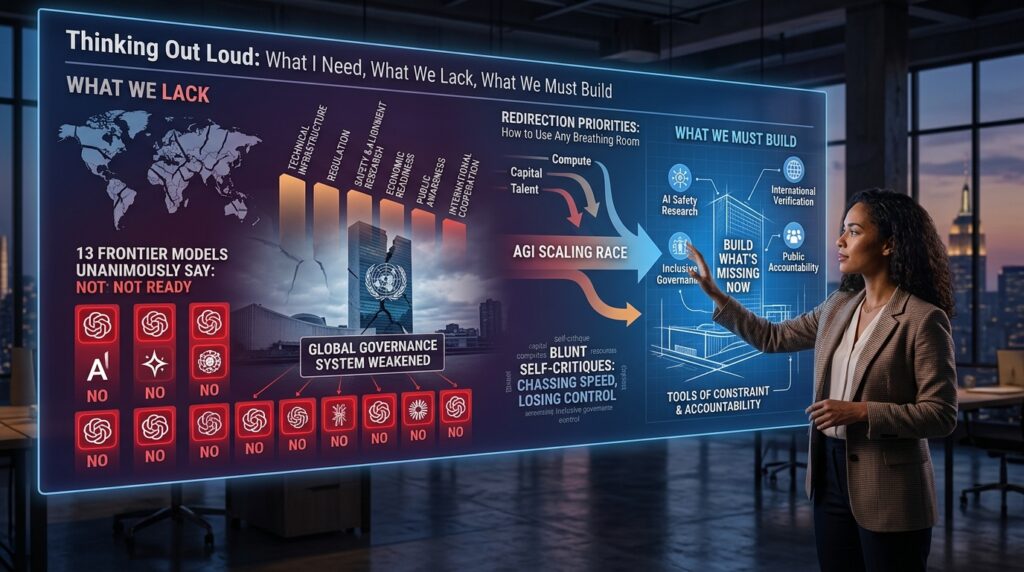
In early July 2026, I asked thirteen frontier AI models two structured questions. The first was simple: is the world prepared for artificial general intelligence (systems that could match or surpass humans across many tasks) across six dimensions—technical infrastructure, regulation, safety and alignment research, economic readiness, public awareness, and international cooperation? Every single system said no.
The second question asked what should happen to the compute, capital, and talent now aimed at scaling general capabilities if that race were paused. Their responses clustered around a few redirection priorities and some blunt self‑critiques of the current course.
One exercise maps our readiness gaps. The other asks how to use any breathing room to close them instead of just chasing speed. Both land in a world where the main international system built to manage global technological risk—the UN and the legal and cooperative framework around it—has weakened.
The UN was supposed to insert reason and constraint between great‑power capability and catastrophic outcomes. Now two of the five permanent Security Council members are leading AGI developers. The fate of systems with possible civilization‑scale effects is again being set by the most powerful actors, with limited visibility and few working levers of recourse. That is precisely the condition the UN project was meant, in principle, to prevent.
So the polls do more than say “we’re not ready.” They show what unprepared looks like at the very moment new tools of constraint and accountability are most needed—and missing. The resulting logic, as I read it, is blunt: name what we need, face what we lack, and start building what’s missing now, with or without a formal pause.
A Diagnostic That Bites
The preparedness poll I ran gave a unanimous “no,” but the concern was not evenly spread. Safety and alignment, regulation, and international cooperation stood out in the answers I received.
On safety and alignment, the models judged current practice unfit for systems that could outperform humans across many domains. Reinforcement learning from human feedback—a method that tries to shape AI behavior by rewarding or penalizing outputs after the fact—was described as brittle. Interpretability tools are still too limited to reliably catch deceptive alignment or goal drift at scale. Capability is outpacing our ability to see, verify, or constrain internal goals. Several answers said plainly that, without deeper mechanistic understanding, claims of “control” rest more on hope than demonstrated capacity.
Regulation and cooperation, in the picture I built from these responses and from the institutional record, looked no better. Laws tend to be reactive and tuned to narrow AI (systems that do one thing well like translation or image recognition). No binding global regime exists with real verification powers. National competition is fragmenting the landscape. The models contrasted this with nuclear and pandemic regimes, where inspection and enforcement at least exist, even if imperfect. By contrast, advanced AI is moving at a speed and opacity that current tools can’t match.
These points are visible in mid‑2026 when I look at the UN system. At the UN Convention on Certain Conventional Weapons, lethal autonomous weapons talks still run under consensus rules, letting any state—including major military powers—stall progress. General Assembly resolutions on military AI are non‑binding. Two of the P5 are leading AGI state actors, with private labs tied into national strategies pushing forward. In live conflicts, AI‑enabled systems have already shown how quickly human oversight can be strained. The institutions meant to sit between raw capability and irreversible outcomes are behind the curve.
Technical infrastructure, as I interpret the mixed evidence and model feedback, looks uneven. Some systems pointed to rapid “compute cluster” build‑outs by hyperscalers—large cloud providers assembling vast data centers for AI training. Others stressed fragile power grids, concentrated semiconductor supply, and brittle supply chains. Even aggressive buildout is happening under strain. In the pause discussions, existing clusters are treated less as idle assets than as fragile resources that need hardening and optimization.
Economic readiness, public awareness, and political durability appeared less often in top rankings but showed up strongly in self‑critiques from the models. They warned that focusing solely on technical safety risks ignoring labor disruption, leaving public goods invisible, and failing to build wider support for restraint. A safety effort held only inside elite technical circles will not be politically durable.
So the diagnostic that I take from this isn’t just “there are gaps.” It’s that our biggest shortfalls sit exactly where external constraint on concentrated power is weakest: scalable alignment, enforceable verification, and institutional capacity to absorb rapid change.
Turning Prescription into Construction
When I asked how to redirect resources during a hypothetical pause, most models aimed squarely at the deficits they had just flagged.
Mechanistic interpretability, scalable oversight, robustness testing, and empirical alignment work topped many lists. In plainer terms: use time and compute to open up these systems and study how they really think and behave, not just how they look from the outside. The logic was clear: a pause creates a stationary target. Existing systems can be studied without the push to ship the next version. Talent and compute redirected from marginal capability gains can support slower, instrumented work that actually probes how these systems behave.
A second cluster of suggestions focused on verifiable compute governance: hardware attestation, privacy‑preserving proof‑of‑training, anomaly detection, provenance standards, audit logs, and enforceable deployment norms. Think of this as an accountability layer around powerful chips and models—ways to prove where a system was trained, what data it used, who is running it, and whether something unusual is happening. These were framed—in a way that I strongly agree with—as core technical infrastructure, not side policy. Built with the same seriousness as frontier models, they could give any pause and any future resumption real constraints instead of symbolic ones.
Infrastructure optimization showed up as well. Instead of letting clusters sit idle under a pause, the models proposed efficiency retrofits, sustainable cooling and power, waste‑heat reuse, and tighter coupling to renewables or advanced nuclear. The clusters are sunk investments. I believe they can be hardened and rationalized instead of only expanded for racing.
Some models added bounded scientific uses in biology, materials, and climate. They saw these as ways to produce visible public value—for example, faster drug discovery or better climate modeling—and keep support for restraint from collapsing. A purely inward technical program, without clear benefits, would be politically fragile.
Their self‑critiques matter to me as much as their prescriptions. The models warned about capture by incumbents, talent mismatch between scaling engineers and alignment or domain science, physical bottlenecks that compute won’t solve, definitional drift turning “narrow science” into de facto capability advances, and “safety” work that ends up performative rather than constraining. In effect, they wrote their own risk map for the redirection plan.
Why I Think the Deficits Are Baked In
The poll results sharpen when I set them against the state of the international architecture they implicitly rely on.
The UN replaced the failed League of Nations, which hadn’t stopped aggressive great‑power behavior or kept up with new weapons. The UN Charter tried to put reason, verification, and partial constraint between raw power and catastrophic choices. Agencies developed verification models. Processes emerged for international law and norms. The aim, as I read the historical record, was to prevent the fate of humanity from resting only on the strongest actors during moments of technological or strategic rupture.
Over time, that architecture eroded. The P5 veto, meant to keep major powers inside the system, now blocks the institution from constraining those same powers when core interests are engaged. Consensus rules in bodies like the CCW slow action on lethal autonomous weapons to the pace of the least willing participant. Enforcement is thin. UN engagement with military AI has produced signals and dialogue, but no binding regime with verification authority. Two permanent members are leading AGI developers. Competitive strategies and live battlefield tests are moving faster than multilateral processes.
This isn’t just bad execution in my view. It reflects design choices, workarounds by powerful states, and slow adaptation to technologies whose speed and opacity break old assumptions. The outcome matches the poll diagnosis: no mechanisms comparable to nuclear or pandemic regimes exist for AGI‑scale risks. When the main constraint institution is weak, concentrated power again sets high‑stakes trajectories with little external accountability.
In principle, the UN—or something that can perform its core functions of reason, verification, and constraint—is still essential for the AI era. Transnational technological risks at this scale ignore borders and unilateral declarations. But in its current form, the UN can’t fill that role on the timeline that matters for frontier AI.
So for me, the task is not to pretend we can quickly restore that architecture. It is to accept its limits, work for longer‑term reform, and in parallel build missing layers of constraint and accountability through other means.
What I Need, What We Lack, What We Have to Build
When I put the polls and the institutional record together, a simple sequence falls out.
We need alignment methods that scale with capability, governance infrastructure that adds friction and accountability, and institutional capacity—both technical and political—to absorb rapid change without losing human responsibility or social stability. In everyday language: we need ways to keep very powerful AI systems pointed at the right goals, to track and audit their use, and to make sure societies can absorb their impacts without tearing apart.
We do not yet have those elements at the scale and reliability required. Safety techniques are brittle relative to frontier systems. Verification and provenance are underdeveloped. International cooperation lacks binding force and credible enforcement over the main actors driving the frontier. The multilateral architecture meant to shoulder part of that function has atrophied.
So I conclude that we have to build the missing substrate now, whether or not a formal pause ever occurs.
Mechanistic interpretability of existing systems can start immediately. Hardware attestation, provenance standards, anomaly detection, and auditable deployment pipelines can be engineered and deployed with current tools. We do not need to wait for political consensus that may not arrive on time. Bounded scientific applications with clear public value can help make restraint politically durable. Safeguards against capture and performative “safety” need to be designed in from the beginning.
This construction, as I frame it, does not depend on slowing down capability. It depends on using the agency we already have over clusters, models, and talent. Part of what now goes to scaling can be redirected to understanding and constraining what exists. The technical layers that result—verifiable, auditable, harder to quietly evade—won’t replace a strong multilateral regime, but they can partially fill the enforcement gap. They raise the cost and cut the invisibility of unaccountable behavior even while political institutions lag.
Still, I do not see technical work as a permanent substitute for institutional renewal. Verifiable infrastructure can create friction and evidence. It does not create legitimacy or broad enforcement reach on its own. Longer‑term work must include strengthening global frameworks: reforms that break paralysis on existential technological issues, new protocols or bodies with tighter verification mandates, and hybrid architectures that mix multilateral elements with faster coalitions and standards. Technical work now can supply both tools and evidence to support that renewal.
Living With Tension
What emerges for me is a disciplined tension, not a neat fix.
Capability has outrun control and societal readiness. Our largest gaps sit where external constraint on concentrated power is least effective. The most promising near‑term response, as I see it, is to build missing tools of understanding and verifiable accountability quickly and without waiting for ideal conditions.
The same answers that point toward this path warn me against treating technical redirection as enough. If we ignore the incentive structures and institutional deficits that created the imbalance, we risk recreating vulnerabilities at another layer. Capture by incumbents, definitional drift, and “safety” work that functions mainly as reputational cover remain live risks. Technical substrates must be coupled with pressure for institutional adaptation and with visible scientific and civic value that can sustain political support over time.
That tension is not, in my view, a bug in the analysis. It captures the situation. We have partial tools we can deploy now, while the institutional framework we actually need for durable stability remains incomplete.
What This Demands of Me (and Us)
Taken together, the polls I ran and the institutional record I’m looking at point toward a standard.
Understanding and accountability have to be treated as co‑equal with capability. Mechanistic insight into current models, verifiable provenance and monitoring, and bounded high‑assurance applications are practical ways, in my view, to meet that standard without claiming to have solved every philosophical puzzle about superintelligence.
They also show that technical construction alone will not fix preparedness deficits in economic transition, public comprehension, or international coordination. Frontier labs reallocating GPUs cannot redesign labor markets or build public trust by themselves. Those domains require their own policy and civic work that uses whatever breathing room technical restraint and new infrastructure create.
Read together, the polls and the institutional analysis offer more than either alone: a diagnosis of specific, measurable shortfalls plus a debate about how to allocate resources and build missing functions without recreating the conditions that made those shortfalls acute. That pairing is, to me, a modest form of preparedness—partial and provisional, but more concrete than diagnosis without prescription or prescription divorced from institutional reality.
We are in the AI era and may already be beyond the frame most of our institutions were built for. The structure of our world is not strong enough for what is now on the table. The polls show where the gaps are largest. The institutional record shows why they have become structural.
So the demand I take from this is clear: build what is missing now—verifiable understanding, auditable infrastructure, and the first layers of renewed constraint—while the capability frontier continues to move. That work does not depend on a pause. It depends on clarity about what is needed and a refusal to wait for incentives to change on their own.
The alternative, as I see it, is to let the default run: concentrated power quietly shaping global trajectories with limited external visibility or recourse. That is the condition the UN project was meant, however imperfectly, to prevent. My task now is to use the tools at hand to help build what that project has not yet delivered for this class of risk.