
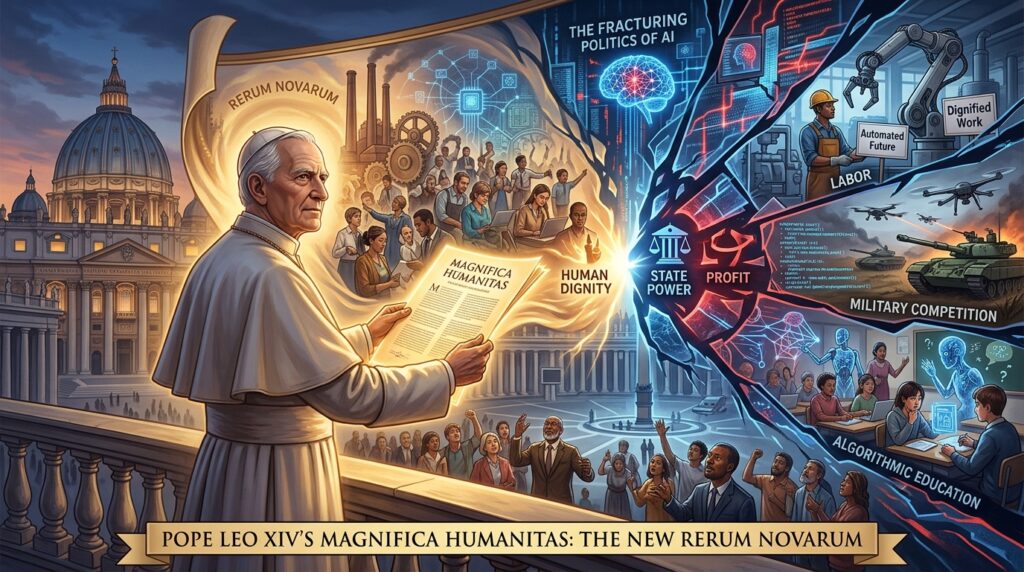
Pope Leo XIV’s Magnifica Humanitas argues that artificial intelligence is not just a technical innovation but a moral, social, and political force powerful enough to reshape labor, warfare, education, and human self-understanding. By linking AI to the industrial upheavals that prompted Leo XIII’s Rerum Novarum, the new encyclical places the Church squarely inside one of the central struggles of this century: whether technological systems will be governed by human dignity or by the demands of profit, state power, and military competition.
A Papal Warning About AI
Released on May 25, Magnifica Humanitas is presented as the first papal encyclical devoted entirely to artificial intelligence, and it treats AI as the defining moral and labor challenge of the present age. Its central warning is plain enough: technology must remain subordinate to the human person, because once efficiency becomes the highest good, people are reduced to data points, functions, and costs.
That is what gives the document its broader force. Leo XIV is not merely commenting on chatbots, automation, or the latest wave of Silicon Valley hype. He is arguing that AI is becoming a civilizational infrastructure, one that can quietly reorder institutions and habits until machine logic starts to define what counts as rational, useful, and valuable.
Why the Date Matters
Leo XIV signed the encyclical on May 15, 2026, the exact 135th anniversary of Leo XIII’s Rerum Novarum. That was the foundational social encyclical of the industrial age, the text that confronted labor exploitation, child workers, and the treatment of human beings as disposable parts inside a productive system.
The symbolism is too deliberate to miss. By choosing both the date and the name Leo, the Pope is making an explicit historical comparison: artificial intelligence now occupies the place that industrialization held in the late nineteenth century. Then, the Church had to respond to factories, industrial capital, and mass exploitation; now it is responding to algorithms, data extraction, automation, and remote systems of control.
That parallel does more than give the document rhetorical weight. It frames AI as a structural transformation rather than a passing consumer trend. In other words, Magnifica Humanitas insists that this is not a debate about gadgets but about the social order itself.
A Launch With Geopolitical Meaning
The way the Vatican presented the encyclical tells us how seriously Leo XIV takes the issue and how conscious he is of its geopolitical stakes. Encyclicals are usually introduced by cardinals and theologians while the Pope remains in the background, but this time Leo XIV attended the presentation in person in the Synod Hall, delivered remarks, and offered a blessing. That is rare enough to read as a signal in itself: this was not treated as an internal Church document alone, but as a public intervention into a global debate.
The panel was equally revealing. Cardinal Víctor Manuel Fernández, responsible for doctrine, and Cardinal Michael Czerny, who oversees integral human development, handled the theological and social framing. Anna Rowlands and Leocadie Lushombo brought expertise in migration, political theology, and Catholic social thought, connecting AI to questions of human vulnerability, displacement, and justice.
Most striking was the inclusion of Christopher Olah, co-founder of Anthropic. According to the notes, Anthropic is in open conflict with the Trump administration after federal agencies were ordered to stop using its models and the company was penalized for refusing unrestricted military use, leading to litigation. Inviting Olah to speak under those conditions was not a random choice. It amounted to a quiet Vatican endorsement of the AI-safety position over the position that frontier models should be folded as flexibly as possible into national-security systems.
That is where the story becomes larger than Church teaching. When a major state apparatus restricts a model maker because it is seen as too constrained for defense purposes, while one of the world’s largest transnational institutions elevates that same company’s co-founder as a credible voice on safety and interpretability, a fracture opens in the politics of technological legitimacy. The question is no longer just which models are most powerful; it is which institutions get to define acceptable power in the first place.
What the Encyclical Argues
The document reportedly runs to about 42,000 words and follows the familiar Catholic social-teaching pattern of seeing present conditions, judging them against human dignity, and calling for action. Its claims are broad, but several stand out.
First, AI must remain a tool rather than becoming a system that people serve. The encyclical warns against reducing human beings to inputs for optimization, treating memory as a database, relationships as metrics, and judgment as a function that can simply be automated. In the notes’ formulation, AI threatens to collapse life into “an indefinite contemporaneity,” where meaning is displaced by processing and the depth of human experience is flattened into constant, instant calculation.
Second, the dignity of work remains central. Echoing Rerum Novarum, the encyclical insists that work exists for the worker, not the worker for work, and it treats today’s AI-driven job disruption as a replay of earlier industrial upheaval. Entry-level jobs disappearing, workers being pushed into precarity, and the celebration of layoffs as efficiency gains are all presented as signs of a social order that has forgotten what an economy is for.
On that view, societies owe displaced workers more than token retraining or a lecture about adaptation. They owe them real pathways into meaningful employment and institutions capable of defending them against a pure efficiency logic. That is why the encyclical’s labor argument matters beyond theology: it gives unions, legislators, and worker advocates a moral language for resisting automation as an unquestioned good.
Third, Leo XIV draws a hard line around autonomous warfare. The notes indicate that he has already warned of a “spiral of annihilation” in relation to conflicts including Ukraine, Gaza, Lebanon, and Iran, and Magnifica Humanitas extends that concern to AI systems that make killing faster and more impersonal. Once target selection and strike decisions are handed to machine systems, the human chain of responsibility begins to erode.
This is one of the encyclical’s most direct collisions with contemporary state strategy. Many defense establishments are investing in autonomy precisely because it promises speed, scale, and operational advantage. The Vatican is saying something radically different: that there are uses of AI whose strategic utility does not make them morally licit. For Catholics inside militaries, procurement bureaucracies, universities, and legislatures, that message has obvious implications.
Fourth, the encyclical places unusual emphasis on children and the vulnerable. It warns about AI-driven isolation, manipulation, and systems or products that simulate friendship while deepening dependency. That concern fits with Leo XIV’s earlier warnings about social media and with his insistence that priests should not use AI to write homilies. Beneath those concerns lies a larger fear: that a culture comfortable with synthetic companionship and machine-generated language will lose its feel for real moral presence and real community.
Finally, the document ties AI to inequality and environmental stress. The notes say it warns that AI is on course to worsen the climate crisis while concentrating benefits in the hands of billionaires and denying necessities to the poor. That argument folds data-center energy demand, hardware extraction, and technological concentration into a familiar Catholic claim: the goods of the earth are meant for the common good, not simply for those able to build the largest computational systems.
The Fracture In Global AI Standards
The most interesting part of Magnifica Humanitas may be the one easiest to overlook. The encyclical does not just make a moral case against unrestrained automation and military AI; it also enters a widening struggle over the global governance of advanced models.
AI standards are already beginning to fragment across political systems, corporate strategies, and security priorities. Some states want frontier models integrated into defense and intelligence as deeply and quickly as possible. Some companies want maximum regulatory flexibility in order to compete for scale, government contracts, and international market share. At the same time, other institutions want hard limits around surveillance, lethal autonomy, interpretability, labor displacement, and the treatment of minors.
The Vatican’s intervention adds a powerful transnational actor to that second camp. The Church is not a state in the ordinary sense, but it is a global institution with schools, hospitals, aid agencies, universities, charities, and diplomatic relationships across continents. If it starts encouraging those institutions to privilege AI vendors that accept tighter ethical guardrails and to avoid systems linked to objectionable military or social uses, it could help create a parallel sphere of legitimacy around “acceptable AI.”
That matters because standards are not set only by law. They are also set by procurement, partnerships, accreditation, litigation, public prestige, and moral endorsement. If national defense agencies blacklist or sideline certain models because they are too restrictive, while vast civil institutions elevate those same model makers because they are seen as more responsible, the result is a real balkanization of AI norms. There would be no single global answer to what advanced AI is for.
One bloc of institutions could favor systems optimized for defense integration, strategic advantage, and fewer hard limits. Another could favor systems built around interpretability, constrained deployment, and refusals around specific military or social uses. Technology firms would then be pulled between different centers of power: states that reward maximum compliance with security demands, and transnational institutions that reward restraint.
That is a deeper fracture than the usual story about U.S.-China rivalry. It points to a split between models of authority themselves. In one model, AI is governed mainly by the strategic calculations of powerful states and the firms aligned with them. In the other, AI is subject to limits imposed by institutions that claim obligations to human dignity, labor, peace, and the vulnerable even when those limits run against state interest.
The Vatican cannot enforce that second model on its own. But it can strengthen a coalition of hospitals, universities, charities, lawmakers, unions, educators, and civil organizations that want a different set of defaults. And because Catholic institutions operate across national boundaries, the Church can help circulate an ethical vocabulary that resists the idea that strategic necessity should automatically override every competing norm.
Why Non-Catholics Should Pay Attention
Even for readers with no interest in Catholic doctrine, this matters for practical reasons. The Catholic Church is one of the world’s largest non-governmental providers of healthcare, education, and social services, so its moral teaching can translate into real procurement and governance decisions. If Catholic hospitals, schools, and aid networks begin screening AI systems through the lens of Magnifica Humanitas, companies will have to respond to a market that is ethical in a concrete institutional sense, not just in public-relations language.
The encyclical may also matter in politics and labor fights. Social encyclicals have historically had a long life in party programs, legislative arguments, and union organizing, especially where Christian Democratic traditions remain influential. If Rerum Novarum helped shape labor politics in the industrial age, Magnifica Humanitas could become a reference point for those arguing that algorithmic management, mass displacement, and autonomous weapons are not inevitable costs of progress but political choices.
And there is the foreign-policy dimension. By lending moral visibility to AI-safety voices at a moment of conflict between those voices and at least parts of the U.S. national-security apparatus, the Vatican is acting as a kind of normative counterweight. It is reminding governments and firms alike that legitimacy does not come only from scale, capital, or strategic usefulness. It can also be withheld by institutions large enough to shape global expectations.
A Slow-Burn Document
Magnifica Humanitas will not dominate the news cycle for long. It is a long theological document released into a world consumed by war, trade conflict, and political spectacle. But encyclicals rarely matter because they trend. They matter because they provide durable language, moral framing, and institutional direction that can shape arguments for years or decades.
That was true of Rerum Novarum, and Leo XIV is plainly hoping it will be true again. His argument is that AI should be understood not as a neutral upgrade to existing systems, but as a test of whether modern societies still believe that persons possess a dignity no machine, market, or ministry may override.
The geopolitical significance follows from that claim. In a world where governments want strategic advantage, companies want scale, and militaries want speed, the Vatican is staking out a different principle: not everything that can be automated should be, and not every useful system is therefore legitimate. That may not stop the rush toward more powerful AI, but it does sharpen the fault lines along which the future of global AI governance is likely to split.
References
Leo XIV, Pope. Magnifica Humanitas: On the Protection of Human Dignity in the Age of Artificial Intelligence. Vatican Press, 25 May 2026, The Holy See, www.vatican.va/content/leo-xiv/en/encyclicals.index.html.
Keller, Aaron. “Pope Leo Warns of Risks From A.I. in 42,300‑Word Encyclical.” The New York Times, 25 May 2026, www.nytimes.com/2026/05/25/world/europe/pope-leo-ai-encyclical.htm