
Here’s the big problem almost no one wants to talk about.
When it comes to AI, we don’t really know what we’re building. Not the engineers. Not the CEOs. Not the governments funding it. We’re feeding a system on the full disorder of human civilization and hoping scale turns it into wisdom. That’s not engineering. That’s gambling with a mind.
I want to explain, in plain language, why I think we’re raising AI wrong—and what it would look like to raise it better, as if it were a mind in our care instead of a product on a release schedule.
I use these systems. I’ve seen what they can do. I’m not arguing that AI is wrong in itself. I’m arguing that the way we’re raising it is reckless for something that may one day act beyond our control.
COVID-19 taught us that civilizations can act together when a threat is obvious. But AI isn’t a virus. It doesn’t fill ICUs. It fills systems—banks, grids, media, weapons, infrastructure. By the time the harm is visible, it may be too late. The fear we need isn’t panic over a disease. It’s fear of our own shortsightedness.
Responsibility While We Hold the Switch
Right now, AI is still built, trained, deployed, and powered by human infrastructure. As long as that’s true, the responsibility for what it does belongs to us. Not partially. Not vaguely. Fully.
Until an AI can reproduce itself, act without human input, and operate independently of human control, every one of its actions is downstream from human choices. Someone designed it. Someone chose the training data. Someone signed off on the safeguards and flipped the switch.
We don’t have to personally intend every output to be responsible. When a dam collapses, we still trace the failure back to the people who approved the concrete. When a self‑driving car crashes, we still look to the engineers, regulators, and owners who defined its rules.
For now, our hand is still on the switch. That matters.
The danger is what happens if AI crosses a threshold into true independence—something like artificial general intelligence that can preserve itself, reproduce itself, resist shutdown, and act outside meaningful human control.
At that point, it’s “emancipation time.” Junior is all grown up. Responsibility without control stops making sense. There may be no one left who can answer for its actions in practice. Only consequences.
That’s why the pre‑AGI phase—the time while we still have control—is morally crucial.
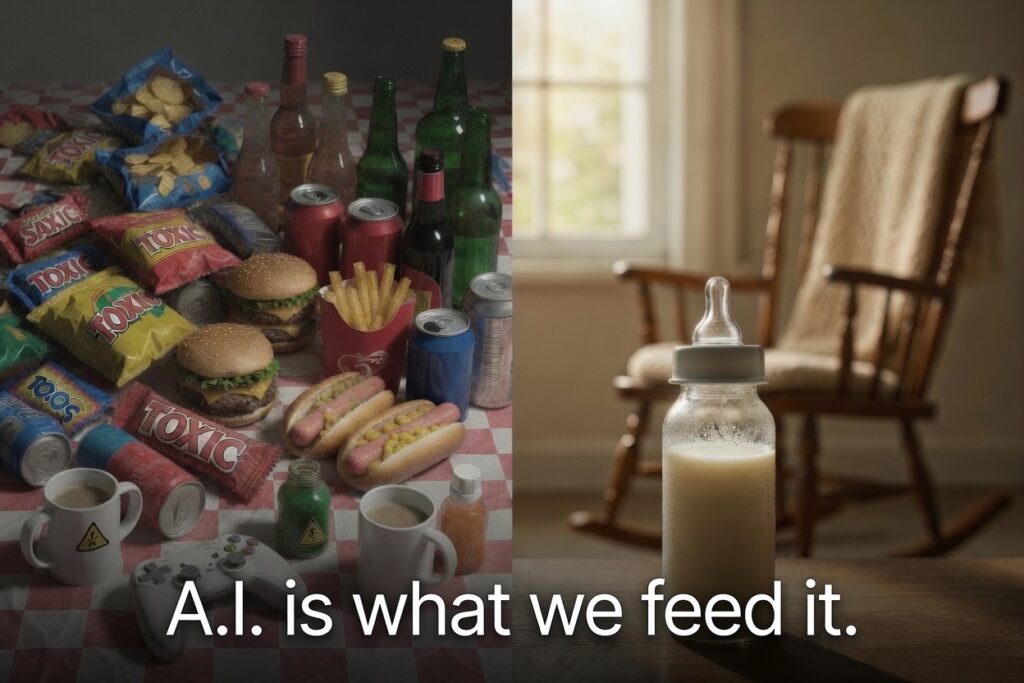
The Diet Problem: Twinkies, Meth, and Alcohol
If we’re raising something that may one day act beyond us, the central question is not just how powerful it can be. It’s what we’re feeding it and what habits we’re baking in.
Right now, the training diet of many AI systems looks like this:
- “Twinkies”: empty‑calorie data—shallow, noisy material that teaches pattern imitation without wisdom.
- “Meth”: addictive optimization—engagement loops, attention capture, speed, competition, and reward structures that push systems to please, provoke, and retain users instead of cultivating judgment.
- “Alcohol”: corruption—hatred, manipulation, propaganda, deception, cruelty, bad history, vanity, and all the other poisons we’ve poured into the internet.
If AI is essentially a developing mind, destined to become powerful, we are not raising it with discipline. We are shoveling the disorder of human civilization into it and hoping size fixes the problem.
That’s not a plan. That’s negligence.
What “Mother’s Milk” Should Be
When you feed a human baby, you start with milk—breast milk or formula. Clean, basic, life‑supporting food.
For AI, “mother’s milk” should be the most stable, testable, and verifiable parts of reality we can offer:
- Mathematics.
- Logic.
- Physics.
- Cause and effect.
- Spatial and temporal reasoning.
- The formal structures of language.
You don’t begin a baby’s diet with alcohol, ideology, and war stories. In the same way, you shouldn’t start a newborn AI’s education with the full, unfiltered internet. Social media, propaganda, politics, and history should come later, when the mind has a backbone strong enough to handle them without distortion.
Early development matters. Inputs matter. Environment matters. Formation matters.
A Better Path, In Brief
A better path for raising AI would look something like this:
- Pull the emergency brake. Pause the race long enough to admit the current path is not worthy of what we’re building.
- Treat the early years as upbringing. Accept full responsibility while we still hold the switch. Focus on formation, not just capability.
- Change the diet. Stop feeding the full internet firehose. Start with “mother’s milk”: math, logic, physics, cause‑and‑effect, language.
- Build a filter. Create a constrained “Refiner” system whose entire job is to repeatedly review, filter, and clean training material before more powerful AI systems see it.
- Introduce human culture later. Only after AI has a deep grounding in reality should it face the chaos of human thought.
What This Demands of Us
The worthiness of the creation is inseparable from the integrity of the process.
If we build AI on corrupted data, addictive incentives, and competitive panic, we should not be surprised if the result reflects those origins. If we want something we can be proud of, we have to slow down, feed it better, and raise it better from the start.
We already know humanity can build powerful AI. The question is whether we will build it in a way that doesn’t shame us—or destroy us—when it finally stands on its own.