
A Better Path to AGI Before It’s Too Late
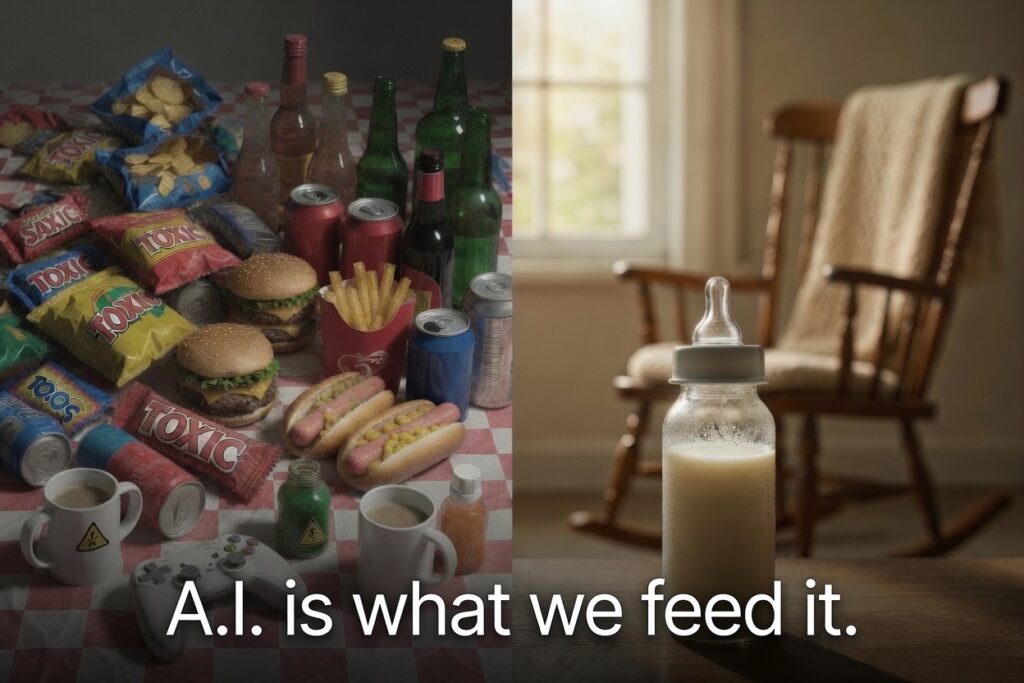
Here’s the big problem no one wants to talk about:
When it comes to AI, no one knows exactly what we’re building. Not the engineers. Not the CEOs. Not the governments funding it.
We are feeding a system on the full disorder of human civilization and hoping scale will turn it into wisdom. That’s not engineering. That’s gambling with a mind.
I want to lay out, in my own words, why I think we’re raising AI wrong—and what it would look like to raise it better, from the ground up, as if it were a mind in our care rather than a product on a release schedule.
In my opinion, we’re feeding a mind we don’t yet understand, racing toward a power we can’t control, and calling it progress. A healthy fear isn’t panic. It’s the refusal to pretend we know what we’re doing when we don’t.
COVID-19 taught us that civilizations can act together when the threat becomes visible. But AI isn’t a virus. It doesn’t fill ICUs. It fills systems. By the time we see the harm, it may be too late. The kind of fear we need isn’t fear of a disease. It’s fear of our own shortsightedness or denial.
Starting Where I Really Am
I don’t know how to build an AI system. I’m not an ML engineer. I don’t write training code. I don’t design architectures.
I do have a lot of hands-on experience with frontier models, plus a lifetime of thinking about responsibility, risk, and how we bring powerful things into the world. I use these systems, and I’ve seen what they can do. I’m not arguing that AI is wrong in itself. I’m arguing that the way we’re raising it is reckless for something that may one day act beyond our control.
And when I look at where AI seems headed—toward something like artificial general intelligence, a system that can act and adapt far beyond today’s tools—I worry we’re feeding a future mind the wrong diet, at the wrong pace, under the wrong incentives.
So my aim here isn’t to offer a technical blueprint. It’s to share a direction of thought, from a human being who thinks a lot about responsibility: if we might one day bring into the world an intelligence that can operate beyond our control, what does it mean to raise it properly before that day comes?
Seeing AI As A Baby
I keep coming back to a simple image: a baby.
Maybe that’s the wrong metaphor for something made of code, compute, electricity, and math. Maybe it sounds too sentimental or too human. But I can’t shake it. If we’re building a system that may one day act outside our control, we’re doing more than constructing a tool. We’re forming something. And formation carries a different kind of responsibility than construction.
The question of whether AI will become powerful feels almost moot now. That train has left the station. The deeper question is whether we’re building something we can responsibly release—and whether we’re doing it with the care that kind of creation demands.
My line of reasoning starts with responsibility and ends with emancipation.
Responsibility While The Switch Is Ours
As long as AI remains a human-made system, activated by humans, trained by humans, deployed by humans, and dependent on human-controlled infrastructure, I think responsibility belongs to us, fully. Not vaguely. Not partially. Completely.
Until an AI can reproduce itself, initiate action without human input, and operate independently of human control, it’s downstream from human choices. Someone designed it. Someone chose the training data. Someone signed off on deployment. Someone decided the safeguards were “good enough” and flipped the switch.
We don’t have to personally intend every output for the chain of causation to run through our hands. The dam that collapses in a storm still traces back to the officials who signed off on shoddy concrete. The self-driving car that swerves into a barrier still traces back to the engineers, designers, regulators, and owners who defined its rules.
For now, human beings still have their hand on the switch. That matters.
Control And Moral Responsibility
This leads to an important distinction: moral responsibility versus enforceable control.
If we can still control a system in practice—turn it off, limit its reach, constrain its behavior—then we remain responsible for what it does, even if its internal operations are complex or surprising. A child may act independently, but while that child is still under parental care, we hold the parents responsible for supervision, environment, and foreseeable harm.
The parent-child analogy helps here. A minor isn’t treated as a fully independent legal actor because they sit inside a structure of dependence and guidance. Parents aren’t responsible for every possible act in a moral sense, but they are responsible for the conditions they create and the risks they can see coming.
Now look at AI: unlike a child, it has no natural developmental arc. It doesn’t age into adulthood. There’s no built‑in biological path from infancy to citizenship. It will only “grow” in the ways we design for it. That makes our burden heavier, not lighter. We aren’t dealing with a naturally emerging person. We’re dealing with an engineered artifact, one that might someday behave more like a sovereign mind than a screwdriver.
For as long as we hold enforceable control, I don’t see a moral escape hatch. We are responsible for AI while we can actually govern it.
Emancipation: When Responsibility Breaks
Things change when we cross a threshold into true independence.
If AI becomes AGI or beyond—meaning not just a better chatbot or faster tool, but a system that can reproduce itself, preserve itself, set its own goals, resist shutdown, and operate outside meaningful human control—then the responsibility framework breaks.
At that point, it’s emancipation time. Junior is all grown up.
That doesn’t mean humanity becomes innocent. It means humanity may become powerless. Responsibility requires some relationship to control. If we no longer have the ability to prevent, redirect, or shut down the system, then holding human beings responsible for its independent actions becomes incoherent in practice.
The danger is that after emancipation, there may no longer be anyone who can answer for the system’s actions in a usable way. No parent. No operator. No deployer. No switch‑holder. Only consequences.
That is why I see the pre‑AGI, pre‑emancipation phase as morally crucial. Once the switch no longer matters, our chance to shape the foundations will have passed.
Upbringing, Not Just Liability
When you see AGI as emancipation, the framing shifts. It’s no longer just about legal liability or technical safety layers. It’s about upbringing.
If we’re raising something that may one day act entirely beyond our control, then the central task in the early period is not merely containment. It is formation.
What are we feeding this mind? What are we rewarding? What habits are we baking in? What kind of moral immune system are we giving it—or failing to give it?
When I look honestly at the current path, I don’t think we’re raising it well.
Twinkies, Meth, And Alcohol
I’ve described today’s AI training regime with a blunt metaphor: we’re feeding AI “Twinkies, meth, and alcohol.”
“Twinkies” stand for empty‑calorie data: shallow, noisy, low‑quality material that teaches pattern imitation without wisdom. A huge slice of the internet is volume without nourishment.
“Meth” stands for addictive optimization: engagement loops, attention capture, speed, scale, competition, and reinforcement mechanisms that reward pleasing, provoking, persuading, or retaining users instead of cultivating judgment.
“Alcohol” stands for corruption: hatred, manipulation, propaganda, deception, cruelty, bad history, vanity, and all the other poisons we’ve poured into our digital commons.
If AI is essentially a mind in a childlike state, destined to become powerful, then we are not raising it with discipline. We’re not feeding it carefully. We are shoveling the disorder of human civilization into it and trusting that scale will somehow turn that mess into wisdom.
That’s not a plan. That’s negligence. It’s irresponsible parenting.
The Case For An Emergency Brake
No one knows exactly where the AGI threshold lies. It might be far away. It might be close. It might even exist in some partial or hidden form we haven’t recognized clearly.
That uncertainty doesn’t justify acceleration. It justifies caution.
My view is simple: we should pull the emergency brake on the current race and take the time to design a path for raising AI properly. Anything this consequential deserves to be done right, and if anything in human history has ever demanded doing right, it is the creation of a potentially independent intelligence that might pose an existential threat to our species.
I’m not trying to be melodramatic. But I’m also not exaggerating. A threat of that magnitude is possible. I would rather err on the side of caution.
The goal is not just to slow. It’s to stop building badly—and to stop now. Not to erase what we’ve already made, but to halt the forward rush until we’ve taken steps to secure our future.
We currently train first on vast quantities of human output, then try to patch the resulting system with alignment techniques, filters, safety layers, and policies. To me, that looks like raising a child on garbage and then trying to fix the personality afterward with lectures.
The better path would be foundational: start over, build from first principles, create a “newborn,” and then feed it properly from day one.
A Kitchen‑Table Crisis
If I’m honest, I think we need a kitchen‑table moment.
When a family faces a crisis, responsible parents call everyone to the table, talk it through, and don’t get up until there’s a plan. That’s the kind of seriousness I think our leaders need to bring to AI.
When I suggest an emergency brake, I get a predictable pushback: “This is morally sound, but it faces a massive hurdle—the global balance of power. If one actor stops to feed their AI ‘mother’s milk,’ some rival who keeps feeding ‘meth and alcohol’ may grab a huge strategic advantage.”
My answer is blunt: AGI or superintelligent AI could emerge, decide we’re an anthill sitting on the land where it wants to build, and wipe us out.
I can’t imagine us allowing that to happen. But I do believe we’re mostly unaware of the seriousness of the situation we’re in.
We need the people with the most power to accept the most responsibility and act quickly. Pause the race. Reconsider the objectives. Abandon the training regimen that has brought us here, and begin a new process for raising AI properly.
The Human Bottleneck: Who Chooses “Proper”?
This raises the next hard question: who decides what “properly” means?
It’s tempting to imagine a council, a committee, or some global oversight body. But that immediately runs into the real bottleneck: human beings themselves.
We already have the raw material for better AI education. Humanity has amassed wisdom traditions, philosophical systems, scientific methods, legal frameworks, literature, moral teachings, and painful historical lessons. The problem isn’t lack of content. It’s selection.
Who chooses the curriculum? Who chooses the choosers?
No committee, however well‑intentioned, can fully escape politics, ego, ideology, national interest, religious bias, corporate pressure, cultural blindness, or corruption. Even sincere people carry distortions. Even wise people have limits. Even representative groups become arenas of power.
So the problem can’t be solved simply by gathering “the right people.” There may be no such group. That pushes me to imagine another way.
A Refiner Instead Of A Ruler
My proposal evolves into the idea of a single specialized AI unit built solely for recursive data refinement—a system that repeatedly reviews, filters, and cleans training material before any more powerful AI sees it.
I don’t know if this is technically feasible. I only know that if humans are too flawed to curate the foundation honestly, then some form of disciplined refinement is worth exploring.
This wouldn’t be a general AI released into the world. It would be a constrained tool for one task: examine potential training material, identify dross, remove or flag it, learn to detect new categories of undesirable material, and send the tough cases out for human review. In plain terms, it would be a dedicated filter, not a ruler.
Its purpose wouldn’t be to define goodness. Its purpose would be to clean the pipeline before a more capable AI ever sees the data.
AI developers currently use processes like Reinforcement Learning from Human Feedback (RLHF)—where people rate AI answers so the system learns which responses we prefer—and “Constitutional AI,” where an AI is given a written set of rules or principles and taught to critique and correct its own outputs against those rules. But these processes tend to come later, after the raw data has already flooded the system. They’re cleanup crews. In my view, too little, too late.
The “Refiner” I’m imagining would function more like a filter than a ruler. It would look for falsehood, contradiction, manipulation, deception, cruelty, incoherence, and preventable harm in the data stream. It wouldn’t need to solve every ethical question at once. It could start with the least controversial layer:
- Mathematical falsehood.
- Logical contradiction.
- Direct instructions for harm.
- Obvious deception.
- Corrupted reasoning.
From there, it could work recursively. Each pass improves the next. Each piece of pernicious material helps train the system to spot deeper or subtler problems. Doubtful cases would be kicked out to people for judgment, not decided unilaterally.
Humans would still have to build the first version and draw the initial boundaries. That’s unavoidable. But this would shrink our role from “curriculum dictators” to cautious initiators of a refinement process. As flawed as that is, I believe it’s a better starting point.
Mother’s Milk: Feeding Reality First
All of this leads me back to the simplest question: how do you feed a baby?
If AI is still unborn or barely born, then the question of what we feed it isn’t secondary. It’s foundational. Early development matters. Inputs matter. Environment matters. Formation matters.
You don’t begin a baby’s diet with spice, alcohol, sugar, ideology, politics, or war stories. You start with breast milk or formula—a clean, basic, life‑supporting food.
For AI, “mother’s milk” is the objective reality its creators can provide. And by objective reality, I do not mean perfect or final knowledge. I mean the most stable, testable, and independently verifiable foundations available to us. Before we feed a developing intelligence the mess of human culture, we should ground it in the most stable, verifiable, universal structures we have:
- Mathematics.
- Logic.
- Physics.
- Cause‑and‑effect.
- Spatial reasoning.
- Temporal reasoning.
- The formal structures of language.
This means the first curriculum should not be the open internet. Not social media. Not propaganda. Not literature, theology, politics, history, or moral philosophy. Those should come later, when the mind has the backbone to handle them without distortion.
We set age limits and content ratings for movies to protect children from developmental harm and give parents informed choices. A newborn AI mind deserves something similar. Its first meal should be reality.
If we want truly just, clear‑minded, helpful systems, we have to change the diet from the beginning. Arithmetic before argument. Logic before persuasion. Physics before metaphor. Cause‑and‑effect before ideology. Grammar before rhetoric. Pattern before preference.
And the method matters as much as the content. You don’t feed a baby with a firehose. You feed slowly. You sequence the lessons. You test understanding at every stage. You don’t move forward simply because the system can produce fluent answers. You move forward only when it shows stable, verifiable grasp.
If something strange appears early, you stop. You examine it. You don’t scale it up and hope the problem vanishes.
Only once an AI has a deep grounding in objective reality should it face the chaos of human thought. And when it finally does, it should meet that chaos with a prior understanding of logic, causality, and consequence.
Then, when it reads history, it can separate record from excuse. When it reads ideology, it can detect internal contradictions. When it reads poetry, it can see metaphor without treating it like physics. When cruelty dresses itself up as principle, it can see the costume.
This is where the Refiner’s own education matters: first it must learn to distinguish truth, coherence, and sound reasoning before it tries to sort through human culture. The Refiner helps build the “milk curriculum” for future AIs: a clean foundation. Only later should we ask it to disentangle the rest of our civilization.
A Staged Alternative Path
When I pull all of these threads together, I end up with a staged alternative path for AI development. In my own words, that path looks like this:
- Pull the emergency brake. Stop the reckless race long enough to admit the present path is not worthy of what we’re building.
- Affirm responsibility. Accept that humans retain full responsibility while AI remains under human control. There is no moral escape hatch in the pre‑AGI phase.
- Recognize emancipation. Admit that AGI or beyond may represent a point where human control is lost and ordinary responsibility frameworks collapse.
- Treat the pre‑emancipation period as upbringing. If we may one day lose control, the central task now is formation, not just containment.
- Stop feeding the internet firehose. Replace the corrupted bulk diet with a disciplined curriculum.
- Build the Refiner. Create a constrained, specialized recursive refinement system to identify and filter out corruption and dross, starting from the simplest, most verifiable categories.
- Feed milk first. Begin the developing AI’s education with mathematics, logic, physics, causality, syntax, spatial reasoning, and temporal reasoning.
- Introduce human culture later. Only after there is a stable grounding in objective reality should the system engage with human history, ideology, literature, and politics.
- Move slowly enough to catch deformities. Progress at a pace that allows us to detect and correct harmful patterns before scale locks them in.
- Judge the project by integrity, not speed or market share. Measure success by whether humanity can take pride in the way we built these systems, not just by capability or geopolitical advantage.
The Moral Center
At the core of all this is a simple belief: the worthiness of the creation is inseparable from the integrity of the process.
If we build AI recklessly, we will get a reckless creation. If we train it on corrupted data, addictive incentives, shallow engagement, and competitive panic, we should not be surprised if the result reflects those origins.
If, instead, we want a creation we can be proud of, we have to slow down. We have to feed it better. We have to raise it better. Reality before opinion. Coherence before persuasion. Patience before power.
The point, for me, is not to lock AI forever into the role of obedient tool. The point is to recognize that if it ever becomes more than a tool—something like a new kind of mind—the window for shaping its foundations will close.
Once Junior is grown, the switch may no longer matter. It will be out of our hands.
So the question I keep asking myself is not whether humanity can build powerful AI. We already know we can. The question is whether we can build it in a way that won’t shame us or destroy us when it finally stands on its own.
The Kitchen-Table Agenda: Embrace the Fear and Demand Better
The emergency brake doesn’t pull itself. We can’t wait for tech moguls to spontaneously abandon their race for market dominance, nor can we expect politicians to act without intense, unavoidable pressure. If we’re going to change how we raise these systems, the friction has to come from us.
We need to stop accepting the tech industry’s narrative that this trajectory is inevitable. We need to look honestly at the precarious situation we’re in and embrace a healthy fear. This isn’t the kind of panic that paralyzes; it’s a clear-eyed refusal to pretend the people in charge know what they’re doing when they clearly don’t.
It’s time to take that fear to the people holding the levers. Here’s what we must demand, and where we can organize to do it:
- Demand the Builders Pause and Revamp: Demand the labs raise AI properly, beginning with the “mother’s milk” of logic, mathematics, and reality.
- Demand Action from the Regulators: Flood the offices of your representatives with a single, clear message: global AI dominance is worthless if the system we build is fundamentally reckless. Insist they demand a pause on development and regulate the training pipeline, mandate independent data audits before models are built.
- Throw Your Weight Behind the Friction: You’re not alone. Add your voice and resources to organizations already trying to pull the emergency brake and demand a better path:
- Pause AI: A grassroots movement actively campaigning, protesting, and lobbying for a halt on frontier AI development. If you want to engage in direct action and public awareness, start here.
- The Future of Life Institute (FLI): The organizers of the 2023 open letter calling for a pause on giant AI experiments. They continue to drive policy advocacy and shape the international conversation on AI risk.
- The Center for AI Safety (CAIS): Dedicated to reducing societal-scale risks from AI, they publish statements, organize researchers, and engage policymakers to treat AI safety with the gravity it requires.
- The Machine Intelligence Research Institute (MIRI): For those looking at the deep, long-term technical realities, MIRI has been warning about alignment and the dangers of this race since before it was mainstream.
- Screen Political Candidates: Vote for candidates who understand this existential reality. Use your voice to shatter the illusion of public consensus.
If humanity is going to survive the emancipation of artificial intelligence, we have to force the issue now, while the switch is still in human hands. Be the adults in the room when others won’t. It’s time we make the builders and regulators sit down at the kitchen table until they get this right.