
When I look at where power is shifting in the world, especially around AI, I don’t start with software. That’s not where the real story is. I look at supply chains. I look at land. I look at the people being pushed aside.
That’s where the truth shows up.
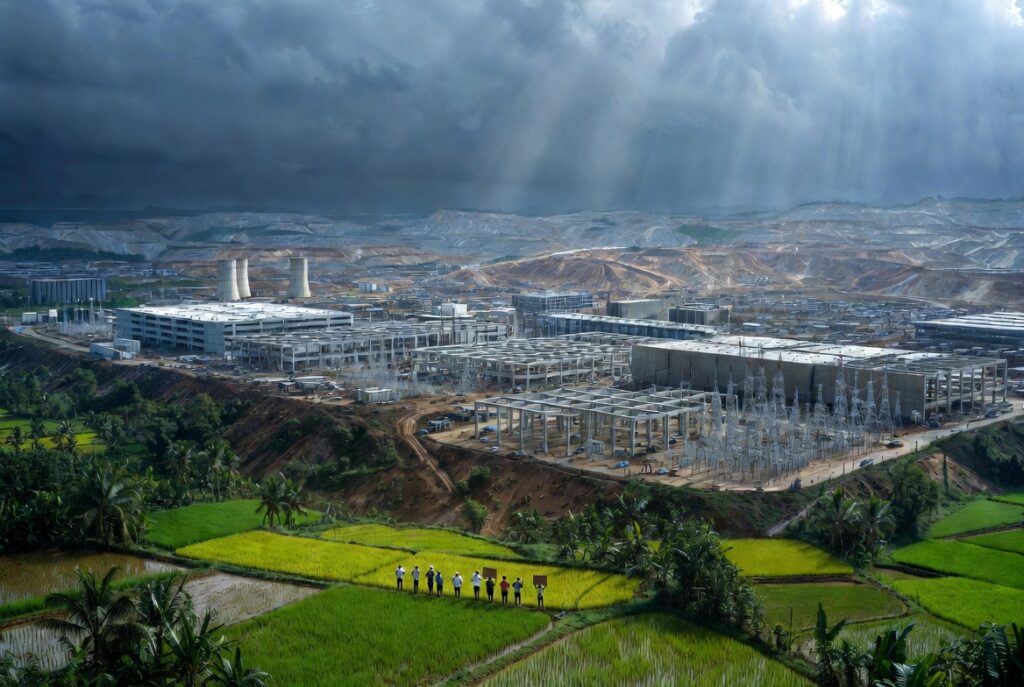
Right now, the push to build out AI infrastructure is already causing real damage on the ground. You can see it clearly in the Philippines. On July 13, farmers, scientists, and environmental groups marched on the U.S. Embassy in Manila. They were protesting what’s being called the Pax Silica initiative.
At the center of it is a plan to build a 4,000-acre AI industrial hub in New Clark City. That means data centers, processing facilities, and all the support systems that come with them. But that land isn’t empty. Farmers are being told to leave so construction can move forward.
This is what “data infrastructure” looks like in practice. It’s not abstract. It’s people losing land they depend on.
Then there’s the resource side. AI runs on hardware, and hardware depends on mining. Rare earth minerals—those are the elements used in electronics and advanced computing—have to come from somewhere. That means large-scale extraction, often in places with weak environmental protections.
People on the ground are calling this what it looks like to them: a form of neocolonialism. By that, they mean powerful countries pulling resources out of poorer ones to fuel their own industries. The benefits don’t flow back in any meaningful way. The infrastructure being built is likely to serve corporate systems, not local communities. In many cases, access will be limited or priced out of reach.
At the national level, the pressure is just as intense. Countries in the Global South are trying to stay relevant without giving up control. That’s getting harder by the day.
Take Indonesia. It recently joined WAICO—an AI coalition—so it wouldn’t be left behind. But almost immediately, officials had to clarify that they’re still working with Pax Silica as well. They’re trying to balance between competing blocs, mainly the U.S. and China.
It’s a tightrope. And it’s not a stable one.
This isn’t a normal market competition. It’s closer to a zero-sum contest, where alignment with one side can limit your options with the other. Countries like Indonesia are trying to extract value from both sides without becoming dependent on either. That’s a difficult position to hold.
What’s clear to me is that the consequences are already here. This isn’t some future risk.
Supply chains are being reshaped in real time. Land is being repurposed at scale. Communities are being displaced. Natural resources are being stripped out faster to meet demand.
All of it is being justified by urgency—the idea that whoever controls AI infrastructure now will control the future.
But the costs aren’t theoretical. They’re being counted right now, in places most people will never see.