
Introduction
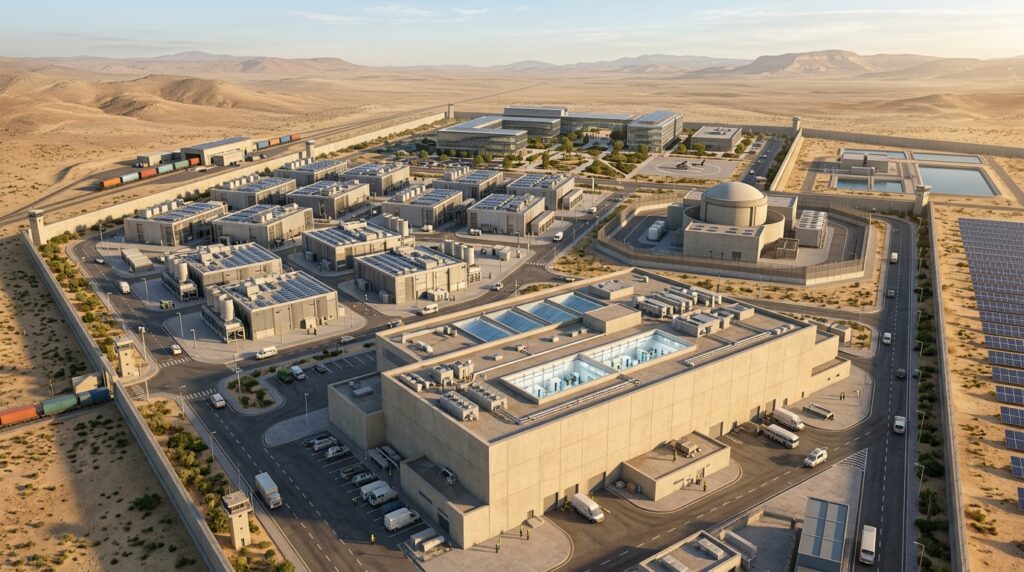
Fort Foundry One is a proposed joint US–Israeli technological and industrial park, announced in early 2026, intended to serve as a hub for chip production, advanced computing, and AI development. It forms part of a strategic cooperation agreement on AI between Israel and the United States. Under a memorandum of understanding, Israel is to allocate approximately 16,000 dunams (about 4,000 acres) in the Negev or near the Gaza Strip border area to the United States under a 99-year lease. The site would remain under Israeli sovereignty, while day-to-day operations and most of the investment would be managed by the United States. The MOU was signed for the United States by Jacob Helberg, Under Secretary of State for Economic Affairs, and for Israel by Brigadier General (res.) Erez Eskel, head of Israel’s National AI Directorate.
One element of the project is its energy infrastructure. The data centers and AI computing systems associated with the park would require a large and stable power supply, and discussions have raised the possibility of constructing a nuclear power plant at the site, potentially using small modular reactors (SMRs). This is complicated by Israel’s status as a non-signatory to the Nuclear Non-Proliferation Treaty (NPT). The MOU refers to “high-intensity energy infrastructure” without further specifying this component.
The Nuclear Component and Non-Proliferation
Israel is one of a small number of UN member states—commonly counted as four, alongside India, Pakistan, and South Sudan—that have not signed the NPT, and it maintains a policy of “nuclear ambiguity” regarding its own capabilities. U.S. nuclear export law, governed by so-called “123 Agreements,” generally requires partner nations to adhere to International Atomic Energy Agency (IAEA) safeguards and NPT guidelines before the United States transfers civilian nuclear technology. Placing an advanced U.S. commercial reactor in a non-NPT state would therefore represent a departure from established U.S. non-proliferation practice.
According to reporting on the MOU discussions, one option raised to address this was an unconventional regulatory arrangement. Rather than exporting the reactor and transferring operational authority to Israel, the arrangement under discussion would keep the facility under U.S. regulation and supervision despite its location in the Negev. In practice, such a model would place fuel management, safety oversight, and the maintenance supply chain in American hands, treating the reactor for regulatory purposes as a U.S.-operated asset situated in Israel. The stated aim is to satisfy U.S. oversight requirements without requiring Israel to sign the NPT or change its policy of nuclear ambiguity.
The reporting specifies small modular reactors. According to Nuclear Engineering International, the site’s location in the very dry Negev makes an advanced design that needs no cooling water the likely choice—specifically a high-temperature gas-cooled reactor (HTGR), which uses gas rather than water for cooling—should the project reach the stage of selecting a reactor design. Such reactors can provide the continuous baseload power that a large AI data center requires.
Stated Objectives and Rationale
Proponents of the project describe its rationale in terms of timing and competition. In this view, the physical infrastructure of advanced AI—fabrication capacity, compute, and supporting energy—will be built over the coming decade regardless of U.S. involvement, and the open question is whose standards, supply chains, and dependencies it will reflect. Advocates point to China as the alternative builder, citing its industrial capacity and its willingness to finance and operate comparable infrastructure across the region.
From this standpoint, several of the project’s most-discussed features are presented as deliberate. The 99-year lease is described as a signal of long-term commitment. The reliance on U.S.-controlled fuel and maintenance is framed as a way to extend advanced capability to a partner while retaining a degree of control over its operation. Anchoring the project in Israel is cited as the choice of an established technology partner with a developed security sector and a record of co-investment. Incorporating Gulf capital is characterized as giving those states a financial stake in the coalition’s success. The stated premise is that speed and integration, rather than caution and distance, are the more effective route to a durable technological position.
The sections that follow set out the concerns that analysts, watchdog groups, and some officials have raised about these same features.
Concerns Raised About the Nuclear Arrangement
Observers including nuclear-policy analysts and security researchers have identified several points of concern in the proposed nuclear arrangement and the wider Pax Silica framework.
Legal Geography and Physical Exposure
The proposed arrangement would treat the reactor as U.S.-regulated for legal purposes, while its physical location would remain in southern Israel. Local officials in the Negev have argued that siting a nuclear reactor in the region would turn an area that already functions as an evacuation and shelter zone in wartime into a potential target. As a general matter, the physical effects of an incident—for example, damage from a rocket or drone strike—would not be bounded by the reactor’s legal designation. Earlier proposals for a commercial nuclear station in the Negev also met with local opposition.
Implications for Non-Proliferation Precedent
Some analysts argue that adapting U.S. export rules to accommodate a non-NPT state could affect the broader non-proliferation regime. If AI infrastructure were treated as grounds for such an exception, they contend, other states—one might point, by way of illustration, to Saudi Arabia, Turkey, or Egypt—might seek comparable access to advanced nuclear technology without accepting full IAEA safeguards. Supporters of the arrangement emphasize that, because the reactor would remain under U.S. control rather than being transferred to the host, they regard it as distinct from a conventional technology export.
Operational Dependency and Maintenance
Advanced U.S. reactor designs are generally not built for independent operation by a host. They rely on proprietary fuel, such as high-assay low-enriched uranium (HALEU), which the United States controls, and on specialized engineering teams for maintenance and cooling management. Analysts note two implications. First, this dependency gives the United States a means of preventing a host from operating the plant independently, since the withdrawal of U.S. personnel would leave a facility the host could not safely run. Second, it creates an asset whose value and safety depend on continued U.S. involvement, which could become difficult to manage if relations deteriorate. Reporting characterizes the U.S. position as a calculated reliance on this dependency, motivated in part by concern that China would otherwise supply comparable infrastructure.
The Pax Silica Coalition
Fort Foundry One sits within Pax Silica, a U.S.-led coalition announced in December 2025 that aims to build a secure supply chain for AI and semiconductor manufacturing. Its founding participants included the United States, Japan, Israel, Australia, Singapore, South Korea, and the United Kingdom, with Qatar and the United Arab Emirates joining subsequently as the eighth and ninth signatories. Some commentary has speculated that Fort Foundry One could involve Intel’s existing complex at Kiryat Gat, where Fab 28 is operational and work on Fab 38 has been paused. The available sources confirm Intel’s status at Kiryat Gat but do not link that complex to Fort Foundry One, so the connection remains conjecture.
Counterintelligence and Coalition Access
Analysts have raised counterintelligence questions specific to the facility, which is intended to house advanced AI models, proprietary chip designs, and associated training datasets. Each additional partner in the coalition increases the number of personnel with physical and logical access, the number of supply-chain vendors involved, and the number of jurisdictions in which a compromise could originate. In this framing, the relevant consideration is not formal alliance status but the range of actors with access and the historical record of intelligence activity among them.
Several current or prospective Pax Silica partners have documented histories of intelligence activity directed at the United States:
- Israel: Jonathan Pollard, a civilian U.S. intelligence analyst, pleaded guilty to passing large quantities of classified U.S. information to Israel in the 1980s.
- South Korea: Robert Kim, a civilian computer specialist, pleaded guilty in 1997 to passing classified national defense information to South Korea.
- Philippines: Leandro Aragoncillo, an FBI intelligence analyst, was arrested in 2005 and convicted and sentenced in 2007 for stealing classified documents and sending them to political figures in the Philippines.
- India: A U.S. Department of Justice indictment unsealed in 2024 charged an Indian government employee in connection with a 2023 plot to assassinate a U.S. citizen on U.S. soil.
- United Arab Emirates: A November 2022 Washington Post report described a classified U.S. National Intelligence Council assessment documenting UAE influence operations.
- Qatar: Federal court filings and investigative reporting have described Qatar’s hiring of former U.S. intelligence personnel for cyber operations and unregistered lobbying.
These cases span several decades and different categories of partner. Analysts who cite them do so to support a specific point: that formal alliance does not preclude intelligence activity, and that the number of parties with access to the facility is therefore a relevant security consideration.
Physical Proximity and Long-Term Access
The 99-year lease and mixed jurisdiction establish a long-term arrangement in which personnel rotations, maintenance crews, supply-chain vendors, and local contractors would have ongoing access to the site over successive generations. Analysts note that even where the United States holds the data and intellectual property, the parties physically servicing critical systems and handling chip designs would be drawn from across the coalition.
Attribution and Accountability
The coalition structure also raises questions of accountability. In the event of data exfiltration, supply-chain compromise, or an intelligence leak, attributing responsibility across multiple sovereign partners—each with its own legal protections and political considerations—could be difficult, which analysts note would complicate any corrective response.
Strategic Entanglement and Questions of Autonomy
Some analysts characterize Fort Foundry One and Pax Silica as creating a form of long-term interdependence through infrastructure that is harder to unwind than conventional treaties or trade agreements. The following considerations are among those raised.
Israel’s Position and Leverage
Israel has frequently positioned itself as a partner in critical technology and security areas. Under the arrangement, Israel would retain sovereignty over the land while the United States operates the facility, giving Israel physical proximity to, and a legal relationship with, infrastructure central to U.S. AI capability. Analysts suggest this could make it more difficult for a future U.S. administration to distance itself from the arrangement.
Interdependence and Lock-In
The same structure that binds partners to the United States also binds the United States to the arrangement. Distributing sensitive capabilities across foreign territory under long leases and mixed jurisdictions involves ceding some degree of unilateral control. Analysts note that this interdependence runs in both directions and would be difficult to reverse once established.
Foreign Funding and Governance
Should coalition partners such as Qatar and the UAE participate as financial stakeholders—a role discussed in connection with regional AI infrastructure, though not established for this project in the available reporting—it would add a further dimension. Investors in infrastructure of this scale typically expect governance rights, transparency, and returns. Analysts note that accepting state funding for critical infrastructure can carry implications for decision-making over access, development, and output, and can create financial interdependence.
Leadership and Control in a Distributed Model
A recurring question is whether the United States would lead the coalition in practice or whether the dispersed physical infrastructure would distribute effective control among partners by default. In the latter case, some analysts argue, the outcome might be a multi-sovereign ecosystem in which no single state, including the United States, exercises full control over the technology.
The Negotiators
The officials who signed the MOU are part of the arrangement’s factual record. Jacob Helberg, who signed for the United States, is the Under Secretary of State for Economic Affairs. He was born and raised in France and is described in reporting as French-American. He came to government from the technology sector: he was a global policy lead at Google and a senior advisor to Alex Karp, the CEO of Palantir Technologies, a defense and intelligence software company, and he founded the Hill & Valley Forum, which convenes technology executives and lawmakers. As he entered the role, an ethics filing disclosed that he planned to retain investments in dozens of AI, defense, and fintech companies—including stakes in OpenAI, SpaceX, and Anduril—holdings that drew conflict-of-interest scrutiny during his confirmation.
Erez Eskel, who signed for Israel, is a reserve brigadier general and the first head of Israel’s National AI Directorate, to which Prime Minister Benjamin Netanyahu appointed him on October 12, 2025. He came to the role from the defense establishment, having commanded the military’s visual-intelligence Unit 9900 and held senior positions in cyber and military intelligence. The directorate was created to formulate and implement a national AI strategy, with the stated aim of making Israel a “global AI superpower.”
Conclusion
Fort Foundry One brings together several distinctive features: a 99-year lease on foreign territory, a proposed U.S.-regulated nuclear facility in a non-NPT state, participation in a multi-state coalition that includes partners with prior records of intelligence activity involving the United States, and foreign financial stakeholders. These features carry implications for operational dependency, jurisdiction, and accountability that would extend beyond any single administration.
The available reporting sets out both a rationale—centered on the competition to build AI infrastructure and the aim of retaining U.S. control over it—and a set of concerns about whether the arrangement’s mechanisms would secure that control or complicate it. How these considerations balance is an open question, and one that depends on the specific terms of an arrangement that, as of this writing, is still developing.
References
Associated Press. (2022, October 27). FBI probing ex-CIA officer’s spying for World Cup host Qatar. https://apnews.com/article/world-cup-technology-sports-soccer-religion-5af544d34cded38ff4093587d2efa0de
Atlantic Council. (2026, April 7). American AI leadership can open a new chapter for Middle East integration. https://www.atlanticcouncil.org/blogs/menasource/american-ai-leadership-can-open-a-new-chapter-for-middle-east-integration/
Atlantic Council. (2026, April 15). Three elements Trump’s “Pax Silica” needs to succeed. https://www.atlanticcouncil.org/dispatches/three-elements-trumps-pax-silica-needs-to-succeed/
Bloomberg. (2025, May 9). Ex-Palantir adviser to keep SpaceX, OpenAI stakes in Trump role. https://www.bloomberg.com/news/articles/2025-05-09/ex-palantir-adviser-to-keep-spacex-openai-stakes-in-trump-role
Bob, Y. J. (2025, October 12). PM Netanyahu appoints Brig.-Gen. Askal to lead National AI Directorate. The Jerusalem Post. https://www.jpost.com/israel-news/article-870258
Djysrv. (2026, February 7). U.S. tech park in Israel may have a nuclear power plant. Neutron Bytes. https://neutronbytes.com/2026/02/07/u-s-tech-park-in-israel-may-have-a-nuclear-power-plant/
Dori, O. (2026, January 26). US tech park in Negev may have nuclear power plant. Globes. https://en.globes.co.il/en/article-us-tech-park-in-negev-may-have-nuclear-power-plant-1001533004
Globes. (2022, April 27). Kiryat Gat bends planning rules for Intel. https://en.globes.co.il/en/article-kiryat-gat-bends-planning-rules-for-intel-1001410246
Globes. (2025, July 10). Intel Kiryat Gat expansion frozen for foreseeable future. https://en.globes.co.il/en/article-intel-kiryat-gat-expansion-frozen-for-foreseeable-future-1001515435
Harris, S., & Nakashima, E. (2022, November 12). UAE meddled in U.S. political system, intelligence report says. The Washington Post. https://www.washingtonpost.com/national-security/2022/11/12/uae-meddled-us-politics-intel-report/
Le Monde. (2026, January 24). Jacob Helberg, l’émissaire de Donald Trump auprès de l’extrême droite française. https://www.lemonde.fr/m-le-mag/article/2026/01/24/jacob-helberg-l-emissaire-de-donald-trump-aupres-de-l-extreme-droite-francaise_6663901_4500055.html
Los Angeles Times. (2007, October 2). FBI called vulnerable to spying. https://www.latimes.com/archives/la-xpm-2007-oct-02-na-fbi2-story.html
National Archives. (n.d.). The Jonathan Jay Pollard espionage case [Declassified document]. https://www.archives.gov/files/declassification/iscap/pdf/2007-010-doc1.pdf
Schwartz, M. J. (2018, May 24). GOP fundraiser: Ex-American spy helped Qatar hack emails. Politico. https://www.politico.com/story/2018/05/24/elliott-broidy-qatar-email-hack-607970
Sludge. (2025, June 12). Helberg poised to shape U.S. foreign policy while retaining tech portfolio. https://readsludge.com/2025/06/12/tech-insider-helberg-poised-to-shape-u-s-foreign-policy-while-retaining-tech-portfolio/
Tracey. (2026, February 10). Israel, US plan AI hub with SMR power. Nuclear Engineering International. https://www.neimagazine.com/news/israel-us-plan-ai-hub-with-smr-power/
U.S. Department of Justice. (2024, October 17). Justice Department announces charges against Indian government employee in connection with foiled plot to assassinate U.S. citizen in New York City [Press release]. https://www.justice.gov/archives/opa/pr/justice-department-announces-charges-against-indian-government-employee-connection-foiled
U.S. Department of State. (n.d.). Pax Silica. https://www.state.gov/pax-silica
U.S. Department of State. (2025, December 15). Jacob Helberg [Biography]. https://www.state.gov/biographies/jacob-helberg
U.S. Department of State. (2025, December 17). Outcomes of the Pax Silica Summit [Press briefing]. https://www.state.gov/briefings-foreign-press-centers/outcomes-of-the-paxs-silica-summit
Weiner, T. (1997, May 8). Ex-analyst pleads guilty in spy case. The New York Times. https://www.nytimes.com/1997/05/08/us/ex-analyst-pleads-guilty-in-spy-case.html
Ynetnews. (05.11.25). Israel selects site for first nuclear power plant. https://www.ynetnews.com/environment/article/s10cuk0egg