
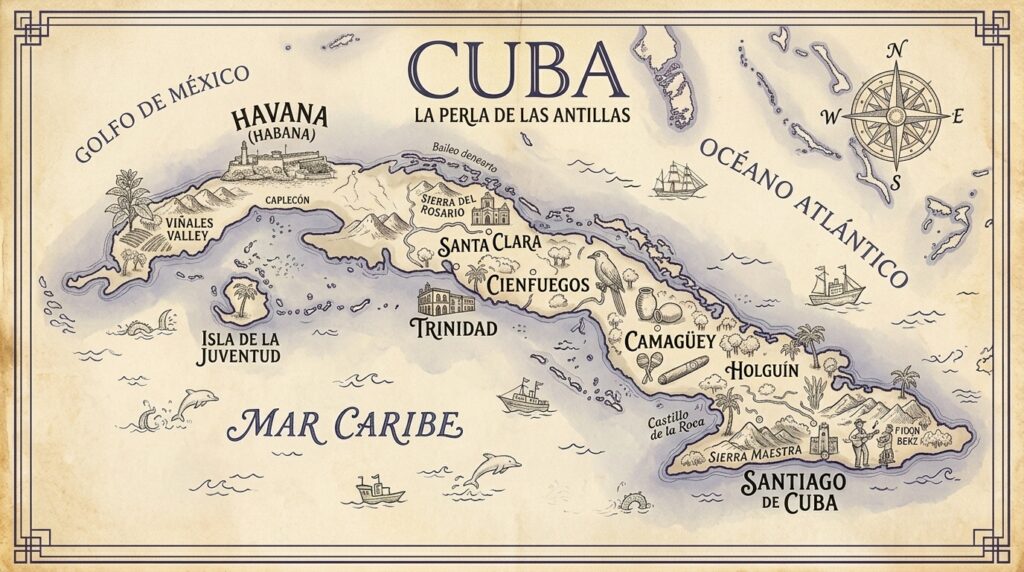
The devastating crisis now unfolding in Cuba is not, in my view, a humanitarian mission. The stated case for the current U.S. campaign is familiar and, on its own terms, coherent: the regime’s repression of its own people, its long alignment with Russia and China, and its entanglement with a collapsing Venezuela. I do not dismiss those concerns. But they do not, to my eye, fully explain why Cuba — of all the world’s troubled authoritarian states — has drawn this particular intensity of pressure at this particular moment.
What follows is not a claim I can prove about anyone’s private intent; it is a hypothesis, a lens through which the timing and the ferocity make more sense to me. I believe Cuba has re-emerged, quietly, as a strategic jewel in the race for AI dominance, and that its value is being pursued one way or another — through the current economic suffocation or, if it comes to that, through force. I want to be equally clear about where I stand: I deeply desire a prosperous, open future for the Cuban people, and I can see real opportunities on the horizon for it. What I cannot endorse are tactics that impose great suffering and the risk of death to force that future into being. To see why I find this reading persuasive, we have to look past the political history and examine what the island actually possesses.
What Cuba Has
Cuba doesn’t have oil or vast mineral wealth on the scale of the Middle East or Africa. What it does have is location, symbolism, and proximity. It is a geopolitical chokepoint, a Cold War relic, a domestic political flashpoint, and a persistent reminder that a small, defiant nation can resist American influence just off the coast of Florida.
The U.S. sees Cuba as a strategic piece of real estate, a potential economic frontier, and a political symbol. But when analyzing what Cuba has that the United States wants, it is helpful to look beyond historical political tensions and examine the island’s tangible geopolitical, economic, and strategic assets.
1. Strategic Geographic Location
Cuba’s location just 90 miles off the coast of Florida makes it geopolitically vital to the United States. It sits adjacent to the Straits of Florida and the Windward Passage, critical maritime chokepoints for U.S. commercial shipping and naval mobility. Maintaining influence in Cuba is also a key part of U.S. strategy to prevent rival powers such as China or Russia from establishing a strategic foothold in the Western Hemisphere. Cooperation with Havana is highly valued by Washington for managing regional migration flows, which remains a major domestic and foreign policy priority.
2. Critical Natural Resources
Cuba possesses significant deposits of minerals essential for modern technology, green energy transitions, and defense manufacturing. According to the U.S. Geological Survey, Cuba is a significant producer of cobalt as a nickel byproduct. The country is tied with or just behind Indonesia as one of the world’s largest cobalt reserves — a critical mineral heavily relied upon for electric vehicle batteries and advanced electronics. Cuba also has notable laterite nickel resources. Securing stable access to these supply chains is a growing strategic interest for the United States as it seeks to reduce reliance on adversarial nations for critical minerals.
3. Biotechnology and Pharmaceuticals
Despite decades of economic restrictions, Cuba has developed a remarkably advanced, state-owned biopharmaceutical industry. Cuban scientists produce a diverse array of genetically engineered drugs, vaccines, and medical treatments that are gaining international attention. Cuban-developed cancer therapies and vaccines, for example, have been trialed or sought after globally. U.S. health and pharmaceutical sectors have periodically expressed interest in collaborating with Cuban biotech institutions, as such partnerships could enhance worldwide health care and provide access to innovative, low-cost drug development.
4. Economic and Market Opportunities
Though Cuba has been experiencing a recent, sharp, emigration-driven decline, it still represents a largely untapped market of approximately 8 to 9.5 million people, located directly on the doorstep of the world’s largest economy. If trade barriers were comprehensively lifted, U.S. businesses would have immediate opportunities in agriculture, consumer goods, telecommunications, and infrastructure development. Cuba’s rich cultural heritage, historic architecture, and natural beauty also make it a prime destination for tourism and hospitality investment — a potential briefly explored by American companies during the diplomatic thaw of 2015 to 2017.
5. Human Capital and Diaspora Ties
Cuba has a highly educated population with a strong emphasis on medicine, science, and engineering, the result of heavy historical state investment in education and healthcare. This human capital is an attractive asset for international research and development partnerships. In addition, the millions of Cuban-Americans living in the United States create deep cultural, familial, and economic ties that ensure Cuba remains a unique and enduring priority in U.S. domestic politics and foreign policy.
Cuba Reimagined
Everything above was an inventory — the kind an outside power draws up when it looks at a smaller neighbor and asks what can be had. Read that way, Cuba is a balance sheet: a chokepoint, a cobalt reserve, a captive market, a pool of cheap expertise. That is the appraising gaze, and it is precisely the gaze that leads to suffocation and, if that fails, to force — because it treats the island as a thing to be acquired rather than a people to be dealt with.
The same inventory reads very differently if you change the question — if you ask not what can be taken from Cuba, but what could be built with Cubans. The assets do not change; the relationship to them does. And once the question shifts, one of those assets stops being a line item on the balance sheet and becomes the whole point.
The opportunities for Cuba are especially strong because its greatest asset is not in the ground. It is its people.
Cuba has a widely and highly educated population. They are resilient. Under decades of severe constraint, they have made scientific advances that few countries of any size could claim, and they have built an advanced, state-owned biopharmaceutical industry that is of genuine value to the world. That is not potential. That is proven. If that level of invention was possible under an embargo, consider what that same human capital could do with open supply chains, clinical trials, and capital.
That talent sits on top of other real assets. Cuba’s tourism appeal, its historic role in sugar, and its market of nearly nine million people are all rebuildable economic frontiers. They are degraded today, after years of crisis and underinvestment, but the base remains. Tourism infrastructure can be rebuilt. Agricultural capacity can be restored. What cannot be easily created elsewhere is an educated, scientifically literate workforce already in place.
This is why Cuba is wooed by both Russia and China, and why it should be seen differently in Washington. In a hypothetical future where Cuba is fully open to investment and trade, that combination becomes transformative.
For the AI era specifically, Cuba offers a combination that no other location currently offers in one place. It possesses laterite nickel and cobalt byproducts essential for hardware and battery backup. It has a high solar irradiation profile and consistent trade winds that could power energy-intensive computing with renewable energy. It has proximity that would enable negligible latency for non-real-time / batch workloads once direct high-capacity connectivity is established. And most importantly, it has the engineers, doctors, and technicians to run complex operations.
This is where its value would manifest in concrete ways:
- A Secure, Near-Shore Critical Mineral Supply Chain. Cuban nickel, particularly from the laterite deposits at Moa, could feed a dedicated, low transit time supply chain into U.S. Gulf and East Coast manufacturing of specialty alloys, plating, and related materials used in AI server and data center hardware. This could supplement the current imports from Canada, Norway, and Australia. Cobalt is already yielded as a byproduct of Cuban nickel processing. A U.S. integrated operation could lock in a transparent, long-term supply, bypassing the volatile and ethically fraught artisanal mining in the Democratic Republic of Congo.
- A Latitude and Proximity Advantage for Sustainable AI Infrastructure. AI’s energy appetite is forcing tech giants to co-locate data centers with dedicated renewable sources. An open Cuba could host AI training data centers powered by renewable energy parks, with results routed back to the U.S. mainland. Its proximity to Miami means latency is negligible for non-real-time, batch AI training tasks. It could also become a logical bridge for U.S. AI services into the Spanish-speaking Caribbean and Latin America.
- A Once-in-a-Century Nearshoring Opportunity. The U.S. would not be retrofitting a 20th-century mining industry. It could build a brand-new, automated, AI-optimized mining and processing operation from scratch, potentially setting the global standard for low-carbon, ethical nickel and cobalt production.
I do not see Cuba as a prize to be captured. I see it as a strategic jewel, especially in the AI era, because of its people first, and its location and resources second. If that jewel is integrated rather than suffocated, the benefit is not only to the United States. It is to the Cuban people themselves, and through their science and capacity, to the world.
The strongest objection to all of this is that I have mistaken Cuba’s assets for Washington’s motives. A skeptic would say the explanation is the obvious one on the surface — the same repression, the same alignments with Russia and China, the same Venezuelan entanglement I opened with, a forward base ninety miles from Florida. On that reading, the nickel and the cobalt and the solar irradiation are incidental — a coincidence I have inflated into a cause. I take the objection seriously, and I concede I cannot prove intent.
But I would offer two replies. First, in this era the line between “national security” and “critical-mineral and compute supply chains” has largely dissolved; the strategic-denial logic already visible in U.S. policy — keeping rivals from gaining a foothold in the hemisphere — is the very same logic that makes controlling those assets desirable. The two explanations are not really competitors. Second, and more important: even if the skeptic is entirely right, and AI plays no part in anyone’s calculations, my conclusion does not change. Whatever the motive, the value is real — and the only question that finally matters, whether that value is pursued through suffocation or through partnership, remains exactly the same.
Conclusion
Whatever finally drives U.S. policy toward Cuba — mineral security, proximity, migration, the old Cold War symbolism, or the AI logic I have argued here — every one of those motives runs into the same wall: Cuba’s value is not in question, and the island will not simply be left alone. What stays open is the manner of the pursuit. I have seen enough suffering and death in the past few years to last a thousand lifetimes. Can we not, as a species, do better?
That is the question to end on. Not whether Cuba has worth, but whether we reach for it through policies that impose suffering, or through a path that lets a resilient, educated people finally build the future they have already earned.
Bibliography
Minerals & Reserves
U.S. Geological Survey. (2026). Mineral commodity summaries 2026: Cobalt. U.S. Department of the Interior. https://pubs.usgs.gov/periodicals/mcs2026/mcs2026-cobalt.pdf
U.S. Geological Survey. (2026). Mineral commodity summaries 2026: Nickel. U.S. Department of the Interior. https://pubs.usgs.gov/periodicals/mcs2026/mcs2026-nickel.pdf
U.S. Geological Survey. (2023). The mineral industry of Cuba in 2022 (2022 Minerals Yearbook, Vol. 3). U.S. Department of the Interior. https://pubs.usgs.gov/myb/vol3/2022/myb3-2022-cuba.pdf
Sherritt International Corporation. (2023, March 31). NI 43-101 technical report on the mineral resource and mineral reserve estimate, Moa Joint Venture, Holguín Province, Cuba (Effective date August 31, 2022). https://s2.q4cdn.com/343762060/files/doc_downloads/whitepapers/NI-43-101-Moa-JV-Technical-Report-Final-_Final.pdf
Sherritt International Corporation. (n.d.). Metals: Moa Joint Venture operations. Retrieved July 21, 2026, from https://sherritt.com/operations/metals/
Geography & Chokepoints
The White House, Office of the Press Secretary. (2015, March 31). Charting a new course on Cuba. Obama White House Archives. https://obamawhitehouse.archives.gov/node/352651
Wikipedia contributors. (n.d.). Straits of Florida. In Wikipedia. Retrieved July 21, 2026, from https://en.wikipedia.org/wiki/Straits_of_Florida
Population & Demography
EFE. (2026, July 13). Crisis demográfica: Cuba cierra 2025 con 68.051 nacimientos y 9,4 millones de habitantes [Demographic crisis: Cuba ends 2025 with 68,051 births and 9.4 million inhabitants]. Infobae. https://www.infobae.com/america/agencias/2026/07/13/crisis-demografica-cuba-cierra-2025-con-68051-nacimientos-y-94-millones-de-habitantes/
CiberCuba Editorial Team. (2026, July 1). The UN reiterates its warning: Cuba’s population will decline to 5.6 million by 2100. CiberCuba. https://en.cibercuba.com/noticias/2026-07-01-u1-e208933-s27061-nid333877-onu-reitera-advertencia-cuba-reducira-56-millones
Le Monde. (2025, April 30). Cuba faces population decline and aging amid mass migration exodus. https://www.lemonde.fr/en/international/article/2025/04/30/cuba-faces-population-decline-and-aging-amid-mass-migration-exodus_6740756_4.html
Netto, A. (2026, January 10). ‘History will tell’: As US pressure grows, Cuba edges closer to collapse amid mass exodus. The Guardian. https://www.theguardian.com/global-development/2026/jan/10/cuba-regime-polycrisis-collapse-exodus-economy-migration-us-sanctions-trump
World Bank. (2026). Population, total—Cuba [Data set]. World Bank Open Data. https://data.worldbank.org/country/cuba
Diaspora & Demographics (United States)
Passel, J. S., & Fahmy, D. (2026, May 7). 10 facts about Cubans in the U.S. Pew Research Center. https://www.pewresearch.org/short-reads/2026/05/07/10-facts-about-cubans-in-the-u-s/
Biotechnology
Berlanga, J., Fernández, J. I., López, E., López, P. A., del Río, A., Valenzuela, C., Baldomero, J., Muzio, V., Raíces, M., Silva, R., Acevedo, B. E., & Herrera, L. (2013). Heberprot-P: A novel product for treating advanced diabetic foot ulcer. MEDICC Review, 15(1), 11–15. https://doi.org/10.37757/MR2013V15.N1.4
Morera-Díaz, Y., Gavilondo, J. V., Bequet-Romero, M., Sánchez Ramírez, J., Hernández-Bernal, F., Selman-Housein, K.-H., Perez, L., & Ayala-Ávila, M. (2018). Specific active immunotherapy with the HEBERSaVax VEGF-based cancer vaccine: From bench to bedside. Seminars in Oncology, 45(1–2), 68–74. https://doi.org/10.1053/j.seminoncol.2018.03.004
Evans, R., Reid, M., Segal, B., Abrams, S. I., & Lee, K. (2018). Case study in international cooperation: Cuba’s Molecular Immunology Center and Roswell Park Cancer Institute. MEDICC Review, 20(2), 35–39. https://doi.org/10.37757/MR2018.V20.N2.8
Ortiz Carrodeguas, R. A., Lorenzo Monteagudo, G., Guerra Chaviano, P. P., Álvarez Montané, I., Salomón Saldívar, E. E., Lobaina Lambert, L., Camacho Sosa, K., Bermúdez Pino, R., Blanco Mustelier, P., Valdés Rodríguez, E., González Piloto, S., Guerra de la Vega, A., Valdés Sánchez, L., Montes De Santis, A., Parra Zabala, J., Viada González, C., Calvo Aguilera, N., Saavedra Hernández, D., Santos Morales, O., & Crombet Ramos, T. (2024). Safety and effectiveness of CIMAvax-EGF administered in community polyclinics. Frontiers in Oncology, 13. https://doi.org/10.3389/fonc.2023.1287902
Centro de Ingeniería Genética y Biotecnología. (n.d.). Heberprot-P®. Retrieved July 21, 2026, from https://www.cigb.edu.cu/en/product/heberprot-p-2/
Roswell Park Comprehensive Cancer Center. (n.d.). CimaVax. Retrieved July 21, 2026, from https://www.roswellpark.org/cimavax
Energy & Infrastructure
World Bank Group, & Solargis. (2026). Global Solar Atlas: Cuba [Data set]. https://globalsolaratlas.info/download
STAR Centre. (n.d.). Cuba solar reports. Retrieved July 21, 2026, from https://star-centre.org/countries/cuba/cuba-solar-reports
National Renewable Energy Laboratory. (n.d.). Cuba wind resource assessment report. U.S. Department of Energy, OpenEI. https://en.openei.org/datasets/files/716/pub/cubawindreport_243.pdf
Study finds 21 regions with high potential for the development of wind farms in Cuba. (2024, December). Power Magazine. https://www.powermag.com/study-finds-21-regions-with-high-potential-for-the-development-of-wind-farms-in-cuba/
Submarine Cable Networks. (n.d.). ALBA-1. Submarine Cable Map. Retrieved July 21, 2026, from https://www.submarinecablemap.com/submarine-cable/alba-1
Wikipedia contributors. (n.d.). ARIMAO (cable system). In Wikipedia. Retrieved July 21, 2026, from https://en.wikipedia.org/wiki/ARIMAO_(cable_system)
Data-Center Battery Chemistry (background for cobalt/battery claim)
Weltrus. (2026, June 17). Battery technology comparison: LFP vs. NMC for stationary energy storage. https://www.weltrus.com/battery-technology-comparison/
Ahmed, M., et al. (n.d.). Energy storage systems for AI data centers [Review]. Virginia Tech Libraries. https://vtechworks.lib.vt.edu/server/api/core/bitstreams/a45be2b8-0974-4398-b839-384f241718ec/content
Strategic / Diplomatic Context
U.S. Department of State. (2015, July 1). Re-establishment of diplomatic relations with Cuba [Press statement]. https://2009-2017.state.gov/r/pa/prs/ps/2015/07/244623.htm
The White House, Office of the Press Secretary. (2015, July 1). President Obama announces U.S. will reopen our embassy in Cuba. Obama White House Archives. https://obamawhitehouse.archives.gov/blog/2015/07/01/president-obama-announces-us-will-reopen-our-embassy-cuba