
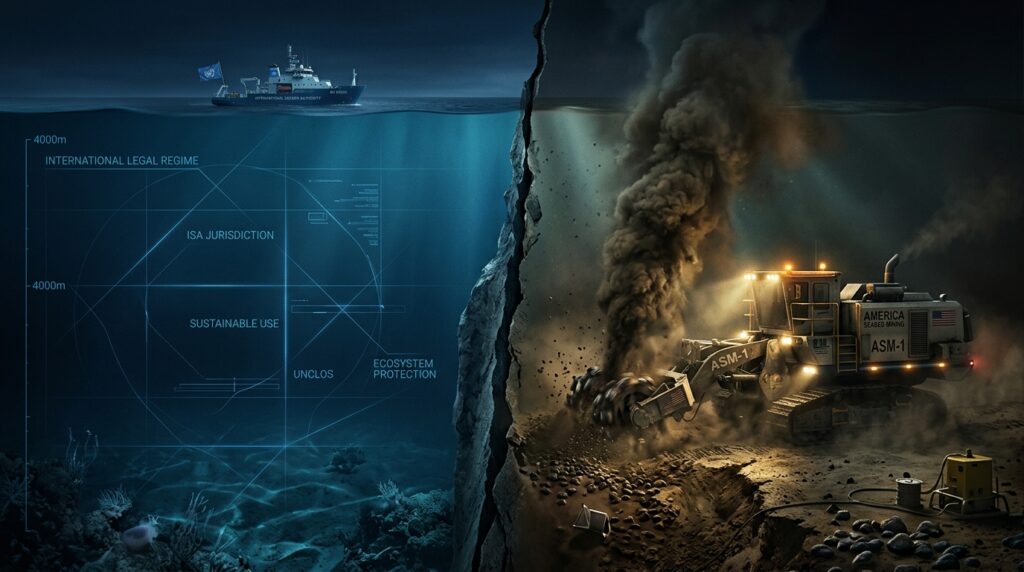
The deep ocean floor holds vast deposits of polymetallic nodules — potato-sized mineral concretions rich in nickel, cobalt, copper, and manganese — scattered across abyssal plains, and concentrated particularly in the Clarion-Clipperton Zone (CCZ), a deep-sea region of the Pacific lying between Hawaii and Mexico. These minerals are inputs for electric vehicle batteries, defense technologies, and the broader energy transition. The question of who may mine them, and under what rules, has been governed in principle by an international framework the United States has never joined. That question is now live. Through a combination of executive action, corporate strategy, and congressional activity, the United States is pursuing seabed mining in areas beyond national jurisdiction (ABNJ) under its own domestic law, raising unresolved questions of international legal obligation, environmental risk, and diplomatic cost.
The International Framework and U.S. Non-Participation
The United Nations Convention on the Law of the Sea (UNCLOS), adopted in 1982, is the foundational treaty governing the world’s oceans. Its Part XI designates the seabed in international waters — termed “the Area” — and its mineral resources as the “common heritage of mankind,” a principle under which those resources belong to all nations collectively and may be appropriated only under internationally agreed rules. To administer this regime, UNCLOS established the International Seabed Authority (ISA), headquartered in Jamaica, which regulates mineral activities in the Area and is charged with ensuring environmental protection.
The United States has ratified neither UNCLOS nor the related 1994 Implementing Agreement. It participates in the ISA as an observer, without a vote and without the ability to obtain ISA exploration or mining contracts. UNCLOS provisions on navigational rights, fisheries, submarine cables, and offshore oil and gas are nonetheless widely regarded as customary international law binding on all states, including non-parties. The distinction between treaty obligations the United States has not accepted and customary obligations that may apply regardless is central to the current legal dispute.
The Domestic Statutory Alternative: DSHMRA
Before UNCLOS entered into force, Congress anticipated that the United States might not join the international regime. In 1980, it passed the Deep Seabed Hard Mineral Resources Act (DSHMRA; 30 U.S.C. §§ 1401 et seq.) as an interim measure intended to allow American companies to conduct seabed mining in ABNJ until an acceptable international framework was established. DSHMRA authorizes the National Oceanic and Atmospheric Administration (NOAA) to issue exploration licenses and commercial recovery permits to U.S. citizens and corporations.
NOAA issued four exploration licenses in the CCZ in 1984 — designated USA-1 through USA-4 — and none since. Two of those, USA-1 and USA-4, remain active, held by Lockheed Martin through June 2, 2027. The statute was otherwise little used for four decades.
Executive Order 14285
On April 24, 2025, President Trump issued Executive Order 14285, “Unleashing America’s Offshore Critical Minerals and Resources.” The order directs NOAA to expedite review and issuance of licenses and permits under DSHMRA, activating the domestic framework for seabed mining outside the ISA process. The White House framed the action as a response to “unprecedented economic and national security challenges in securing reliable supplies of critical minerals independent of foreign adversary control” — a reference to China’s dominance of nickel, cobalt, and other strategic mineral processing.
Several factors bear on the timing. First, the ISA has negotiated a “Mining Code” to govern commercial exploitation for years without finalizing it. In 2021, Nauru triggered UNCLOS’s “two-year rule,” which in principle required the ISA to complete regulations by July 2023 or permit mining to proceed under provisional terms. The deadline lapsed without resolution, producing regulatory uncertainty that has strengthened the position of actors prepared to operate outside the ISA framework. Second, U.S. lawmakers and national security officials increasingly frame seabed minerals as a supply chain vulnerability that domestic mining could reduce. Third, at least one company was positioned to act on the change in policy.
The Metals Company’s Applications
The Metals Company (TMC), a Canadian seabed mining firm with substantial U.S. investor backing, is the principal corporate actor in the current dispute. TMC holds ISA exploration contracts in the CCZ sponsored by Nauru and Tonga. With ISA exploitation rules unfinalized, the company announced it would seek mining authorization directly from the U.S. government under DSHMRA.
Its subsidiary TMC USA acted quickly after Executive Order 14285. On April 29, 2025 — five days after the order — TMC USA submitted applications to NOAA for two exploration licenses and one commercial recovery permit. The application areas overlap portions of TMC’s existing ISA contract areas, an approach that allows the company to draw on work conducted under ISA sponsorship while shifting to the U.S. regulatory pathway. NOAA has reportedly received more than ten applications since the order was issued.
On January 21, 2026, NOAA issued a final rule establishing a “consolidated license and permit application process,” under which applicants may satisfy exploration and commercial recovery requirements simultaneously. TMC USA submitted a consolidated application the following day.
NOAA subsequently determined that TMC USA’s consolidated application complied with DSHMRA and its implementing regulations, announcing the determination publicly in early May 2026. A separate exploration-license application covering an additional area was later certified as compliant. These determinations advanced the applications further into review but did not constitute approval of a commercial recovery permit. TMC has stated it expects a decision point by the first quarter of 2027.
Analysis from Duke Law notes that TMC’s strategy would bypass the ISA entirely. The ISA has issued 31 exploration contracts and no exploitation contracts. If NOAA approves TMC’s commercial recovery permit, it would be the first authorization for commercial deep-seabed mining in international waters granted outside the international regime.
Legal, Diplomatic, and Reputational Risks
The unilateral approach has drawn criticism from several quarters. China, the European Union, and the ISA contend that it violates international law by circumventing Part XI of UNCLOS. Following Executive Order 14285, the ISA Secretary-General stated that “any unilateral action… sets a dangerous precedent that could destabilize the entire system of global ocean governance.”
Legal commentators have set out the specific exposure. Coalter Lathrop of Duke Law argues that bypassing the ISA would weaken the international legal regime on which the United States relies for its own interests — navigational freedoms, offshore oil and gas rights, fisheries management, and submarine cable protection — and could place the United States in breach of customary international law. The Congressional Research Service, in its analysis for Congress, relayed the ISA’s assessment that authorizing seabed mining outside the UNCLOS framework “may incur legal, diplomatic, economic, security, financial and reputational risks.”
A 2026 analysis in Frontiers in Marine Science takes a more qualified position. Its authors accept that the United States, as a non-party, is not bound by UNCLOS as treaty law, but argue that it remains subject to customary obligations to cooperate with the international community — including conducting environmental impact assessments, showing due regard for other states’ interests, sharing data, and controlling pollution. They further argue that market-based mechanisms and institutional pressure may constrain unilateral conduct in the absence of direct treaty obligations.
Environmental Concerns
Marine scientists and conservation organizations argue that harvesting polymetallic nodules would cause severe and potentially irreversible damage to deep-sea ecosystems that have developed over millions of years under highly stable conditions. Extraction involves heavy machinery operating on the seafloor and pumping ore to the surface, generating sediment plumes that researchers expect to affect benthic organisms well beyond the mining site, and introducing noise and light into environments that have not previously been exposed to them. Critics also note that deep-sea ecology remains incompletely characterized, which constrains the reliability of environmental impact assessment.
Industry is not uniform on the question. Some companies argue that operating without an internationally recognized legal framework creates financial and reputational risk, given that buyers may be reluctant to purchase minerals of contested legal provenance. These firms favor a finalized ISA Mining Code that would provide market certainty.
Congressional Action
The question remains unsettled within the U.S. government. In the 119th Congress, three bills — S. 2860, H.R. 3803, and H.R. 4018 — would codify the objectives of Executive Order 14285 in statute, variously by directing expedited permitting and confirming NOAA’s authorizing role. Two competing measures run the other way: H.R. 664 would bar NOAA from authorizing seabed mining until environmental impacts are better understood, and H.R. 663 would call for an international moratorium. None has been enacted, leaving the executive order and existing DSHMRA regulations as the operative framework. Internationally, as of February 2026, forty countries have announced formal opposition to deep-seabed mining, an alignment of governments, scientists, and civil society around application of the precautionary principle.
Outstanding Questions
By invoking a four-decade-old interim statute and directing agencies to accelerate its use, the United States has put the ISA’s exclusive role in authorizing seabed mining to a practical test. Three questions remain open: whether NOAA will approve a commercial recovery permit under DSHMRA; whether such an approval would withstand legal challenge, diplomatic pressure, or market resistance; and whether other non-parties would follow the same route. How they are resolved will determine both the near-term future of deep-sea mining and the durability of the international regime governing the seabed beyond national jurisdiction, which covers roughly 54 percent of the world’s ocean area.
References
Primary Legal and Government Sources
- Deep Seabed Hard Mineral Resources Act (DSHMRA) of 1980, Public Law 96-283, 30 U.S.C. §§ 1401 et seq. Available via U.S. Government Publishing Office / NOAA.
- Executive Order 14285, “Unleashing America’s Offshore Critical Minerals and Resources,” issued April 24, 2025.
- NOAA Final Rule, “Consolidated License and Permit Application Process” for Deep Seabed Mining, issued January 21, 2026.
- United Nations Convention on the Law of the Sea (UNCLOS), adopted December 10, 1982, Part XI on “The Area.” Available via UN Treaty Collection.
- Congressional Research Service (CRS), “U.S. Interest in Seabed Mining in Areas Beyond National Jurisdiction,” IF12608. Available via congress.gov.
- 119th Congress legislation:
- S. 2860 — To codify Executive Order 14285
- H.R. 3803 — To facilitate domestic seabed mining permitting
- H.R. 4018 — Related seabed mining authorization bill
- H.R. 664 — To prohibit NOAA seabed mining authorization pending environmental review
- H.R. 663 — To call for an international moratorium on deep-seabed mining
- The Metals Company (TMC USA) applications, submitted April 29, 2025 and January 22, 2026 to NOAA for exploration licenses and a commercial recovery permit under DSHMRA.
News Media Coverage
- Reuters, “U.S. lawmakers push to allow seabed mining in international waters,” November 2023.
- Politico, “Biden administration weighs recognizing deep-sea mining permits,” 2023–2024 reporting.
Legal and Academic Analyses
- Duke Law School, Coalter Lathrop, “Why unilateral action on mining the deep seabed could put other U.S. interests at risk.”
- Coalter Lathrop, Duke Law, analysis on TMC strategy circumventing the ISA.
- Frontiers in Marine Science, “Constraining U.S. unilateral deep seabed mining: cooperative obligations of non-party states,” 2026.
- International Seabed Authority (ISA), statement by the Secretary-General on unilateral mining actions, post-April 2025.
Environmental Organizations
- Deep Sea Conservation Coalition (DSCC), statements opposing unilateral U.S. seabed mining.
- Center for Biological Diversity, statements opposing deep-seabed mining on environmental grounds.
Background Context
- Lockheed Martin, holder of NOAA exploration licenses USA-1 and USA-4 through June 2, 2027.
- ISA statistics, as of 2026: 31 exploration contracts issued; zero exploitation contracts approved.
- Nauru “two-year rule” trigger, 2021, under UNCLOS, requiring the ISA to finalize the Mining Code by July 2023 or face provisional mining rules.