
Actions speak louder than words. And sometimes timing tells you almost everything you need to know.
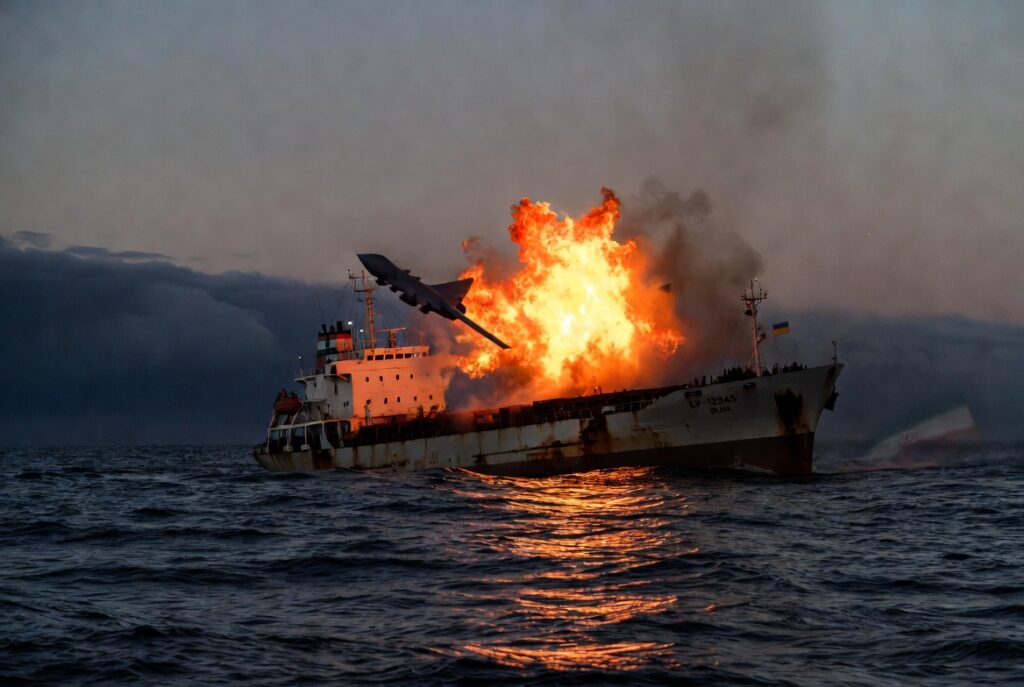
That’s what I keep coming back to when I look at Ukraine’s strike on an Iranian vessel in the Caspian Sea. This wasn’t a random move. Ukraine has been saying for a while now that it’s already at war with Iran, not just Russia. In Kyiv’s eyes, Iran isn’t a bystander. It’s a co-combatant. So I want to walk through why I think Ukraine chose this moment, what weapons it likely used, and where the United States stands in all of this.
Why Ukraine Struck
I see three threads running through this decision, and they all tangle together.
First, Ukraine wants to cut off Iran’s pipeline to Russia. From Kyiv’s perspective, Iran isn’t just a supplier. It’s a participant in the war. Ukraine has said, over and over, that Iran has handed Russia thousands of Shahed attack drones (that’s the exploding drone Iran designed and Russia now builds under license), plus the know-how to manufacture them, along with missiles and artillery shells. Those drones have been hammering Ukrainian cities since 2022. The Caspian Sea matters here because it’s the main shipping lane between Iran and Russia for military cargo. By hitting Iranian ships there, Ukraine raises the cost of that support. It forces Russia to spend resources protecting a route it probably assumed was safe. President Zelenskyy has put it plainly: Iran supplied the weapons that killed Ukrainians, so Iran already attacked Ukraine. In his view, that makes Iran’s supply lines fair targets (Kyiv Independent).
Second, this is Ukraine showing its allies what it’s worth. Ukraine has been under real pressure from the Trump administration to make concessions to Russia. So striking Iran, an adversary the US and Israel both take seriously, lets Ukraine make a case: I’m not just a country asking for help. I’m a partner who can hit back at your enemies too. Ukraine has also started framing its war as one front in a larger fight, an “axis of evil” that links Russia and Iran together. Ukrainian officials describe themselves and Israel as fighting the same war on different fronts. Ukraine’s ambassador to Israel, Yevgen Korniychuk, said as much directly, and Ukraine’s foreign minister, Andrii Sybiha, called Iran “a direct accomplice to Russian aggression against Ukraine” (BBC News). On top of that, Ukraine has built up real expertise fighting off Iranian-made drones, since it’s been dodging them for years. It’s now offering that knowledge to Gulf states and to Israel. That’s not charity. That’s positioning.
Third, Iran isn’t taking this quietly. Tehran has denied arming Russia, called the strike a violation of the UN Charter, and promised to hit back. Iran’s foreign minister, Abbas Araghchi, went further and accused Ukraine of acting “at Israel’s behest” to drag Europe into a wider Middle East war (BBC News). Tehran also told Reuters the strike killed one sailor and injured another, and called it an act of aggression meant to widen the Russia-Ukraine war (Reuters). Ukraine’s ambassador to Israel says the ship was actually carrying drone and missile parts headed for Iran, which, if true, only sharpens the point Ukraine is trying to make (The Jerusalem Post).
Put it all together and here’s what I think is going on. Ukraine sees Iran as an enemy that’s already spilled Ukrainian blood by proxy. Hitting Iran’s supply lines slows Russia down and, at the same time, tells Washington and Jerusalem that Ukraine can carry weight beyond its own borders. It’s a risky bet. Ukraine is opening a second front while it’s still fighting the first one. But Kyiv seems to have decided the payoff, in resources denied to Russia and credibility gained with allies, is worth that risk.
What Weapons Did Ukraine Use?
Ukraine hasn’t said publicly, exactly, what it used to hit these ships. But the pieces we do have point in a pretty clear direction.
Long-range drones are the leading explanation. Ukraine’s Security Service, the SBU, confirmed its drones carried out the strikes (BBC News). The Caspian Sea sits roughly 1,000 kilometers, about 620 miles, from likely Ukrainian launch points. That’s well within range of the long-range drones Ukraine has already used to hit defense plants and logistics hubs deep inside Russia. The Kyiv Post reports that, per the SBU, long-range drones struck several military targets in this operation (Kyiv Post), and The Week describes it as a long-range strike carried out on July 25 (The Week).
Cruise missiles are a real possibility too. Ukraine builds its own cruise missile, the Neptune, and has extended its range. The newer version, sometimes called “Long Neptune,” can reportedly hit targets up to 1,000 kilometers away, which would put the Caspian well within reach (World Ports Organization). Ukraine’s General Staff has said it used Neptune missiles, alongside various attack drones, in strikes on the Russian port of Novorossiysk. So the capability is there.
Naval drones are less likely, but I won’t rule them out. Ukraine has used sea drones like the Sea Baby and the Magura extensively in the Black Sea. These are usually short-range boats, but the updated Sea Baby can reportedly travel over 1,500 kilometers, about 930 miles, and carry up to 2,000 kilograms of cargo (Navy Times). That range would technically cover the distance. But every report I’ve seen describes the Caspian strikes as “drone” strikes without specifying “naval drone,” and getting a sea drone into the landlocked Caspian would take real logistical effort, since that body of water has no direct route from Ukraine’s coastline. So my best guess, based on what’s public, is that this was carried out by air-launched or ground-launched long-range drones, with a Neptune cruise missile strike also plausible.
Bottom line: Ukraine hasn’t confirmed the exact system, but everything points to long-range drones, possibly backed up by cruise missiles.
Where Does the United States Stand?
This is where things get complicated, because Washington’s position here isn’t really about Ukraine and Iran on their own. It’s about what the US is trying to do with Iran overall.
The US just spent 13 nights bombing Iran, then stopped. On July 24, President Trump ordered a pause in strikes on Iran after nearly two weeks of continuous airstrikes. A senior administration official said Trump’s “preference is diplomacy,” while adding that he’s still willing to use force if Iran doesn’t negotiate seriously. Part of the goal here is to open a path toward ending Iran’s blockade of the Strait of Hormuz, a narrow waterway that a huge share of the world’s oil passes through.
Washington already told Ukraine to back off similar strikes. Before this incident, the Trump administration had reportedly warned Ukraine not to attack non-Russian vessels in the Black Sea. That warning traced back to concerns about oil exports, including operations tied to the American energy company Chevron (Kyiv Post, citing The Wall Street Journal). A US official reportedly described the Caspian Pipeline Consortium, the pipeline system that moves Kazakh oil to European markets, as a vital route the US doesn’t want disrupted.
The US hasn’t said anything publicly, one way or the other. No condemnation, no endorsement. But I think the silence says something on its own. The US is trying to open a diplomatic door with Iran right now. It just paused a military campaign to do it. Given that, it would make sense if the US isn’t thrilled about Ukraine escalating with Iran at exactly this moment, even if it isn’t willing to say so out loud.
So here’s how I read the US position: Washington has its own interests, and right now those interests point toward calming things down with Tehran, not stirring them up. Ukraine’s strike doesn’t fit that plan. But since the US hasn’t spoken publicly, this is my inference based on the pattern, not a confirmed policy.
Where This Leaves Things
Pulling it together, I see this as Ukraine acting on a belief it’s held for a while: Iran is already a combatant in this war, not a neutral supplier standing off to the side. By hitting Iran’s supply lines, Ukraine hopes to slow Russia down and prove, to the US and Israel both, that it’s a partner worth backing. Iran is furious and threatening retaliation. The US, caught in the middle of its own delicate diplomacy with Tehran, seems to be staying quiet in public while clearly wanting this kind of escalation to stop. Ukraine is betting that the gains outweigh the risk of a new front. Whether that bet pays off is something we’ll only know with time.
Sources
The Attack on the Iranian Vessel
- Kyiv Independent: Ukrainian forces struck an Iranian vessel transporting military cargo between Iran and Russia in the Caspian Sea, confirmed by the SBU on July 25.
- BBC News: Ukraine dismissed Iranian threats; the strike marks the first direct link between the wars in Iran and Ukraine; SBU said its drones hit an oil platform, a Russian missile boat, and sanctioned cargo ships.
- Reuters: Iran’s Foreign Ministry condemned the attack on an Iranian commercial vessel, which killed one sailor and injured another.
- The Jerusalem Post (search: “Ship struck in Caspian Sea carried Iran-bound drone, missile parts, envoy says”): Ukrainian Ambassador to Israel Yevgen Korniychuk stated the vessel contained drone and missile components bound for Iran.
- Kyiv Post: Iran threatened “unforeseen” consequences following Ukraine’s strikes on vessels carrying military cargo linked to Iran.
Iran’s Reaction and Accusations
- BBC News: Iranian Foreign Minister Abbas Araghchi called the attack “a blatant UN Charter violation done at Israel’s behest to drag Europe into its war,” saying it “CANNOT GO UNANSWERED.”
- Reuters: Tehran called the strike an act of aggression and accused Ukraine of trying to expand the Russia-Ukraine war.
- TASS (search: “Ukraine’s attack on Iranian ship done at Israeli behest to drag Europe into war — Araghchi”): Iran’s foreign minister accused Ukraine of attacking the Iranian merchant ship at Israel’s behest.
- Kyiv Post: Iran’s foreign ministry called the attack “an absolutely illegal and unjustified act, contrary to the Charter of the United Nations.”
Ukraine’s Motivation
- BBC News: Ukraine’s ambassador to Israel said Ukraine and Israel face the same “axis of evil” on different fronts; Ukraine’s foreign minister called Iran “a direct accomplice to Russian aggression against Ukraine.”
- Kyiv Independent: President Zelensky said Moscow has coordinated with Tehran to share satellite imagery of US and Gulf military installations.
Weapons Used by Ukraine
- BBC News: The SBU said its drones hit an oil platform, a Russian missile boat, and cargo ships.
- The Week (search: “Ukraine’s drone strike on an Iranian ship explained: A new front opens”): Reports a long-range strike carried out July 25.
- Kyiv Post (search: “Zelensky Confirms Strikes on Russian Air Defenses, Sanctioned Sea Ships, and Deep Logistics”): SBU says long-range drones struck several military targets.
- World Ports Organization (search: “Ukraine Attack affected 2% of global oil supply”): Ukraine’s General Staff says it used Neptune cruise missiles and attack drones against Novorossiysk; a longer-range “Long Neptune” has been developed.
- Navy Times (search: “Ukraine is launching strike-drones from everything – including Black Sea robo-boats”): Sea Baby strike boats can carry FPV drones; updated versions travel over 1,500 km carrying up to 2,000 kg of cargo.
The United States’ Position
- Kyiv Post, citing The Wall Street Journal: The Trump administration formally warned Ukraine against attacking non-Russian vessels in the Black Sea, following strikes that disrupted oil operations tied to Chevron; a US official called the Caspian Pipeline Consortium vital for Kazakh energy exports to Europe.
- Reuters: Provides broader context on the US-Iran conflict during this period.