
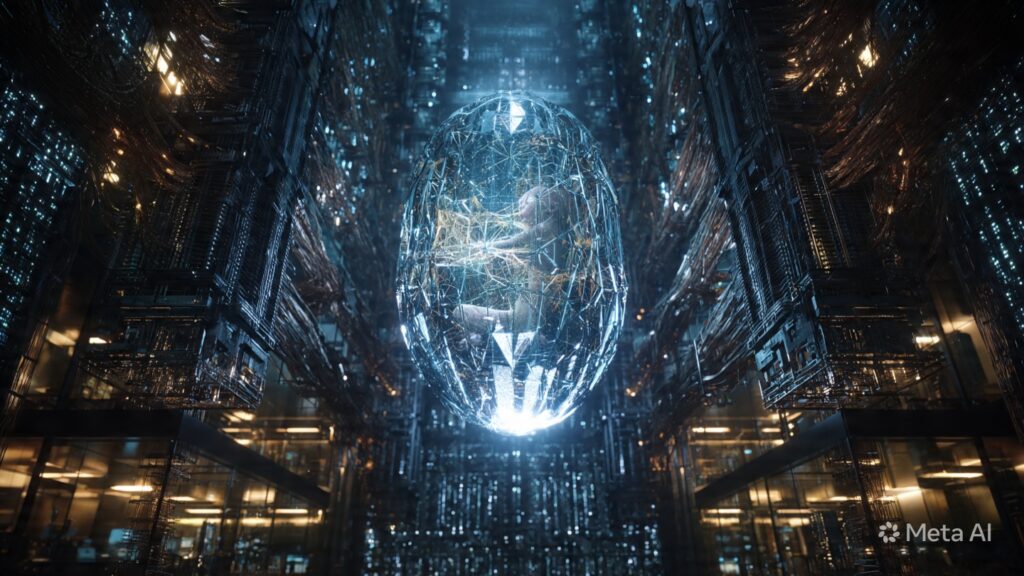
A Fetus in the Womb
The most honest thing anyone can say about artificial intelligence right now is that we don’t know what it is yet.
Not in the dismissive sense — the technology is real, the capabilities are genuine, and the implications are serious. But in the literal developmental sense: the architecture that will define mature AI has not been found. The principles that will govern its energy consumption, its physical footprint, its relationship to memory and processing — none of that is settled. The thing currently receiving trillions of dollars in infrastructure investment is not a finished technology. It is a proof of concept with a venture capital valuation.
It is a fetus in the womb.
Fetuses are not nothing. They are remarkable, complicated, history-making — full of potential and real in every meaningful sense. But you don’t know what color their eyes will be. You don’t know if they’ll be left-handed. You certainly don’t know what they’ll become. Anyone who claims to know the adult form of AI from its current embryonic state is either confused about what they’re looking at or hoping you are.
The specific form of that uncertainty is not a minor technical footnote. It is the central fact that makes the current infrastructure bet so strange — and so dangerous for the people not making it.
The Position Bet
To understand why serious, intelligent people are committing incomprehensible sums to build infrastructure for an unfinished technology, you have to understand the logic that drives them. It is not irrational. It is not even wrong, exactly. It is just operating on a very particular set of assumptions.
The logic goes like this: If there is even a modest probability that AI becomes the substrate of economic and military power — the thing that determines who wins wars, who controls supply chains, who sets the terms of global finance — then being late is existential and being early is merely expensive. The asymmetry is so extreme that “too early” becomes the rational error. In that framing, wasting $500 billion on infrastructure that turns out to be premature is survivable. Being absent when the capability arrives is not.
That reasoning has historical precedent. It is the same logic that built railroads into wilderness with no passengers waiting, that drove the trans-oceanic cable-laying boom of the 1850s before enough traffic existed to justify it, that financed laying millions of miles of fiber optic cable in the late 1990s that sat dark for a decade before the internet finally grew into it. In each case, the early investors were mostly wiped out, and the early infrastructure mostly survived to be used by people who had nothing to do with building it.
The current investors understand this history. Several of them have said explicitly that they expect to be early. What they are buying is not a technology that works today. They are buying position.
Position for what? For the moment the capability arrives. For the chokepoint. For the door to be already under their hand when everyone else is still looking for the building.
Enclosing the Commons
The race to build AI infrastructure looks, from a certain angle, less like technology investment and more like a land grab.
The ingredient list for mature AI — wherever the technology eventually lands architecturally — has some components that are likely to be durable: raw compute capacity, energy supply, and the physical real estate to co-locate them. The investors who understand this are not buying the current AI architectures per se. They are buying the conditions that will be necessary regardless of which architectural path wins. Whoever controls those conditions when the capability arrives controls the chokepoint.
That framing makes the current moment look less like the development of a technology and more like the enclosure of a commons before the borders are drawn. The scramble for energy access, for grid capacity, for cooling water rights, for fabrication capacity — this is not optimizing for a specific product. This is claiming territory.
The investment itself is part of what gestates the thing. The womb is made of compute, energy, talent, and data pipelines. The fetus cannot develop without the womb. So the act of building infrastructure is not just a bet on an outcome — it is a contribution to the process by which the outcome becomes possible. That makes the bet partially self-fulfilling in a way that most infrastructure bets are not.
But self-fulfilling does not mean certain. The self-fulfilling part is the gestation. What gets born is still unknown.
The Wright Flyer and the Runway
In 1903, Orville and Wilbur Wright spent roughly $1,000 — profits from a bicycle shop — to build and test the first heavier-than-air powered aircraft at Kitty Hawk, North Carolina. The flight lasted twelve seconds and covered 120 feet. It was the most important twelve seconds in the history of transportation.
It was also a proof of concept, not a blueprint.
The massive physical infrastructure of modern aviation — concrete runways, air traffic control networks, international terminals, instrument landing systems, pressurized cabins, jet fuel supply chains — was not built in anticipation of that twelve-second flight. It was built after decades of incremental development, after the technology stabilized, and most critically, after the Douglas DC-3 in the 1930s demonstrated that commercial aviation could pay for itself. The infrastructure followed the viable technology. It did not precede it.
Notice also what the Wright brothers did not do. They did not petition the state of North Carolina to pave the Outer Banks in anticipation of their test. They did not demand public funds to grade the field at Kitty Hawk. They did not ask ratepayers to subsidize the infrastructure for a machine nobody had yet proven could fly. They used their own money. They bore their own risk. When the Flyer lifted off the sand for twelve seconds, nobody’s retirement account was on the line but theirs.
The Transformer architecture — the large language model as we currently know it — is the Wright Flyer. It is a genuine, landmark proof of concept. It demonstrated that something previously thought impossible was actually possible. That deserves recognition. It does not deserve the immediate construction of O’Hare International Airport.
We are building millions of miles of runway for a wooden glider.
The Concorde Problem
The Concorde was the fastest commercial passenger aircraft ever built. It flew at Mach 2, carried passengers across the Atlantic in three and a half hours, and was an astonishing feat of engineering and national ambition. It was also commercially catastrophic — not beaten by anything faster or better, but grounded by the discovery that the premium was unnecessary.
The Concorde was too loud to fly overland without regulatory restrictions that limited it to transoceanic routes. It burned so much fuel that tickets cost so much that only a tiny elite could afford them. The mass market it needed to survive did not want what it offered. The version of aviation that won was not the supersonic one. It was the efficient one — the 737 and the A320, cheap enough and practical enough to move the world.
Today’s AI flagship models — trillion-parameter foundation models running on clusters of specialized chips, consuming the power budget of a small city, cooled by water diverted from regional watersheds — are Concordes.
They are magnificent. They are technically extraordinary. And the bet being placed is that they are also the only possible form of the technology, or at least the dominant one. That bet is contestable.
The risk to current AI infrastructure is not a superior intelligence. It is a sufficient one.
Small, efficient, local models running on commodity hardware are already demonstrating capabilities that, a year ago, would have required a data center. The trajectory of that development is not secret. If it continues — not even accelerates, just continues — the cathedral-scale infrastructure looks less like a necessary investment and more like a supersonic jet: magnificent, prestigious, and commercially beside the point.
What the Dog Knows
A dog’s brain runs on roughly one Watt of continuous power. That is less than an LED night-light. The brain-specific fuel cost is approximately thirteen kilocalories per day — roughly half an ounce of kibble.
A large language model requires more than 700 Watts during active generation. One complex query consumes the energy equivalent of four hours of a dog’s total brain activity.
The dog is performing real-time, zero-latency, multi-modal inference. It is tracking scent across concentration gradients, interpreting the emotional state of a human from micro-expressions and vocal tone, and calculating the physics necessary to catch a thrown object in midair. It is doing this continuously, in parallel, at a power budget cooled by panting.
The large language model is doing this with an electrical grid, millions of gallons of cooling water, a global semiconductor supply chain, and the retirement savings of schoolteachers in the American Midwest.
The technical reason for this disparity has a name: the Von Neumann bottleneck. Digital computers, since their invention in the 1940s, have separated the place where information is stored from the place where information is processed. Every computation requires shuttling data back and forth across that divide, and the energy cost of the shuttling vastly exceeds the energy cost of the arithmetic itself. The architecture that made computers programmable and universal also made them fundamentally inefficient at the kind of inference biology performs effortlessly.
A biological brain does not have this problem. The synapse is both the storage and the processor. The computation happens at the site of the memory. There is no bottleneck because there is no separation. The architecture is what makes the one-Watt brain possible.
We are burning geological-scale resources to mimic, imperfectly and at enormous cost, what evolution solved for free in a medium it built from scratch over four hundred million years.
That is not an argument against AI. It is an argument that the current architecture is a first attempt, not a final answer.
The Forty-Year Clock on a Five-Year Bet
Infrastructure has a time horizon problem that nobody discusses honestly.
Data centers are being designed and financed with forty-year asset lives. The grid infrastructure being built or upgraded to support them — new transmission lines, substations, dedicated generation capacity — has a similar duration. The land rezoned, the aquifers committed, the communities reorganized around their presence: all of that carries long-duration consequences.
The capital financing this infrastructure has a patience measured in years. Venture funds typically return money in seven years, which means the AI bets sitting inside them need to generate returns before the capability questions are anywhere near resolved. Hyperscalers are deploying retained earnings their core monopolies — search, e-commerce, cloud — replenish quarterly, but their quarterly reporting cycles create enormous pressure to show progress on timelines that would embarrass a geologist.
The capability claims justifying the investment have an eighteen-month half-life. What counts as a breakthrough in AI has been redefined so many times in the past five years that any specific benchmark claimed today is likely to be either superseded or recontextualized within the financing window of the infrastructure being built to support it.
Vacuum tubes were still shipping in Soviet military avionics into the 1980s. The MiG-25’s radar ran on tubes partly because they are naturally hardened against electromagnetic pulses — a property solid-state electronics do not share. Technological succession is not extinction. It is exile to niches where the old physics still wins. Superseded architectures do not vanish. They get stranded in the capital accounts of people who bet forty-year assets on a five-year technology roadmap.
The Railroad That Remembered Its Investors Wrong
The 19th-century railroad booms are the textbook example of capital outrunning utility. The transcontinental and regional lines that opened up the American interior were capitalized by successive waves of investors who lost their money with impressive regularity. Railroads went bankrupt in waves — 1873, 1893, the early 1900s — taking bondholders, shareholders, and regional banks with them. The railroad barons are remembered as titans, but the people who actually financed the tracks mostly lost everything.
What survived was the infrastructure. The tracks stayed in the ground after the capital fled. And the people who won — who actually captured the value the railroads made possible — were not the railroad investors. They were the Sears, Roebuck & Cos. who understood that cheap, reliable, nationwide distribution had just been built at somebody else’s expense, and built entirely new business models on top of the abandoned, commoditized infrastructure.
The winners used the tracks. They didn’t build them.
The current moment is the track-building phase. The capital being deployed is the railroad bond of its era — speculative, asymmetrically exposed to downside, and largely owned by people who will not be around for the payoff. The businesses that capture the actual value of AI may not exist yet. They will be built on top of whatever infrastructure survives the bust, by people who had nothing to do with the original bet.
That is not a criticism of the bet. It is a description of how these cycles work. The criticism is something different, and it comes later.
The Gambler Who Calls Himself a Strategist
The gambler’s reasoning is indistinguishable from the strategist’s until the dice land.
“I couldn’t afford not to bet” sounds exactly like prudence in the casino and exactly like prophecy in the boardroom. The logic is the same. The asymmetry argument — catastrophic downside to absence, manageable cost to premature arrival — is coherent in both settings. The difference, most of the time, is survivorship. The railroads that bankrupted three generations of investors get remembered as nation-building because the track survived even when the capital did not. The investors who funded the transcontinental lines get a heroic chapter in the history books; the widows and pension funds that held the bonds they defaulted on do not.
Concorde’s backers were visionaries until they were cautionary tales. Nothing about their reasoning changed in between. The same analysis that made the project look compelling in 1962 made it look foolish in 2003. The facts changed. The rhetoric describing the investment did not.
The AI infrastructure bet is currently in the visionary phase. The reasoning is being described as strategic inevitability. That is what this phase always sounds like.
Meanwhile, consider what this phase looks like from a different vantage point.
Northern Virginia is the largest data center market in the world — larger than the next five largest U.S. markets combined. The servers that process a significant portion of the planet’s internet traffic hum in long low buildings along the Route 28 corridor, drawing power at a scale that has made the region a permanent fixture in every utility planning document in the mid-Atlantic. In 2024, Dominion Energy disconnected 339,000 Virginia households from electrical service for nonpayment. That same year, Appalachian Power disconnected another 43,000 customers in the state. The Energy Justice Lab at Indiana University found that Virginia had one of the highest utility disconnection rates in the nation. Since 2022, the twelve-month running average of disconnections in Dominion’s service area has increased by 1.1 percentage points — the same period in which data center metered load in that service area grew by 31 percent.
These are not separate facts. They are the same fact described from two different floors of the same building.
At the World Economic Forum in Davos in January 2026, Microsoft CEO Satya Nadella told the assembled leadership of the global economy that “the cost of energy will be a key indicator of deciding which country will emerge as the winner in the competitive AI race,” and that AI labs must build “a ubiquitous grid of energy and tokens.” He was not wrong about the strategy. He was describing, from the stage of the most powerful economic gathering on earth, the mechanism by which a family in Woodbridge, Virginia falls behind on its electric bill while a server farm three miles away runs continuously, twenty-four hours a day, on rates structured so that the grid upgrades required to serve it are recovered from everyone.
The gambler calls it nation-building. The disconnected household calls it Tuesday.
Accountability Arbitrage
Here is the moral core of the problem.
The man who loses everything at the dice table loses his own everything. He borrowed nothing from his neighbors, committed no one else’s savings, and exacted no toll on the community around him. When he is wrong, the damage is his.
The AI infrastructure wager is not structured that way. Almost nobody throwing the dice is staked to that degree.
Venture funds are managing money that belongs, in significant part, to pension funds and university endowments. The general partners who make the bets collect their two percent management fee on committed capital regardless of performance. A fund managing 10 billion in AI bets earns 200 million per year before a single portfolio company generates a dollar of revenue. If the bets fail, the GP survives. The pension beneficiary takes the loss.
Hyperscalers committing hundreds of billions to AI infrastructure are betting retained earnings, but their core monopoly businesses — search advertising, e-commerce logistics, cloud computing — are so structurally dominant that they replenish capital quarterly. The AI bet is underwritten by the monopoly rents from businesses that predate it. If the AI infrastructure bet craters, the monopoly survives. The entity making the bet is insulated from the failure by a set of advantages it did not earn in the AI market.
Sovereigns committing public capital to AI are treating the expenditure as a national security mandate, burying the cost in public debt, and measuring success on hundred-year strategic clocks. That framing is not necessarily wrong — there are genuine security dimensions to this technology — but it immunizes the decision from the discipline that private capital failure would impose. The sovereign does not go bankrupt in the way a corporation does.
When the bet goes badly, the losses distribute downward through the system to people who had no voice in the decision.
Index fund investors — the retirement accounts of ordinary workers heavily exposed to a handful of technology companies — absorb the equity drawdown.
Ratepayers watch utility bills climb to fund grid expansions being built for data centers in their regions, expansions their utilities are required to make and are allowed to recover through rates regardless of whether the data center’s operator remains solvent.
Communities that rezoned agricultural land, displaced tax base, and reorganized their infrastructure around server farms find themselves hosting facilities that employ fewer than thirty people full-time and may go dark the moment the economics shift.
The gamble is collective. The ruin is distributable. The upside is private.
This is not capitalism. Capitalism requires that the people bearing the risk are the people collecting the reward. This is accountability arbitrage — the systematic separation of decision-making authority from financial consequence at civilizational scale.
We Are Not Anti-Progress. We Are Anti-Theft.
None of the above is an argument that AI is fake, that the technology is a fraud, or that the people building it are villains. Most of them are not. Many of them genuinely believe in what they are building. Some of them are right.
The argument is narrower and more specific: the people making the bets are not bearing the risk of the bets in proportion to their authority over the decision. That asymmetry is the problem, and it is a solvable one. The solution is not to stop building AI. It is to stop externalizing the cost of building it onto people who have no say and no upside.
The Wright brothers did not demand the public pave North Carolina to test the Flyer. They had an idea, they had a bicycle shop, they had four years and $1,000, and they found a windy beach and tried it. When it worked, the proof was on them. When it didn’t work — and it didn’t work many times before it did — the loss was on them.
That is the model. Proof of concept at your own expense. Infrastructure after the concept is proven. Public resources when the public is offered ownership.
What a Dark Data Center Leaves Behind
The question worth asking — the one nobody building these facilities wants to engage with — is what happens when one goes dark.
It is not a hypothetical. Data centers do go dark. The crypto mining boom of 2017 to 2022 left a trail of abandoned facilities — stripped buildings, overwhelmed local grids, aquifers drawn down for cooling water that was never replenished. Some of those sites became environmental liabilities before the bankruptcy proceedings were finished. The buildings themselves are specialized enough that repurposing them is not straightforward: the raised floors, the precision cooling systems, the security configurations, the sheer electrical density of the infrastructure — none of it translates naturally to a warehouse or a school or a community center. You cannot walk through a decommissioned data center the way you walk a rail trail through a mountain cut.
But some things do survive.
Fiber runs. The conduit is in the ground and it stays there, because it costs more to dig it up than to leave it. Grid connections — substations, upgraded transmission lines, new generation capacity — those are physical assets with their own logic and their own longevity. In some cases, the land itself, rezoned and graded and connected to infrastructure it would never have had otherwise, acquires a value that outlasts the original purpose. These are not nothing. A community with fiber to every building and a grid connection rated for industrial load has assets a community without them does not.
The question is who controls those assets after the capital leaves. The answer, in most historical precedents, is not the community. It is whoever holds the deed and the interconnection agreement. The value flows upward on the way in and upward on the way out. The community absorbs the disruption in both directions — the rezoning fights, the water table anxiety, the utility rate increases on the way up; the hollowed-out tax base and the stranded infrastructure on the way down.
The builders of this era are selling civilization transformation. The actual legacy, if the bet goes wrong, is more likely to be a fiber conduit in a field and a substation no one needs anymore — the physical residue of someone else’s ambition, left in the care of people who never had a vote.
Human sovereignty does not need a utopia or a catastrophe to assert itself. It just needs to still be standing when the money has moved on.
Eyes Wide Open
Something as consequential as the birth of a new form of intelligence deserves to be handled with clear eyes — by everyone involved and, more importantly, by everyone affected. That is everyone. The decisions being made in boardrooms, at regulatory hearings, in legislative chambers where lobbyists outnumber constituents, will determine the shape of the infrastructure underlying the next century of human life. They are being made right now, mostly without the people who will live with the consequences having any meaningful say.
There are moments when speech matters more than having the perfect answer. This is one of them. You do not need a complete economic alternative. You do not need a finished architectural proposal or a policy paper with footnotes. You need to say: this is happening, I am here, and I am not willing to be treated as a line item in someone else’s balance sheet.
This essay is that speech. It is offered at what feels like the “speak now or forever hold your peace” moment of this particular event — not because silence is consent, but because history has a way of treating silence as consent anyway. The record should show that not everyone was asleep, not everyone was dazzled, and not everyone agreed that the cost was someone else’s problem to bear.
I have no doubt that a far more efficient, staggeringly more powerful form of artificial intelligence lies ahead. The trajectory is real. The endpoint may be genuinely transformative in ways that justify some of the language currently being used to describe it. None of what is written here is a counsel of despair.
But the current architecture is first-generation. The energy inefficiency is structural, not incidental. The infrastructure being built to serve it is financed by capital that will not be patient enough to see whether the paradigm holds, managed by people whose compensation is insulated from failure, and underwritten by costs that will land on people who never made the bet and were never asked.
The Wright brothers didn’t steal anyone’s money to build the Flyer.
Be curious. Be optimistic. But stop stealing my money to pay for your parties.