
Two questions get asked together so often that they can sound like one question. They aren’t. “Where is AI headed?” is a question about engineering — about what frontier labs can build next. “Can the world’s nations keep up?” is a question about power — about who can afford to build it, who controls the inputs, and who gets a vote on the rules. The honest answer to the first question is that AI is shifting from a race to build the smartest model toward a race to control the physical and legal stack underneath it: chips, power, capital, and law.1 The honest answer to the second is that most countries were never actually in that race. They are choosing, or being forced into, a different one — over access, influence, and the terms of dependency.
This essay tries to keep those two questions separate, the way the evidence keeps them separate. It draws on trade data, corporate disclosures, export-control filings, and the public statements of the governments and companies doing the building. Where the record is genuinely unsettled — chip smuggling volumes, the durability of open-weight models, whether global governance can hold — it says so.
1. The technology is bending toward agents, not just scale
For several years, the dominant strategy in frontier AI was simple: more data, more parameters, more compute. That strategy is running out of runway. Parameter growth in the largest frontier models has slowed to roughly 5 percent a year since 2021, compared with more than a hundredfold expansion between 2019 and 2021, according to research firm Omdia.2 Omdia’s own analysts don’t attribute the slowdown to an AI winter. They attribute it to a shift in where performance comes from: agents that use tools, plan multi-step tasks, and call external systems, trading cheap CPU cycles for costlier GPU ones as they do it.3
That shift shows up across the leaderboard. The top score on the Artificial Analysis Intelligence Index rose from 51 to 60 in the first part of 2026, with OpenAI’s GPT-5.5, Anthropic’s Claude Opus 4.7, and Google’s Gemini 3.1 Pro effectively tied at the frontier.4 More telling is what’s happening one tier down: the gap between the best open-weight models and the proprietary frontier has narrowed to roughly six points on the same index, and models like DeepSeek V4 and GLM-5.1 are matching proprietary systems on many benchmarks using sparse attention and mixture-of-experts architectures that cost less to run.5 Long context has also stopped being a marketing number. Claude 4.7 and GPT-5.5 both operate in the range of a million effective tokens, and — unlike the retrieval workarounds common a year earlier — the models now appear to reason coherently across that whole window rather than skimming it.6
Agentic deployment is real but uneven. Coding agents drove most of the commercial growth for AI companies in 2025; 2026 has brought the first wave of agents built for other domains, including desktop tools like Anthropic’s Claude Cowork that read, edit, and organize files across multi-step tasks.7 Enterprise adoption tells a more sober story: McKinsey found only 23 percent of enterprises are actually scaling AI agents in production, with 39 percent still stuck in pilots.8 Gartner’s own projection — that AI agents will make 15 percent of daily work decisions autonomously by 2028, up from nearly zero today — is itself a forecast, not a measurement.9 The gap between announcement and deployment, in other words, is one of the least settled parts of this story.
What is settled is the direction: the industry has moved from asking whether a model can see an entire document to asking whether it can act coherently across a long, multi-tool, multi-day task. That’s a more expensive and more infrastructure-dependent kind of intelligence than the chatbot era required.
2. Compute becomes the new oil
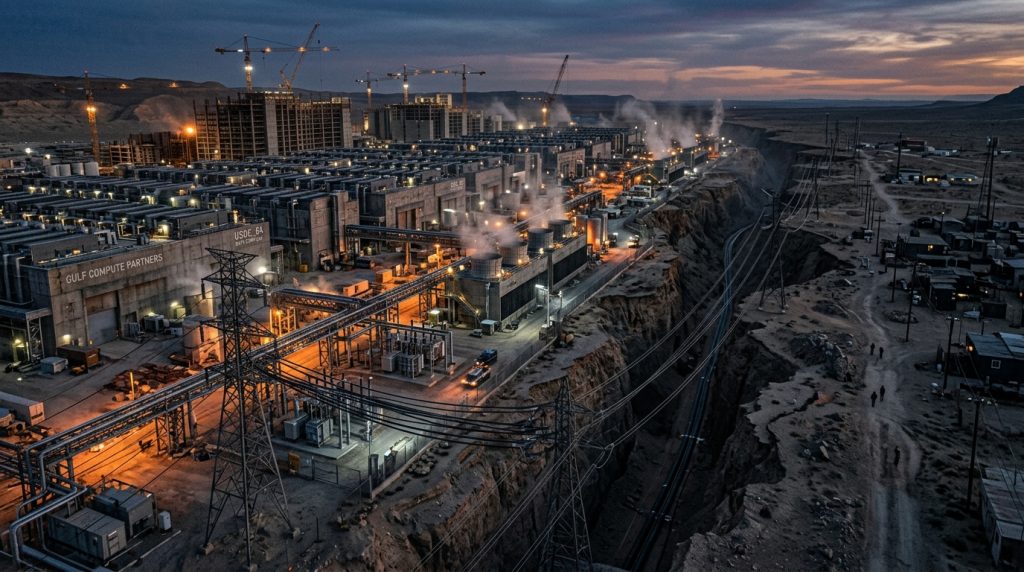
If model architecture is the visible layer of this transition, the physical layer underneath it is where the money — and the geopolitics — actually sits. It is also where the financial risk is most concentrated; the tech sector is effectively racing to finance an infrastructure for a level of agentic deployment that enterprises have not yet proven they can execute. A think tank paper from the Geopolitics of AI research group frames 2026 as the year the contest moved “from chip war to system control”: the relevant question is no longer only who has the best model or the most advanced chip, but who can finance, host, power, secure, and operationalize AI computing at scale.10
The numbers behind that claim are large enough to function as their own argument. Carnegie Endowment researchers describe the current buildout as “one of the largest peacetime industrial mobilizations in history”: American technology companies alone will spend roughly $670 billion — about 2 percent of U.S. GDP — on compute clusters this year, with global spending on data centers approaching $1 trillion.11 McKinsey estimates data centers will require $6.7 trillion in capital by 2030, with $5.2 trillion of that going specifically toward AI-capable capacity.12 As of May 2025, close to three-quarters of the world’s advanced AI computing clusters sat on American soil, and the U.S. still hosts roughly half of all global data centers.13 Federal Reserve figures cited by researchers at Humane Intelligence put the U.S. share of global high-end AI compute at about 74 percent, against 14 percent for China and under 5 percent for the entire European Union.14
That concentration is now colliding with a harder constraint than money: power. McKinsey projects global data-center capacity demand could more than triple by 2030, with roughly 70 percent of that growth driven by AI workloads, and the International Energy Agency projects a refined-copper deficit of more than 300,000 tons in 2025 alone, a material bottleneck for the networking infrastructure new campuses need.15 In the U.S., electricity demand from data centers could reach 325 to 580 terawatt-hours by 2028 — 6.7 to 12 percent of total national electricity consumption — a trajectory the World Economic Forum now describes as reason to treat AI infrastructure as critical national infrastructure, comparable to ports or power grids, rather than ordinary commercial real estate.16 Time-to-power, not chip availability, is emerging as the single biggest driver of where new compute gets sited.17
Everyone without America’s existing capital markets and grid capacity is responding by leaning on whatever comparative advantage they actually have. The Gulf states are leaning on energy and sovereign capital to cement their roles within a formidable strategic technological bloc. Alongside the U.S. and Israel, Saudi Arabia and the UAE are forming a four-nation coalition that pools American models, Israeli tech infrastructure, and Gulf capital and grid capacity. Saudi Arabia’s Public Investment Fund launched HUMAIN in May 2025, with partnership announcements covering several hundred thousand Nvidia GPUs over five years, a $10 billion, 500-megawatt deployment with AMD, and a $5 billion AI zone with AWS.18 The UAE’s Stargate UAE project — backed by G42, OpenAI, Oracle, Nvidia, and SoftBank — is targeting five gigawatts of total campus capacity, with its first 200-megawatt block scheduled to come online in the third quarter of 2026.19 Europe is leaning on regulation and coordinated public investment: its 2025 AI Continental Action Plan calls for 19 “AI Factories” to serve startups and researchers and up to five larger “AI Gigafactories” to train general-purpose models, an effort to build what officials call a European tech stack rather than remain dependent on American cloud providers.20 Stanford’s AI Index reports that Europe and Central Asia expanded state-backed AI supercomputing clusters from 3 to 44 between 2018 and 2025 — rapid growth in relative terms, still a fraction of American and Chinese capacity in absolute terms.21
3. From chip war to system war
The compute buildout doesn’t happen in a policy vacuum. Washington has spent four years converting semiconductor export policy from a paper licensing regime into something closer to active hardware and software tracking, and the pace of change has accelerated sharply in 2026.
The framework as of this writing has several layers, and it has moved fast enough that any snapshot risks going stale within months:
| Date | Development |
|---|---|
| January 2025 | Biden administration’s AI Diffusion Rule creates a three-tier framework across 120-plus countries: unrestricted access for close allies, licensed access with compute caps for most of the world, and an outright ban for China, Russia, and a handful of other states.22 |
| May 13, 2025 | The Bureau of Industry and Security rescinds the Diffusion Rule two days before it was due to take effect.23 |
| January 13–15, 2026 | New rule shifts Nvidia H200 and AMD MI325X exports to China from “presumption of denial” to case-by-case review, paired with a 25 percent tariff, a volume cap near one million units, and end-use certification requirements; exports to China-owned data centers located outside China remain presumptively denied.24 |
| April 2026 | The H20 is banned outright; Huawei’s Ascend 910C is added to the restricted list; Nvidia records a multi-billion-dollar inventory write-down tied to restricted China-bound product.25 |
| May 2026 | Reports describe a 25 percent “revenue-for-access” charge on H200-class sales to China, up from 15 percent on the H20 — a mechanism whose legal basis under export-control and federal user-fee law is actively contested.26 |
| June 2026 | The U.S. suspends Chinese access to Anthropic’s Mythos and Fable models and extends export-style controls to OpenAI’s GPT-5.6, using existing Export Administration Regulations authority rather than new legislation — the first clear move of controls from hardware to the model layer itself.27 |
| July 23, 2026 | A White House official tells reporters Moonshot AI accessed Nvidia chips despite the export ban and distilled Anthropic’s Fable model in building its K3 model — the same kind of “industrial-scale” extraction Anthropic alleged earlier in the year.28 |
Analysts disagree sharply on what all of this has actually accomplished. One estimate suggests China can produce advanced chips at only 1 to 4 percent of U.S. production capacity, a share expected to fall further to 1 to 2 percent in 2026 as American and allied chipmakers keep scaling; on that view, even full legal access to H200-class chips would leave the U.S. holding a 21-to-49-times compute advantage over China this year.29 Other researchers argue the controls have simply pushed the problem underground: enforcement gaps, false end-use certifications, shell companies, and transshipment networks through Southeast Asia are eroding the restrictions in ways paper compliance can’t close, and cloud-based access to restricted compute remains the least-governed circumvention route of all.30 The U.S. House passed the Remote Access Security Act by a 369–22 vote specifically to close the cloud-GPU rental loophole, which is itself an acknowledgment that the loophole exists and matters.31
What’s genuinely unknown is which of these two pictures — a durable American lead, or a slower but real Chinese catch-up sustained through workarounds — will look correct in five years. Both camps are working from real data. Neither has a complete one.
4. A world of uneven rules
Underneath the infrastructure race sits a governance race that is fragmenting faster than the technology is converging. More than seventy countries now have some form of national AI strategy, but only about twenty-seven have passed binding AI-specific legislation, and the ones that have chosen genuinely incompatible approaches.32 The European Union enforces mandatory, rules-based compliance. Transparency obligations under the AI Act become enforceable on August 2, 2026; high-risk system obligations for most standalone systems were deferred to late 2027 by the Digital Omnibus package. A separate compute threshold at 10^{25} floating-point operations continues to pull any model trained at that scale into “systemic risk” (GPAI) obligations, with fines up to 7 percent of global turnover, regardless of where its developer is based.33 The United States has moved toward federal deregulation even as individual states fill the gap; more state AI bills passed in 2026 than in any prior year, and California’s Transparency in Frontier AI Act and Texas’s Responsible AI Governance Act both took effect January 1.34 Asia-Pacific has mostly chosen voluntary frameworks, with two notable exceptions: Singapore launched the world’s first governance framework specifically for agentic AI on January 22, 2026, and South Korea’s AI Basic Act took effect the same day as the region’s first binding comprehensive AI law.35
For most of the rest of the world, the more basic problem isn’t which regulatory philosophy to choose. It’s whether any regulation can actually be enforced once it’s written. The AGILE Index, which tracks AI governance capacity across forty countries, finds a gap of more than forty percentage points between high-income and middle-income countries in their practical ability to implement the rules they pass — a gap researchers describe as structural rather than a matter of political will.36 The pattern shows up in specific cases. Ghana’s National AI Strategy launched in October 2023; its cabinet didn’t approve it until February 2026, and the Responsible AI Office the strategy promised still doesn’t exist.37 Rwanda’s National AI Policy, approved in April 2023, carries an estimated implementation cost of $76.5 million over five years; as of the most recent reporting, only $1.2 million had been mobilized, and its own Responsible AI Office has not opened.38 Indonesia adopted an AI strategy in 2020 running through 2045 and calling for an AI Ethics Council that still doesn’t exist; in 2024 the country suffered a major breach of its National Data Centre while simultaneously rolling out facial recognition for law enforcement with no legal framework governing it at all.39
Representation in the rooms where global rules get written is similarly lopsided. Fewer than 7 percent of the roughly 500 AI policies issued globally so far originate from Latin America and Africa combined.40 The clearest attempt to correct that imbalance to date is the India AI Impact Summit, held in New Delhi from February 16 to 21, 2026 — the first Global South country to host in the summit series that began at Bletchley Park in 2023 and continued through Seoul in 2024 and Paris in 2025.41 Its outcome document, the New Delhi Declaration on AI Impact 2, had ninety-two signatory countries as of March 2026, though — consistent with the pattern above — the declaration is a statement of principle, not a binding instrument.42 The United Nations followed with a Global Dialogue on AI Governance that opened in Geneva on July 6, 2026, one week after an Independent International Scientific Panel on AI released a preliminary report warning that current safeguards “cannot keep pace” with the technology’s advance.43 Secretary-General António Guterres framed the stakes bluntly at the opening: “AI is advancing at runaway speed. The question is whether we will govern it together — or let it govern us.”44
Whether that framing will produce anything binding is an open question, and the researchers who study this closely are not optimistic. A Chatham House analysis published in March 2026 argues that durable, coordinated AI governance may only emerge in response to a crisis severe enough to make the political cost of continued fragmentation exceed the cost of coordination — and notes that even the EU, long the standard-bearer for rules-based AI regulation, has begun shifting its own emphasis from safety toward “competitiveness” under industry pressure and concern about a U.S. backlash.45 Researchers at CSIS make a related point about the Global South specifically: infrastructure access without a seat at the governance table just changes who is dependent on whom, since most of the substantive rules are still being written in Washington, Brussels, and Beijing.46
5. What “keeping up” actually means
Separating what the evidence shows from what it’s reasonable to believe matters here, because the two get blended constantly in AI commentary.
The evidence shows a real and, on most measures, widening compute gap between a small number of states and everyone else. It shows export controls that have gotten more aggressive and more technically sophisticated over the past year, reaching from hardware into the models themselves, while also showing measurable gaps in enforcement. It shows more countries writing AI strategies than ever before, and a comparably large — sometimes larger — number of those same countries lacking the institutional capacity to enforce what they’ve written. It shows genuine, well-funded attempts by the EU, India, and the Gulf states to carve out partial independence from the U.S.-China axis, using different comparative advantages: regulatory coordination, population and talent, and energy capital, respectively.
What’s less settled, and more a matter of informed judgment than established fact, is how much the diffusion of open-weight models changes the picture. A country or company that can’t build a frontier lab can still run a near-frontier open-weight model on rented or domestically built hardware at a fraction of the cost of training one from scratch. That is a real, if partial, counterweight to compute concentration — it’s the one trend in this landscape that plausibly favors smaller states rather than large ones. Whether it’s enough to offset the infrastructure and governance gaps described above is not something the current data can answer with confidence. Reasonable analysts disagree, and this essay does not pretend to resolve that disagreement.
What can be said with more confidence: for the overwhelming majority of nations, “keeping up” with AI will not mean building competitive frontier capability. That contest is effectively closed to all but a handful of state and corporate actors with the capital, energy, and chip access to run it. The more realistic and more consequential contest — over deployment choices, data governance, access terms, and a voice in the emerging multilateral rules — is still open, but the window several Global South delegations have described as twelve to eighteen months wide is closing.47 Whether that window produces meaningful influence or simply formalizes the current dependency is the question the next two years will answer, and it is, for now, genuinely unknown.
Notes
[1] Geopolitics of AI, “From Chip War to System Control: AI Geopolitics in the First Half of 2026,” June 8, 2026, https://www.geopoliticsofai.com/research/from-chip-war-to-system-control-ai-geopolitics-h1-2026.
[2] Omdia, “Frontier AI Model Growth Slows as ‘Small’ Models Scale Up and Reshape Infrastructure Demand,” Informa, April 22, 2026, https://omdia.tech.informa.com/pr/2026/apr/frontier-ai-model-growth-slows-as-small-models-scale-up-and-reshape-infrastructure-demand.
[3] Ibid.
[4] Artificial Analysis, “2026 AI Trends: Frontier Intelligence Accelerates, Agents Expand Beyond Coding,” LinkedIn, May 4, 2026, https://www.linkedin.com/posts/artificial-analysis_2025-year-end-edition-highlights-reportpdf-activity-7457106010365894656-MQ9X.
[5] Ibid.; “The 2026 Frontier: Open-Weight Models and Agentic Engineering,” YouTube, April 9, 2026, https://www.youtube.com/watch?v=rRMadfC88ws.
[6] Arihant Deva, “Frontier AI in 2026, What Actually Changed and What Did Not,” dev.to, June 1, 2026, https://dev.to/arihantdeva/frontier-ai-in-2026-what-actually-changed-and-what-did-not-eek.
[7] Artificial Analysis, “2026 AI Trends,” LinkedIn, May 4, 2026.
[8] McKinsey Global Survey on the State of AI (2025 data, reported in “The State of AI in 2025: Agents, Innovation, and Transformation” and subsequent 2026 updates). 23 percent of respondents reported scaling agentic systems in at least one function; an additional 39 percent reported experimenting or piloting.
[9] Gartner prediction, widely cited since 2024–2025 and still referenced in 2026 enterprise analyses: AI agents will make 15 percent of daily work decisions autonomously by 2028.
[10] Geopolitics of AI, “From Chip War to System Control,” June 8, 2026.
[11] Carnegie Endowment for International Peace, “The Compute Coalition: How to Build the Future of AI in the Free World,” June 8, 2026, https://carnegieendowment.org/research/2026/06/the-compute-coalition-how-to-build-the-future-of-ai-in-the-free-world.
[12] McKinsey & Company, “The Cost of Compute: A $7 Trillion Race to Scale Data Centers,” April 2025 (figures of $6.7 trillion total / $5.2 trillion AI-capable capacity continued to be cited throughout 2026 industry reporting).
[13] Carnegie Endowment, “The Compute Coalition,” June 8, 2026.
[14] Humane Intelligence, “Changing Geopolitics from Data Center Concentration,” January 22, 2026, https://humane-intelligence.org/post/changing-geopolitics-from-data-center-concentration/.
[15] The Fast Mode, “How Data Center Demand and Geopolitics Will Reshape Digital Infrastructure in 2026,” April 2, 2026, https://www.thefastmode.com/expert-opinion/47927-how-data-center-demand-and-geopolitics-will-reshape-digital-infrastructure-in-2026.
[16] World Economic Forum, “It’s Time to Start Treating AI Infrastructure as Critical Infrastructure,” April 2, 2026, https://www.weforum.org/stories/geo-economics-and-politics/ai-infrastructure-critical-infrastructure/.
[17] Carnegie Endowment, “The Compute Coalition,” June 8, 2026.
[18] Energy Connects, “Market Outlook: AI Infrastructure Is an Energy Decision Before It Is a Technology Decision,” June 15, 2026, https://www.energyconnects.com/opinion/features/2026/june/market-outlook-ai-infrastructure-is-an-energy-decision-before-it-is-a-technology-decision/.
[19] Ibid.
[20] Jacques Delors Centre, “From Strategy to Implementation: Building an EU-India AI Partnership,” March 24, 2026, https://www.delorscentre.eu/fileadmin/2_Research/1_About_our_research/2_Research_centres/6_Jacques_Delors_Centre/Publications/20260324_EU_India_AI_Baum_Sharma_update.pdf.
[21] Stanford Institute for Human-Centered Artificial Intelligence, “AI Index Report 2026: Chapter 8, Policy and Governance,” 2026, https://hai.stanford.edu/assets/files/ai_index_report_2026_chapter_8_policy_and_governance.pdf.
[22] Vamsi Talks Tech, “Sovereign AI and the Geopolitics of Compute: Export Controls, National Chip Programs, and the Fracturing Global AI Stack,” June 14, 2026, https://www.vamsitalkstech.com/ai-infrastructure/sovereign-ai-and-the-geopolitics-of-compute-export-controls-national-chip-programs-and-the-fracturing-global-ai-stack/.
[23] ECorpIT, “2026 AI Export Controls: Chip Rules and Model Choice,” July 21, 2026, https://ecorpit.com/ai-regulation-export-controls-enterprise-models-2026/.
[24] Council on Foreign Relations, “The New AI Chip Export Policy to China,” January 14, 2026, https://www.cfr.org/articles/new-ai-chip-export-policy-china-strategically-incoherent-and-unenforceable; Introl, “BIS Export Policy Shift,” February 7, 2026, https://introl.com/blog/bis-export-policy-h200-mi325x-china-case-by-case-2026.
[25] Vamsi Talks Tech, “Sovereign AI and the Geopolitics of Compute,” June 14, 2026.
[26] WireScreen, “GPU & AI Compute Intelligence Briefing,” June 2, 2026, https://wirescreen.ai/briefings/gpu-ai-compute-intelligence.
[27] Mapshock, “AI Compute Governance: Chip Tracking, Export Controls, and Model-Level Restrictions,” June 27, 2026, https://mapshock.com/briefings/ai-compute-governance-chip-tracking-export-controls-compute.
[28] CNBC, “Moonshot AI Accessed Nvidia’s Chips Despite Chinese Export Ban, White House Official Says,” July 23, 2026, https://www.cnbc.com/2026/07/23/moonshot-kimi-nvidia-ai-chips-export-ban.html.
[29] Semiconductor Insight, “US China Chip Export Controls H200 2026: The Policy Landscape,” April 29, 2026, https://semiconductorsinsight.com/us-china-chip-export-controls-h200-2026/.
[30] Mapshock, “AI Compute Governance,” June 27, 2026.
[31] Introl, “BIS Export Policy Shift,” February 7, 2026.
[32] BISI, “Global Fragmentation of AI Governance and Regulation,” January 30, 2026, https://bisi.org.uk/reports/global-fragmentation-of-ai-governance.
[33] Ibid.; Vamsi Talks Tech, “Sovereign AI and the Geopolitics of Compute,” June 14, 2026.
[34] BISI, “Global Fragmentation of AI Governance,” January 30, 2026.
[35] Ibid.
[36] Phys.org, “Developing Countries Are Writing AI Laws They Cannot Enforce,” April 29, 2026, https://phys.org/news/2026-04-countries-ai-laws.html.
[37] Ibid.
[38] Ibid.
[39] Ibid.
[40] AIFOD, “Can the Global South Write Its Own AI Rulebook? AIFOD Panelists Say It Must,” af.net, June 27, 2026, https://af.net/news/can-the-global-south-write-its-own-ai-rulebook-aifod-panelists-say-it-must/.
[41] Wikipedia, “India AI Impact Summit 2026,” accessed July 2026, https://en.wikipedia.org/wiki/India_AI_Impact_Summit_2026.
[42] South Centre, “Leading Global AI Governance from Outcomes to Impact,” Policy Brief No. 160, May 2026, https://www.southcentre.int/wp-content/uploads/2026/05/PB160_Leading-Global-AI-Governance-from-Outcomes-to-Impact_EN.pdf.
[43] United Nations, “UN Global Dialogue Opens with Urgent Call for Safe and Inclusive AI That Benefits All,” press release, July 6, 2026, https://www.un.org/global-dialogue-ai-governance/sites/default/files/2026-07/press_release_global_dialogue_6_july_2026_en.pdf.
[44] Ibid.
[45] Chatham House, “Breaking the Deadlock on AI Governance,” March 30, 2026, https://www.chathamhouse.org/2026/03/breaking-deadlock-ai-governance/02-barriers-global-ai-governance.
[46] Center for Strategic and International Studies, “From Divide to Delivery: How AI Can Serve the Global South,” August 10, 2025, https://www.csis.org/analysis/divide-delivery-how-ai-can-serve-global-south.
[47] AIFOD, “Global South Issues 18-Month Ultimatum to Standardize or Be Sidelined at Bangkok UN Forum,” af.net, February 6, 2026, https://af.net/news/global-south-issues-18-month-ultimatum-to-standardize-or-be-sidelined-at-bangkok-un-forum/.