
Four Years of U.S. Chip Controls and What China Built Instead
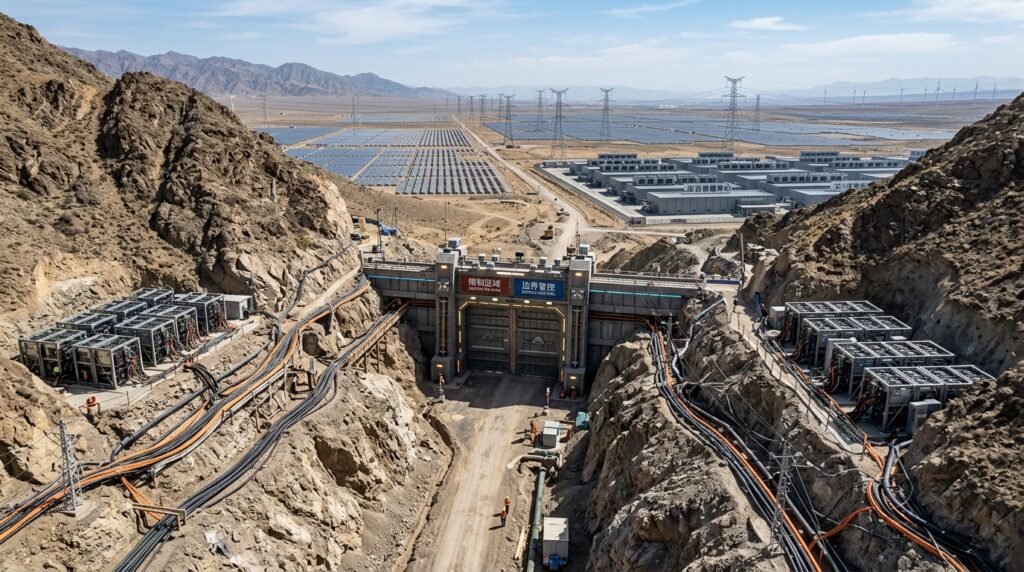
Washington built a wall to keep China off the AI frontier. China went around it, under it, and eventually started building its own version of the wall out of the rubble. That’s the short version of a four-year story that’s still unfolding, and it’s worth telling carefully, because the record is a lot more interesting than either “the sanctions worked” or “the sanctions failed.”
One point of vocabulary first. Nearly everything described below is technically an export control — a licensing regime run out of the Commerce Department — rather than a sanction, which is a financial penalty run out of Treasury. I use the looser word in places because that’s how the policy gets discussed. But the distinction turns out to matter by the end of this piece, when a Treasury Secretary starts talking about reaching for the other instrument.
The Chokepoint Bet
On October 7, 2022, the Commerce Department’s Bureau of Industry and Security (BIS) rolled out what it called the most sweeping export control action in decades.[1] The doctrine behind it had been stated in public three weeks earlier. On September 16, 2022, National Security Advisor Jake Sullivan told the Special Competitive Studies Project’s emerging-technology summit that the U.S. had long used a “sliding scale” approach to China, staying just a couple of generations ahead on chip technology. That approach was over. “Given the foundational nature of certain technologies, such as advanced logic and memory chips, we must maintain as large of a lead as possible,” he said.[2] The sequence is worth getting right: the rule did not arrive and then acquire a rationale. The rationale was announced first, and the rule implemented it. In an interview quoted by CSIS, Commerce Secretary Gina Raimondo called the new rules “the next logical step, to prevent China from getting to the next step.”[3]
The theory behind the rules was simple, and it’s why I’m calling it a chokepoint bet. Frontier AI, at the time, ran on a small number of individual chips — Nvidia’s A100 and H100 above all — that only a few fabs on Earth could make. Cut off those chips, and China’s AI ambitions would hit a hard ceiling. The strategy leaned on four points of control: the chips themselves, the software used to design them, the equipment used to manufacture them, and the people who knew how to run all of it.[1] It’s a good plan on paper. What it didn’t fully account for was that China would stop trying to solve the problem the way the West solves it.
2022: Capping the Chips
The October 2022 rule worked by setting two technical thresholds. A chip was restricted if it exceeded a certain “total processing performance,” a measure of raw compute, or a certain interconnect bandwidth — roughly, how fast chips can talk to each other, with the line drawn around 600 gigabytes per second.[4] Both the A100 and H100 cleared both thresholds, so Nvidia’s two premier AI chips were immediately banned from the Chinese market.[1]
Nvidia’s answer came fast. Within a month, Reuters reported the company had a new chip for China called the A800 — an A100 with its interconnect bandwidth capped at roughly two-thirds of the original, just low enough to clear the new bar while keeping most of the raw compute power intact.[5] The H800 followed the same playbook on the H100 the following spring.[6] It was a clean bit of engineering: obey the letter of the rule, keep as much performance as the rule allowed. Because the modified chips still communicated more slowly than the originals, Chinese firms training large models on them couldn’t just copy Western data-center blueprints. They had to start wiring together more chips than they otherwise would have needed, which — as it turned out — was an early rehearsal for a much bigger shift in strategy a year later.
The October 2022 rule did more than cap silicon, though. It also imposed a license requirement on U.S. persons — citizens, green-card holders, and U.S. companies — who wanted to support the “development” or “production” of advanced chips in China, even using non-U.S.-origin equipment.[7] The rule took effect within days, and it wasn’t gentle. A CSIS analysis found the change left at least 43 senior executives who were U.S. citizens working inside Chinese chip firms “in limbo,” facing a choice between their jobs and their citizenship or permanent-resident status.[8] Several American engineers and executives at Chinese chipmakers resigned rather than risk running afoul of federal law. That’s a real cost that gets less attention than the chip bans, but it forced Chinese firms to backfill senior technical roles with homegrown talent faster than they’d planned to.
2023: Closing the Loophole
A year is a long time in this fight. By October 2023, BIS had watched Nvidia’s A800 and H800 do exactly what they were designed to do, and it rewrote the rules to close the gap.[9] The update, effective in mid-November 2023, made two changes that mattered. First, it eliminated the interconnect-bandwidth parameter entirely — the same parameter Nvidia had designed its China-specific chips around.[10] Second, it introduced something new: a “performance density” threshold, which measured how much compute was packed into a given physical footprint, specifically to prevent the next generation of workaround chips.[11] The A800 and H800 were banned outright.12
BIS backed that up with two more mechanisms worth naming. It imposed a worldwide licensing requirement on chip exports to any company headquartered in a country under U.S. arms embargo — China included — or whose parent company is, closing a path where a restricted buyer could simply route purchases through a third country.[9] And it expanded the Entity List’s “footnote 4” foreign-direct-product designation, adding thirteen more entities and requiring foundries anywhere in the world to get a BIS license before shipping chips made with U.S. technology to them.[9]
The rules were still tightening when the most visible evidence arrived that they weren’t tightening fast enough. In late August 2023 — days before Raimondo landed in Beijing, a coincidence nobody in China treated as one — Huawei quietly began selling the Mate 60 Pro, publishing no specifications for the processor inside. A teardown by the analysis firm TechInsights found a Kirin 9000S fabricated by SMIC on a second-generation 7-nanometer process, with an integrated 5G modem, and made without EUV lithography.[14]
Two qualifications matter here, and both cut against the easy version of this story. The first is that this was not SMIC’s first 7-nanometer silicon. TechInsights had already found a 7-nanometer SMIC part inside a bitcoin mining chip the year before, and Gregory Allen dates SMIC’s 7-nanometer production to July 2022 at the latest — which is to say, before the October 2022 rule existed at all.[15] China’s advanced-node capability did not appear in response to the controls. It predated them. What was new in the Mate 60 Pro was the application: a high-volume mobile system-on-chip with embedded SRAM and an integrated 5G modem is a considerably harder thing to yield than a mining ASIC, and it shipped in a consumer flagship rather than a niche product. The second qualification is that yield and cost were open questions then and remain open now; multipatterning on deep-ultraviolet tools can reach 7 nanometers, but it burns wafers doing it. That caveat matters, and it is also the whole point. The chip established the pattern that governs everything after it: denied the best tools, Chinese manufacturers accepted materially worse economics in exchange for an acceptable result.
Reaching Beyond Chips: ASML and the Toolmakers
The Foreign Direct Product Rule (FDPR) is the reason none of this stayed a purely bilateral fight between Washington and Beijing. Under the FDPR, if a product anywhere in the world is made using certain U.S.-origin software, design tools, or equipment, it’s subject to U.S. export controls regardless of where it’s built.[16] The October 2022 rule expanded the FDPR to cover advanced-computing items and supercomputer components bound for China, whether or not they contained a single American-made part.[16]
That gave Washington leverage over allies, and it used it. The Dutch company ASML makes the extreme- and deep-ultraviolet lithography machines that are essential to manufacturing advanced logic chips. In deep ultraviolet it has competitors — Nikon and Canon both build DUV steppers. In extreme ultraviolet, the technology the leading edge actually depends on, it has none, anywhere in the world. In March 2023, the Dutch government confirmed it would restrict ASML’s exports of “very specific technologies” to China, following a joint understanding reached with the U.S. and Japan two months earlier.[17] The pressure escalated from there — ASML halted shipments of some deep-ultraviolet systems in early January 2024 after a request from Washington,[18] and by September 2024 the Netherlands required ASML to obtain individual licenses even to service some of its already-installed machines inside China.[19] Denied both the chips and the tools to make more advanced chips domestically, Chinese firms split their strategy: what advanced equipment they still had access to went toward a small, protected frontier-research effort, while the broader commercial semiconductor industry adapted to build on older, “legacy” process nodes that sat safely outside the reach of the FDPR.
2024 and 2025: Tightening, Then Trading
Two more rounds followed, and they point in opposite directions.
On December 2, 2024, BIS issued its most expansive package to date: controls on twenty-four types of semiconductor manufacturing equipment and three categories of software tools, two additional foreign direct product rules, and 140 additions to the Entity List.[20] The centerpiece was high-bandwidth memory. HBM is the stacked memory that sits beside an AI accelerator and feeds it data, and it bounds how useful any given chip actually is more tightly than raw compute does. For the first time, the U.S. imposed country-wide restrictions on exporting advanced HBM to China.[15] The rule was well aimed and partly self-defeating. Washington had been signaling HBM controls for months, and the gap between announcement and implementation left a window; by one accounting, Huawei and Baidu accumulated roughly six million HBM stacks from Samsung before it closed.[21] That inventory is a meaningful part of what made the accelerator clusters described in the next section possible at all.
Then the direction reversed. The Biden administration’s Framework for Artificial Intelligence Diffusion, published January 15, 2025, would have imposed a worldwide tiered licensing system on advanced chips and, for the first time, on the weights of advanced closed models. It never took effect. The incoming administration announced its rescission on May 13, 2025, two days before the compliance date, arguing it saddled American firms with burdensome requirements.[22] The H20 sequence was sharper still. In April 2025, Commerce told Nvidia that the H20 — the chip engineered to sit just under the prevailing thresholds — would now require a license, forcing a $5.5 billion inventory write-down.[23] By August, Nvidia and AMD had their licenses, on the condition that they remit fifteen percent of Chinese revenue to the U.S. government, an arrangement with no real precedent in the history of export control.[24] In December 2025 the administration went further and waived restrictions on the H200, Nvidia’s second-most-advanced line, for a year.[25]
Whatever one makes of the reversals on the merits, they complicate the premise of the original bet. A chokepoint strategy works only if the chokepoint holds; a chokepoint that reopens under commercial and diplomatic pressure is closer to a tariff with extra steps. And it is at least suggestive that the most aggressive domestic-substitution measures described below — including Beijing’s electricity subsidies for data centers running Chinese chips — arrived after these reversals rather than before. If you are a Chinese planner deciding whether to bet on continued access to Nvidia, the events of 2025 are an argument for building your own.
From Silicon to System
Here’s where the story stops looking like containment and starts looking like something else. The people who designed these controls were focused on individual chip specifications — how small the transistor, how fast the processor. What they underestimated was how much performance could be recovered at the system level by connecting many weaker chips together.
Huawei’s CloudMatrix 384, unveiled in 2025, is the clearest example. It links 384 of Huawei’s Ascend 910C accelerators through an all-to-all optical network. On its own, a single Ascend 910C is roughly a third the speed of an Nvidia Blackwell chip.[26] But wire 384 of them together, and the semiconductor research firm SemiAnalysis found the resulting cluster delivers roughly 300 petaflops of dense BF16 compute — about 1.7 times the 180 petaflops of Nvidia’s flagship GB200 NVL72 rack, along with more than three times the memory capacity.[26] The tradeoff is real: the Huawei system draws about four times the power of Nvidia’s rack to get there.[26] In China’s energy environment, that tradeoff is one Beijing has been willing to make.
Alibaba took the same approach in a different form. In September 2025 it introduced the Panjiu AI Infra 2.0 supernode, which packs 128 accelerators into a single rack with petabyte-per-second internal bandwidth,[27] and by May 2026 had paired it with its own Zhenwu M890 chip and a new interconnect chip capable of 25.6 terabits per second across a cluster.[28] Alibaba’s chip design arm, T-Head, says it has shipped more than 560,000 of these chips to over 400 customers.[28] In April 2026, Alibaba and China Telecom switched on a 10,000-chip cluster in Guangdong built entirely on this homegrown hardware, with plans to scale it to 100,000 chips.[29] Baidu has its own 256-chip system in the same category.[30] None of this required smuggling a single frontier chip. It required treating the data center itself, rather than any one component inside it, as the unit of engineering.
The counterargument deserves stating at full strength, because it isn’t weak. A supernode is a method for spending more inputs to reach the same output: more accelerators, more power, more floor space, more optical interconnect, more engineering hours. Every one of those inputs is itself constrained. SMIC’s advanced-node capacity is bounded by equipment it cannot buy — Allen’s assessment is that while the controls did not stop SMIC from producing 7-nanometer chips, they dramatically constrained its ability to scale, holding output to the low tens of thousands of wafers a month against the hundreds of thousands originally planned.[15] Huawei’s accelerator output is bounded in turn by SMIC and by an HBM stockpile it has been drawing down since 2024; the fourfold power penalty is survivable mainly because the state absorbs part of the bill. That is not a stable equilibrium so much as an expensive workaround that buys time. The defensible reading is narrower than either triumphalism or declinism: the controls raised China’s cost per unit of compute substantially, and did not prevent China from obtaining compute. Whether “substantially more expensive” eventually compounds into “prohibitive” depends on yield curves inside a handful of Chinese fabs that nobody outside them can currently see.
Compute as a Public Utility
The second thing Western analysts missed, by most accounts, is that China stopped treating compute like a private commercial investment and started treating it like infrastructure — closer to the electrical grid or the high-speed rail network than to a corporate data center.
The clearest sign is where the new capacity is going: China’s remote western and northwestern provinces, where land is cheap, renewable energy is abundant, and state subsidies run deep. A Bloomberg investigation found Chinese firms planning to install more than 115,000 Nvidia AI chips across roughly three dozen data centers in Xinjiang and Qinghai, with about 70 percent of that capacity concentrated in a single government-backed compound.[31] Under China’s “East Data, West Compute” initiative, 633 hyperscale and large data centers had been built and made operational by 2024, pushing national computing capacity to roughly 268 exaflops.[32] In November 2025, Beijing began offering electricity subsidies of up to 50 percent to data centers that run on domestically produced chips, a direct response to being cut off from Nvidia’s best hardware.[32]
None of that works without a grid that can move power over enormous distances without losing most of it along the way, which is where China’s ultra-high-voltage direct current (UHVDC) transmission lines come in — a technology China has spent well over a decade perfecting and now leads the world in deploying.[33] State Grid’s 1,100-kilovolt line running roughly 3,300 kilometers from Xinjiang to Anhui province can carry up to 12 gigawatts, enough to power some 50 million households, and it set world records for voltage, distance, and capacity when it went into service.[33] China has continued building on that base; by late October 2025, the country had put 45 ultra-high-voltage projects into operation nationwide.[34] Where Western analysts were watching fabs, Beijing was building power lines, and the power lines turned out to matter just as much.
The Distillation Economy
The most contested — and most current — front in this fight isn’t about hardware at all. It’s about whether China’s AI labs have been building their models, in part, by learning from the outputs of the very American models the chip controls were designed to protect.
The connection to everything above isn’t incidental, and it’s worth making explicit. A lab with abundant compute can afford to buy capability the expensive way, by training from scratch on enormous clusters. A compute-constrained lab has every incentive to acquire it the cheap way, by extracting it from a model that has already absorbed that cost. On this reading, distillation isn’t a separate story from export controls at all — it’s what a chokepoint strategy produces when the resource being choked off can be partially reconstructed from its own outputs. That’s the strongest form of the argument. It is also an argument about incentives rather than evidence of conduct, and the rest of this section tries hard to keep those two things apart.
The technique is called distillation: training a smaller, cheaper model to mimic the behavior of a larger, more expensive one by feeding it that larger model’s outputs. It’s a legitimate and common training method inside a single company. The controversy is over whether Chinese labs have been running distillation attacks against competitors’ proprietary models from the outside, at scale.
The dispute became public in January 2025, when DeepSeek’s R1 model — reportedly trained at a fraction of the cost of comparable American systems — prompted OpenAI and Microsoft to open investigations into whether DeepSeek had improperly extracted outputs from OpenAI’s models through its API.[35] OpenAI escalated the allegation in a February 2026 memo to Congress’s House Select Committee on China, saying DeepSeek was continuing “ongoing efforts to free-ride on the capabilities developed by OpenAI and other U.S. frontier labs” using increasingly obfuscated methods.36 Later that same month, Anthropic told Congress that DeepSeek, Moonshot AI, and MiniMax had all run coordinated “distillation attack” campaigns against its Claude models, flooding them with carefully engineered prompts designed to extract training-quality data.[38] By June 2026, Anthropic was naming Alibaba specifically, calling one campaign the “largest known distillation attack” it had documented, in a letter to the Senate Banking Committee.39 Alibaba responded in July by banning its own employees from using Claude.[41]
On July 21, 2026, Scott Bessent told Fox Business the administration is looking into whether Chinese AI models have been distilled from American ones, and said sanctions were on the table if the evidence held up. “We are finding watermarks of our U.S. large language models on many of the Chinese models, and that’s unacceptable,” he said.[42] The following day, July 22, White House science and technology policy director Michael Kratsios alleged that Moonshot AI had distilled Anthropic’s Fable 5 to build Kimi K3 — its 2.8-trillion-parameter model, released July 16, which had just closed the performance gap with frontier American systems and surpassed them on some coding benchmarks — and separately that Moonshot had reached Nvidia’s restricted GB300 chips through servers in Thailand.[43] Moonshot’s official response did not address the distillation charge directly, though the company’s technical materials credit Kimi K3’s gains to architectural changes — a sparse mixture-of-experts design and new attention mechanisms — rather than any outside model’s outputs.[44]
The timeline is the crux, and it needs stating precisely, because the obvious version of it is wrong. Anthropic first released Fable 5 on June 9, 2026, suspended access three days later to comply with Commerce Department export controls, and restored it on July 1 after those controls were lifted. So the model had existed for roughly five weeks when Kimi K3 shipped, but had been continuously available for about two. That shorter window is what the pushback rests on: it is the period in which a 2.8-trillion-parameter model would have had to be systematically distilled and then trained. The sharpest version of the objection came from Moonshot itself, where an employee noted publicly that the company would have had to build a frontier model in fifteen days.[45] That is an interested party and should be read as one. But independent observers were also unpersuaded — OpenAI’s president said it was too early to tell whether Kimi K3 had distilled anything, and outside researchers questioned whether the arithmetic worked at all.[46] China’s foreign ministry, for its part, dismissed the broader U.S. distillation narrative as “misguided and counterproductive.”[47] None of this is resolved as I write this, and I want to be honest about that rather than pretend otherwise.
If the broader pattern holds up, it points to something almost elegant in its unfairness: American labs spend billions training frontier “teacher” models, and if the allegations are accurate, Chinese labs are training “student” models to mimic them for a fraction of that cost — meaning U.S. innovation may be subsidizing the very competitor the chip controls were built to slow down.
A Bifurcated Stack
Put the hardware story and the software story together, and a pattern emerges that I think is more useful than a simple “did sanctions work” verdict. China’s AI ecosystem now runs on two tracks. One is a small, protected frontier-research effort, running on whatever advanced chips have been hoarded, smuggled, or squeezed through third countries, aimed at breakthrough capability. The other is a much larger, “good enough” track running on legacy chips wired into supernode clusters and powered by subsidized western-China electricity, aimed at pushing AI into everything from electric vehicles to social media at a scale Western firms — still chasing the smartest model rather than the most ubiquitous one — haven’t matched. Sanctions didn’t stop China’s AI buildout. They shaped which of these two tracks it would run on, and arguably made the second, more durable track the priority.
What We Know, What’s Still Contested
The chip and equipment controls I described above — the 2022 rule, the 2023 update, the December 2024 HBM package, the U.S.-persons restriction, the FDPR expansion, the ASML licensing fights, and the 2025 reversals on the H20 and H200 — are documented in the Federal Register, in Commerce Department press releases, and in contemporaneous reporting, and I’m confident in them.192024 The SMIC 7-nanometer finding rests on a single firm’s teardown, but TechInsights is the standard reference for this kind of analysis and no one has seriously contested the result.[14] The specifications and performance claims for CloudMatrix 384 and Alibaba’s Panjiu system come from the manufacturers themselves and from SemiAnalysis’s independent technical analysis, and I’d treat the manufacturer numbers with the same skepticism I’d apply to any vendor benchmark.26[28] The scale of China’s western data-center buildout and its UHVDC grid is well documented by Bloomberg, IEEE Spectrum, and Chinese state media, though “planned capacity” and “capacity actually in productive use” are two different numbers, and the gap between them is real — one recent Australian assessment found China’s own data-center buildout has outpaced its ability to use it efficiently.[32]
The distillation allegations are a different matter. OpenAI and Anthropic have made specific, on-the-record claims to Congress, and Treasury Secretary Bessent has said the administration is looking into sanctions.3538[42] Moonshot AI disputes the characterization of its own model, and I haven’t seen independent, technical verification of the “largest known distillation attack” claim beyond the accusing company’s own account.[44] I think it’s fair to say the pattern — American labs alleging Chinese labs are training on their outputs — is now well established across multiple companies and multiple months. Whether any specific instance amounts to theft, ordinary imitation, or something in between is a question I’d leave open until more evidence surfaces, and I’d encourage you to do the same.
Notes
- Sujai Shivakumar, Charles Wessner, and Thomas Howell, “A Seismic Shift: The New U.S. Semiconductor Export Controls and Implications for U.S. Firms, Allies, and the Rest of the World,” Center for Strategic and International Studies, November 14, 2022, https://www.csis.org/analysis/seismic-shift-new-us-semiconductor-export-controls-and-implications-us-firms-allies-and.
- Jake Sullivan, “Remarks by National Security Advisor Jake Sullivan at the Special Competitive Studies Project Global Emerging Technologies Summit” (The White House, September 16, 2022), https://bidenwhitehouse.archives.gov/briefing-room/speeches-remarks/2022/09/16/remarks-by-national-security-advisor-jake-sullivan-at-the-special-competitive-studies-project-global-emerging-technologies-summit/.
- Shivakumar, Wessner, and Howell, “A Seismic Shift.”
- Bureau of Industry and Security, “Commerce Implements New Export Controls on Advanced Computing and Semiconductor Manufacturing Items to the People’s Republic of China (PRC),” Federal Register 87, no. 197 (October 13, 2022), https://www.bis.doc.gov/index.php/documents/federal-register-notices-1/3165-87-fr-62186-advanced-computing-and-semiconductor-manufacturing-items-rule-published-10-13-22/file.
- Kate Kaye, “Nvidia Touts a Slower Chip for China to Avoid US Ban,” TechCrunch, November 7, 2022, https://techcrunch.com/2022/11/07/nvidia-us-china-ban-alternative/.
- “Nvidia Tweaks Flagship H100 Chip for Export to China as H800,” Reuters, March 21, 2023, https://www.reuters.com/technology/nvidia-tweaks-flagship-h100-chip-export-china-h800-2023-03-21/.
- Willkie Farr & Gallagher LLP, “New, Far-Reaching Export Controls on Semiconductors and Advanced Computing Items Destined for China,” October 2022, https://www.willkie.com/-/media/files/publications/2022/newfarreachingexportcontrolsonsemiconductorsandadv.pdf.
- Shivakumar, Wessner, and Howell, “A Seismic Shift.”
- Bureau of Industry and Security, “Commerce Strengthens Restrictions on Advanced Computing Semiconductors, Semiconductor Manufacturing Equipment,” October 17, 2023, https://www.bis.gov/press-release/commerce-strengthens-restrictions-advanced-computing-semiconductors-semiconductor-manufacturing-equipment.
- Center for Security and Emerging Technology, “The Commerce Department’s October 2023 Export Control Update,” Georgetown University, December 4, 2023, https://cset.georgetown.edu/article/bis-2023-update-explainer/.
- Bureau of Industry and Security, “Commerce Strengthens Restrictions,” October 17, 2023.
- Arjun Kharpal, “U.S. Bans Export of More AI Chips, Including Nvidia H800, to China,” CNBC, October 17, 2023, https://www.cnbc.com/2023/10/17/us-bans-export-of-more-ai-chips-including-nvidia-h800-to-china.html.
- Aaron Klotz, “US Prohibits Exports of Nvidia’s A800 and H800 to China, Blacklists Chinese GPU Developers,” Tom’s Hardware, October 17, 2023, https://www.tomshardware.com/news/us-prohibits-exports-of-nvidias-a800-and-h800-to-china-blacklists-chinese-gpu-developers.
- TechInsights, “TechInsights Finds SMIC 7nm (N+2) in Huawei Mate 60 Pro,” September 2023, https://www.techinsights.com/blog/techinsights-finds-smic-7nm-n2-huawei-mate-60-pro; see also “Look Inside Huawei Mate 60 Pro Phone Powered by Made-in-China Chip,” Bloomberg, September 4, 2023, https://www.bloomberg.com/news/features/2023-09-04/look-inside-huawei-mate-60-pro-phone-powered-by-made-in-china-chip.
- Gregory C. Allen, “Understanding the Biden Administration’s Updated Export Controls,” Center for Strategic and International Studies, December 11, 2024, https://www.csis.org/analysis/understanding-biden-administrations-updated-export-controls.
- Willkie Farr & Gallagher LLP, “New, Far-Reaching Export Controls.”
- “Netherlands Confirms It Will Restrict More ASML Exports to China,” NL Times, March 8, 2023, https://nltimes.nl/2023/03/08/netherlands-confirms-will-restrict-asml-exports-china.
- “Netherlands Blocks ASML Exports of Some Chip-Making Equipment to China,” Wall Street Journal, January 2, 2024, https://www.wsj.com/tech/netherlands-blocks-asml-exports-of-some-chip-making-equipment-to-china-2fe4a162; see also “ASML Halts Hi-Tech Chip-Making Exports to China Reportedly After US Request,” The Guardian, January 2, 2024, https://www.theguardian.com/technology/2024/jan/02/asml-halts-hi-tech-chip-making-exports-to-china-reportedly-after-us-request.
- “China Hit Hard by New Dutch Export Controls on ASML Chip-Making Equipment,” South China Morning Post, September 16, 2024, https://www.scmp.com/tech/tech-war/article/3278535/china-hit-hard-new-dutch-export-controls-asml-chip-making-equipment.
- Bureau of Industry and Security, “Commerce Strengthens Export Controls to Restrict China’s Capability to Produce Advanced Semiconductors for Military Applications,” December 2, 2024, https://www.bis.gov/press-release/commerce-strengthens-export-controls-restrict-chinas-capability-produce-advanced-semiconductors-military.
- “High-Bandwidth Memory: The Critical Gaps in US Export Controls,” AI Frontiers, February 2026, https://ai-frontiers.org/articles/high-bandwidth-memory-critical-gaps-us-export-controls.
- Wiley Rein LLP, “BIS Rescinds AI Diffusion Rule and Issues Guidance on Advanced Computing Integrated Circuits,” May 2025, https://www.wiley.law/alert-BIS-Rescinds-AI-Diffusion-Rule.
- “All Eyes on China Restrictions as Nvidia Gets Set to Report Results,” CNBC, May 27, 2025, https://www.cnbc.com/2025/05/27/nvidia-nvda-preview-china-chip-curbs.html.
- “Nvidia and AMD Will Give US 15% of China Sales. But Chinese State Media Warns About Their Chips,” CNN, August 11, 2025, https://www.cnn.com/2025/08/11/china/us-china-trade-nvidia-chips-intl-hnk.
- “The US Pivot on Regulating AI Diffusion,” Strategic Comments, International Institute for Strategic Studies, December 2025, https://www.iiss.org/publications/strategic-comments/2025/12/the-us-pivot-on-regulating-ai-diffusion/.
- Dylan Patel et al., “Huawei AI CloudMatrix 384: China’s Answer to Nvidia GB200 NVL72,” SemiAnalysis, April 15, 2025, https://newsletter.semianalysis.com/p/huawei-ai-cloudmatrix-384-chinas-answer-to-nvidia-gb200-nvl72.
- Alibaba Cloud Community, “In-Depth Analysis of Alibaba Cloud Panjiu AL128 Supernode AI Servers and Their Interconnect Architecture,” https://www.alibabacloud.com/blog/in-depth-analysis-of-alibaba-cloud-panjiu-al128-supernode-ai-servers-and-their-interconnect-architecture_602665.
- Alibaba Group, “Alibaba Unveils New AI Chip, Flagship Model, and Rebuilt Cloud Platform,” May 20, 2026, https://www.alibabagroup.com/document-1994119844504535040.
- “Alibaba Launches Data Center with 10,000 of Its Own Chips as China Ramps Up AI Push,” CNBC, April 8, 2026, https://www.cnbc.com/2026/04/08/china-alibaba-data-center-ai-chips-zhenwu.html.
- “China Bets on Chip Clusters to Survive U.S. Sanctions,” Caixin Global, February 12, 2026, https://www.caixinglobal.com/2026-02-12/analysis-china-bets-on-chip-clusters-to-survive-us-sanctions-102413919.html.
- Bloomberg News, “China Wants 115,000 Nvidia Chips to Power Data Centers in the Desert,” Bloomberg, July 8, 2025, https://www.bloomberg.com/graphics/2025-china-data-centers-nvidia-chips/.
- Australian Strategic Policy Institute, “Abundant Electricity Isn’t Enough: China’s Overbuilt AI Computing Power Is Underused,” The Strategist, May 6, 2026, https://www.aspistrategist.org.au/abundant-electricity-isnt-enough-chinas-overbuilt-ai-computing-power-is-underused/.
- Peter Fairley, “China’s State Grid Corp Crushes Power Transmission Records,” IEEE Spectrum, January 10, 2019, https://spectrum.ieee.org/chinas-state-grid-corp-crushes-power-transmission-records.
- “China Puts 45 Ultra-High-Voltage Projects into Operation,” People’s Daily Online, October 30, 2025, https://en.people.cn/n3/2025/1030/c90000-20383967.html.
- Blake Montgomery, “OpenAI ‘Reviewing’ Allegations That Its AI Models Were Used to Make DeepSeek,” The Guardian, January 29, 2025, https://www.theguardian.com/technology/2025/jan/29/openai-chatgpt-deepseek-china-us-ai-models.
- “OpenAI Says China’s DeepSeek Trained Its AI by Distilling from GPT Models,” Reuters, February 13, 2026, https://www.reuters.com/world/china/openai-accuses-deepseek-distilling-us-models-gain-advantage-bloomberg-news-2026-02-12/.
- “OpenAI Accuses DeepSeek of Distilling US Models to Gain an Edge,” Bloomberg, February 12, 2026, https://www.bloomberg.com/news/articles/2026-02-12/openai-accuses-deepseek-of-distilling-us-models-to-gain-an-edge.
- “Anthropic Joins OpenAI in Flagging ‘Industrial-Scale’ Distillation Campaigns by Chinese AI Firms,” CNBC, February 24, 2026, https://www.cnbc.com/2026/02/24/anthropic-openai-china-firms-distillation-deepseek.html.
- “Anthropic Accuses Chinese Rival Alibaba of Illicitly Extracting Data from Claude,” BBC News, June 24, 2026, https://www.bbc.com/news/articles/cwyklykn5dwo.
- “Anthropic Accuses Alibaba of Campaign to Extract AI Data,” CNBC, June 24, 2026, https://www.cnbc.com/2026/06/24/anthropic-alibaba-distillation-campaign.html.
- “China’s Alibaba Bans Anthropic AI for Employees After ‘Distillation Attack’ Accusation,” CNBC, July 6, 2026, https://www.cnbc.com/2026/07/06/alibaba-anthropic-ai-ban-claude-china.html.
- Ashley Capoot, “Bessent Says U.S. Could Sanction China Over AI Model ‘Theft,'” CNBC, July 21, 2026, https://www.cnbc.com/2026/07/21/bessent-china-ai-sanctions.html.
- Kai Nicol-Schwarz, “Moonshot AI Accessed Nvidia’s Chips Despite Chinese Export Ban, White House Official Says,” CNBC, July 23, 2026, https://www.cnbc.com/2026/07/23/moonshot-kimi-nvidia-ai-chips-export-ban.html.
- Rebecca Bellan, “Experts Say Exploiting Anthropic’s Fable Isn’t How Kimi K3 Got So Good,” TechCrunch, July 23, 2026, https://techcrunch.com/2026/07/23/experts-say-exploiting-anthropics-fable-isnt-how-kimi-k3-got-so-good/.
- “Global AI Experts Push Back on US ‘Distillation’ Claims Against Moonshot’s Kimi K3 Model,” South China Morning Post, July 23, 2026, https://www.scmp.com/tech/tech-war/article/3361625/global-ai-experts-push-back-us-distillation-claims-against-moonshots-kimi-k3-model.
- Bellan, “Experts Say Exploiting Anthropic’s Fable.”
- “China Rebuts AI Distillation Claims as Kimi K3 Launch Intensifies Tech Rivalry,” EnterpriseAI (Economic Times), July 19, 2026, https://enterpriseai.economictimes.indiatimes.com/news/industry/chinas-moonshot-ai-unveils-kimi-k3-igniting-global-ai-competition-and-distillation-debate/132491376.
Bibliography
AI Frontiers. “High-Bandwidth Memory: The Critical Gaps in US Export Controls.” February 2026. https://ai-frontiers.org/articles/high-bandwidth-memory-critical-gaps-us-export-controls.
Alibaba Cloud Community. “In-Depth Analysis of Alibaba Cloud Panjiu AL128 Supernode AI Servers and Their Interconnect Architecture.” https://www.alibabacloud.com/blog/in-depth-analysis-of-alibaba-cloud-panjiu-al128-supernode-ai-servers-and-their-interconnect-architecture_602665.
Alibaba Group. “Alibaba Unveils New AI Chip, Flagship Model, and Rebuilt Cloud Platform.” May 20, 2026. https://www.alibabagroup.com/document-1994119844504535040.
Allen, Gregory C. “Understanding the Biden Administration’s Updated Export Controls.” Center for Strategic and International Studies. December 11, 2024. https://www.csis.org/analysis/understanding-biden-administrations-updated-export-controls.
Australian Strategic Policy Institute. “Abundant Electricity Isn’t Enough: China’s Overbuilt AI Computing Power Is Underused.” The Strategist. May 6, 2026. https://www.aspistrategist.org.au/abundant-electricity-isnt-enough-chinas-overbuilt-ai-computing-power-is-underused/.
BBC News. “Anthropic Accuses Chinese Rival Alibaba of Illicitly Extracting Data from Claude.” June 24, 2026. https://www.bbc.com/news/articles/cwyklykn5dwo.
Bellan, Rebecca. “Experts Say Exploiting Anthropic’s Fable Isn’t How Kimi K3 Got So Good.” TechCrunch. July 23, 2026. https://techcrunch.com/2026/07/23/experts-say-exploiting-anthropics-fable-isnt-how-kimi-k3-got-so-good/.
Bloomberg News. “China Wants 115,000 Nvidia Chips to Power Data Centers in the Desert.” Bloomberg. July 8, 2025. https://www.bloomberg.com/graphics/2025-china-data-centers-nvidia-chips/.
Bloomberg News. “Look Inside Huawei Mate 60 Pro Phone Powered by Made-in-China Chip.” September 4, 2023. https://www.bloomberg.com/news/features/2023-09-04/look-inside-huawei-mate-60-pro-phone-powered-by-made-in-china-chip.
Bloomberg News. “OpenAI Accuses DeepSeek of Distilling US Models to Gain an Edge.” February 12, 2026. https://www.bloomberg.com/news/articles/2026-02-12/openai-accuses-deepseek-of-distilling-us-models-to-gain-an-edge.
Bureau of Industry and Security, U.S. Department of Commerce. “Commerce Implements New Export Controls on Advanced Computing and Semiconductor Manufacturing Items to the People’s Republic of China (PRC).” Federal Register 87, no. 197, October 13, 2022. https://www.bis.doc.gov/index.php/documents/federal-register-notices-1/3165-87-fr-62186-advanced-computing-and-semiconductor-manufacturing-items-rule-published-10-13-22/file.
Bureau of Industry and Security, U.S. Department of Commerce. “Commerce Strengthens Export Controls to Restrict China’s Capability to Produce Advanced Semiconductors for Military Applications.” December 2, 2024. https://www.bis.gov/press-release/commerce-strengthens-export-controls-restrict-chinas-capability-produce-advanced-semiconductors-military.
Bureau of Industry and Security, U.S. Department of Commerce. “Commerce Strengthens Restrictions on Advanced Computing Semiconductors, Semiconductor Manufacturing Equipment.” October 17, 2023. https://www.bis.gov/press-release/commerce-strengthens-restrictions-advanced-computing-semiconductors-semiconductor-manufacturing-equipment.
Caixin Global. “China Bets on Chip Clusters to Survive U.S. Sanctions.” February 12, 2026. https://www.caixinglobal.com/2026-02-12/analysis-china-bets-on-chip-clusters-to-survive-us-sanctions-102413919.html.
Capoot, Ashley. “Bessent Says U.S. Could Sanction China Over AI Model ‘Theft.'” CNBC. July 21, 2026. https://www.cnbc.com/2026/07/21/bessent-china-ai-sanctions.html.
Center for Security and Emerging Technology. “The Commerce Department’s October 2023 Export Control Update.” Georgetown University. December 4, 2023. https://cset.georgetown.edu/article/bis-2023-update-explainer/.
“China Rebuts AI Distillation Claims as Kimi K3 Launch Intensifies Tech Rivalry.” EnterpriseAI (Economic Times). July 19, 2026. https://enterpriseai.economictimes.indiatimes.com/news/industry/chinas-moonshot-ai-unveils-kimi-k3-igniting-global-ai-competition-and-distillation-debate/132491376.
CNBC. “Alibaba Launches Data Center with 10,000 of Its Own Chips as China Ramps Up AI Push.” April 8, 2026. https://www.cnbc.com/2026/04/08/china-alibaba-data-center-ai-chips-zhenwu.html.
CNBC. “All Eyes on China Restrictions as Nvidia Gets Set to Report Results.” May 27, 2025. https://www.cnbc.com/2025/05/27/nvidia-nvda-preview-china-chip-curbs.html.
CNBC. “Anthropic Accuses Alibaba of Campaign to Extract AI Data.” June 24, 2026. https://www.cnbc.com/2026/06/24/anthropic-alibaba-distillation-campaign.html.
CNBC. “Anthropic Joins OpenAI in Flagging ‘Industrial-Scale’ Distillation Campaigns by Chinese AI Firms.” February 24, 2026. https://www.cnbc.com/2026/02/24/anthropic-openai-china-firms-distillation-deepseek.html.
CNBC. “China’s Alibaba Bans Anthropic AI for Employees After ‘Distillation Attack’ Accusation.” July 6, 2026. https://www.cnbc.com/2026/07/06/alibaba-anthropic-ai-ban-claude-china.html.
CNN. “Nvidia and AMD Will Give US 15% of China Sales. But Chinese State Media Warns About Their Chips.” August 11, 2025. https://www.cnn.com/2025/08/11/china/us-china-trade-nvidia-chips-intl-hnk.
Fairley, Peter. “China’s State Grid Corp Crushes Power Transmission Records.” IEEE Spectrum. January 10, 2019. https://spectrum.ieee.org/chinas-state-grid-corp-crushes-power-transmission-records.
Guardian, The. “ASML Halts Hi-Tech Chip-Making Exports to China Reportedly After US Request.” January 2, 2024. https://www.theguardian.com/technology/2024/jan/02/asml-halts-hi-tech-chip-making-exports-to-china-reportedly-after-us-request.
International Institute for Strategic Studies. “The US Pivot on Regulating AI Diffusion.” Strategic Comments. December 2025. https://www.iiss.org/publications/strategic-comments/2025/12/the-us-pivot-on-regulating-ai-diffusion/.
Kaye, Kate. “Nvidia Touts a Slower Chip for China to Avoid US Ban.” TechCrunch. November 7, 2022. https://techcrunch.com/2022/11/07/nvidia-us-china-ban-alternative/.
Kharpal, Arjun. “U.S. Bans Export of More AI Chips, Including Nvidia H800, to China.” CNBC. October 17, 2023. https://www.cnbc.com/2023/10/17/us-bans-export-of-more-ai-chips-including-nvidia-h800-to-china.html.
Klotz, Aaron. “US Prohibits Exports of Nvidia’s A800 and H800 to China, Blacklists Chinese GPU Developers.” Tom’s Hardware. October 17, 2023. https://www.tomshardware.com/news/us-prohibits-exports-of-nvidias-a800-and-h800-to-china-blacklists-chinese-gpu-developers.
Montgomery, Blake. “OpenAI ‘Reviewing’ Allegations That Its AI Models Were Used to Make DeepSeek.” The Guardian. January 29, 2025. https://www.theguardian.com/technology/2025/jan/29/openai-chatgpt-deepseek-china-us-ai-models.
Nicol-Schwarz, Kai. “Moonshot AI Accessed Nvidia’s Chips Despite Chinese Export Ban, White House Official Says.” CNBC. July 23, 2026. https://www.cnbc.com/2026/07/23/moonshot-kimi-nvidia-ai-chips-export-ban.html.
NL Times. “Netherlands Confirms It Will Restrict More ASML Exports to China.” March 8, 2023. https://nltimes.nl/2023/03/08/netherlands-confirms-will-restrict-asml-exports-china.
Patel, Dylan, et al. “Huawei AI CloudMatrix 384: China’s Answer to Nvidia GB200 NVL72.” SemiAnalysis. April 15, 2025. https://newsletter.semianalysis.com/p/huawei-ai-cloudmatrix-384-chinas-answer-to-nvidia-gb200-nvl72.
People’s Daily Online. “China Puts 45 Ultra-High-Voltage Projects into Operation.” October 30, 2025. https://en.people.cn/n3/2025/1030/c90000-20383967.html.
Reuters. “Nvidia Tweaks Flagship H100 Chip for Export to China as H800.” March 21, 2023. https://www.reuters.com/technology/nvidia-tweaks-flagship-h100-chip-export-china-h800-2023-03-21/.
Reuters. “OpenAI Says China’s DeepSeek Trained Its AI by Distilling from GPT Models.” February 13, 2026. https://www.reuters.com/world/china/openai-accuses-deepseek-distilling-us-models-gain-advantage-bloomberg-news-2026-02-12/.
Shivakumar, Sujai, Charles Wessner, and Thomas Howell. “A Seismic Shift: The New U.S. Semiconductor Export Controls and Implications for U.S. Firms, Allies, and the Rest of the World.” Center for Strategic and International Studies. November 14, 2022. https://www.csis.org/analysis/seismic-shift-new-us-semiconductor-export-controls-and-implications-us-firms-allies-and.
South China Morning Post. “China Hit Hard by New Dutch Export Controls on ASML Chip-Making Equipment.” September 16, 2024. https://www.scmp.com/tech/tech-war/article/3278535/china-hit-hard-new-dutch-export-controls-asml-chip-making-equipment.
South China Morning Post. “Global AI Experts Push Back on US ‘Distillation’ Claims Against Moonshot’s Kimi K3 Model.” July 23, 2026. https://www.scmp.com/tech/tech-war/article/3361625/global-ai-experts-push-back-us-distillation-claims-against-moonshots-kimi-k3-model.
Sullivan, Jake. “Remarks by National Security Advisor Jake Sullivan at the Special Competitive Studies Project Global Emerging Technologies Summit.” The White House. September 16, 2022. https://bidenwhitehouse.archives.gov/briefing-room/speeches-remarks/2022/09/16/remarks-by-national-security-advisor-jake-sullivan-at-the-special-competitive-studies-project-global-emerging-technologies-summit/.
TechInsights. “TechInsights Finds SMIC 7nm (N+2) in Huawei Mate 60 Pro.” September 2023. https://www.techinsights.com/blog/techinsights-finds-smic-7nm-n2-huawei-mate-60-pro.
Wall Street Journal. “Netherlands Blocks ASML Exports of Some Chip-Making Equipment to China.” January 2, 2024. https://www.wsj.com/tech/netherlands-blocks-asml-exports-of-some-chip-making-equipment-to-china-2fe4a162.
Wiley Rein LLP. “BIS Rescinds AI Diffusion Rule and Issues Guidance on Advanced Computing Integrated Circuits.” May 2025. https://www.wiley.law/alert-BIS-Rescinds-AI-Diffusion-Rule.
Willkie Farr & Gallagher LLP. “New, Far-Reaching Export Controls on Semiconductors and Advanced Computing Items Destined for China.” October 2022. https://www.willkie.com/-/media/files/publications/2022/newfarreachingexportcontrolsonsemiconductorsandadv.pdf.