
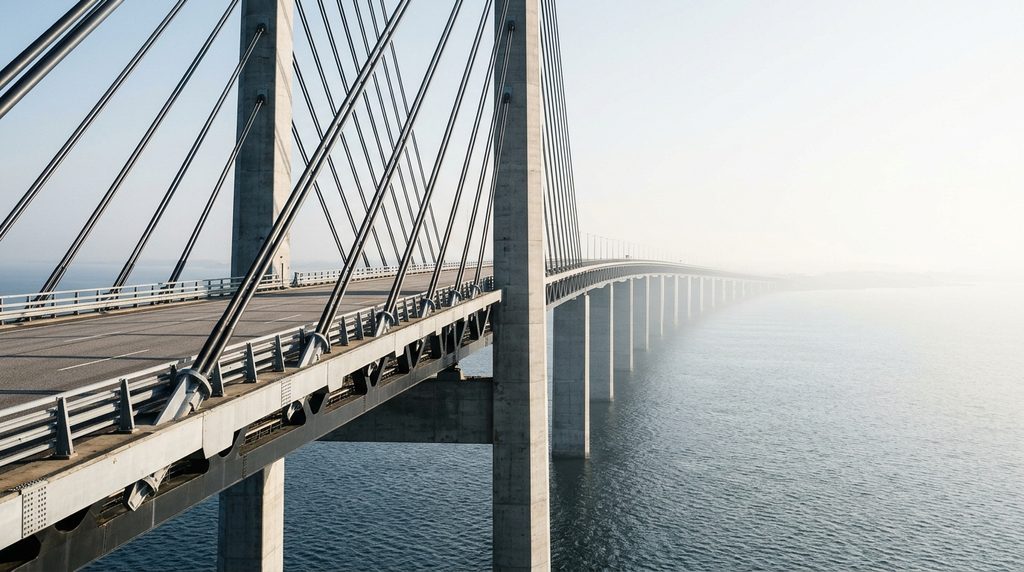
I think dissatisfaction is a double-edged sword. It may be our greatest engine of progress, but it can also keep us from appreciating the present. That tension makes it important to examine our aspirations carefully. We can’t just ask whether we can build a bridge; we have to ask where it will take us.
We tend to treat progress as inherently good. We discover we can do something, we do it, and then we celebrate the achievement. We often postpone serious consideration of the consequences until we’re already committed to the path.
There’s a peculiar asymmetry in that. We scrutinize the feasibility of our aspirations more rigorously than we scrutinize their worth.
Can we build it? Can we make it faster, cheaper, and stronger? Can we outperform the competition? These questions have relatively clear answers. But should we build it? What might we sacrifice in the process? What happens when we succeed? Those questions are harder, partly because their answers depend on values, competing interests, and consequences we may not be able to predict.
And dissatisfaction further complicates matters.
The double edge of dissatisfaction
Dissatisfaction can lead us to relieve suffering, expand our knowledge, and improve our circumstances. Recognizing that something could be better is often the first step toward making it so. But dissatisfaction can also become self-perpetuating. We can solve a problem, set a new standard, and immediately pursue the next improvement—with each achievement only briefly satisfying us before becoming the baseline for the next.
We can spend our lives improving the conditions of our existence without ever learning to appreciate the very existence those improvements were meant to serve.
That seems especially relevant to technological progress. We develop technologies to save time, then use the time we saved to do more. We develop tools to reduce effort, then raise our expectations for productivity. We develop faster ways to send messages, supposedly to make communication easier—then create an expectation that we should always be reachable. We increase our material capabilities, then keep moving the psychological goalposts.
There’s nothing inherently wrong with wanting more. The problem arises when more becomes an unquestioned substitute for improvement.
Dissatisfaction tells us that we want something to change. It does not, by itself, tell us which changes are worth making.
The bridge can take us somewhere we didn’t intend to go
When standing still feels like falling behind, we can become more concerned with keeping pace than with choosing a direction. The pressure to move forward can crowd out the question of where we actually want to go.
The bridge analogy highlights a distinction among three questions we often collapse into one: Can we build it? Should we build it? What happens after we cross the bridge?
We often devote more attention and resources to answering the first than to confronting the second and third.
The pursuit of artificial intelligence brings this asymmetry into particularly sharp focus. We are accelerating toward systems that can reason, solve problems, and perhaps eventually outperform us across many domains. But we’re driving this timeline with a familiar impatience with existing limits—a relentless urge to escape the friction of the present. AI isn’t just another bridge; it could become a tool that reshapes the choices available to its builders and, eventually, does more of the building itself.
We want to outsource our cognitive friction. We want to eliminate scarcity, accelerate scientific discovery, and transcend our biological limits. These are compelling aspirations. But what happens if we achieve capabilities that fundamentally alter the human experience before we’ve adequately considered what we want that experience to be?
If AI systems become more capable faster than we can govern their use, we may gain extraordinary means of changing our lives without becoming any clearer about what would make those lives better.
The greater the potential consequences of a capability, the more seriously we should examine the purpose for which we intend to use it.
That doesn’t mean demanding certainty before acting. Certainty is often impossible, and excessive caution carries its own costs. It means treating foresight, humility, and the willingness to reconsider our direction as essential to progress, not as obstacles. We can inspect a bridge as we build it. And we don’t have to pretend we know every detail of the far shore before taking the first step. However, we should at least look toward it.
And then there’s the present
There’s a difference between recognizing that the present can be improved and regarding it merely as a temporary condition to escape.
One allows us to work toward a better future while still living the life we have. The other risks turning our lives into a waiting room for something better.
This applies beyond material ambition. We can become dissatisfied with our knowledge, our relationships, our accomplishments, even ourselves. Some of that dissatisfaction encourages growth, while some prevents us from recognizing that the very things we’re trying to improve are already worth appreciating.
Perhaps wisdom involves learning to distinguish between dissatisfaction that reveals a genuine opportunity and that which simply creates another deficiency.
The distinction isn’t always clear. Sometimes we don’t recognize the value of what we have until we’ve lost it. Sometimes what we consider a limitation is precisely what gives an experience its meaning.
We shouldn’t romanticize our limitations. Suffering isn’t inherently ennobling, and preventable hardship shouldn’t be preserved in the name of appreciating life. But neither should we assume that every form of effort is a defect to be engineered away. Some difficulties obstruct a meaningful life; others are part of what makes an activity meaningful. Learning to play a musical instrument takes time and effort, but part of the satisfaction lies in developing the skill—not simply in hearing the finished music.
What if progress requires not only learning which bridges to build, but also developing the wisdom to leave some bridges unbuilt?
Humanity’s technical capabilities may eventually allow us to change almost anything about our circumstances, our biology, and perhaps even our minds. At that point, the question of what we can change becomes less important than the question of what we should change—and what we might inadvertently lose by changing it.
That’s not an argument against progress. It’s an argument for making our aspirations as sophisticated as our capabilities are.
And perhaps that brings us back to dissatisfaction. We need enough of it to imagine something better, but also enough self-awareness to question whether our desire for something better is actually pointing us in the right direction.
A bridge is a remarkable achievement. But the achievement alone cannot tell us whether the crossing is worthwhile.