
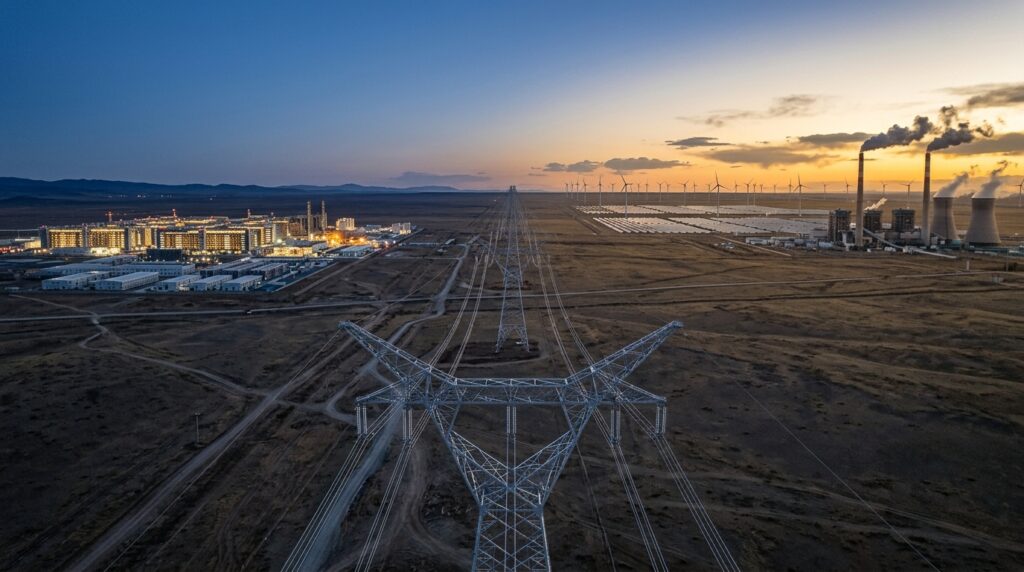
I’ve been watching the current buildout of UHVDC—the ultra-high-voltage lines designed to move massive amounts of electricity across continents—and AI data centers, and I keep coming back to a couple of questions: Are these two things building a virtuous cycle that pays for the grid of the future? Or are they locking us into a vicious cycle that keeps us tied to fossil fuels for years to come?
Here’s my take: both outcomes are possible. But given the incentives we’ve got right now, I think the vicious cycle will win out first.
UHVDC isn’t a clean-energy technology. It’s a transport technology. It moves electricity from one place to another. It doesn’t change what that electricity is made of. Hook it up to remote wind, solar, hydro, geothermal, or nuclear power, and it becomes the backbone of a low-carbon grid that spans a continent. Hook it up to coal and gas plants built to feed huge, always-on AI loads, and it becomes a very efficient way to deliver fossil fuel power instead.
That makes UHVDC an amplifier. The real question is what we put on each end of the line.
The virtuous cycle
AI data centers could become the anchor customers that finally make long-distance transmission lines affordable to build.
Their demand is large and steady. That gives utilities and investors the revenue certainty they need to finance lines that would otherwise sit stuck in planning for years. Once those lines are built, they can reach remote regions rich in renewable energy. They can spread out weather risk. They can cut curtailment — that’s when we waste extra clean power because the grid has nowhere to send it. And they can move power between grids that can’t presently trade much electricity with each other. HVDC lines are especially useful over long distances and between grids that run on different electrical rhythms, since they can’t otherwise share power directly.
Here’s how the cycle would work:
AI demand → transmission lines get financed → access to remote clean energy → bigger clean-energy markets → cheaper, more reliable electricity → more electrification and a more modern grid.
There’s real evidence behind this. The IEA (International Energy Agency) projects that renewables will meet nearly half of the added global demand from data centers through 2030, partly because tech companies are financing new power plants through long-term purchase contracts.
So AI might do something climate policy has struggled to do for years: create a rich customer willing to pay for a massive buildout of new electricity infrastructure.
The vicious cycle
Here’s the catch. AI companies need power in two or three years. Big transmission projects, nuclear plants, and other clean, reliable power sources usually take much longer to plan, permit, and build. The IEA points to this exact mismatch between fast data-center construction and slow energy infrastructure.
So utilities reach for whatever can deliver power soonest:
- Run existing coal and gas plants harder.
- Push back plant retirements that were already scheduled.
- Build new gas plants.
- Run transmission lines out from regions that already produce energy today.
- Sign long-term contracts so those investments pay for themselves.
The IEA expects coal and natural gas together to supply more than 40% of the added electricity that data centers will use through 2030. In its faster-growth scenario, grid bottlenecks push an even bigger share of unexpected AI demand onto fossil fuels.
Once a utility builds a gas plant, a pipeline, a converter station, and a transmission corridor around one contracted AI customer, that system takes on a life of its own. Regulators give decades to recover the money spent building it. Fuel suppliers lock in contracts. Local governments start counting on the tax revenue. Grid operators build their reliability plans around that plant staying online. What started as a temporary bridge turns into infrastructure nobody wants to shut down, because too much money is riding on it.
That’s the real danger. It’s not that UHVDC lines can only carry fossil power — they can carry anything. The danger is that the whole economic system built around them ends up depending on fossil fuel.
China is already showing us both futures
China gives us something close to a live experiment.
Its UHVDC network was built to move power from the renewable-rich north and west out to cities and factories in the east. But as of 2026, wind and solar reportedly make up only around 20% of the electricity carried on that network, while coal supplies about 42%. Several planned lines meant to connect renewable “megabases” — huge clusters of wind and solar farms — also include a lot of new coal capacity, built to keep the power supply steady and reliable.
Analysts call this dual coal lock-in: coal plants on the sending end to keep the line stable, and more coal plants on the receiving end as backup for outages and swings in supply. One estimate says current planning for these renewable megabases could require another 104 gigawatts of coal capacity just on the sending side.
But the evidence isn’t all one-sided. Some studies find that UHV transmission has actually cut regional emissions, especially where the exporting region has genuinely clean power to send. Other research finds that these early gains can turn into a small long-term increase in emissions, unless the share of renewable generation keeps climbing.
That contradiction tells me something important: transmission doesn’t decide the outcome of the energy transition on its own. The policies that govern how power gets generated, which plants get to run first (called dispatch rules), and how the market is designed — those are what decide what transmission actually accomplishes.
What would decide which cycle wins?
The virtuous cycle needs conditions that don’t happen automatically today.
First, AI companies need to pay the full added cost of the power plants and grid infrastructure built just for them. If they don’t, the public ends up financing private growth while regular ratepayers carry the risk. This issue is unsettled enough that FERC (the federal agency that regulates the U.S. power grid) ordered all six major U.S. grid operators in June 2026 to address cost shifting, be more transparent about transmission, and set special rates for large power users.
Second, “clean power” contracts need to represent new power generation that’s actually built near the facility and matched to when it’s used. Buying a certificate that says you funded some renewable power somewhere, sometime, while your data center runs on coal power at night, doesn’t make it clean in any real sense.
Third, data centers need to become flexible about when they draw power. Some AI computing can shift to another location or wait a few hours. If a customer demands full power every single minute without exception, the grid has to build enough capacity for the worst hour of the year, every year. Flexibility, storage, and contracts that allow interruptions can all cut down how much fossil-fuel backup we need.
Fourth, approval for new transmission lines should come with a schedule to cut their carbon intensity — how dirty or clean the power on that line is — over time. A UHVDC corridor might start out with a mixed supply, but its allowed share of fossil fuel should shrink on a published timeline. Otherwise, “temporary balancing power” has a funny way of becoming permanent.
Finally, we need to plan the grid as public infrastructure, not as a private extension cord running from one power plant to one cluster of data centers. A transmission line should stay useful even if AI demand falls short, computing gets far more efficient, or the data centers move somewhere else.
My judgment
AI and UHVDC can help pay for the grid of the future. But they won’t get there on their own.
If we leave this to speed-to-power economics, I think we’ll see a fossil-heavy construction surge in the late 2020s, followed by big promises to clean it up later. Some of that infrastructure will eventually carry cleaner power. Some of it will sit unused once conditions change. And some of it will keep running only because too many powerful institutions have staked their finances on it staying open.
I don’t think decades of fossil dependency are inevitable. UHVDC itself stays adaptable — electricity doesn’t remember where it came from. But the contracts, the power plants, the endpoints, and the political interests built around that line do remember.
So here’s where I land on this, for now: AI can be the financial engine behind a twenty-first-century grid. But unless we build clean power before this new demand arrives — or write it into the contract so the two can’t be separated — UHVDC will just help us build the twentieth-century grid on a bigger map.
Sources
International Energy Agency
China UHVDC and renewable megabases
- Reuters / Global Energy Monitor, “China’s world-leading renewable megabases rely on coal-heavy transmission, report finds,” 21 July 2026. Link
- Dialogue Earth, “Done right, China’s UHV grid can help phase out coal rather than lock it in,” 25 March 2026. Link
U.S. regulatory developments
- Federal Energy Regulatory Commission, “FERC Launches Aggressive Targeted Action to Speed Large Load Integration,” 18 June 2026. Link
- FERC Fact Sheet, “FERC Takes Action to Supercharge America’s Grid for Efficiency, Reliability, and a Bold Energy Future,” 18 June 2026. Link
Supporting studies and background
- Wang, Hui et al., “Transregional electricity transmission and carbon emissions: Evidence from ultra-high voltage transmission projects in China,” Energy Economics, 2023.
- U.S. Department of Energy, “Connecting the Country with HVDC.” Link