
Voicing my suspicions about what India is actually building
Why I keep returning to this
For months I have had the same nagging feeling whenever I read another headline about India. The headlines come in fragments: a port here, a chip subsidy there, a sovereign language model, a cable inaugurated, a summit convened. Each piece is reported on its own terms, by its own beat reporter, in its own silo. Manufacturing analysts cover the Production Linked Incentive scheme. Defense correspondents track the runway expansion at INS Baaz. Tech writers explain the IndiaAI Mission. Diplomatic columnists chronicle the Voice of the Global South Summit. Each story is competent. None of them, as far as I can tell, is connecting the pieces.
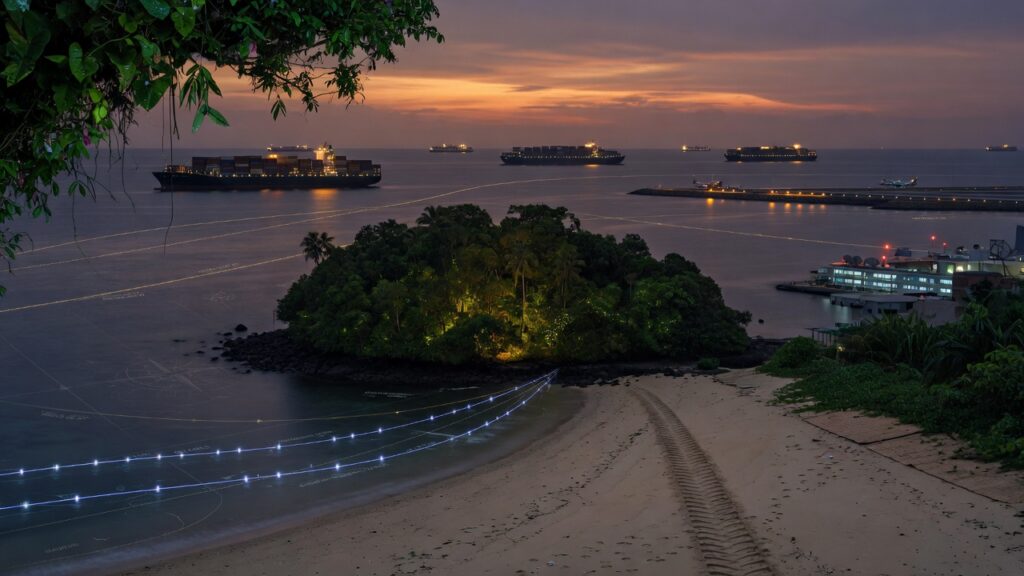
I think the pieces connect. I think they connect very deliberately. And I think the connecting line, once you trace it, points to something more ambitious than anyone is saying out loud: India is constructing a parallel infrastructure stack, physical, digital, and commercial, designed to offer the Global South a credible alternative to China’s Belt and Road, distinguished by democratic governance, service-led digital growth, and maritime autonomy. The keystone of that stack, the place where the shipping lanes and the data cables meet, is a remote rainforest island most of the world cannot find on a map.
That is the suspicion. This essay is an attempt to write it down honestly: what I think India is doing, why the pieces fit together, what it would mean for smaller states deciding which great power to deal with, and the very real reasons the project might fail or deserve to.
I want to say two things up front. First, I am not a partisan of the Modi government. The environmental and tribal-rights costs at the heart of the Great Nicobar project are severe, and I will not paper over them. Second, “the India Pattern” is my phrase, not a policy document leaked from South Block. I am inferring intent from a pattern of investments. I could be wrong about the intent. But the pattern is real and the spending is real, and that is enough to take seriously.
Part 1. The anchor: Great Nicobar
Start with a map. Great Nicobar is the southernmost island in the Andaman and Nicobar chain, closer to Banda Aceh in Indonesia than to the Indian mainland. It sits roughly forty nautical miles from the international shipping lane that threads the Strait of Malacca, the narrow waterway that carries about a quarter of all global maritime trade and roughly eighty percent of China’s imported crude oil.12 The island is small, mostly rainforest, and home to one of the world’s last uncontacted peoples. Until very recently, almost nothing happened there.
That is changing on a scale that is hard to overstate. The Government of India is implementing what it calls the Great Nicobar Island Development Project across roughly 166 square kilometers, in three phases stretching from 2025 to 2047, at an estimated cost of about ₹81,000 crore, roughly nine billion U.S. dollars.3 Within that envelope sits the centerpiece: the Galathea Bay International Container Transshipment Port, which India’s central government has formally notified as the country’s fourteenth major port, owned by the Union and pointedly closed to foreign operators.4
The numbers tell the strategic story. Phase One of Galathea Bay is targeted to begin operations in 2028 with capacity for four million twenty-foot equivalent units, scaling to roughly sixteen million TEUs by 2058, placing it, on paper, among the largest container facilities in Asia.5 The port is being built next to natural water depths of more than twenty meters, which means it can take the largest container ships afloat without dredging the kind of channels that bedevil older Indian ports.6
Layered on top of the commercial port is a hard-power buildout. Tribune India reported in May 2026 that the Indian Navy has been waiting nearly five years for approval to expand INS Baaz, the naval air station on the island, from a runway of barely 3,000 feet to something closer to 9,000–10,000 feet, long enough to handle P-8I maritime patrol aircraft and fighter jets rather than the small Dorniers it now operates.7 A naval jetty is part of the same package. None of this is decorative. The same Tribune piece quotes a former Air Marshal reframing India’s posture in the eastern Indian Ocean: the goal is not just blue-water power projection but to “deny the adversary passage through our backyard.”7
That is the line I keep returning to. Deny the adversary passage through our backyard. That is not a commercial port doctrine. That is a chokepoint doctrine.
Deutsche Welle, in a 2026 analysis I think captured the strategic reading more bluntly than most Indian outlets dare to, framed the entire project as a deliberate counter to China: a roughly nine-billion-dollar investment to convert Great Nicobar into a hub straddling “the busiest shipping route in the world,” with New Delhi seeking to enhance regional influence and counter Beijing.8 Domestic Indian commentary has been only slightly more polite. News18 called the port a “masterstroke” intended to deny China “a free run in India’s near seas.” India Today framed the ambition as rivaling Singapore’s transshipment throughput and producing what its writers called “India’s Hong Kong.”9
Whatever you call it, the geography is the argument. If you control a deepwater transshipment port forty nautical miles from Malacca, with patrol aircraft and a jetty next door, you have just put a finger on the windpipe of the most important sea lane in the Indo-Pacific.
Part 2. Why a port is also a factory door
Great Nicobar matters by itself. It matters more when you read it alongside what India is doing on the mainland to industrial capacity. Here, the policy lever is the Production Linked Incentive scheme, and the headline target is electronics, especially mobile phones.
The Press Information Bureau’s own April 2026 stocktake is striking when read coldly. Under the PLI Scheme for Large Scale Electronics Manufacturing, mobile phone production in India rose from roughly ₹2.14 lakh crore in FY 2019–20 to about ₹5.5 lakh crore in FY 2024–25, more than doubling in five years. Mobile phone exports rose almost eightfold over the same period, from about ₹27,000 crore to roughly ₹2 lakh crore.10 Total cumulative exports under the scheme through February 2026 had reached ₹6.2 lakh crore, twenty-seven percent above the original target, and India had become the world’s second-largest manufacturer of mobile phones.10
A second-generation policy is now being drafted on top of the first. Reuters-fed reporting in The Economic Times’ telecom vertical described in April 2026 a Mobile PLI 2.0 with an expected outlay above five billion dollars, focused specifically on doubling exports.11 The Union Budget for 2026–27 layered in further measures, including duty cuts on cell phone and laptop components designed to push the manufacturing base from final assembly into actual component production.12 The stated horizon is ambitious: $500 billion in electronics output by 2030–31.12
Plenty of analysts have been skeptical of these numbers, and some skepticism is warranted. PLI’s job-creation results have lagged its production results. The official data say the scheme generated about 1.85 lakh jobs against a target of 2 lakh, eight percent under target.10 Component depth is still shallow. Apple is the headline story but also a single point of failure. None of that disproves the larger pattern.
The pattern is this: India is using direct fiscal incentives, tariff engineering, and budget signaling to insert itself into the “China Plus One” reshuffling of global supply chains. World Bank President Ajay Banga has publicly acknowledged the opening, noting that India has a real chance to capture the “China Plus One” opportunity but that the window is short.13 India seems to be taking him at his word.
Here is the connection I want to draw. A manufacturing base that is exporting $25 billion-plus in mobile phones a year needs ports. A manufacturing base that aspires to half a trillion dollars of electronics output by the end of the decade needs deepwater transshipment hubs that do not run through Singapore or Colombo or Port Klang. Otherwise, every dollar of value added on the Indian assembly line pays a transit tax to a third country.
Galathea Bay is being built precisely to break that arrangement.
Part 3. The shipping cargo problem India is actually solving
This is the part of the puzzle that mainstream coverage understates most. More than seventy-five percent of India’s transshipped cargo currently passes through foreign ports: Singapore, Colombo, and Port Klang above all.14 That is a stunning sovereignty problem dressed up as a logistics statistic. Every Indian export crate that needs to be consolidated onto a megaship is paying a fee, generating data, and accruing leverage in another country.
Galathea Bay is designed to break this dependency. Its proponents are explicit about it. The location, with a natural water depth above twenty meters and a position roughly forty nautical miles from the Malacca shipping lane, lets it pull cargo away from the existing transshipment giants and consolidate it inside Indian sovereign territory.6 News18 went so far as to call the project an instrument to “deny China a free run in India’s near seas,” which is the same logic as the INS Baaz expansion expressed in commercial language.9
There is a softer, complementary line that India has been quietly drawing through the Quad. At India Maritime Week in October 2025, the four Quad members announced a “Quad Ports of the Future” initiative, led by India, building on a steadily denser run of Indo-Pacific Maritime Domain Awareness exercises.15 India’s MAHASAGAR policy, articulated through 2025 and 2026, frames Indian Ocean port development as part of a broader Indo-Pacific connectivity strategy, and CSEP, a Delhi think tank, has been candid that the policy’s logic includes “countering Chinese influence.”16
This is shipping policy doing strategic work. India is not just trying to capture transshipment fees that currently leak to Singapore. It is trying to build the maritime spine of a non-Chinese Indo-Pacific.
Part 4. The digital path: AI without the Chinese blueprint
A port is also a cable landing station, and that brings us to the second half of the parallel stack. Here the question is not just where the ships go but where the data goes, and which model of artificial intelligence the Global South ends up adopting.
India’s AI strategy is genuinely different from China’s, and the difference is the point. The IndiaAI Mission, approved by the Union Cabinet in March 2024, carries a five-year envelope of more than ₹10,300 crore, roughly $1.2 billion at current exchange rates.17 Within that envelope, the government has authorized a sovereign foundational model effort, most visibly through Tech Mahindra, which announced in October 2025 that it had been selected under the IndiaAI Mission to build a one-trillion-parameter sovereign large language model, a scale its CEO described as placing it among the largest models then under development globally.18 A separate ₹988.6 crore allotment, announced in 2026 under the same Mission, funds an IIT Bombay-led consortium for further sovereign LLM and data-lab work.19
You can criticize the spending levels, and Indian opposition leaders do. A parliamentary panel flagged in March 2026 that against a proposed ₹2,000 crore ask for AI in 2026–27, only ₹1,000 crore was actually granted, and that even the smaller allocations had been underspent.20 Compared with what Washington and Beijing are pouring into compute, India’s numbers are modest. The number to watch, however, is not the absolute spend but the architecture of the bet.
Two academic and trade-press readings get this exactly right. The International Journal of Cyber Diplomacy has described India’s posture as “digital neo-nonalignment,” a deliberate attempt to safeguard infrastructural sovereignty and accumulate normative influence in global AI governance without locking into either the U.S. or the Chinese stack.21 Comparative work in ScienceDirect contrasts China’s top-down, security-first AI development model against India’s more open and “light-touch” environment, which spreads decision-making across a wider field of actors.22 The trade press, including CIO Economic Times, has begun describing India as an emerging “Compute North” rather than a Compute South, with more than twenty AI training centers and the capacity to both train and deploy frontier models.23
What this adds up to is a pitch the Global South has not heard before. The U.S. offers world-class AI but with export controls, national-security review, and a closed-stack commercial model dominated by a handful of companies. China offers cheap deployment but with a hardware-first model, surveillance-friendly defaults, and conditional access. India is trying to offer something in between: a sovereign model on open-ish rails, in English and Indic languages, built by a democracy.
That is a thinner pitch than its boosters claim. It is also a real one.
Part 5. The cables under the ocean
The reason I keep saying Great Nicobar is the keystone, and not just an outlying port, is the cable. In August 2020, Prime Minister Modi inaugurated the Chennai-to-Andaman-and-Nicobar-Islands (CANI) submarine optical fiber cable, a 2,300-kilometer link connecting the Indian mainland to Port Blair and six other islands, including Great Nicobar.24 At the time it was billed largely as a digital-inclusion project, bringing real bandwidth to a remote archipelago.
That framing is now obsolete. In October 2025, India’s Union Minister for Electronics and Information Technology, Ashwini Vaishnaw, publicly proposed turning the Andaman and Nicobar Islands into “the next major hub for global internet data transfer,” citing the chain’s strategic geography.25 Deccan Herald, reporting on the same speech, described the vision as a Global Internet Data Hub stretching its reach into Southeast Asia and Australia.26 If even partially executed, this would convert Great Nicobar from a remote naval-and-shipping outpost into a node in global data flow, a place where physical cargo and digital traffic share the same coastline.
The strategic implication is straightforward. AI workloads are not abstract. They run on data centers, and data centers run on submarine cables, and submarine cables make landfall at very specific points on very specific islands. If the Indian Ocean is going to carry the traffic of a hundred new data centers built across South Asia, Southeast Asia, the Gulf, and East Africa over the next decade, then whoever controls the islands sitting astride those cable routes controls something very valuable. India is investing in being that whoever: through CANI, through the proposed data hub, through Galathea Bay’s ancillary infrastructure, and through the IndiaAI Mission’s emphasis on sovereign data.
I want to underline the point because it is the hinge of the whole essay. Great Nicobar is the place where the Malacca shipping lane and the Indo-Pacific cable map physically intersect inside Indian sovereign territory. That is what makes it a fortress and a gateway at once. That is also what makes it irreplaceable in the larger plan.
Part 6. Exporting the digital state
If the parallel stack stopped at ports and cables it would still be impressive. But the most interesting export India is preparing is one that does not move on a ship: the India Stack itself.
The India Stack, which includes Aadhaar identity, the Unified Payments Interface, DigiLocker, ONDC, and the rest, is the world’s only working example of population-scale digital public infrastructure in a democracy. As of early 2026, government data put the cumulative number of Aadhaar IDs above 1.4 billion and UPI’s monthly transaction count above twenty-one billion.27 India’s PIB reports that, as of February 2026, the government had signed cooperation agreements on India Stack and DPI with twenty-four countries; UPI itself was live in eight, including the UAE, Singapore, France, and Mauritius.27 Six of those agreements are with African countries, namely Sierra Leone, Tanzania, Kenya, Ethiopia, The Gambia, and Lesotho, that will replicate or adopt Indian platforms through “India Stack Global,” a portal that packages eighteen Indian digital public goods for use abroad.28
This is not philanthropy and it is not infrastructure-export-as-debt either. It is closer to a standards play. India’s pitch is that the architecture is open, modular, and adaptable, and that adopting partners get to bend the system to their own contexts. The G20 New Delhi Leaders’ Declaration in 2023, under India’s presidency, explicitly enshrined Digital Public Infrastructure as a development accelerator and launched a Global DPI Repository to which India contributed the most solutions.29
If you are a finance minister in Lagos, Nairobi, or Manila looking at how to digitize your population’s identity and payments, you now have three real options. You can buy from American platforms and inherit their commercial terms. You can take Chinese vendors and inherit their architecture, plus questions about data flows. Or you can adopt Indian-style DPI, designed by a fellow developing-country democracy, on open rails, with technical support but without the strings.
That third door did not exist a decade ago. India built it. The fact that the door now opens onto twenty-four countries, with eight of them already using Indian payments rails domestically, is one of the most underreported geopolitical facts of this decade.
Part 7. The diplomatic frame: Vishwa Mitra
All of this needs a story to sell it. India has been writing one.
The phrase that has emerged over the past two years, and that I think is genuinely revealing, is “Vishwa Mitra,” or friend of the world. India Today’s January 2026 retrospective on a decade of Indian foreign policy described the doctrine bluntly: India has moved from old-style non-alignment to “multi-alignment,” holding strategic partnerships with the West while championing the Global South on platforms like the G20, BRICS, and the United Nations.30 That is not the language of a swing state. That is the language of a power positioning itself as a pivot.
The institutional vehicle is the Voice of the Global South Summit. India has now convened three editions (January 2023, November 2023, and August 2024), each drawing more than one hundred countries.31 The Ministry of External Affairs has used the summits to articulate, in increasingly explicit language, a vision of “rebalancing” the multilateral system so that developing countries have a stronger voice. External Affairs Minister S. Jaishankar has been the most consistent public face of the argument, framing the existing global order as one in which Global South countries face structural disadvantages that India, uniquely, can speak to.31
In January 2026 India formally took the BRICS chair from Brazil, becoming the first founding member to lead the expanded ten-country grouping.32 The chairmanship is not a windfall. It is a stage. ISAS, the National University of Singapore’s South Asia institute, framed the 2026 chair as an opportunity for India to push BRICS in the direction of practical, development-oriented cooperation rather than the openly anti-Western posture some other members favor.33 Whether India can hold that line is one of the most consequential diplomatic questions of this year.
What I read in all of this is a coherent positioning. India is not asking smaller states to choose between Washington and Beijing. India is offering itself as the actor that does not require the choice. The infrastructure stack (ports, cables, factories, AI, DPI) is the material thing that turns the rhetoric into a usable offer.
Part 8. Why this might be the best deal a smaller state can get
Pull all of it together and you can see why I have come to think India’s pattern is, for many smaller nation-states, probably the best deal they are going to get from anyone.
Consider the alternatives. The U.S. offer is conditional and increasingly transactional, structured around alliance commitments and export controls that feel coercive to states that simply want infrastructure. The Chinese offer is fast and lavishly capitalized but comes with concerns, fairly or not, about debt sustainability, asset transfer, and the architecture of digital surveillance. The Russian offer is essentially arms and energy, with no developmental component. The European offer is real but small and focused on its own neighborhood.
India’s offer, in 2026, has four properties no other major power can replicate at the same time:
No debt-trap diplomacy. India is not lending the way China lends. The Hambantota narrative, in which Sri Lanka surrendered a port to Beijing after defaulting, is contested in serious analytical work; Chatham House, for example, has argued that the actual mechanics are more complicated than the popular slogan suggests, and that domestic Sri Lankan decisions and Western lending mattered as much as Chinese behavior.34 But what matters here is not the precise truth of Hambantota; it is the political memory of it. India has been careful not to replicate the structure that produced the memory. The DPI export model, in particular, is closer to standards-setting than to lending, which is exactly why it travels well.
Democratic governance. I do not want to oversell this. India has its own credible critics on civil liberties, press freedom, and majoritarian politics, and those critiques are not unfounded. But for a finance minister in a Global South democracy looking for a partner, the difference between dealing with a fellow elected government, however imperfect, and dealing with a one-party state is not nothing. It shows up in everything from how disputes are arbitrated to whose laws govern the data.
Digital sovereignty as a feature. The Indian DPI model is explicitly designed to be adapted, not licensed. That is a real, technical, architectural difference from the dominant Western and Chinese alternatives. NTU’s Centre for African Studies, in its 2026 review, described the India Stack approach as treating digital infrastructure as a public good, kept “open and interoperable,” and held it up as a model many African countries are actively studying.35
Multi-alignment, not zero-sum. India explicitly does not require partner states to break with anyone else. A country can take India Stack and still buy American chips and still sell to China. For most governments, the ones that do not want to be in anyone’s bloc, that flexibility is decisive.
This is not an argument that India will win. It is an argument that India is, for the first time in its post-1947 history, actually competing in the same league as the U.S. and China for the loyalty of the world’s middle and lower-middle-income countries. That is a structural shift, and it is the substance of what I keep calling the India Pattern.
Part 9. What could break the pattern
I want to be honest about the things that could undo it. There are at least four, and they are not symmetric.
The Shompen and the rainforest. The most damaging story for India’s pitch is being told from inside India itself. The Shompen are a Particularly Vulnerable Tribal Group living almost entirely in the interior rainforest of Great Nicobar; an estimated three hundred of them, the majority uncontacted.36 In April 2025, Survival International published a report titled “Crushed: How India Plans to Sacrifice One of the World’s Most Isolated Tribes to Create ‘the New Hong Kong.’” Thirty-nine genocide scholars had earlier written to the Indian government in February 2024 warning that the project, as designed, would not allow the Shompen to survive.36 The Nicobarese tribal council formally withdrew its consent for the project in 2022, citing pressure during the clearance process; multiple objections to the Union Environment Ministry, the Tribal Affairs Ministry, and the Andaman and Nicobar administration have, by these accounts, gone unanswered.37
The environmental costs are in keeping with this. The project will fell, by various accounts, between 8.5 and 9.6 lakh trees in a recognized biosphere reserve, threaten more than twenty thousand coral colonies, and disturb the nesting site of the Giant Leatherback turtle.38 Senior Congress leader Jairam Ramesh has argued that compensatory afforestation proposed in Haryana cannot replace forest loss in Nicobar, and has called for the project to be paused and reviewed.39 Forest Rights Act procedures, by Ramesh’s account, were completed in less than twenty days and without mandatory tribal representation.39
This is the part of the story that should give every reader pause. The geopolitical case for Great Nicobar is real. The human and ecological case against it is also real, and the Indian government has not, to date, answered the most serious objections. A doctrine of multi-aligned democratic development will not survive long if the foundational project of that doctrine extinguishes a tribe and a forest.
Domestic politics. The opposition has decided to make Great Nicobar a national issue. Rahul Gandhi, leader of the opposition in the Lok Sabha, called the project, after a personal visit in late April 2026, “one of the biggest scams and gravest crimes against this country’s natural and tribal heritage in our lifetime,” describing what he saw as “millions of trees marked for the axe” and “communities ignored while their homes have been snatched away.”40 The government’s response, issued three days later, claimed no relocation of tribes was planned; the Congress called the response damage control that ignored detailed objections submitted to the Environment Ministry in 2024.39 A parliamentary stand-off of this scale, sustained for years, can change a project’s pace and shape, even if it does not stop it outright.
Funding. The most underreported risk is the simplest one: the money is not consistently arriving. The IndiaAI Mission saw its 2026–27 ask cut roughly in half. Actual spending on AI and chip schemes has lagged allocations.20 The Mobile PLI 2.0 outlay, while generous on paper, is still at the proposal stage and depends on a budget cycle the finance ministry has reasons to slow.11 India’s defense, infrastructure, and industrial-policy ambitions are competing with welfare commitments in a still-developing economy. If the curves cross the wrong way, the parallel stack does not get built. It just gets announced.
Geopolitical drag. India is not navigating an empty ocean. The Trump administration’s 2025–26 trade and sanctions posture has, by India Today’s reading, produced “Trumpian setbacks” for New Delhi’s alignment with the West.30 The 2025 military exchange with Pakistan tested the political bandwidth of India’s foreign policy establishment in ways the Vishwa Mitra framing would prefer to forget. China is responding to the Quad’s maritime push with its own infrastructure investments across the Indian Ocean rim. Any of these can slow the pattern; in combination they can stall it.
None of this, in my reading, undoes the underlying logic. But the obstacles are not cosmetic. The pattern is real and so are its limits, and a serious essay should hold both at the same time.
Part 10. What I think the next five years look like
If I am even roughly right about what India is building, the period from 2026 to roughly 2030 should produce four observable signals. None of them, on its own, would be conclusive. Together they would be hard to dismiss as coincidence.
First, watch for the commissioning of Phase One at Galathea Bay around 2028 and the parallel approval and groundbreaking of the INS Baaz expansion. If both happen on schedule, India will have, for the first time in its history, a deepwater commercial port and a hardened naval-air base sitting on the same Malacca-adjacent island. Read together, they are a chokepoint capability.
Second, watch the cable map. If the Andaman and Nicobar Islands become a publicly announced landing point for one or more new transoceanic cables beyond CANI, then Vaishnaw’s Global Internet Data Hub vision is becoming real. The data flows that follow will be the actual measure of India’s “Compute North” claim.
Third, watch the India Stack export number. As of early 2026 the figure is twenty-four cooperation agreements and eight live UPI corridors. If those numbers are forty and fifteen by 2028, the digital-public-goods pitch has matured into a soft-power instrument with no real precedent.
Fourth, watch what happens to the Shompen and to the Nicobar rainforest. This is not a side issue. It is the moral test of the whole project. If the Indian government finds a way to honor the consent objections, restructure phasing to protect Shompen territory, and fund credible in-situ conservation, the Vishwa Mitra framing will hold up. If it does not, the parallel stack will be built on a foundation that compromises the very thing, democratic and pluralist development, that distinguishes it from the Chinese alternative.
I want to be careful here. I am not predicting success. India has a history of announcing transformational infrastructure and delivering a fraction of it on a slower timeline. The PLI scheme has overshot some targets and missed others. The IndiaAI Mission has been underfunded relative to its ambitions. The Galathea Bay port, on the most optimistic timeline, will not reach its full capacity until 2058. Most of what I have described in this essay is a thirty-year project at the cusp of its most expensive decade. Plenty can go wrong.
But the direction is unmistakable. India is no longer behaving like a country that wants a seat at someone else’s table. It is behaving like a country building its own table, quietly, in pieces, in ways most Western coverage cannot quite metabolize because it does not fit either the “rising power” cliché or the “fragile democracy” cliché. The pattern is the thing.
Closing thought
For most of my professional life, the conversation about the future of the Indo-Pacific has been a conversation about the United States and China. Every other country in the region has been described in terms of how it positions itself relative to those two. The unstated assumption is that the durable architecture of this century will be designed in Washington or Beijing, and everyone else will choose a side, hedge, or get run over.
I no longer think that is true. I think there will be a third architecture. Not a third pole in any classical Cold War sense, but a third stack, designed in New Delhi, sold to Lagos and Jakarta and Manila and Quito, and underwritten by an island most readers of this essay had never heard of before they started reading it.
That is the suspicion I started with. Writing it down has made me more sure of it, not less.
Whether the architecture is good for the people of Great Nicobar, for the Shompen in their rainforest and for the leatherback turtles on the beach, is a different question, and a harder one. The honest answer, today, is that we do not yet know. The world should be paying very close attention to who, if anyone, in New Delhi is willing to give us that answer.
That’s what I wanted to think out loud about.
Endnotes
1. U.S. Energy Information Administration data, summarized in Bernama, “Strait of Malacca Keeps Top Spot as World’s Largest Oil Transit Chokepoint,” April 3, 2026, https://garasi.bernama.com/quick-reads/strait-of-malacca-keeps-top-spot-as-worlds-largest-oil-transit-chokepoint.
2. “Malacca Dilemma,” Wikipedia, last modified April 2025, https://en.wikipedia.org/wiki/Malacca_dilemma. The Strait carries roughly 25% of global maritime trade and approximately 80% of China’s imported crude oil.
3. Indian Express, “After Rahul’s ‘Gravest Crime’ Attack on Nicobar Project, Centre Claims No Relocation of Tribes,” May 2026, https://indianexpress.com/. Project area, phasing, and ₹81,000 crore figure as reported.
4. Economic Times Infra, “Galathea Bay Container Transhipment Port Will Be Out of Bounds for Foreign Operators,” December 2025, https://infra.economictimes.indiatimes.com/. Notification as India’s fourteenth Union-owned major port.
5. “International Container Transshipment Port, Galathea Bay,” Wikipedia, last modified October 2023, https://en.wikipedia.org/wiki/International_Container_Transshipment_Port,_Galathea_Bay; see also World Ports, “India Plans 14.2m TEU Great Nicobar Transshipment Hub,” May 2026, https://www.worldports.org/.
6. Indian Naval Indicators (TheINIofficial), summary post on Galathea Bay DPR readiness, X/Twitter, October 31, 2025, https://x.com/TheINIofficial/status/1984114230761545811. Natural water depth above 20 m and forty-nautical-mile distance to international shipping lane.
7. Tribune India, “INS Baaz Expansion in Great Nicobar Awaits Approval,” May 2026, https://www.tribuneindia.com/news/india/ins-baaz-expansion-in-great-nicobar-awaits-approval/. Five-year approval delay; planned runway expansion from 3,000 to 9,000–10,000 ft; “deny the adversary passage through our backyard.”
8. Deutsche Welle (Chinese-language service), “与中国角力?印度重点打造大尼科巴岛” (“Wrestling with China? India focuses on building Great Nicobar”), May 2026, https://www.dw.com/.
9. India Today, “The Great Nicobar Project Aims to Create India’s Hong Kong,” September 10, 2025, https://www.indiatoday.in/india/story/great-nicobar-port-project-controversy-sonia-gandhi-bjp-attack-row-ecology-legal-human-rights-concern-explained-2784301-2025-09-10; India Today, “India’s Pearl Harbour in the Nicobar Islands,” September 10, 2025, https://www.indiatoday.in/india/story/greater-nicobar-port-project-india-pearl-harbour-benefits-indian-navy-2784999-2025-09-10; India Today, “NGT Great Nicobar Project: Path Cleared for India’s Hong Kong,” February 17, 2026, https://www.indiatoday.in/india/story/ngt-clearance-great-nicobar-project-transshipment-hub-andaman-island-china-trade-explained-2869516-2026-02-17. Framing of Galathea Bay as rivaling Singapore’s transshipment throughput near the Malacca Strait and as “India’s Hong Kong.”
10. Press Information Bureau, Government of India, “PLI Scheme for Large Scale Electronics Manufacturing — Targets and Achievements as of February 2026,” April 2026, https://www.pib.gov.in/PressReleasePage.aspx?PRID=2247771. Mobile-phone production rose from ₹2.14 lakh crore (FY 2019–20) to ₹5.5 lakh crore (FY 2024–25); exports rose roughly eightfold; India became the world’s second-largest mobile manufacturer.
11. Economic Times Telecom, “India’s $5 Billion Mobile PLI 2.0 Aiming to Boost Exports by May,” April 16, 2026, https://telecom.economictimes.indiatimes.com/news/policy/indias-5-billion-mobile-pli-20-aiming-to-boost-exports-by-may/130295798.
12. Press Information Bureau, Government of India, “Electronics Components Manufacturing Scheme,” February 3, 2026, https://www.pib.gov.in/PressReleasePage.aspx?PRID=2222519; DD News, “Union Budget 2026-27 Boosts Electronics Manufacturing with Rs 40,000 Crore Outlay for ECMS,” February 3, 2026, https://ddnews.gov.in/en/union-budget-2026-27-boosts-electronics-manufacturing-with-rs-40000-crore-outlay-for-ecms/. ECMS outlay raised to ₹40,000 crore; explicit policy goal of a $500 billion electronics manufacturing ecosystem by 2030–31.
13. Reuters, “India Should Cash In on ‘China Plus One’ Strategy — World Bank Chief,” July 19, 2023, https://www.reuters.com/world/india/india-should-cash-china-plus-one-strategy-world-bank-chief-2023-07-19/; Economic Times, “India Has 3-5 Year China+1 Window: World Bank President Ajay Banga,” July 20, 2023, https://economictimes.com/news/india/india-has-3-5-year-to-cash-in-on-the-china1-window-world-bank-president-ajay-banga/articleshow/101970626.cms.
14. Economic Times Infra, “India’s Dependence on Foreign Ports for Container Transhipment Has Ended with Opening of Vizhinjam Port, Says PM Modi,” May 2, 2025, https://infra.economictimes.indiatimes.com/news/ports-shipping/indias-dependence-on-foreign-ports-for-container-transhipment-has-ended-with-opening-of-vizhinjam-port-says-pm-modi/120824462. Government estimate: ~75% of India-origin/destination cargo containers transhipped at foreign ports annually, with Colombo, Singapore, and Port Klang handling more than 85% of that volume; Colombo alone handles roughly 2.5 million TEUs.
15. The Week, “Will the Quad Rewrite Indo-Pacific Maritime Security?” January 14, 2026, https://www.theweek.in/news/maritime/2026/01/14/opinion-guest-will-the-quad-rewrite-indo-pacific-maritime-security-expertspeak.html. Announcement of the India-led Quad Ports of the Future initiative at India Maritime Week, October 2025.
16. Centre for Social and Economic Progress (CSEP), “Quad Maritime Cooperation in the Indo-Pacific: What Next?” January 2026, https://csep.org/wp-content/uploads/2026/01/Quad-Maritime-Cooperation-in-the-Indo-Pacific-What-next.pdf. Discussion of India’s MAHASAGAR policy and its role in countering Chinese influence.
17. IndiaAI Mission overview and Cabinet approval, March 2024; ₹10,300 crore five-year envelope; see Government of India materials at https://www.indiaai.gov.in/.
18. Moneycontrol, “Tech Mahindra Developing 1-Trillion-Parameter Sovereign LLM under IndiaAI Mission,” October 14, 2025, https://www.moneycontrol.com/news/business/information-technology/tech-mahindra-developing-1-trillion-parameter-sovereign-llm-under-indiaai-mission-13616345.html; see also YourStory, “Tech Mahindra Has Begun 1-Trillion-Parameter Sovereign LLM,” October 15, 2025, https://yourstory.com/ai-story/tech-mahindra-1-trillion-llm-indiaai.
19. NewsOnAir, “India to Set Up 500 Data Labs, Boost AI Capabilities with 988 Crore Investment,” May 2026, https://www.newsonair.gov.in/. Allotment to an IIT Bombay-led consortium under the IndiaAI Mission.
20. Hindustan Times, “Parl Panel Flags Delays and Underutilisation of Funds in AI, Chip Schemes,” March 2026, https://www.hindustantimes.com/. ₹2,000 crore proposed; ₹1,000 crore granted; broader pattern of underspending.
21. Daria-Elena Popescu, “Cyberdiplomacy and the New Digital Non-Alignment in the Global South: India as a Case Study of Technological Sovereignty in the Age of AI,” International Journal of Cyber Diplomacy 6 (2025): 39–59, https://doi.org/10.54852/ijcd.v6y202503, https://ijcd.ici.ro/current/cyberdiplomacy-and-the-new-digital-non-alignment-in-the-global-south-india-as-a-case-study-of-technological-sovereignty-in-the-age-of-ai/.
22. Authors as listed, “Contrasting Approaches to AI Regulation in China and India,” Telecommunications Policy 49, no. 8 (2025), https://www.sciencedirect.com/science/article/abs/pii/S0308596125001168; see also the IDEAS/RePEc record at https://ideas.repec.org/a/eee/telpol/v49y2025i8s0308596125001168.html. Comparative analysis contrasting China’s top-down, security-driven AI regulatory model with India’s more open, light-touch, multi-stakeholder approach.
23. For the underlying buildout informing the “Compute North” framing, see Press Information Bureau, Government of India, “India’s Common Compute Capacity Crosses 34,000 GPUs,” May 30, 2025, https://www.pib.gov.in/PressReleasePage.aspx?PRID=2132817; Associated Press, “India Eyes $200B in AI Data Center Investments,” February 16, 2026, https://apnews.com/article/india-modi-vaishnaw-ai-investments-4e170da0a3b883a9659569dd538e9019; CIO Economic Times, “AI-Driven Evolution: Reshaping India’s Data Center Infrastructure for a High-Density Future,” February 25, 2026, https://cio.economictimes.indiatimes.com/news/data-center/ai-driven-evolution-reshaping-indias-data-center-infrastructure-for-a-high-density-future/128769172; Firstpost, “India’s AI Strategy Offers a Blueprint for Global South,” May 7, 2026, https://www.firstpost.com/opinion/indias-ai-strategy-offers-a-blueprint-for-global-south-14008686.html.
24. NEC India, “CANI Submarine Cable — Case Study,” 2021, https://in.nec.com/en_IN/case/cani/pdf/CANI-case-study-20210803.pdf; see also Submarine Telecoms Forum, “PM to Inaugurate CANI Submarine Cable on August 10,” August 7, 2020, https://subtelforum.com/pm-to-inaugurate-cani-submarine-cable-on-august-10/.
25. India TV News, “Ashwini Vaishnaw Proposes Making Andaman Islands Next Global Internet Data Hub,” October 15, 2025, https://www.indiatvnews.com/technology/news/ashwini-vaishnaw-proposes-making-andaman-islands-next-global-internet-data-hub-2025-10-15-1012847.
26. Deccan Herald, “Internet Hub Andaman: Ashwini Vaishnaw’s Vision for the Islands,” October 14, 2025, https://www.deccanherald.com/india/ashwini-vaishnaw-proposes-to-make-andaman-next-big-hub-for-global-internet-data-transfer-3764576.
27. Press Information Bureau, Government of India, “India’s Digital Public Infrastructure,” March 6, 2026, https://www.pib.gov.in/PressReleasePage.aspx?PRID=2235812. As of February 2026: 24 cooperation agreements on India Stack/DPI; UPI live in 8 countries; cumulative Aadhaar IDs above 1.4 billion; 21.6 billion UPI transactions in December 2025.
28. Ecofin Agency, “Six African Countries Adopt India’s Digital Public Infrastructure Framework,” February 12, 2026, https://www.ecofinagency.com/news-digital/1202-52814-six-african-countries-adopt-india-s-digital-public-infrastructure-framework. Sierra Leone, Tanzania, Kenya, Ethiopia, The Gambia, and Lesotho.
29. G20 New Delhi Leaders’ Declaration, September 2023, https://www.mea.gov.in/, and PIB DPI release cited at note 27.
30. India Today, “Foreign Policy: The Vishwa Mitra,” January 3, 2026, https://www.indiatoday.in/magazine/50th-anniversary-special/2015-2025-assertive-india/story/20260112-foreign-policy-2015-2025-the-vishwa-mitra-50th-anniversary-special-2845631-2026-01-03.
31. Ministry of External Affairs, Government of India, “The 3rd Voice of Global South Summit 2024,” August 2024, https://www.mea.gov.in/press-releases.htm; “Question No. 5644 — Cooperation Among Global South Countries,” March 2026, https://www.mea.gov.in/. Three editions to date: January 2023, November 2023, August 2024; over 100 countries participating per edition. See also Dakshin India, “Voice of Global South Summit,” March 10, 2026, https://dakshin.org.in/voice-of-global-south.
32. TV BRICS, “India Officially Becomes BRICS Chair,” January 1, 2026, https://tvbrics.com/en/news/india-officially-becomes-brics-chair/.
33. Institute of South Asian Studies (ISAS), National University of Singapore, “India’s BRICS Chairmanship in 2026: Leadership in Times of Global Uncertainty,” January 19, 2026, https://www.isas.nus.edu.sg/papers/indias-brics-chairmanship-in-2026-leadership-in-times-of-global-uncertainty/.
34. Chatham House, “Debunking the Myth of ‘Debt-Trap Diplomacy’: Sri Lanka and BRI,” August 19, 2020, https://www.chathamhouse.org/2020/08/debunking-myth-debt-trap-diplomacy/4-sri-lanka-and-bri. Argument that ownership was not transferred and that Sri Lanka’s debt distress was driven primarily by domestic decisions and Western lending.
35. NTU-SBF Centre for African Studies, “How Compatible Is the India Stack in Africa?” January 30, 2026, https://www.ntu.edu.sg/cas/news-events/news/detail/how-compatible-is-the-india-stack-in-africa.
36. Survival International, “New Report: Indian Government Plans Spell Disaster for Uncontacted Shompen,” April 15, 2025, https://www.survivalinternational.org/news/14189. Approximately 300 Shompen, mostly uncontacted; 2024 letter from 39 genocide scholars to the Indian government.
37. Mongabay India, “Asked to Surrender Land for the Great Nicobar Project, Tribal Leaders Say No,” January 23, 2026, https://india.mongabay.com/2026/01/asked-to-surrender-land-for-the-great-nicobar-project-tribal-leaders-say-no/. Nicobarese consent withdrawn 2022; objections to Union ministries reportedly unanswered.
38. Author’s compilation of scientific and parliamentary objections regarding biosphere reserve impacts: estimated 8.5–9.6 lakh trees marked for felling, 20,000+ coral colonies at risk, threat to Giant Leatherback turtle nesting site; on file with the author. See also Tribune India, “Great Nicobar Project Faces Fresh Questions on Ecology, Tribal Consent and Feasibility,” May 2, 2026, https://www.tribuneindia.com/news/india/great-nicobar-project-faces-fresh-questions-on-ecology-tribal-consent-and-feasibility-jairam-ramesh/.
39. Tribune India, “Great Nicobar Project Faces Fresh Questions on Ecology, Tribal Consent and Feasibility,” May 2, 2026, https://www.tribuneindia.com/news/india/great-nicobar-project-faces-fresh-questions-on-ecology-tribal-consent-and-feasibility-jairam-ramesh/. Statements by Jairam Ramesh on compensatory afforestation in Haryana, FRA procedures completed in under 20 days, and the 2024 objections to the Environment Ministry.
40. India Today, “Rahul Gandhi Calls Great Nicobar Project a Crime against Nature and Tribes,” April 29, 2026, https://www.indiatoday.in/india/story/great-nicobar-project-rahul-gandhi-crime-against-nature-tribes-2903143-2026-04-29; Tribune India, “Great Nicobar Project One of Biggest Scams, Gravest Crimes,” April 29, 2026, https://www.tribuneindia.com/news/india/great-nicobar-project-one-of-biggest-scams-gravest-crimes-against-natural-tribal-heritage-rahul/.